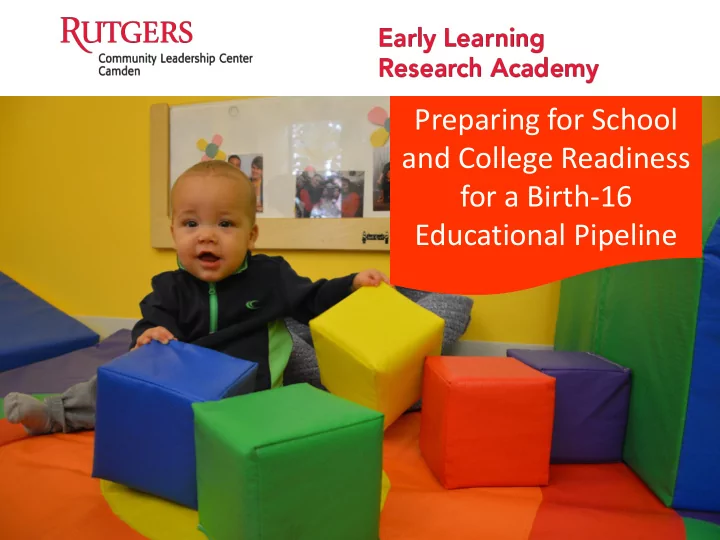
SLIDE 1
Preparing for School and College Readiness for a Birth-16 Educational Pipeline
SLIDE 2
ELRA program hosted at Rutgers-Camden since 2001; Infant/Toddler program begins in 2011; both within a Birth-16 school and college pipeline of LEAP Academy University Charter School in Downtown Camden
SLIDE 3
The mission of the Early Learning Research Academy (ELRA) is to enhance the future school success of Camden City children from birth through age five by providing high-quality, research- based education and comprehensive wellness services while also improving research and best practices in early childhood development and education.
SLIDE 4 Camden Context
- Population is roughly 77,000
- 37% of Camden’s population is under 18
- More than 50% of children live below the poverty line
- The median family income in Camden City is $24,612, compared with
$65,370 in New Jersey
- 22% of Camden’s families earn less than $10,000 per year
- 5.5% of Camden’s adults have a bachelor’s or professional degree. Only
about half of Camden’s adult residents have completed high school.
- Almost 40% of Camden residents speak a language other than English at
home; almost all those who do not speak English at home speak Spanish.
- 10% of Camden’s families have a grandparent as the primary caretaker.
http://hopeworks.org/about/camden-facts/
SLIDE 5 Challenges of Early Learning in Low Income Environment like Camden
- Millions of children in low-income families are
being left at home alone, left in informal child care
- r brought to work and exposed to unsafe working
conditions
- Young children exposed to social and biological
risk factors are at a greater risk for not developing foundational competencies, placing them at future risk of poor school performance
SLIDE 6 Challenges of Early Learning in High Poverty Environment
Poverty affects school performance when parents tend to have:
- less education
- higher rates of single and teen
parenthood
- poorer health, and
- other characteristics that place their
children at risk for less successful outcomes
SLIDE 7
Lessons Learned from Research
On average, Black, Hispanic, and American Indian children demonstrate significantly lower reading, math, and vocabulary skills at school entry than white and Asian American children (Sadowski, 2006)
SLIDE 8
Lessons Learned from Research
3-year-olds whose parents are professionals have vocabularies that are 50% larger than those of children from working-class families, and twice as large as children whose families receive welfare (Hart and Risley, 1995)
SLIDE 9
Lessons Learned from Research
At kindergarten entry, cognitive scores of children in the highest socioeconomic group were 60% higher than those of the lowest group (Lee and Burkam, 2002)
SLIDE 10
Lessons Learned from Research
About half of the black-white test score gap at 12th grade is attributable to gaps that exist at 1st grade
(Phillips, Crouse, and Ralph, 1998)
SLIDE 11 Foundation Support for Rutgers/ELRA Early Childhood Development Initiative
- Beginning in 2006, William Penn Foundation
grant ($700,000) for Parent Training
- Knight Foundation ($2 million) collaborated
with ELRA to train Teachers and Instructional Assistants
- Knight gave $7 million capital grant to
construct current ELRA building at 501 Cooper Street
SLIDE 12
ELRA Pipeline into LEAP Academy
Change expectation from a cradle to prison to a cradle to college pipeline that enables children and parents to be lifted from both isolation and poverty.
SLIDE 13 ELRA Pipeline into LEAP Academy
capacity for school readiness
- Strengthening families’ own
levels of functionality, socio- economic status and expectations for self-sufficiency leads to higher graduation and college placement rates
SLIDE 14 A Focus on Pipeline Development The Rutgers/LEAP Pipeline to College
14
SLIDE 15
- 100% in 2005
- 100% in 2006
- 100% in 2007
- 100% in 2008
- 100% in 2009
- 100% in 2010
- 100% in 2011
- 100% in 2012
- 100% in 2013
- 100% in 2014
- 100% in 2015
High School Graduation and College Placement Success Rate
SLIDE 16 ELRA Best Practices
- Love drives learning
- Dual Language Curriculum improves
language acquisition
- STEM/STEAM begins in the early learning
- High-quality learning experiences
- Practice family-child relationships
- Children are global citizens of the world
- Positive environment based on
trust and respect
SLIDE 17
- Promote growth, development
and individual differences of each child
- Respect the individuality, culture
and language of each child and family
- Value and preserve teacher-child,
parent-teacher relationships
- Partnership with families, sharing
decision making and enhancing communications at all levels
SLIDE 18
- Healthy, safe and a culturally
diverse environment
- Active learning and play drive
cognition and social competence
- Responsive curriculum that respects
children’s initiative and abilities
understand and document children’s developmental growth
SLIDE 19
documentation through internal and external evaluation
- Zone of Practice, innovation
and excellence
- Observation labs for learning,
research, documentation, evaluation and inquiry
SLIDE 20 Variety of Assessments to Measure Learning
- Teaching Strategies Performance
and Growth Indicators
- New Jersey Preschool Teaching
and Learning Standards
- ESI (Early Screening Inventory) –
identifying student deficits
infants/toddlers
SLIDE 21 Variety of Assessments to Measure Learning
- Upon entering Kindergarten,
transition to MAP (Measures of Academic Progress)
- From 3rd to 12th Grade, testing with
PARCC (Partnership for Assessment
- f Readiness for College and
Careers)
SLIDE 22 Variety of Assessments to Measure Learning
- By end of high school,
- btaining 100% graduation
and college placement of all LEAP students
- After college, ELRA students
have returned to teach at LEAP
SLIDE 23 Research Objective
- We want to understand the
importance of development
language and motor skills in early childhood for school readiness, with particular focus on urban minority children.
SLIDE 24 Teaching Strategies Dimensions
- Social-Emotional
- Physical
- Language
- Spanish Language
- Cognitive
- Literacy
- Spanish Literacy
- Mathematics
SLIDE 25 Area of Development Number of Children Percentage of Children Below Growth Range Percentage of Children Meeting or Above Growth Range Social Emotional 64 28% 72% Physical 64 14% 86% Language 64 27% 73% Cognitive 64 22% 78% Literacy 64 23% 77% Mathematics 64 20% 80%
TSG Current Pre-K Cohort Growth Summary
SLIDE 26 Social Emotional measures:
- Manages feelings
- Follows limits and
expectations
appropriately
adults
- Responds to emotional cues
- Interacts with peers
- Makes friends
- Balances needs and rights of
self and others
Social Emotional Dimension Longitudinal Chart
SLIDE 27 Physical measures:
skills
skills
manipulative skills
- Uses fingers and hands
- Uses writing and drawing
tools
Physical Dimension Longitudinal Chart
SLIDE 28 Language measures:
- Comprehends language
- Follows directions
- Uses and expanding
expressive vocabulary
- Speaks clearly
- Uses conventional grammar
- Tells about another time and
place
- Engages in conversations
- Uses social rules of language
Language Dimension Longitudinal Chart
SLIDE 29 Spanish Language measures:
- Comprehends language
- Follows directions
- Uses and expanding expressive
vocabulary
- Speaks clearly
- Uses conventional grammar
- Tells about another time
and place
- Engages in conversations
- Uses social rules of language
Spanish Language Dimension Longitudinal Chart
SLIDE 30 Cognitive measures:
- Attends and engages
- Persists
- Solves problems
- Shows curiosity and motivation
- Shows flexibility and
inventiveness in thinking
- Recognizes and recalls
- Makes connections
- Uses classification skills
- Thinks symbolically
- Engages in socio dramatic play
Cognitive Dimension Longitudinal Chart
SLIDE 31 Literacy measures:
- Notices and discriminates rhyme
- Notices and discriminates
alliteration
- Notices and discriminates smaller
and smaller units of sound
- Identifies and names letters
- Uses letter-sound knowledge
- Uses and appreciates books
- Uses print concepts
- Interacts during read-alouds and
book conversations
- Uses emergent reading skills
- Retells stories
- Writes name
- Writes to convey meaning
Literacy Dimension Longitudinal Chart
0.00 1.00 2.00 3.00 4.00 5.00 6.00 7.00 Spring 2013 Fall 2013 Winter 2014 Spring 2014 Fall 2014 Winter 2015 Spring 2015 Summer 2015
SLIDE 32 Spanish Literacy measures:
- Notices and discriminates rhyme
- Notices and discriminates
alliteration
- Notices and discriminates smaller
and smaller units of sound
- Identifies and names letters
- Uses letter-sound knowledge
- Uses and appreciates books
- Uses print concepts
- Interacts during read-alouds and
book conversations
- Uses emergent reading skills
- Retells stories
- Writes name
- Writes to convey meaning
Spanish Literacy Dimension Longitudinal Chart
0.00 0.50 1.00 1.50 2.00 2.50 3.00 3.50 Fall 2013 Winter 2014 Spring 2014 Fall 2014 Winter 2015 Spring 2015 Summer 2015
SLIDE 33 Mathematics measures:
- Counts
- Quantifies
- Connects numerals with
their quantities
relationships
- Understands shapes
- Compares and measures
- Demonstrates knowledge
- f patterns
Mathematics Dimension Longitudinal Chart
SLIDE 34
All Dimensions
SLIDE 35 Future Research Opportunities
alignment and similar criteria between Infant/Toddler, Pre-K, and K-12 measurement systems
longitudinal comparable study of K-12 students who have been in ELRA and those who have not
SLIDE 36
Research shows that preschool programs – if they’re of high quality – can provide an enormous boost that changes children’s lives forever