
SLIDE 1
Disclaimer: This report is not a product of the Hydrologic Frequency Analysis
Work Group and the opinions expressed in the paper are those of the authors and do not necessarily reflect those of the members of the Hydrologic Frequency Analysis Work Group.
HYDROLGIC SCIENCE at the NATIONAL SCIENCE FOUNDATION
- L. Douglas James – October 18, 2007
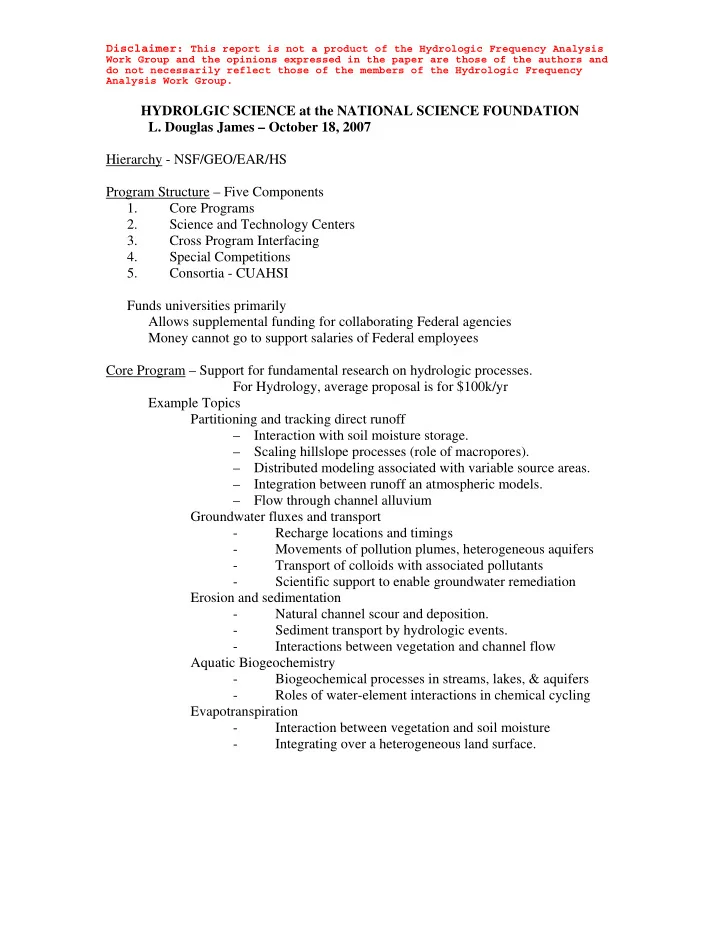
Hierarchy - NSF/GEO/EAR/HS Program Structure – Five Components 1. Core Programs 2. Science and Technology Centers 3. Cross Program Interfacing 4. Special Competitions 5. Consortia - CUAHSI Funds universities primarily Allows supplemental funding for collaborating Federal agencies Money cannot go to support salaries of Federal employees Core Program – Support for fundamental research on hydrologic processes. For Hydrology, average proposal is for $100k/yr Example Topics Partitioning and tracking direct runoff – Interaction with soil moisture storage. – Scaling hillslope processes (role of macropores). – Distributed modeling associated with variable source areas. – Integration between runoff an atmospheric models. – Flow through channel alluvium Groundwater fluxes and transport
- Recharge locations and timings
- Movements of pollution plumes, heterogeneous aquifers
- Transport of colloids with associated pollutants
- Scientific support to enable groundwater remediation
Erosion and sedimentation
- Natural channel scour and deposition.
- Sediment transport by hydrologic events.
- Interactions between vegetation and channel flow
Aquatic Biogeochemistry
- Biogeochemical processes in streams, lakes, & aquifers
- Roles of water-element interactions in chemical cycling
Evapotranspiration
- Interaction between vegetation and soil moisture
- Integrating over a heterogeneous land surface.