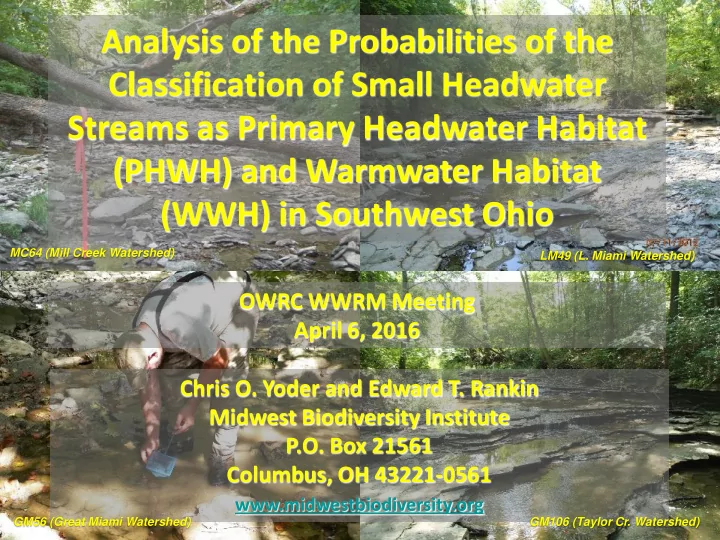
SLIDE 1 Chris O. Yoder and Edward T. Rankin Midwest Biodiversity Institute P.O. Box 21561 Columbus, OH 43221-0561
www.midwestbiodiversity.org
Analysis of the Probabilities of the Classification of Small Headwater Streams as Primary Headwater Habitat (PHWH) and Warmwater Habitat (WWH) in Southwest Ohio
OWRC WWRM Meeting April 6, 2016
MC64 (Mill Creek Watershed) LM49 (L. Miami Watershed) GM56 (Great Miami Watershed) GM106 (Taylor Cr. Watershed)
SLIDE 2 Specific Concerns
- “Rules-of-thumb” used in regulatory programs for
small streams are suspect – examples include:
- “Bright line” criteria such as a 1 sq. mi. drainage area
for functionally eliminating the WWH suite of uses;
- >40 cm maximum pool depth for the same.
- Policy issues:
- Applicability of PHWH is excluded by the Ohio EPA
definition of existing use;
- Federal definition of existing use is more inclusive.
- Execution of 401 Nationwide Permits:
- “Rules-of thumb” can result in erroneous outcomes;
- What, if any, monitoring is required can equally affect
- utcomes & potentially abrogate existing uses.
SLIDE 3
Existing uses are those uses actually attained in the water body on or after November 28, 1975, whether or not they are included in the water quality standards.
(40 CFR Part 131.3[e])
Existing Quality = Existing Use Existing Quality is vulnerable to not collecting the right kinds of data.
SLIDE 4 Small Stream Issues
- Perception of having less
value than larger streams.
- Too numerous to deal with.
- “Fuzzy” jurisdiction and
guidance issues.
important role in watersheds.
- Requiring the “right” type
- f monitoring is met with
resistance.
based on small size.
common & inaccurate.
SLIDE 5 Primary Headwater Stream Initiative
Robert D. Davic
Steve Tuckerman
Paul Anderson
Mike Bolton
SLIDE 6 What is a Primary Headwater Stream?
A surface watercourse with a defined Bed and Bank Either continuous or periodical flowing water A watershed generally less than one square mile and
deepest pools < 40cm
Widely divergent communities based upon instream
Biology
SLIDE 7
Primary Headwater Stream Watershed
USGS 7.5 Minute Quad 1: 24,000 0.68 sq. mi.
SLIDE 8 “Invisible” Stream
1999
Unnamed Tributary to Tinkers Creek
SLIDE 9 What Are the Current Issues?
- Transition from the Warmwater Habitat (WWH) suite of
aquatic life use designations to Primary Headwater Habitat (PHWH) occurs at ≈1-3 sq. mi. drainage area.
- Each are defined in terms of the biological assemblages
that can be supported.
- WWH suite of uses have biocriteria based on fish and
macroinvertebrates codified in Ohio WQS (OAC 3745-1- 07[A]).
- PHWH is a method-based framework with no codification
in the WQS.
- Does an over-reliance on “rules-of thumb” for regulatory
applications in these small headwater streams result in inaccuracies in terms of protections?
SLIDE 10 MBI Sampling Sites in Hamilton Co.
Our involvement with a comprehensive assessment of streams & rivers in Hamilton
- Co. provided an opportunity to apply a
different approach to headwater streams.
SLIDE 11 Three Principal Objectives of Systematic Bioassessment in Ohio
- Determine if use designations are appropriate
and attainable
- Determine condition and status of the resource
(including causal associations)
- Are changes taking place over time and what do
they mean?
The monitoring was performed under a Level 3 Project Study Plan making the data eligible for making use designation determinations.
SLIDE 12
Step 1: Evaluate if current uses are appropriate & attainable consistent with Ohio WQS.
SLIDE 13
Primary Headwaters in Hamilton Co.
We designed a monitoring approach to provide a data driven outcome for determining WWH or PHWH.
SLIDE 14
At sites <2.5 sq. mi. all data types were collected and not assuming either WWH or PHWH as a use designation outcome. Fish, macroinvertebrates, salamanders, QHEI, and HHEI were sampled at each site providing for a data driven outcome.
SLIDE 15 20 40 60 80 100
>2.0-2.5 >1.5-2.0 >1.0-1.5 >0.5-1.0 <= 0.5
Hamilton County 91.7 81.3 60 50 27.8
% of Sites with WWH Potential Stream Size (Square Miles)
Occurrence of WWH Potential by Stream Catchment Size
125 sites sampled 2011-14
SLIDE 16 10 20 30 40 50 60 70 80 Natural Recovered Recovering Recent or No Recovery Hamilton County Streams < 2.5 sq mi QHEI 10 20 30 40 50 60 70 80 WWH PHW3A PHW2 LRW Hamilton County Streams < 2.5 sq mi QHEI
SLIDE 17 2 4 6 8 10 12 <20 cm 20-40 cm 40-70 cm 70-100 cm >100 cm
Headwater Streams <2.5 mi.2 (Hamilton Co.)
Qual EPT Taxa
The original depth threshold is actually a range of 20-40 cm.
SLIDE 18 10 20 30 40 50 60
Headwater Streams <2.5 mi.
2 (Hamilton Co.)
<20 cm 20-40 cm 40-70 cm 70-100 cm >100 cm
IBI Score
- Max. Pool Depth (cm)
- Min. IBI = 12
WWH IBI Headwater Biocriterion = 40
Hamilton Co. results show that a 20 cm threshold is more accurate.
SLIDE 19 Some Conclusions
- The methods used to assess small streams in Ohio can affect
classification and assessment outcomes.
- Currently used rules-of-thumb such as 1 sq. mi. and 40 cm
maximum depth can lead to the flawed execution of regulatory programs.
- Based on the Hamilton Co. study the misclassification of
streams could be as high as 40-45%.
- There is no way to predict at what drainage area a stream will
fall under the WWH suite of uses or the PHWH methodology.
- Maximum pool depth of >20 cm is a more reliable & accurate
screening benchmark.
- Better first order screening criteria are needed so that
monitoring resources are not wasted on “obvious” situations (see next slide).
SLIDE 20
SLIDE 21 Remaining Questions
- How applicable are the Hamilton Co. results to the
remainder of the state?
Very much so where the key physical features are the same (i.e., in the dissected regions of northern, eastern, & southern Ohio). Northwest Ohio is an outlier with few if any intact headwater streams due to land use practices.
- Is there sufficient monitoring capacity to support a
data driven approach in Ohio?
- Yes, because the training, methodological, and
regulatory frameworks are already in place.
- Most field surveys can be completed in a single day.