ANALYSES TO PERFORM 1. Choose a duration of the simulation to be - - PDF document

analyses to perform
SMART_READER_LITE
LIVE PREVIEW

ANALYSES TO PERFORM 1. Choose a duration of the simulation to be - - PDF document

Lesson 6 University of Bergamo Engineering and Management for Health FOR CHRONIC DISEASES MEDICAL SUPPORT SYSTEMS LESSON 6 Lumped parameter models of the cardiovascular system: practical lesson. Ettore Lanzarone March 25, 2020 Practical


slide-1
SLIDE 1

Lesson 6 Lumped parameter models of the cardiovascular system: practical lesson.

Ettore Lanzarone March 25, 2020

MEDICAL SUPPORT SYSTEMS FOR CHRONIC DISEASES

Engineering and Management for Health University of Bergamo

LESSON 6

Practical lesson

ANALYSES TO PERFORM

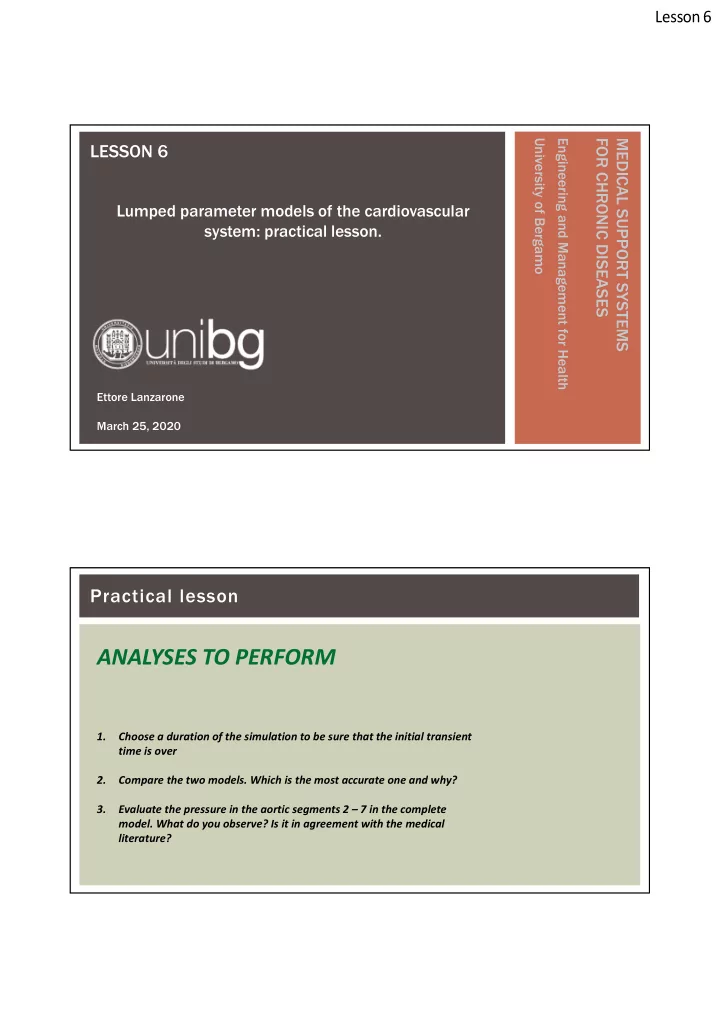
1. Choose a duration of the simulation to be sure that the initial transient time is over 2. Compare the two models. Which is the most accurate one and why? 3. Evaluate the pressure in the aortic segments 2 – 7 in the complete

  • model. What do you observe? Is it in agreement with the medical

literature?

slide-2
SLIDE 2

Lesson 6

Practical lesson

ANALYSES TO PERFORM

4. Study a pathological case: old patient with rigid vessels. All compliances reduced by a fixed percentage. What do you

  • bserve? Did you expect that?

5. Study a surgical case: insertion of an aortic prosthesis. Resistances are increased and compliances are decreased in segments 3 – 7

Practical lesson

Feedbacks from the students…

slide-3
SLIDE 3

Lesson 6

Practical lesson

  • Transient time model 1

Pressure P Transient is expired when two consecutive cardiac cycles are equal. Any analysis (e.g., average pressure) should be performed after removing the initial cycles.

Practical lesson

  • Transient time model 2

Pressure P3 Same consideration. Even starting with an initialization the system is not yet at the steady state. By changing initialization the transient is reduced but it is impossible to know a priori the pressures at the beginning of the cycle.

To change average pressures vary peripheral resistances

slide-4
SLIDE 4

Lesson 6

Practical lesson

  • Waveform model 1

Pressure P Shape not fully accurated but main characteristics are respected.

Practical lesson

  • Waveform model 2

Pressure P3 Accurate shape that respects physiological measurements

Dicrotic notch

slide-5
SLIDE 5

Lesson 6

Practical lesson

  • Waveform model 2

Pressures P3 – P4 – P5 – P6 Increased and delayed systolic peak (in agreement with the literature) is kept. If you «export» and compute average values, they decrease along with the network

Practical lesson

  • Rigid vessels model 2
  • Prosthesis model 2

Generally increased pressures. Pressure increasing in the segments above and with the prosthesis. If you impose a flow and vary the properties of a segment, all segments below are not affected (unless the modifications change the flow: heart reacts as it is not a perfect volumetric pump,

  • r different distribution of flows above the variation).