SLIDE 1
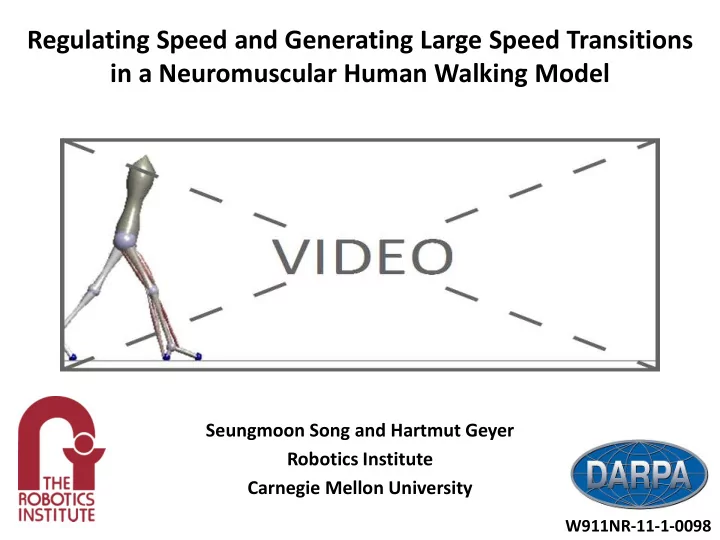
Regulating Speed and Generating Large Speed Transitions in a Neuromuscular Human Walking Model
Seungmoon Song and Hartmut Geyer Robotics Institute Carnegie Mellon University
W911NR-11-1-0098
SLIDE 2
Local Reflex Control Has a Large Potential for Controlling Robotic Legs
Humanoid vs Human Control Local Reflex Control
1/10 Humanoid: HONDA (ASIMO), Boston Dynamics (PETMAN) CPG + reflex: Taga et al. (1991), Ogihara et al. (2001) Robotic ankle: iWalk BiOM CPG Reflex
SLIDE 3 Our Reflex Based Neuromuscular Walking Model Current Limitations
- Confined to the sagittal plane
- Only walks at a single speed
NM Model (Geyer et al., 2010), Ankle prosthesis (Eilenberg et al, 2010) 2/10
SLIDE 4 Walking Speed Adaptation of the Human Model
- 1. Neuromuscular Model
- 3. Speed Adaptation
- 2. Optimization
SLIDE 5 Control Groups and Underlying Principles
Left leg cycle Swing-leg retraction
(Seyfarth et al., 2003)
PD trunk control
(Gunther et al., 2003)
Knee stability
(Seyfarth et al., 2001)
Spring mass model & F+
(Geyer et al, 2003 and 2006)
Swing-leg Initiation
(Mochon et al., 1980)
Right leg cycle Right leg control NM Model (Geyer et al., 2010) 3/10
SLIDE 6 Walking Speed Adaptation of the Human Model
- 1. Neuromuscular Model
- 3. Speed Adaptation
- 2. Optimization
SLIDE 7
, Energy rate (Umberger, 2003) 4/10
Target speed Pain Energy cost
The Cost Function Includes Walking Speed, Energetic Cost, and Pain
, CMA-ES (Hansen, 2006) Cost fn. (Neptune et al., 2001)
SLIDE 8 Walking Speed Adaptation of the Human Model
- 1. Neuromuscular Model
- 3. Speed Adaptation
- 2. Optimization
SLIDE 9
Optimization Results for Steady Walking Matches Human Data
v (Murray et al., 1984), CE (Minetti et al., 2001), L & f (Hirasaki et al., 1999) 0.8ms-1 1.4ms-1 1.8ms-1 5/10
SLIDE 10
Nine Control Parameters Show Strong Trend
6/10
SLIDE 11
Generation of Speed Transition: Switch Between Steady Speed Walking Controls
7/10
Works for small speed transitions. Fails for large speed transitions!
SLIDE 12
8/10
Generation of Speed Transition: Explicit Transition Phase Control
SLIDE 13
9/10
Successful Generation of Speed Transition: Explicit Transition Phase Control
SLIDE 14 Conclusion
10/10
We extended a local reflex based walking control to regulate walking speed and generate large speed transitions between 0.8ms-1 and 1.8ms-1 An explicit transition control was required to generate large speed transitions To walk faster the model …
- leans forward
- makes stronger ankle push-off
- makes larger swing initiation