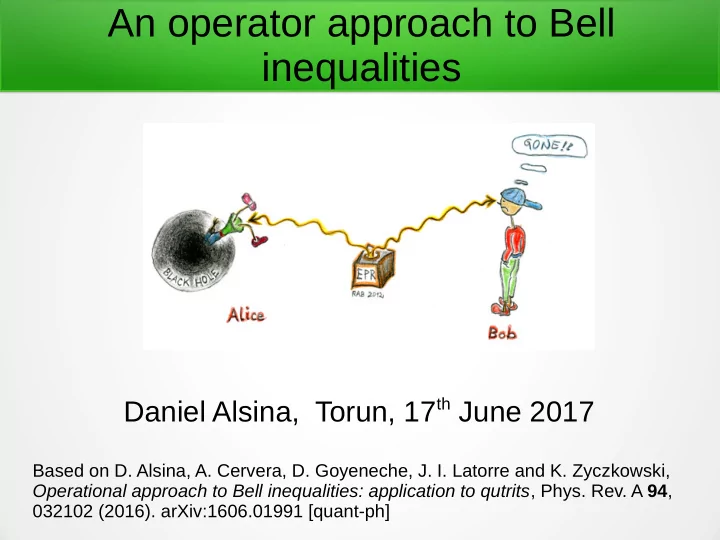
An operator approach to Bell inequalities Daniel Alsina, Torun, 17 - - PowerPoint PPT Presentation

an operator approach to bell inequalities
SMART_READER_LITE
LIVE PREVIEW

An operator approach to Bell inequalities Daniel Alsina, Torun, 17 - - PowerPoint PPT Presentation

An operator approach to Bell inequalities Daniel Alsina, Torun, 17 th June 2017 Based on D. Alsina, A. Cervera, D. Goyeneche, J. I. Latorre and K. Zyczkowski, Operational approach to Bell inequalities: application to qutrits , Phys. Rev. A 94 ,


slide-1
SLIDE 1

An operator approach to Bell inequalities

Daniel Alsina, Torun, 17th June 2017

Based on D. Alsina, A. Cervera, D. Goyeneche, J. I. Latorre and K. Zyczkowski, Operational approach to Bell inequalities: application to qutrits, Phys. Rev. A 94, 032102 (2016). arXiv:1606.01991 [quant-ph]

slide-2
SLIDE 2

Summary

  • Basics of entanglement
  • Bell inequalities
  • Bell operator
  • Bell operator for qutrits
  • Mapping states to Bell operators
  • Experiments
  • Conclusions
slide-3
SLIDE 3

Basics of entanglement

  • Entanglement: quantum correlations between particles

Intuitive conditions for entanglement: 1) Result of a measurement on A is somewhat (possibly totally) uncertain 2) A measurement on B will give more (possibly total) information about A. Paradigmatic example: Bell/EPR state We don't know the result of a measure on A (could be 0 or 1) but a measure on B will give us the key to A (it will be 0 if B has been 0, and 1 if B has been 1)

| ψ⟩= 1

√2 (|0A0B ⟩+|1A1B ⟩)

slide-4
SLIDE 4

Basics of entanglement

| ψ⟩= 1

√2 (|0A0B ⟩+|1A1B ⟩)

A measures 0, B also measures 0 A measures 1, B also measures 1 This suggests there is some information traveling between A and B to “tell” the other particle which state should it collapse to.

slide-5
SLIDE 5

Basics of entanglement

|ψ⟩= 1

√2 (|0A0B⟩+|1A1B ⟩)

A B

| ψA⟩=|0A⟩

A B A B A B A B

| ψA⟩=|0A⟩

A B

ρB

A B

| ψA⟩=|0 A⟩

A B A B

| ψA⟩=|0 A⟩

A B

ρB

I am 0! I am 0!

A B

| ψA⟩=|0A⟩

A B A B

| ψA⟩=|0A⟩

A B

| ψB⟩=| 0B⟩

A B A B A B

ρB ρA

Creation of 2 entangled particles Separation Measurement and collapse of A Information traveling Collapse of B

slide-6
SLIDE 6

Basics of entanglement

Spacelike separation between A and B? Possibility 1: B will collapse independently of A (entanglement is lost at some point) Possibility 2: Results of collapses in A and B match anyway (entanglement is a non-local property)

Possibility 2 is what really happens!

slide-7
SLIDE 7

Basics of entanglement

Spooky action at a distance... 2 new possibilities: 1- Hidden variables: QM is incomplete and there are new variables that determine the outcome of any experiment with certainty. EPR (1935), De Broglie-Bohm (1927-1952) 2- QM is intrinsically non-local and we have to live with it. Is there an experiment to differentiate between those two? Letter Einstein to Born (1947)

slide-8
SLIDE 8

Bell inequalities

  • The answer is YES: Bell inequalities

Constraints of local realism

"If [a hidden variable theory] is local it will not agree with quantum mechanics, and if it agrees with quantum mechanics it will not be local. This is what the theorem says”. (John Bell, 1987)

1+E (bc)⩾| E(ab)− E(ac)|

Original Bell inequality (1964) a,b,c = +1,-1 E(x): Expected value

slide-9
SLIDE 9

Bell inequalities

  • CHSH Inequality (Clauser et al., 1969)

a(b+b')+a'(b−b')⩽2

a ,a' ,b,b'

stand for 4 different variables with

values {+1,-1}. A observes randomly a or a', B

  • bserves randomly b or b'

a a' b b' A B

In QM applied to a spin 1/2 system, is to be interpreted as where is the Pauli vector.

a

⃗ σ·⃗ a ⃗ σ={σx ,σ y ,σ z}

slide-10
SLIDE 10

Bell inequalities

taking

|ψ⟩= 1

√2 (|0 A1B⟩−|1A 0B⟩)

If we take the singlet state: we have the simple form:

E(ab)=−cos(⃗ a ,⃗ b)

|−√ 2 2 −√ 2 2 −√2 2 −√ 2 2 |=2√ 2>2

a=90º ,b=45º ,a'=0º ,b'=135º

Violation of the Bell inequality!

| E(ab)+E(a' b)+E(ab')− E(a' b')|⩽2

Quantum limit

  • f CHSH
slide-11
SLIDE 11

Bell inequalities

CHSH inequality

S=4 S=2.82 S=2

S=a(b+b' )+a' (b−b')

Local realism Quantum mechanics Non- signaling

slide-12
SLIDE 12

Bell inequalities

We had to guess first which state would violate the BI: Compute the expected value (which can be more complicated for other states): and then optimize the directions: Useful for experiments where we have a concrete state (up to uncertainties) but not from an analytical point of view.

| ψ⟩= 1

√2 (|0A1B⟩−|1A0B⟩)

E(ab)=−cos(⃗ a ,⃗ b)

a=90º ,b=45º ,a'=0º ,b'=135º

slide-13
SLIDE 13

Bell operator

B=ab+ab' +a' b−a' b'

Bell operator

The maximal eigenvalue of C gives the maximum violation of the BI, and the corresponding eigenvector will be the state responsible for it. We only have to maximize over the directions now. Let's look for a more deductive way to find the classical and quantum limits of a BI and the states that saturate the quantum limit.

slide-14
SLIDE 14

Bell operator

We can still do better with a little trick: computing B²

B

2=4 I a⊗I b−[a,a'][b,b' ]

([x , y]=xy− yx)

From this expression we can obtain a lot of information:

  • Classically, all commutators are 0, so
  • In QM, It is thus easy to see that in
  • rder to maximize the commutators, it's enough to

impose that a and a' are perpendicular ( the same for b and b' ). Each commutator will then give a maximum value of 2, and:

Bclas

2 =4

[σi,σ j]=2i ϵijkσk .

Bquant

2

⩽8

slide-15
SLIDE 15

Bell operator

But mathematically: so we readily deduce that and the states responsible for the maximum quantum violation of B will be the same as those of B², so we got all information almost for free!

Avi=λivi→A

2vi=A(λivi)=λi Avi=λi 2vi

⟨⟦B⟧⟩LR=2 ⟨⟦B⟧⟩QM=2√2

slide-16
SLIDE 16

Bell operator

Can the trick be extended to other BI? General BI: BI(n,m,d)

  • n: number of parties: a,b,c...
  • m: number of settings: a,a',a''…
  • d: local dimension: 2,3,4…

CHSH is the most simple BI: it's a BI(2,2,2)

slide-17
SLIDE 17

Bell operator for qutrits

  • Motivations for qutrits

Existence of the AME(4,3): Absolutely maximally entangled state of four qutrits There is no complete characterization of the family of BI(n,2,3) Experimentally qutrits are harder to realize but are more robust against decoherence

∣ψ〉= 1 3 (∣0000 〉+∣0112 〉+∣0221〉+∣1011〉+∣1120〉 +∣1202〉+∣2022〉+∣2101〉+∣2210 〉)

slide-18
SLIDE 18

Bell operator for qutrits

  • Qutrits have values {0,1,2} or {1,0,-1}.

The operator basis needs to be expanded to {a,a2} (because now , ) The elements of the basis are no longer the 3 Pauli Matrices of SU(2) but the 8 Gell-Mann matrices of SU(3).

slide-19
SLIDE 19

Bell operator for qutrits

BI(2,2,3): (CGLMP Inequality, 2002) Its Bell operator is: The form of B² is too complicated. But we can just

  • ptimize over the directions to find:
slide-20
SLIDE 20

Bell operator for qutrits

for the directions: And the corresponding state is: Not the maximally entangled state!!

slide-21
SLIDE 21

Bell operator for qutrits

A smarter alternative is to turn to complex values {1,w,w2} where w=Exp(2i Pi /3). The elements of the basis of operators are the generalized Pauli matrices:

Shift matrix Clock matrix

slide-22
SLIDE 22

Bell operator for qutrits

CHSH for qubits

slide-23
SLIDE 23

Bell operator for qutrits

We call them Multiplets of Optimal Settings (MOS). They have the property that their commutator and anticommutator are nilpotent matrices.

slide-24
SLIDE 24

Bell operator for qutrits

  • 3 qutrits:
  • 4 qutrits:
slide-25
SLIDE 25

Bell operator for qutrits

  • For both inequalities,

Mutually unbiased bases!

Apparently two different families for 2qt and 3,4 qt. Is there a generating formula for BI(n,2,3)?

slide-26
SLIDE 26

Nº qutrits 2 3 4 5 6 3 3 9 9 27

  • 3
  • 6
  • 9
  • 18
  • 27

2.524 5.058 9.766 15.575 32.817 Ratio 1.457 1.686 1.879 1.731 2.105 Settings MOS MUB MUB Num. MOS Purity 0.347 0.342 1/3 0.351 0.334

Bell operator for qutrits

√3

3√ 3 3√3 9√ 3 9√3 −2√3 −3√3 −6√3 −9√3 −18√3

⟨⟦B⟧A⟩LR ⟨⟦B⟧A⟩LR

m

⟨⟦B⟧H⟩LR ⟨⟦B⟧H⟩LR

m

⟨⟦B⟧x⟩QM

slide-27
SLIDE 27

B a b a' b'

Mapping states to Bell operators

  • Observation: Maximally entangled state

|ψ⟩= 1

√2 (|+A0B⟩+|−A1B⟩)

|±⟩= 1

√2 (|0⟩±|1⟩)

can be expanded into

|ψ⟩= 1

√2 (|0A0B⟩+|0A1B⟩+|1A0B⟩−|1A1B⟩)

|ψ⟩ |0 ⟩A |0 ⟩B |1⟩A |1⟩B

B=ab+ab'+a' b−a' b'

CHSH operator

slide-28
SLIDE 28

B a b a' b' a'' b''

Mapping states to Bell operators

  • An equivalent strategy for qutrits would be:

|ψ⟩ |0 ⟩A |0 ⟩B |1⟩A |1⟩B |2⟩A |2⟩B

Obtaining Bell inequalities of qutrits and three settings, i.e. BI (n, 3, 3)

We apply the map to the GHZ of 2 and 4 qutrits and to the AME of 4 qutrits

| AME ⟩= 1 3 (|0000⟩+|0112⟩+|0221⟩+|1011⟩+|1120⟩ +|1202⟩+|2022⟩+|2101⟩+|2210⟩)

slide-29
SLIDE 29

Mapping states to Bell operators

Table of results:

State 2 (GHZ) 2 4 (GHZ) 4 (AME) 4 4.5 3 13.5 13.5 9

  • 4.5
  • 3
  • 27
  • 27
  • 9

5.117 2.524 26.025 25.372 9.766 R 1.137 1.457 1.928 1.879 1.879 Settings MUB MOS Num. MUB and Num. MUB P 1/3 0.347 1/3 1/3 1/3

⟨⟦B⟧A⟩LR ⟨⟦B⟧A⟩LR

m

⟨⟦B⟧H⟩LR ⟨⟦B⟧H⟩LR

m

⟨⟦B⟧x⟩QM

3√ 3 9√ 3 9√ 3 −3√3 −9√3 −9√3

√3

3√3 −2√3 −6√3

slide-30
SLIDE 30

Experiments

BI have been tested experimentally for quite a while now, albeit generally just in the CHSH form with the singlet state. Various experiments in the 70's and 80's (ex. Aspect et al. (1982) found confirmations of CHSH violation Now already quite close to the quantum bound: 10-3 in Poh et al., (2015)

slide-31
SLIDE 31

Experiments

Possible loopholes in experiments

  • Detection loophole
  • Locality loophole
  • Freedom of choice loophole (sometimes included in the

previous one) Many recent experiments are claiming having closed all loopholes: Hensen et al. (August 2015) Shalm et al. (November 2015)

slide-32
SLIDE 32

Conclusions

  • Bell inequalities are a crucial tool to falsify hidden

variable theories and strengthen our belief in quantum mechanics

  • The Bell operator is a useful tool to analyze

mathematically all properties of Bell inequalities

  • It is possible to generate Bell inequalities by

mapping maximally entangled states into them

  • Lots of recent experiments are closing the CHSH,

but still lot of scope to probe other BI

slide-33
SLIDE 33

Thanks for your attention!