
SLIDE 1
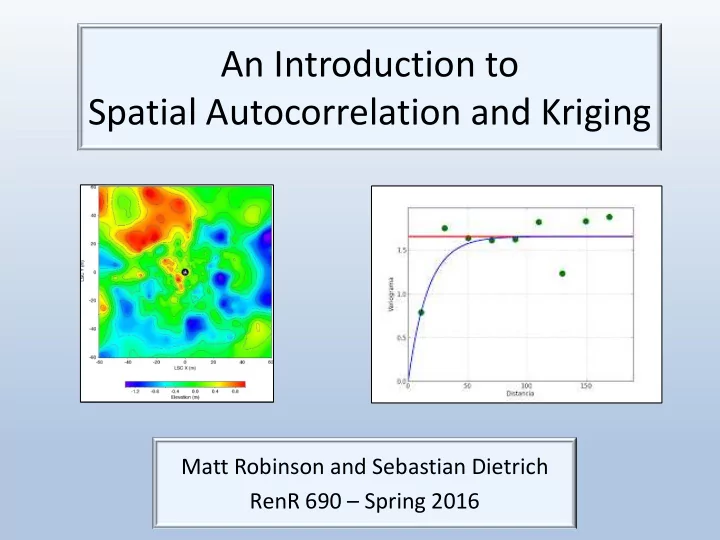
An Introduction to Spatial Autocorrelation and Kriging Matt - - PowerPoint PPT Presentation
An Introduction to Spatial Autocorrelation and Kriging Matt Robinson and Sebastian Dietrich RenR 690 Spring 2016 Tobler and Spatial Relationships Toblers 1 st Law of Geography : Everything is related to everything else, but near
(1) Tobler W., (1970) "A computer movie simulating urban growth in the Detroit region". Economic Geography, 46(2): 234-240.
Waldo R. Tobler
(2) Legendre P. Spatial Autocorrelation: Trouble or New Paradigm? Ecology. 1993 Sep;74(6):1659–1673.
(1) Artifact of Experimental Design (sample sites not random) (2) Interaction of variables across space (see below) Univariate case – response variable is correlated with itself
plants (seeds fall and germinate close to parent). Multivariate case – interactions of response and predictor variables due to inherent properties of the variables
and preferred soil conditions Mechanisms underlying patterns will depend on study system!!
Parent Plant
Presence of SAC can be good or bad (depends on your
at nearby, non-sampled sites (interpolation).
(violates assumption of many statistical tests) Failure to recognize/account for SAC can lead to erroneous statistical results and conclusions
(3) Legendre P, Fortin MJ. 1989. Spatial pattern and ecological analysis. Vegetation. 80(2):107–138.
(4) How Spatial Autocorrelation (Global Moran’s I) works - (ArcGIS Desktop Help). Available from: http://help.arcgis.com/En/Arcgisdesktop/10.0/Help/index.html#//005p0000000t000000
Range: -1.0 (negative SAC) and 1.0 (positive SAC) Value close to zero indicates no/little SAC
(5) Fortin, M.J., Dale, M.R. and Ver Hoef, J.M. 2002. Spatial analysis in ecology. Encyclopedia of environment.
(1) Calculate Matrix of Inverse Distance Weights - defines spatial relationship between all sample point pairs within a specified area. (2) Calculate Observed and Expected Moran I (3) Compare to Observed to Expected Moran’s I (expected under H0 of no SAC)
Distance weight (from matrix) S0 = Sum of all weights
Observed I Expected I (Under H0 of No SAC)
Variable x at points i and j
Example Dataframe Station Av8top Lat Lon 1 60 7.225806 34.13583 -117.9236 2 69 5.899194 34.17611 -118.3153 3 72 4.052885 33.82361 -118.1875 4 74 7.181452 34.19944 -118.5347 5 ……..
Source: http://www.ats.ucla.edu/stat/r/faq/morans_i.htm
Response variable x and y coordinates (specify location of sample points to be tested)
zone.dists <- as.matrix(dist(cbind(ozone$Lon, ozone$Lat)))
diag(ozone.dists.inv) <- 0
Moran.I(ozone$Av8top, ozone.dists.inv) (1) Input dataframe (2) Calculate Inverse Distance Matrix (3) Run Moran’s I Function
Source: http://www.ats.ucla.edu/stat/r/faq/morans_i.htm Source: http://www.inside-r.org/packages/cran/ape/docs/Moran.I
Observed = Moran’s I calculated from the data Expected = Moran’s I expected under H0 (no spatial autocorrelation) sd = standard deviation of Moran’s I under H0 p.value = p-value of the test of H0 against HA
Moran’s I is an Inferential Statistic - Must examine in Context of Null Hypothesis (No Spatial Autocorrelation) (1) Look at p-value
(2) Examine Observed and Expected Moran’s I
Observed > Expected: values cluster spatially ( + autocorrelation) Observed < Expected values disperse spatially (- autocorrelation) Output in R
values
preferred (more powerful)5,6 For more information see:
http://geog.ucsb.edu/~chris/readings/Spatial.Analysis.in.Ecology.Encyclopedia.E nvironmetrics.pdf Geary’s C
(5) Cliff, AD and Ord, JK (1975). The choice of a test for spatial autocorrelation. In J. C. Davies and M. J. McCullagh (eds) Display and Analysis of Spatial Data, John Wiley and Sons, London, 54-77 (6) Cliff, A. D. and Ord, J. K. 1981 Spatial processes - models and applications. (London: Pion).
Source: http://faculty.washington.edu/edford/Variogram.pdf Georges François Paul Marie Matheron
December 2, 1930 – August 7, 2000
French mathematician and geologist, known as the founder
Georges Matheron Princ ncip iple les s of geostat atist istics ics Economic Geology 1963 58:1246-1266
All credit to / Source: http://faculty.washington.edu/edford/Variogram.pdf
The variogram in a more ecologic context: The experimental variogram allows the description of the overall spatial pattern and the estimation of spatial autocorrelation parameters: (a) the spatial range, a, where the variable is spatially influenced by the same underlying process; (b) the nugget effect, which is the estimate of the error inherent in the measurements (sampling design and sampling unit size) and environmental variability; and (c) the sill that quantifies the spatial pattern intensity Secondly we derive a theoretical variogram which can be used for prediction of values (kriging)
All credit to / Source (good read!): Spatial analysis in ecology Marie-Josee Fortin, Mark R.T. Dale & Jay ver Hoef ´ Volume 4, pp 2051–2058 in Encyclopedia of Environmetrics http://geog.ucsb.edu/~chris/readings/Spatial.Analysis.in.Ecology.Encyclopedia.Environmetrics.pdf
Variogram or Semivariogram? Variance or Semivariance? Allan Variance or Introducing a New Term? Martin Bachmaier , Matthias Backes Mathematical Geosciences August 2011, Volume 43, Issue 6, pp 735-740 First online: 01 July 2011
Some history: Method developed by Professor Daniel Gerhardus Krige The concept of Support is very basic to geostatistics and was first covered by Ross (1950) and further developed by Krige (1951), including Krige’s variance- size of area relationship. 37 Spatial Structure and Variograms The corresponding correlograms or covariograms were used on a Simple Kriging basis for block evaluations Initially Professor Krige’s regressed estimates were then still called ‘weighted moving averages’ until Matheron’s insistence in the mid- 1960’s on the term Kriging in recognition of Professor Krige’s pioneering work. Matheron, also then proposed the use of the variogram to define the spatial structure. This model is an extension and refinement of the concept covered by De Wijs (1951/3);
(Source:https://www.goldfields.com/pdf/presentations/2015/summary_prof_danie_krige_m emorial_lecture.pdf)
The theoretical basis for the method was developed by the French mathematician Georges Matheron based on the Master's thesis of Danie G. Krige, the pioneering plotter of distance-weighted average gold grades at the Witwatersrand reef complex in South Africa.
(Source: https://en.wikipedia.org/wiki/Kriging)
variogram
All credit to / Source (good read!): Spatial analysis in ecology Marie-Josee Fortin, Mark R.T. Dale & Jay ver Hoef ´ Volume 4, pp 2051–2058 in Encyclopedia of Environmetrics http://geog.ucsb.edu/~chris/readings/Spatial.Analysis.in.Ecology.Encyclopedia.Environmetrics.pdf
Description: Kriging algorithm explained: To estimate the value of Cell 1 (C1) no data points are found within the range (note, the value of C2 has not been estimated yet). The range is governed by the variogram and indicates the point at which data shows no correlation (or where the semi-variance vs distance plot starts to flatten). Because no data exists whithin the range the average of all data points is used for the C1 cell. When the C2 cell is now visited the C1 cell and the other datapoints (two green and one yellow) are also used. Their relative weight is based on the variogram. The grey datapoint is only used to calculate the average, but is not used directly for estimating the point C1 and C2. All credit to / source: http://www.epgeology.com/gallery/image_page.php?album_id=10&image_id=201
Kriging maps created with ArcGIS Spherical variogram model Not standardized Ideal for single site anlysis, but Challenging for interpretetation Solutions?! Solution: plot standardized kriging maps? Can for comparison different variogram models be used to derive kriging maps?
Mining Hydrogeology ...and more!
(see below for resource)
(6) Dale, M.R.T., Fortin, M. 2002 Spatial autocorrelation and statistical tests in ecology. Écoscience. 2002; 9(2):162–167.