An Equitable Approach to Food Banking How to Build Access, - - PowerPoint PPT Presentation

an equitable approach to food banking
SMART_READER_LITE
LIVE PREVIEW

An Equitable Approach to Food Banking How to Build Access, - - PowerPoint PPT Presentation

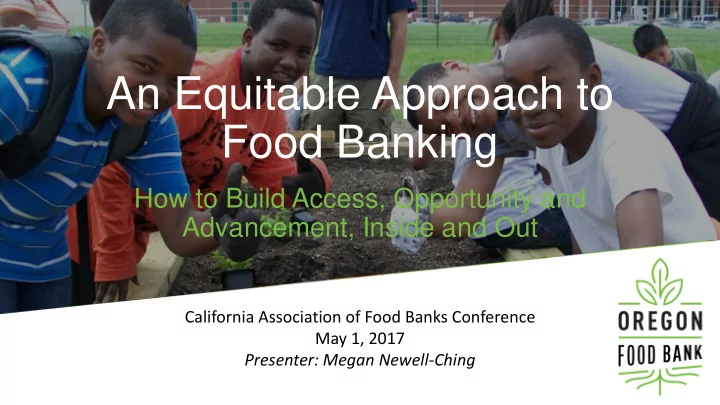
An Equitable Approach to Food Banking How to Build Access, Opportunity and Advancement, Inside and Out California Association of Food Banks Conference May 1, 2017 Presenter: Megan Newell-Ching Oregon Food Bank 160+ staff 4 branch

slide-1
SLIDE 1

An Equitable Approach to Food Banking

How to Build Access, Opportunity and Advancement, Inside and Out

California Association of Food Banks Conference May 1, 2017 Presenter: Megan Newell-Ching

slide-2
SLIDE 2
  • 160+ staff
  • 4 branch locations
  • 17 PDOs
  • 37 counties
  • 970+ food assistance

programs with 700+

  • rganizational partners

Oregon Food Bank

slide-3
SLIDE 3

People Served (pantries)

  • White: 74%
  • Hispanic: 13%
  • African American: 3%
  • American Indian or Native

Alaskan: 3%

  • Asian: 2%
  • Native Hawaiian or Other

Pacific Islander: 1%

  • Mixed Race: 4%

Oregon Food Bank Demographics

Staff/Board

  • 15% of staff identify as

people of color

  • 29% of OFB board identify

as people of color

  • 0% of executive leadership

identify as people of color

slide-4
SLIDE 4

Beyond the Can

OFB’s Mission To eliminate hunger and its root causes…because no one should be hungry In order to end hunger, we believe we must also address the root causes of hunger through public policy, nutrition and garden education, and public awareness.

slide-5
SLIDE 5

Why Equity, Why Now?

slide-6
SLIDE 6
slide-7
SLIDE 7
slide-8
SLIDE 8
slide-9
SLIDE 9
slide-10
SLIDE 10
slide-11
SLIDE 11

Our Equity Journey

slide-12
SLIDE 12

Timeline

2014

  • Strategic Plan

Launch

  • Staff

engagement on internal culture

  • Assessment and

determination of underserved areas & populations 2015

  • Equity Team

formed

  • 3-day all staff

training

  • Regular staff

dialogues

  • Partner

Alignment Initiative & Link2Feed Launch

  • School Pantry

Focus Groups 2016

  • Equity Sub-

committees

  • Equity Lens

completed

  • Board training
  • Organizational

Equity Assessment

  • Community

Equity Coordinator hired

  • Barrier removal

pilot for education programs 2017

  • Equity Statement

approved by board

  • Formal Equity

Planning

  • Increasing FTE

for internal equity

  • External

communications launch

  • Culturally

specific farm/garden partnerships launch

slide-13
SLIDE 13

Lessons Learned

  • Leadership buy-in is key
  • Engage the board early in the process
  • Plan to capture staff momentum post-

training

  • On-going training for new employees
  • It will feel hard and you will make mistakes,

keep going!

slide-14
SLIDE 14

The Daily Work is…

Shifting perspective and slowing down processes to make more space for reflection, community validation and thoughtful action.

slide-15
SLIDE 15

At OFB this looks like…

  • Tools and support for

staff & board

  • Equity Statement
  • Equity Lens
  • Required and optional

learning/engagement

  • pportunities
  • Relationship building
  • Shifting budget and work

plan priorities

  • On-going cross-

department/cross- functional teams and initiatives

  • E-Team
  • Inclusive Culture
  • HR
  • Communication

(internal/external)

  • Staff capacity (FTE

dedicated to equity & inclusion)

slide-16
SLIDE 16

Equity Statement

slide-17
SLIDE 17

What is an Equity Lens?

slide-18
SLIDE 18

Equity Lens

slide-19
SLIDE 19

What is an Equity Lens?

A quality improvement tool used for planning, decision-making, and resource allocation that ideally leads to more racially equitable policies, program delivery and ultimately more equitable outcomes for our clients. At its core, it is a set of principles, reflective questions, and processes that functions at the individual, institutional, and systemic levels by:

  • proactively seeking to eliminate inequities and advance equitable solutions;
  • shifting the way we make decisions and think about our work; and
  • identifying clear goals and objectives, measurable outcomes for successful

implementation

slide-20
SLIDE 20

OFB Equity Lens Key Questions

  • In considering your decision, what are you hoping to

achieve?

  • How will you intentionally involve a diverse set of

stakeholders, including those who may be impacted?

  • How might your beliefs and biases impact this

decision?

  • How does this decision advance racial equity?
  • How will the final decision be shared?
slide-21
SLIDE 21

Equity in Action at OFB

slide-22
SLIDE 22

Where i is equity s showing up?

  • Advocacy: client engagement, supporting “non-food” policy work
  • Agency Relations: new partnerships, agency segmentation, agency

education

  • Education Programs: culturally specific and translated curricula,

barrier removal to program participation, culturally specific partners

  • Operations: culturally appropriate foods, increased capacity for

underserved areas (delivery, etc.)

  • HR: staff training, recruitment, hiring & onboarding, dedicated

equity FTE

slide-23
SLIDE 23

Agency Relations

  • Agency Training Series
  • Partner Alignment Initiative (agency segmentation)
  • Translation & Interpretation
  • Client engagement & leadership development
slide-24
SLIDE 24

Garden Programs

  • New Garden Partners: First Foods

Garden, Mudbone Grown, Black Food Sovereignty Council

  • Seed-to-Supper culturally specific

curriculum translation

  • Barrier removal pilot (childcare,

interpretation, transportation)

  • Spanish speaking volunteer shifts
  • Mural designed by incarcerated

Seed-to Supper participants

slide-25
SLIDE 25

What have w e we e wor

  • rked on
  • n ou
  • utsid

ide of

  • f foo
  • od p

pol

  • lic

icy?

What are the non-food policies we have supported:

  • Minimum Wage Increase
  • Housing
  • Emergency Housing Funds
  • Portland Housing Bond Campaign
  • Just Cause eviction legislation
  • Affordable Housing
  • Payday Lending
  • Temporary Assistance to Needy Families (TANF)
  • Earned Income Tax Credit/Child tax credit
  • Transportation
  • Affordable Healthcare
slide-26
SLIDE 26

RESOURCES

  • Coalition of Communities of Color Protocol for Culturally

Responsive Organizations

  • OFB Equity Statement
  • Meyer Memorial Trust- DEI Resources
  • Nonprofit Quarterly- DEI Article Series
  • Center for Equity & Inclusion
  • Partners for a Hunger Free Oregon Equity Commitment
slide-27
SLIDE 27

Contact Information

Megan Newell-Ching, Associate Director Partnerships & Programs mnewellching@oregonfoodbank.org 503-419-4186