An EnerPHit Certified Retrofit Joel Seagren Images courtesy of Dale - - PowerPoint PPT Presentation

an enerphit certified retrofit
SMART_READER_LITE
LIVE PREVIEW

An EnerPHit Certified Retrofit Joel Seagren Images courtesy of Dale - - PowerPoint PPT Presentation

An EnerPHit Certified Retrofit Joel Seagren Images courtesy of Dale Roberts & Phil Hines Project Location Bellbrae Project Bellbrae Project Bellbrae Project Decision Process New Build vs Retrofit Maintain family connection to


slide-1
SLIDE 1

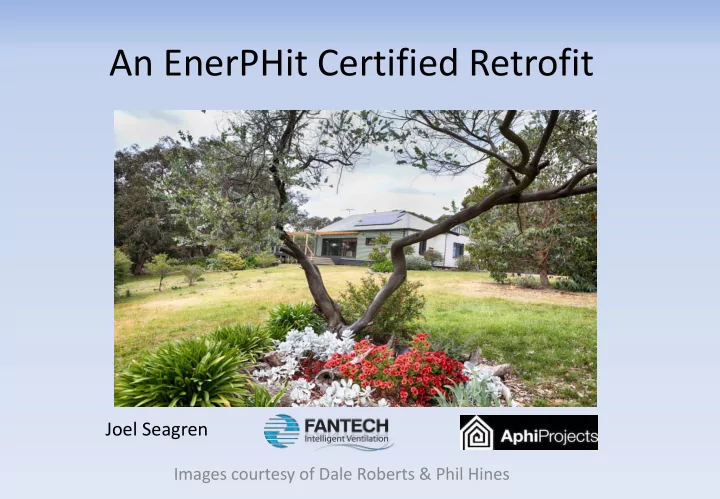
An EnerPHit Certified Retrofit

Joel Seagren

Images courtesy of Dale Roberts & Phil Hines
slide-2
SLIDE 2

Project Location

slide-3
SLIDE 3

Bellbrae Project

slide-4
SLIDE 4

Bellbrae Project

slide-5
SLIDE 5

Bellbrae Project

slide-6
SLIDE 6

Decision Process

  • New Build v’s Retrofit

– Maintain family connection to building

  • Extent of works

– Complete strip down to frame and weatherboard cladding

(except 2 bedrooms where wall remained intact)

  • Budget - $3.5K/sqm across 130 sqm

– although executed on cheaper family rates :) – $50K of structure retained

slide-7
SLIDE 7

PHPP Design

  • EnerPhit certification intent from outset
  • Fully stripped areas

– high confidence in insulation and airtightness

  • 2 unstripped bedrooms (budget driven)

– creates uncertainty

slide-8
SLIDE 8

Insulation - walls

slide-9
SLIDE 9

Insulation - ceiling

Air Tightness = taped XPS board

slide-10
SLIDE 10
  • Full wall wrap in insulated board

Thermal Bridges

slide-11
SLIDE 11

Thermal Bridges

slide-12
SLIDE 12

Glazing

  • Triple Glazed
  • UW 0.90-0.95 W/m2K (total window)
slide-13
SLIDE 13

Glazing

Additional stumps added to support window weight

slide-14
SLIDE 14

Air Tightness

  • Main leakage via 2

unstripped bedrooms

  • Some ceiling contribution
slide-15
SLIDE 15

Ventilation System

  • Passive House Methodology

– EN13779 – IDA3 22-36 m3/h of fresh air / person => 600-1000ppm CO2 increase compared outside air. Maintains acceptable IAQ 20-30 m3/h adopted per person across the whole building – Tested & proven in residential buildings – Minimum of 0.3 ach (air changes/hour) for building

slide-16
SLIDE 16

Ventilation Layout

MVHR Energy Consumption 35 Watts @ 150 m3/h

slide-17
SLIDE 17

Maintaining air balance

Rangehood Extraction Combustion Heating

  • In bench style
  • Recirculation (with carbon filters.)

High efficiency wood heater

  • Tested 71% therm. eff
  • 7kW radiant output (fuel dependant!!)
  • Self contained supply air via base /rear
slide-18
SLIDE 18

Retrofitting MVHR duct

Insulated ductwork outside thermal envelope

  • 25mm thick R1 insulation
  • 90mm pipe
  • 45 C roof space
  • 8m avg duct length x 16 runs

(supply & extract) Up to 1 kW heat again!

slide-19
SLIDE 19

Building Performance

  • Occupant Feedback

– Very pleased with project – Proposing to build 2 more small PH buildings – 2 unstripped bedrooms are not as comfortable

Image: Pro Insulation Dublin

slide-20
SLIDE 20

Temperature Data Logging

Living Room Temp Sensor Bedroom Temp Sensor

Outside Air Exhaust Supply Air Extract Air

slide-21
SLIDE 21

Temperature Data

5 10 15 20 25 30

12:12:00 AM 3:12:00 AM 6:12:00 AM 9:12:00 AM 12:12:00 PM 3:12:00 PM 6:12:00 PM 9:12:00 PM 12:12:00 AM 3:12:00 AM 6:12:00 AM 9:12:00 AM 12:12:00 PM 3:12:00 PM 6:12:00 PM 9:12:00 PM 12:13:00 AM 3:13:00 AM 6:13:00 AM 9:13:00 AM 12:13:00 PM 3:13:00 PM 6:13:00 PM 9:13:00 PM 12:13:00 AM 3:13:00 AM 6:13:00 AM 9:13:00 AM 12:13:00 PM 3:13:00 PM 6:13:00 PM 9:13:00 PM 12:13:00 AM 3:13:00 AM 6:13:00 AM 9:13:00 AM 12:13:00 PM 3:13:00 PM 6:13:00 PM 9:13:00 PM 12:14:00 AM 3:14:00 AM 6:14:00 AM 9:14:00 AM 12:14:00 PM 3:14:00 PM 6:14:00 PM 9:14:00 PM 12:14:00 AM 3:14:00 AM 6:14:00 AM 9:14:00 AM 12:14:00 PM 3:14:00 PM 6:14:00 PM 9:14:00 PM OA SA RA EA Bedroom Temperature Living Room Temperature

Bellbrae House Temperature Data

(Oct 31st - Nov 7th 2016) Temp (degrees C) Time of Day

Bedroom temp range 17-21 Deg.C Living room temp range 18-23 Deg.C

slide-22
SLIDE 22

EnerPHit Certification

slide-23
SLIDE 23

Lessons Learnt

  • Underfloor insulation

– Insulation board difficult to work with overhead

  • Ventilation system time consuming to fit

– Roof space insulation time consuming – Ceiling height reduction would have allowed duct runs inside thermal envelope

  • 2 unstripped bedrooms

– weak points in the envelope (insulation and airtightness) – Should have stripped as per rest of building