An ALE Approach for the Numerical Simulation of Drosophila Flight - - PowerPoint PPT Presentation

an ale approach for the numerical simulation of
SMART_READER_LITE
LIVE PREVIEW

An ALE Approach for the Numerical Simulation of Drosophila Flight - - PowerPoint PPT Presentation

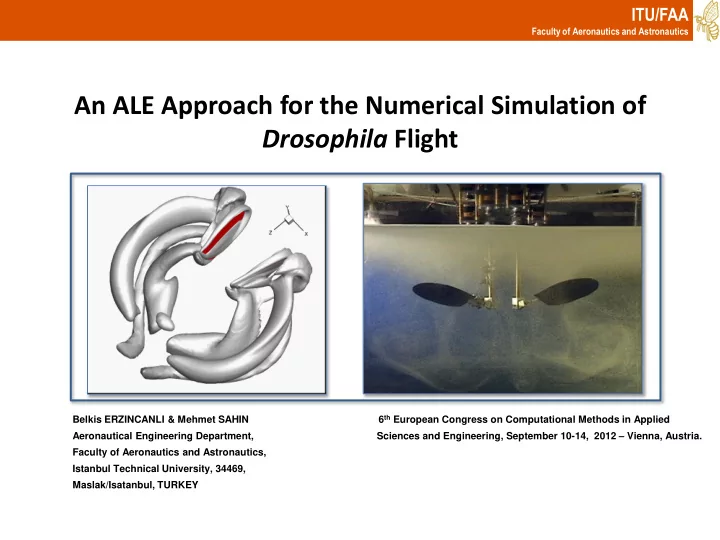
ITU/FAA Faculty of Aeronautics and Astronautics An ALE Approach for the Numerical Simulation of Drosophila Flight Belkis ERZINCANLI & Mehmet SAHIN 6 th European Congress on Computational Methods in


slide-1
SLIDE 1

An ALE Approach for the Numerical Simulation of Drosophila Flight

Belkis ERZINCANLI & Mehmet SAHIN 6th European Congress on Computational Methods in Applied Aeronautical Engineering Department, Sciences and Engineering, September 10-14, 2012 – Vienna, Austria. Faculty of Aeronautics and Astronautics, Istanbul Technical University, 34469, Maslak/Isatanbul, TURKEY

ITU/FAA

Faculty of Aeronautics and Astronautics

slide-2
SLIDE 2

Contents

  • Motivations
  • ALE Formulation
  • Governing equations
  • Discrete Geometric Conservation Law (GCL)
  • 3D Numerical discretization
  • Iterative solver
  • Numerical Validations
  • Kovasznay flow
  • The flow past an oscillating circular cylinder in a channel
  • The flow induced due to a horizontally oscillating sphere
  • The Numerical Simulation of Flow Field Around Drosophila
  • Conclusions and Future Work

ECCOMAS 2012 2

ITU/FAA

Faculty of Aeronautics and Astronautics

slide-3
SLIDE 3

The Fruit Fly, Drosophila

ECCOMAS 2012 3

ITU/FAA

Faculty of Aeronautics and Astronautics

Debat et al., Evolution, 60(12), 2006, pp. 2529–2538

slide-4
SLIDE 4

Insect Flight Aerodynamics

ECCOMAS 2012 4

ITU/FAA

Faculty of Aeronautics and Astronautics

Clap & Fling A comparison of 2-D linear translation vs 3-D flapping translation Stable attachment of the leading edge vortex

Sane, S.P.,”The Aerodynamics of Insect Flight”, The Journal of Experimental Biology 206,4191-4208, (2003).

slide-5
SLIDE 5

Numerical Aprroaches Used for Moving Boundary Flow Problems

  • Immersed Boundary Method (IBM): This approach solves Navier-Stokes

equations on a Cartesian mesh with a moving immersed body (Miller & Peskin, 2004; Gilmanov & Sotiropoulos, 2005; Mittal et al., 2006; Bush et al., ) .

  • Fictious Domain Method: This approach uses Eulerian mesh and the body

motion is represented using the distributed Lagrangian multiplier method.

  • Overset (Chimera) Grid Method: This method uses several body fitted

meshes inside the fluid domain and an interpolation algorithm is used between the neighbouring meshes (Liu and Aono, 2009).

  • Arbitrary Lagrangian-Eulerian (ALE) Method: The mesh follows the

interface between the fluid and solid boundary and the governing equations are discretized on a moving/deforming mesh (Johnson, 2006; Ramamurti & Sandberg, 2002).

ECCOMAS 2012 5

ITU/FAA

Faculty of Aeronautics and Astronautics

slide-6
SLIDE 6

A Fully Coupled Parallel Unstructured Finite Volume Method based on ALE Formulation

  • In the Arbitrary Lagrangian-Eulerian (ALE) method, the interface between

the solid and fluid is sharply represented.

  • The mesh movement has to satisfy a special condition called Geometric

Conservation Law (GCL) in order to maintain the accuracy and the stability

  • f the time integration scheme.
  • An unstructured ALE method based on the side-centered finite volume

technique has been developed for parallel large-scale moving boundary problems.

  • The present arrangement of the primitive variables leads to a stable

numerical scheme and it does not require any ad-hoc modifications in order to enhance the pressure-velocity coupling.

  • The most appealing feature of present primitive variable arrangement is the

availability of very efficient multigrid solvers.

  • A fully coupled implicit iterative solver is used for large-scale calculations

since the CFL restriction may lead to inadmissible time steps on deforming meshes and does not introduce any splitting error when the advection- diffusion operator is treated impicitly.

ECCOMAS 2012 6

ITU/FAA

Faculty of Aeronautics and Astronautics

slide-7
SLIDE 7

Mathematical and Numerical Formulation

The incompressible Navier-Stokes equations that govern the viscous fluid flow of an arbitrary moving Eulerian Lagrangian control volume Ω(t) with boundary ∂Ω(t) can be written in Cartesian coordinate system in dimensionless form as follows: The continuity equation: The momentum equation:

Three-dimensional dual volume

ECCOMAS 2012 7

ITU/FAA

Faculty of Aeronautics and Astronautics

Grid velocity

slide-8
SLIDE 8

Numerical Discretization

Side-centered finite volume method

  • A stable numerical scheme with exact mass conservation
  • No ad-hoc modifications for pressure-velocity coupling
  • Very efficient multigrid solvers are available

(a) Two-dimensional dual volume (b) Three-dimensional dual volume

ECCOMAS 2012 8

ITU/FAA

Faculty of Aeronautics and Astronautics

slide-9
SLIDE 9

Numerical Discretization Cont’d

The contributions for the x-momentum equation for the right element: The time derivation is the volume of the pyramid between points

ECCOMAS 2012 9

ITU/FAA

Faculty of Aeronautics and Astronautics

slide-10
SLIDE 10

Numerical Discretization Cont’d

The convective term due to fluid motion are the area vectors of the dual volume triangular

  • surfaces. are the velocity vectors defined at the mid-

point of each dual volume surface area.

ECCOMAS 2012 10

ITU/FAA

Faculty of Aeronautics and Astronautics

slide-11
SLIDE 11

Numerical Discretization Cont’d

The convective term due to mesh motion First-order backward difference is used for grid velocity

ECCOMAS 2012 11

ITU/FAA

Faculty of Aeronautics and Astronautics

Geometric conservation law satisfied.

slide-12
SLIDE 12

Numerical Discretization Cont’d

The pressure term 2nd order Taylor series expansion is used for the pressure values at .

ECCOMAS 2012 12

ITU/FAA

Faculty of Aeronautics and Astronautics

slide-13
SLIDE 13

Numerical Discretization Cont’d

The viscous term Gauss-Green theorem is used for the gradient terms:

ECCOMAS 2012 13

ITU/FAA

Faculty of Aeronautics and Astronautics

slide-14
SLIDE 14

Numerical Discretization Cont’d

The continuity equation is integrated within each hexahedral elements and evaluated using the mid-point rule on each of the element faces where is the hexahedral element surface area vector and u, v and w are the velocity vector components defined at the mid-point of each hexahedral element face. The discretization of above equations leads to a saddle point problem of the form: where, are the convection diffusion operators, is the pressure gradient operator and is the divergence operator.

ECCOMAS 2012 14

ITU/FAA

Faculty of Aeronautics and Astronautics

slide-15
SLIDE 15

Iterative Method

The preconditioner matrix is Where .For the inverse of the scaled Laplacian S, we use two-cycle AMG solver provided by the HYPRE library, a high performance preconditioning package developed at Lawrence Livermore National Laboratory, which we access through the PETSC library.

ECCOMAS 2012 15

ITU/FAA

Faculty of Aeronautics and Astronautics

slide-16
SLIDE 16

Parallelization and Efficiency

ECCOMAS 2012 16

ITU/FAA

Faculty of Aeronautics and Astronautics

Mesh Generation (GAMBIT, CUBIT, ...) Mesh Partition (METIS library) Linear Solver with Multigrid Preconditioner Post Processing (Tecplot) Parallel Unstructured ALE Code Kroylov subspace methods (PETSc library) Preconditoners (PETSc and HYPRE libraries )

slide-17
SLIDE 17

Computing Resources for Parallel Calculations

  • SGI Altix 3000 (1300MHz, Itanium 2) with 32 nodes
  • National Center for High Performance Computing of Turkey
  • TUBITAK ULAKBIM, High Performance and Grid Computing Center

ECCOMAS 2012 17

ITU/FAA

Faculty of Aeronautics and Astronautics

slide-18
SLIDE 18

TEST CASE I: 2D Kovasznay Flow

ECCOMAS 2012 18

ITU/FAA

Faculty of Aeronautics and Astronautics

The spatial convergence of the error with mesh refinement .

slide-19
SLIDE 19

TEST CASE II: An Oscillating Circular Cylinder in a Channel

  • The location of the cylinder center
  • Amplitude and frequency of the oscillation
  • Time step
  • Reynolds number
  • 70,667 quadrilateral elements
  • 71,349 vertices
  • 354,699 total DOF

ECCOMAS 2012 19

ITU/FAA

Faculty of Aeronautics and Astronautics

slide-20
SLIDE 20

TEST CASE II: An Oscillating Circular Cylinder in a Channel

The computed u-velocity vector component contours with streamtraces.

ECCOMAS 2012 20

ITU/FAA

Faculty of Aeronautics and Astronautics

t=20.0s t=21.0s t=22.0s t=23.0s

slide-21
SLIDE 21

TEST CASE II: An Oscillating Circular Cylinder in a Channel

The comparion of cd and cl plots with results from Wan and Turek (JCP, 2007).

ECCOMAS 2012 21

ITU/FAA

Faculty of Aeronautics and Astronautics

slide-22
SLIDE 22

ITU/FAA

Faculty of Aeronautics and Astronautics

TEST CASE III: An Oscillating Sphere in a Cubic Cavity

  • The location of the sphere
  • Time step
  • Reynolds number (Gilmanov & Sotiropoulos , 2005)

The Reynolds number is based on the sphere diameter and the maximum sphere velocity.

  • 473,856 hexahedral elements
  • 492,596 vertices
  • 4,794,264 total DOF

ECCOMAS 2012 22

slide-23
SLIDE 23

ITU/FAA

Faculty of Aeronautics and Astronautics

TEST CASE III: An Oscillating Sphere in a Cubic Cavity

  • The location of the sphere x(t) = h [1- cos(2฀t)] h = 0.125D

ECCOMAS 2012 23

The instantaneous streamtraces with u-velocity component contours at different phases over a cycle for a rigid sphere oscillating in a cubic cavity at Re = 20: t=0, t=T/4, t=T/2 and t=3T/4. The time variation of drag coefficient for a rigid sphere oscillating in a cubic cavity at Re = 20.

slide-24
SLIDE 24

The Numerical Simulation of Flow Field Around Drosophila

ECCOMAS 2012 24

ITU/FAA

Faculty of Aeronautics and Astronautics

Robofly experiment of M. Dickinson (CalTech / ICB), Science (1999).

slide-25
SLIDE 25

The Numerical Simulation of Flow Field Around Drosophila

ECCOMAS 2012 25

ITU/FAA

Faculty of Aeronautics and Astronautics

Downstroke motion at times t=0; t=0.1; t=0.2; t=0.3; t=0.4; t=0.5. Upstroke motion at times t=0.5; t=0.6; t=0.7; t=0.8; t=0.9; t=1. The kinematics of the Drosophila wing motion:

slide-26
SLIDE 26

The Numerical Simulation of Flow Field Around Drosophila

ECCOMAS 2012 26

ITU/FAA

Faculty of Aeronautics and Astronautics

The initial mesh [a] and the deformed mesh [b] for the Drosophila wing. The mesh consists of 1,300,358 vertices and 1,276,666 hexahedral elements leading to 12,837,448 DOF.

[a] [b]

slide-27
SLIDE 27

The Numerical Simulation of Flow Field Around Drosophila

ECCOMAS 2012 27

ITU/FAA

Faculty of Aeronautics and Astronautics

The instantaneous downstroke wake structures (Q-criterion) around the Drosophila wing at several different time levels: t = 0.00T [a], t = 0.1T [b], t = 0.2T [c], t = 0.3T [d], t = 0.4T [e] and t = 0.5T [f ].

[a] [b] [c] [d] [e] [f]

slide-28
SLIDE 28

The Numerical Simulation of Flow Field Around Drosophila

ECCOMAS 2012 28

ITU/FAA

Faculty of Aeronautics and Astronautics

The instantaneous upstroke wake structures (Q-criterion) around the Drosophila wing at several different time levels: t = 0.5T [a], t = 0.6T [b], t = 0.7T [c], t = 0.8T [d], t = 0.9T [e] and t = 1.0T [f ].

[a] [b] [c] [d] [e] [f]

slide-29
SLIDE 29

The Numerical Simulation of Flow Field Around Drosophila

ECCOMAS 2012 29

ITU/FAA

Faculty of Aeronautics and Astronautics

The instantaneous v-velocity component isosurfaces with the streamtraces showing the stable leading edge vortex [a] and the streamtraces with the v-velocity contours on the z=0 plane [b] at t = 0.70T .

[b] [a]

slide-30
SLIDE 30

The Numerical Simulation of Flow Field Around Drosophila

ECCOMAS 2012 30

ITU/FAA

Faculty of Aeronautics and Astronautics

The computed instantaneous pressure contours during the downstroke motion at t=0; t=0.1; t=0.2; t=0.3; t=0.4; t=0.5 [a] and the upstroke motion at t=0.5; t=0.6; t=0.7; t=0.8; t=0.9; t=1 [b]. [a] [b]

slide-31
SLIDE 31

The Numerical Simulation of Flow Field Around Drosophila

ECCOMAS 2012 31

ITU/FAA

Faculty of Aeronautics and Astronautics

The computed total force coefficients for a pair of Drosophila wings [a] and the comparison of the lift coefficient with the experimental (Dickinson et. al, 1999) and numerical results (Kweon and Choi, 2010) [b]. [a] [b]

slide-32
SLIDE 32

The Numerical Simulation of Flow Field Around Drosophila

ECCOMAS 2012 32

ITU/FAA

Faculty of Aeronautics and Astronautics

The instantaneous wake structures (Q-criterion) around the Drosophila wing.

slide-33
SLIDE 33

Conclusions and Future Work

  • A parallel unstructured ALE method based on the side-centered

unstructured finite volume has been developed and successfuly tested for 2D and 3D benchmark problems.

  • Boddy fitted unstructured meshes are allowed on the solid surface.
  • The continuity equation is satisfied within each element at machine

precission.

  • A special attention is given to satisfy the Geometric Conservation Law.
  • The current mesh deformation is achieved by using an algebraic approach

based on distance function. The radial based function (RBF) approach is being implemented.

  • A fully-coupled implicit iterative solver is used at each time level.
  • The numerical method is applied to the numerical solution of the flow field

around a pair of flapping Drosophila wing in hover. The numerical method can accurately capture the wake structure around the Drosophila.

ECCOMAS 2012 33

ITU/FAA

Faculty of Aeronautics and Astronautics

slide-34
SLIDE 34

Acknowledgement

The authors gratefully acknowledge the financial support from Scientific and Technical Research Council of Turkey (TUBITAK ) under project number

  • 111M332. The authors also would like to acknowledge the use of the Chimera

machine at the Faculty of Aeronautics and Astronautics at ITU, the computing resources provided by the National Center for High Performance Computing

  • f Turkey (UYBHM) under grant number 10752009 and the computing

facilities at TUBITAK ULAKBIM, High Performance and Grid Computing Center. The authors also would like to thank Michael Dickinson and his graduate student Michael Elzinga for providing the experimental data.

ECCOMAS 2012 34

ITU/FAA

Faculty of Aeronautics and Astronautics

slide-35
SLIDE 35

THANK YOU FOR YOUR ATTENTION!

ECCOMAS 2012 35

ITU/FAA

Faculty of Aeronautics and Astronautics