Amphetamine, cocaine and cannabinoids use among truck drivers on the - - PDF document

amphetamine cocaine and cannabinoids use among truck
SMART_READER_LITE
LIVE PREVIEW

Amphetamine, cocaine and cannabinoids use among truck drivers on the - - PDF document

Amphetamine, cocaine and cannabinoids use among truck drivers on the roads in the State of Sao Paulo, Brazil Vilma Leyton Daniele Mayumi Sinagawa Keziah C. B. G. de Oliveira Wagner Schmitz Gabriel Andreuccetti Bruno Spinosa de Martinis


slide-1
SLIDE 1

Amphetamine, cocaine and cannabinoids use among truck drivers on the roads in the State of Sao Paulo, Brazil

Vilma Leyton

Daniele Mayumi Sinagawa

Keziah C. B. G. de Oliveira Wagner Schmitz Gabriel Andreuccetti Bruno Spinosa de Martinis Mauricio Yonamine Daniel Romero Muñoz

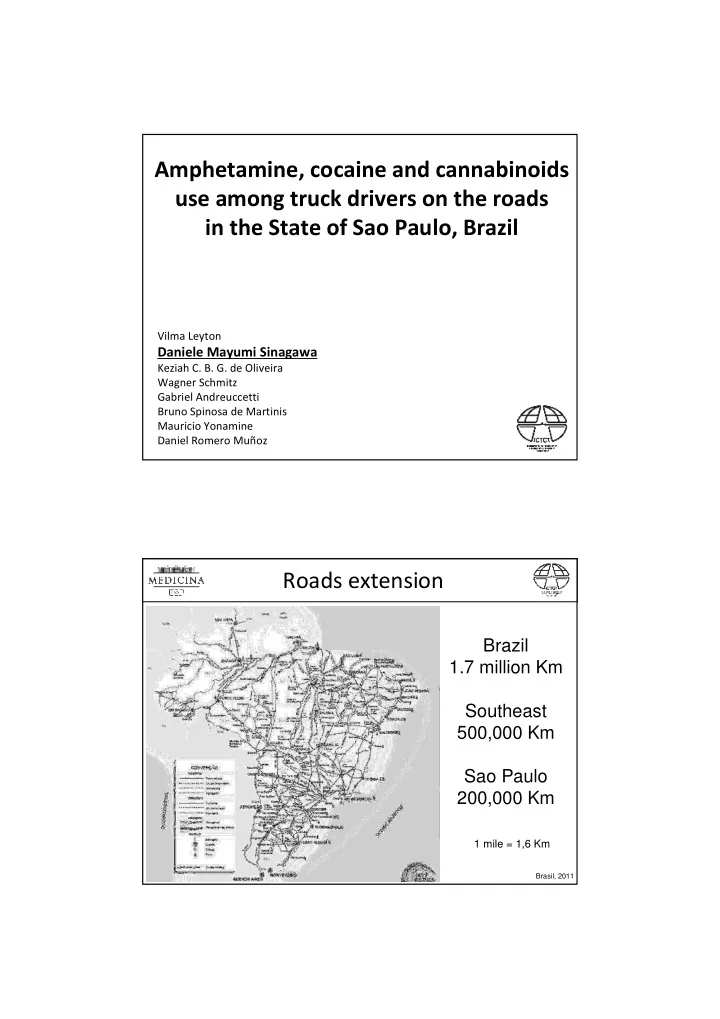
Roads extension

Brazil 1.7 million Km Southeast 500,000 Km Sao Paulo 200,000 Km

1 mile = 1,6 Km

Brasil, 2011

slide-2
SLIDE 2

Roads extension

  • 2,143,467 TRUCKS in Brazil
  • The truck drivers in Brazil often report the drug use to keep

the state of alertness and to be able to accomplish their extensively long journeys

Drugs and driving

  • The more commonly used by truck drivers are:

* Amphetamines * Cocaine * Cannabis

slide-3
SLIDE 3

Drugs and driving

DRIVING involves multiple procedures that are coordinated by our Central Nervous System

Increase the risk

  • f traffic accidents

DEATHS INJURIES 1.3 million 20-50 million ↑ 43,000 160,000

Traffic accidents - per year

slide-4
SLIDE 4

Project

University of Sao Paulo Medical School Department of Federal Highway Police “Health Commands on the Roads”

Aim

The purpose of this study was to demonstrate the prevalence of drug use

(amphetamines, cocaine, cannabinoids)

by truck drivers on the roads of Sao Paulo State, during 2009.

slide-5
SLIDE 5

Itapecerica da Serra Guarulhos Atibaia Roseira Régis Bittencourt Highway Fernão Dias Highway P r e s i d e n t e D u t r a H i g h w a y

Drivers approach

slide-6
SLIDE 6

Activities Samples colletion

Truck drivers who participated of our study: * They were informed about the aim of the study; * Signed the consent term; * Answered to questionnaire informing about their health and work conditions and drug use; * Provided an urine sample.

slide-7
SLIDE 7

Consent Term Questionnaire

slide-8
SLIDE 8

Casuistic

Drivers approach:

  • 488 drivers were approached
  • 456 provided urine samples

Sample collection

slide-9
SLIDE 9

Toxicological analysis

a) SCREENING Multidrogas One Step Teste - INLAB

Toxicological analysis

Examples of positive samples

slide-10
SLIDE 10

Toxicological analysis

b) CONFIRMATION Gas chromatography - mass spectrometry (GC-MS)

Results

  • All of the drivers were male;
  • The mean age was 40 ± 10.8 years;

Positive samples: 42.86% between 25-34 years

  • Health: 29.3% reported having at least one health

problem: diabetes, high blood pressure and/or stress.

slide-11
SLIDE 11

Results

When asked about the use of amphetamines: * 7.5% reported regular consumption (1 to 5 times per week) * 16.6% reported they had already used (at least once during their lifetime) When asked about the purpose of using: * 70% reported “to stay awake”

Drug use

Results of drug detection analysis on truck drivers’ urine samples and distribution of positive cases according to drug groups (n= 456).

slide-12
SLIDE 12

Health problems

Health problems and drug/medicine use reported by truck drivers (n=456).

Purpose

* Produce scientific knowledge about drug use by Brazilian drivers; * Reduce accidents; * Offer public policies related issues for traffic safety.

slide-13
SLIDE 13

Final thoughts

* Driving under influence of drugs is as harmfull as drunk driving; * In Brazil people know a lot about drunk driving but not about other drugs; * Urgent need to regulate which drugs should be investigated; * Training officers on how to detect impaired drivers.

Contact

Thank you for your attention! danimayumi@usp.br