AMPEA: the EERA Joint Programme on Advanced Materials for Energy - - PowerPoint PPT Presentation

ampea the eera joint programme on advanced materials for
SMART_READER_LITE
LIVE PREVIEW

AMPEA: the EERA Joint Programme on Advanced Materials for Energy - - PowerPoint PPT Presentation

AMPEA: the EERA Joint Programme on Advanced Materials for Energy Applications Frdric CHANDEZON (CEA Grenoble) Joint Programme Coordinator The role of advanced materials as enablers in tackling the EU energy challenges Side event, Rome,


slide-1
SLIDE 1

AMPEA: the EERA Joint Programme on Advanced Materials for Energy Applications

www.eera-set.eu
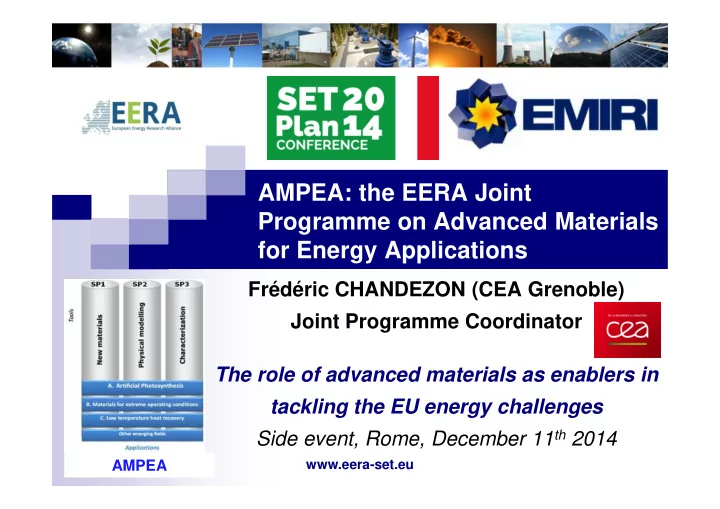
AMPEA

Frédéric CHANDEZON (CEA Grenoble) Joint Programme Coordinator The role of advanced materials as enablers in tackling the EU energy challenges Side event, Rome, December 11th 2014

slide-2
SLIDE 2

EERA: 15 Joint Programmes (JPs)

  • AMPEA
  • Bioenergy
  • Carbon capture and storage
  • Concentrated Solar Power
  • Energy Storage
  • Fuel cells and hydrogen
  • Geothermal
  • Nuclear materials
  • Ocean Energy
  • Photovoltaic
  • Shale gas
  • Smart cities
  • Smart grids
  • Wind energy
  • Societal challenges

150 public research centres Staff approx. 3000 involved Applicative JPs

AMPEA: Advanced Materials and

Processes for Energy Applications →Coordinate and promote multidisciplinary joint research in basic science for energy (materials and processes) →TRL 1 → 4 →Future emerging energy technologies and established

  • nes

(other JPs) where materials issues are involved →15 EU countries, 46

  • rganizations (≈ 540 FTE)

AMPEA within EERA

slide-3
SLIDE 3

Matricial SP structure involving:

  • "Tools" sub-programmes (SPs)

→Generic research areas

  • "Applications" tranversal SPs

→Future emerging energy technologies not (yet) covered by another applicative JP Main challenges: cross-fertilization between "Tools" and "Applications" SPs and with applicative EERA JPs

AMPEA sub-programme structure

slide-4
SLIDE 4

AMPEA v/s other EERA JPs

  • Bioenergy
  • Carbon capture and storage
  • Concentrated Solar Power
  • Energy Storage
  • Fuel cells and hydrogen
  • Geothermal
  • Nuclear materials
  • Ocean Energy
  • Photovoltaic
  • Shale gas
  • Smart cities
  • Smart grids
  • Wind energy
  • Societal challenges

Applicative JPs

Cross-fertilization between "Tools" AMPEA SPs and applicative JPs

slide-5
SLIDE 5

AMPEA and industry

Energy Materials Industrial Research Initiative Managing director: Dr Fabrice Stassin www.emiri.eu

Observer status of EMIRI in AMPEA and AMPEA in EMIRI: → Participation to events of the partner network → Working on a common strategy regarding materials for energy issues → Organization of joint events (e.g. Materials side event at SET Plan 2014) → Joint collaborative actions between members of both organizations

slide-6
SLIDE 6

H2020 / EERA positioning on the TRL scale compared to

  • ther European instruments in the field of energy

TRL scale 1 2 3 4 5 6 7 8 9 ERC FET Open Infrastructures KET : ICT, NMP, Biotechnologies JTI FCH 2 Challenges Energy, Transport, Climate Mobility Marie Curie

KIC Innoenergy

Innovation projects

EERA AMPEA

6

EMIRI

slide-7
SLIDE 7

ENERGY MATERIALS INDUSTRIAL RESEARCH INITIATIVE

Bridging the Innovation Gap

EMIRI Side Event – Presentation of Prof. Dr. Harald BOLT

7

Challenge 1 Advanced Materials for Energy Efficiency Key Component 1 Key Component 2 Key Component 3 Key Component 4 Advanced Materials to increase the energy performance of buildings Advanced Materials to make renewable electricity technologies competitive Advanced Materials to enable energy system integration (energy storage, grids) Advanced Materials enabling the decarbonisation of power sector

Advanced Materials for high performance & durable coatings Advanced Materials for the weight reduction of structural and functional components in wind energy technology Advanced Materials for lower cost, high safety, long cycle life & environmentally- friendly electrochemical batteries Advanced Materials for the affordable implementation of carbon capture & storage Advanced Materials & new deposition processes for building-integrated photovoltaics Advanced Materials to improve the corrosion resistance of structural and functional components in wind energy technology Advanced Materials for lower cost storage

  • f energy in the form of hydrogen,

methane, other molecules (power to gas / chemicals) Advanced Materials for the separation & utilization of CO2 (carbon capture and utilization) Advanced Materials for thermal energy storage Advanced Materials and processes for high yield, large scale manufacturing of solar energy harvesting systems Advanced Materials to facilitate the integration of storage technologies in the electrical grid Advanced Materials and processesfor high efficiency solar energy harvesting

Advanced Materials for a "competitive, efficient, secure, sustainable & flexible energy system" Challenge 2 Advanced Materials as "key enablers" tackling EU Energy Challenges INNOVATION TRACKS (non-exhaustive list)

At least 12 “orientations” (innovation tracks) defined by Industry & Research in EMIRI for H2020

Challenge-oriented In line with industrial realities & needs TRL >=4

slide-8
SLIDE 8

From the lab to the fab: the example of emerging PV technologies

slide-9
SLIDE 9

From the lab to the fab: the example of emerging PV technologies Whatever the technology: efficiency records being held by academias or RTOs then spin-offs or large companies

slide-10
SLIDE 10

Interplay between different TRL levels

→ D. Joly et al., Scientific Reports 4, 4033 (2014)

New organic dyes for dye-sensitized solar cells: from basic science developments towards a building integrated product TRL ≤ 4

slide-11
SLIDE 11

Interplay between different TRL levels

→ D. Joly et al., Scientific Reports 4, 4033 (2014)

New organic dyes for dye-sensitized solar cells: from basic science developments towards a building integrated product

→ RK1 dye-based solar panel included in the 300 m2 solar facade of the Swiss Tech Convention Center (Lausanne) → RK1 dye licensed to Solaronix and on sale

http://shop.solaronix.com/s ensidizer-rk1.html

TRL ≤ 4 TRL > 4

slide-12
SLIDE 12

ENERGY MATERIALS INDUSTRIAL RESEARCH INITIATIVE

Bridging the Innovation Gap

EMIRI Side Event – Presentation of Prof. Dr. Harald BOLT

12

Challenge 1 Advanced Materials for Energy Efficiency Key Component 1 Key Component 2 Key Component 3 Key Component 4 Advanced Materials to increase the energy performance of buildings Advanced Materials to make renewable electricity technologies competitive Advanced Materials to enable energy system integration (energy storage, grids) Advanced Materials enabling the decarbonisation of power sector

Advanced Materials for high performance & durable coatings Advanced Materials for the weight reduction of structural and functional components in wind energy technology Advanced Materials for lower cost, high safety, long cycle life & environmentally- friendly electrochemical batteries Advanced Materials for the affordable implementation of carbon capture & storage Advanced Materials & new deposition processes for building-integrated photovoltaics Advanced Materials to improve the corrosion resistance of structural and functional components in wind energy technology Advanced Materials for lower cost storage

  • f energy in the form of hydrogen,

methane, other molecules (power to gas / chemicals) Advanced Materials for the separation & utilization of CO2 (carbon capture and utilization) Advanced Materials for thermal energy storage Advanced Materials and processes for high yield, large scale manufacturing of solar energy harvesting systems Advanced Materials to facilitate the integration of storage technologies in the electrical grid Advanced Materials and processesfor high efficiency solar energy harvesting

Advanced Materials for a "competitive, efficient, secure, sustainable & flexible energy system" Challenge 2 Advanced Materials as "key enablers" tackling EU Energy Challenges INNOVATION TRACKS (non-exhaustive list)

At least 12 “orientations” (innovation tracks) defined by Industry & Research in EMIRI for H2020

Challenge-oriented In line with industrial realities & needs TRL >=4

slide-13
SLIDE 13

Objectives : Production of solar fuels from solar energy and water or CO2 in direct processes in order to convert solar energy under a chemical form, the solar fuel.

Artificial photosynthesis: an emerging energy technology (TRL < 4) Material Water Sun Fuel: H2

Key point to push this emerging technology towards higher TRLs

slide-14
SLIDE 14

Materials for artificial photosynthesis

Materials are at the core of complex physico-chemical processes thus calling for a multiscale approach combining experiment in theory → 3 main approaches: molecular, bio-inspired and solid state

  • A. Thapper et al., Green 3, 43-57 (2013)
slide-15
SLIDE 15

Conclusions

Materials: a key enabling technology for many energy technologies at different levels in terms

  • f TRLs (mature or emerging)

Calls for a reinforcement of the interaction between the research and the innovation pillars: e.g. EERA-AMPEA and EMIRI Need for funding instruments/calls targetting materials for energy at different TRL levels