ALMA CLOA Improvements and Upgrades Christophe Jacques, Bill - - PowerPoint PPT Presentation

alma cloa improvements and upgrades
SMART_READER_LITE
LIVE PREVIEW

ALMA CLOA Improvements and Upgrades Christophe Jacques, Bill - - PowerPoint PPT Presentation

ALMA CLOA Improvements and Upgrades Christophe Jacques, Bill Shillue, Jason Castro Photonic LO Group 1 ALMA Future Science Development Workshop, 24-25 Aug 2016 Outline Overview of current system performance ALMA 2030 motivation


slide-1
SLIDE 1

1

ALMA Future Science Development Workshop, 24-25 Aug 2016
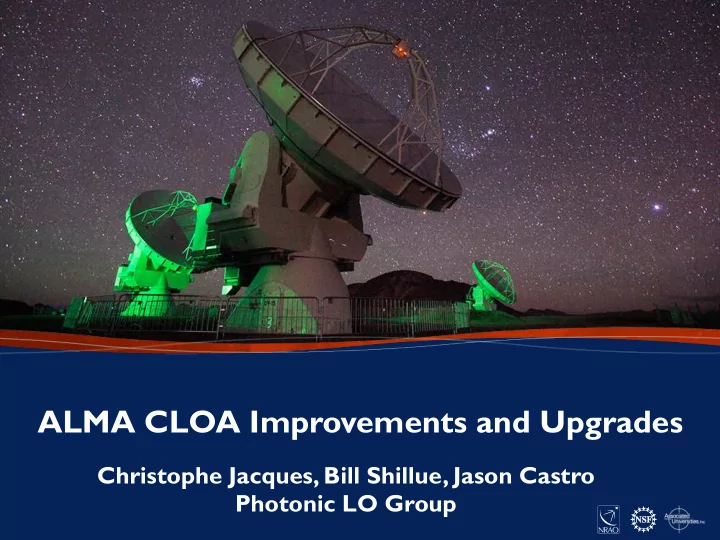
ALMA CLOA Improvements and Upgrades

Christophe Jacques, Bill Shillue, Jason Castro Photonic LO Group

slide-2
SLIDE 2

2

ALMA Future Science Development Workshop, 24-25 Aug 2016

Outline

  • Overview of current system performance
  • ALMA 2030 motivation
  • Phase Drift,

Visibility and Coherence

  • Longer Baselines
  • CLOA 2.0
slide-3
SLIDE 3

3

ALMA Future Science Development Workshop, 24-25 Aug 2016

Current Central LO References for ALMA

AOS Central Bldg

Key

Antenna

Central Reference Generator Correlator Master Laser and Laser Synthesizer Master Frequency Standard LO Photonic Receiver LO Reference Receiver Central Variable Reference Line Length Corrector

10 MHz 125 MHz 13.5—20 GHz

WDM

1556 nm 27-122 GHz 1532 nm, 2 GHz, 125 MHz, 48 msec 5 MHz

WDM

Buried Fiber to Antenna 48 msec

1st LO Offset

20-45 MHz 1st LO PLL ref 2nd LO ref 8-14 GHz comb 2nd, 3rd LO 125 MHz 1st LO ref 27-122 GHz

` Fiber Patch Panel

Electronic Fiber Optic 5 MHz

slide-4
SLIDE 4

4

ALMA Future Science Development Workshop, 24-25 Aug 2016

Current Central LO References for ALMA - 2

  • Tunable LO for all ALMA bands, 27~ 122 GHz, including an

extended Band 1 tuning range of 27~ 39 GHz

  • 1st LO RMS integrated phase noise < 53 fs
  • 1st LO phase drift < 18 fs, over 15 km (w/. active stabilization).
  • < 1 second fast-switching time to any frequency
  • 5 independently tunable SubArrays, expandable to 6
  • For all 66 antennas, can already expand to 80
  • 1 hour reset free operation / 24 hour polarization calibration

stability

1E-15 1E-14 1E-13 1E-12 1E-11 10 100 1000

Phase Structure Function (sec) Tau ¡(Seconds) Measured Phase Expected Phase without Correction LO spec

ALMA LO Phase Drift over 300 seconds

slide-5
SLIDE 5

5

ALMA Future Science Development Workshop, 24-25 Aug 2016

Current Central LO References for ALMA - 3

  • Antenna motion, a 100+ ton structure:

– Azimuth: -275 to + 275 degrees – Elevation: -1.5 to 93.5 degrees – Velocity: 6 deg/sec – Acceleration: 18 deg/sec2

Unprecedented phase stability at each antenna guaranteed vs. temperature, time, fiber length, antenna motion, …

slide-6
SLIDE 6

6

ALMA Future Science Development Workshop, 24-25 Aug 2016

Current Central LO References for ALMA - 4

slide-7
SLIDE 7

7

ALMA Future Science Development Workshop, 24-25 Aug 2016

ALMA 2030 motivation - 1

To enhance current ALMA Science, and allow new study fields:

  • Galactic and Extra-Galactic astronomy, galactic surveys, Solar

Science, mapping, innermost cores of protoplanetary disks, imaging of masers in excited regions, imaging of nearby star- forming disks and star-forming galaxies, astrometry of nearby solar-type stars, …

  • Imaging and molecular spectroscopy of small feature size solar

system objects (~10km at 10 AU): planetary moons, Kuiper Belt

  • bjects.

We need improvements in array sensitivity, resolution, FOV, image quality, and calibration.

slide-8
SLIDE 8

8

ALMA Future Science Development Workshop, 24-25 Aug 2016

ALMA 2030 motivation - 2

  • The existing hardware was not designed to support these science
  • enhancements. It was “delicately crafted” to meet the original

specifications.

  • We should pro-actively identify and study which areas of the

CLOA will require upgrading, and how.

  • …and since the CLOA must operate well past 2030, reliability of

these solutions has to be on par with current system.

slide-9
SLIDE 9

9

ALMA Future Science Development Workshop, 24-25 Aug 2016

Not only to realize the ALMA 2030 vision…

  • The current ALMA array would quickly benefit from these

potential improvements in coherence, phase and calibration stability.

Photonic ¡LO V ¡1.0 Line ¡Length ¡ Correction

  • V. ¡1.0

15 ¡km

Currrent ¡implementation

Photonic ¡LO V ¡2.0 Line ¡Length ¡ Correction

  • V. ¡2.0

n1 ¡km Bidirectional Optical ¡amplifier n2 ¡km

LO ¡ Regeneration

n 3 ¡ k m

Study ¡implementation

slide-10
SLIDE 10

10

ALMA Future Science Development Workshop, 24-25 Aug 2016

Phase Drift, Visibility and Coherence

  • Current 1st LO overall phase noise measured (mm-wave antenna based LO

locked to Laser Synthesizer): < 53 fs for 65~122 GHz

  • Laser Synthesizer PLL corrects phase noise to ~ 0.01 rad (< 27 fs)

During the best months of the year, the quietest time of the day, and the highest

  • bserving bands 8/9/10, is the phase noise & slow phase drift limiting the

instrument, i.e. degrading array visibility ? (temporal delay/phase noise drift variations be smaller than those of the natural environment at least 95% of the time, over 300 s)

slide-11
SLIDE 11

11

ALMA Future Science Development Workshop, 24-25 Aug 2016

Phase Drift, Visibility and Coherence study

What are the areas of potential improvement ?

  • Improve the phase stability of the LS by 10 %, to regain maximum

value at highest frequencies (coherence, resolution)

  • Reduce the LS locking time to enable more frequent LO tunings

(efficiency)

  • Improve band-switching/phase calibration, to reduce/eliminate LS

lock failures

  • Improve antenna-to-antenna phase stability: Line Length

Corrector (bigger impact at shorter wavelengths)

  • Increase the dynamic range of the active phase correction

system, increasing time between calibrations (efficiency)

  • Increase Band 1 CLOA tuning range past 39 GHz
slide-12
SLIDE 12

12

ALMA Future Science Development Workshop, 24-25 Aug 2016

Longer Baselines - 1

  • Multiple sources (ALMA Development Working Group, 2008,

A Roadmap for Developing ALMA, Kameno-san’s presentation, 2013…) conclude that longer baselines (20, 30, 50, …300 km) would allow for improved Galactic, Extra-Galactic science (better resolution, more precise imaging, more accurate astrometry) Ex: a 32 km baseline (~double the current one) would allow an ~ 8 mas resolution @ 230 GHz – think of the HL Tau & SDP81 gravitational lens studies, achieved at 10 km

But …

(in addition to trenching & data transport, pad and antenna costs, snow removal and maintenance)

slide-13
SLIDE 13

13

ALMA Future Science Development Workshop, 24-25 Aug 2016

Longer Baselines -2: Master Laser Coherence

X ¡

> 50 % at 30 km

  • Reliable lock achieved at 22.5 km at the NTC (lab environment)
  • Fringes observed @ 86.2 GHz between an AOS and an OSF antenna, 24 km

baseline (Olguin et al. 2012) This is just about the maximum that can be achieved with the current Master Laser

slide-14
SLIDE 14

14

ALMA Future Science Development Workshop, 24-25 Aug 2016

Longer Baselines study

  • We need to find a laser with much greater coherence -OR-

implement a new correction/regeneration scheme

  • The Line Length Correction needs a greater range (currently 4.5

mm) to be able to correct the much longer path lengths

  • We should look at alternative technologies to stretching fiber, to

achieve greater range and speed, less polarization sensitivity (because of polarization to phase conversion)

Less ¡than ¡0.4 ¡radians ¡SOP ¡change ¡ ¡for ¡540-­‑degree ¡antenna ¡rota9on. ¡ ¡ ¡ SOP ¡change ¡plo<ed ¡against ¡input ¡ polariza9on ¡

slide-15
SLIDE 15

15

ALMA Future Science Development Workshop, 24-25 Aug 2016

Longer Baselines study

  • The Line Length Correction needs greater resolution in the

fringe detector circuit, to 16 bits, to implement a finer fringe count and ultimately allow a “software only” type correction. A 50 km baseline may require it.

  • Direct photonic LO for the longer baseline antennas ? Maybe a

hybrid system ? We propose to provide a roadmap for the technical solutions that need to be implemented before longer baselines are decided upon.

slide-16
SLIDE 16

16

ALMA Future Science Development Workshop, 24-25 Aug 2016

To realize the ALMA 2030 vision…

  • As delivered, the CLOA is a complete, “holistically” designed

system, where each element impacts phase stability, power budget, polarization change … of the entire LO.

  • Increasing the baseline length is NON trivial.
  • The team, having delivered the current state-of-the-art LO, is

“wired” to look for solutions that will integrate into the existing ALMA structure, at the lowest cost.

Photonic ¡LO V ¡1.0 Line ¡Length ¡ Correction

  • V. ¡1.0

15 ¡km

Currrent ¡implementation

Photonic ¡LO V ¡2.0 Line ¡Length ¡ Correction

  • V. ¡2.0

n1 ¡km Bidirectional Optical ¡amplifier n2 ¡km

LO ¡ Regeneration

n3 ¡km

Study ¡implementation

slide-17
SLIDE 17

17

ALMA Future Science Development Workshop, 24-25 Aug 2016

Photonic LO group has a complete CLOA at the NTC

1 x MFS, CRG, CVR, ML, LS, MLD, PRD, LFRD 2 x SAS, LLC, LPR, FOW, WCA, and approx. 75 km of fiber

slide-18
SLIDE 18

18

ALMA Future Science Development Workshop, 24-25 Aug 2016

“Proof-of-Concept” bidirectional EDFA

Er doped fiber bandpass filter LO Signal Output Monintor pump/signal combiner 980 nm pump laser

5/95

Return Signal Input Monitor LO Signal Input Monitor Return Signal Output Monintor

LO Signal (to antenna) Return Signal (from Antenna) 5/95

Allows stable LLC locking to the “equivalent” of a 70 km baseline.

slide-19
SLIDE 19

19

ALMA Future Science Development Workshop, 24-25 Aug 2016

www.nrao.edu science.nrao.edu public.nrao.edu ¡ ¡

The National Radio Astronomy Observatory is a facility of the National Science Foundation

  • perated under cooperative agreement by Associated Universities, Inc.

¡

slide-20
SLIDE 20

20

ALMA Future Science Development Workshop, 24-25 Aug 2016

Current Central LO for ALMA

slide-21
SLIDE 21

21

ALMA Future Science Development Workshop, 24-25 Aug 2016

Elevation wrap Azimuth wrap Buried Fiber Optic Cable, L<15 km Photonic Distribution Master Laser

4 sets of 66 Fibers

Subarray Switch Modules Line Length Corrector Modules Laser Synthesizers

ML ref 1 Set of 66 Fibers

LO Photonic Receiver WCA WCA FRM WCA Band 1 Band 2 Band 9 WCA Band 10 Frequency References

To other Antennas Master Laser (1556 nm) Master + Slave (1556 + 1557 nm) Electronic Signal

slide-22
SLIDE 22

22

ALMA Future Science Development Workshop, 24-25 Aug 2016

Subarray Switch Line Length Corrector LO Photonic Receiver FRM Band 1 Band 10 Frequency Shifter EDFA 1:10 Switch Compensating Fiber LO RCVR LO 1st LO Driver YIG+Active Multiplier Chain and PLL Input from Laser Synthesizers Div by N

Phase Detector Fringe Counter Stretcher Driver MicroControlller

50 MHz Fiber Stretcher

Polarimeter

5 MHz ref PBS 1:6 Switch PC PC “Beatnote ” Det 5% PC l s l

M

FBG WDM 1532 nm

LO Reference Receiver WDM

48 msec

1st LO Offset

20-45 MHz 1st LO PLL ref 2nd LO ref 8-14 GHz comb 2nd, 3rd LO 125 MHz

Compensating Fiber

Round-­‑trip ¡phase ¡correc9on ¡path ¡in ¡red ¡