
SLIDE 1
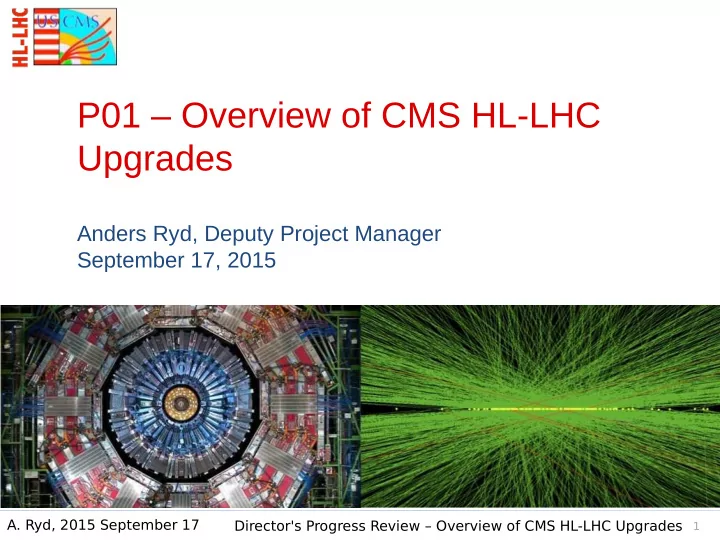
P01 – Overview of CMS HL-LHC Upgrades
Anders Ryd, Deputy Project Manager September 17, 2015
1
Director's Progress Review – Overview of CMS HL-LHC Upgrades
- A. Ryd, 2015 September 17
P01 Overview of CMS HL-LHC Upgrades Anders Ryd, Deputy Project - - PowerPoint PPT Presentation
P01 Overview of CMS HL-LHC Upgrades Anders Ryd, Deputy Project Manager September 17, 2015 A. Ryd, 2015 September 17 Director's Progress Review Overview of CMS HL-LHC Upgrades 1 Outline Overview of CMS HL-LHC Upgrades P5 report
1
Director's Progress Review – Overview of CMS HL-LHC Upgrades
Upgrade Plans
2
Director's Progress Review – Overview of CMS HL-LHC Upgrades
3
Phase-2 U.S. CMS deputy upgrade project manager (2014-present) Pixel online software/DAQ (2005-2010) CMS Run coordinator (2010&2011) Convener of track trigger integration group (2009 and 2012-present) SUSY searches and ttH CLEO-c 2003-2011 Hadronic D-decays and precision tracking
Postdoc, Caltech 1996-2003
BABAR; L3 trigger, offline software coordinator, and rare B-decays
Ph.D. UCSB 1996
CLEO; Semileptonic B-decays and tracking
Director's Progress Review – Overview of CMS HL-LHC Upgrades
4
4
Director's Progress Review – Overview of CMS HL-LHC Upgrades
“Complete the LHC phase-1 upgrades and continue the strong
5
US LHC Phase II Upgrade - Ryd & Tuts
Director's Progress Review – Overview of CMS HL-LHC Upgrades
The main conclusion regarding the LHC phase-2 upgrades
MREFC has a minimum of ~ $140M Will be joint for CMS and ATLAS Provides support for university groups 6
Director's Progress Review – Overview of CMS HL-LHC Upgrades
Evidence for di-Higges Tagging of forward jets (VBF) Searches for new physics,
7
Director's Progress Review – Overview of CMS HL-LHC Upgrades
8
Before the start of the Phase-2 operation the CMS will have
Detector components such as the central trackers were designed
The higher luminosity and the increased pileup (proton-proton
Higher occupancy – larger data volumes Higher radiation Harder to select (trigger) the interesting physics This address these challenges we need more powerful detectors to
Director's Progress Review – Overview of CMS HL-LHC Upgrades
At <PU>=140 same performance as <PU>=50 for phase-1 At <PU>=200 allow moderate degradation
9
Director's Progress Review – Overview of CMS HL-LHC Upgrades
10
Director's Progress Review – Overview of CMS HL-LHC Upgrades
11
Director's Progress Review – Overview of CMS HL-LHC Upgrades
Tracker
Higher granularity to handle occupancy Using CMS B=3.8T field to provide input to L1 trigger for
Extend forward coverage out to η=~4 Reduce material
Endcap calorimeter
Use a high granularity Si sensors with W/Cu absorbers Find segmentation allow 3D shower shape reconstruction
Trigger/DAQ
Increase L1 accept rate to 750 kHz Increase the High Level Trigger (HLT) output rate to 7.5 kHz Incorporate L1 tracking information, combined with
12
Director's Progress Review – Overview of CMS HL-LHC Upgrades
13
Director's Progress Review – Overview of CMS HL-LHC Upgrades
The HL-LHC upgrade address 3 of the 5 science drives identified in
The HL-LHC upgrades for CMS has to address many challenges: High occupancy (Pileup) Large data rates Harsh radiation environment CMS has proposed a series of upgrades to address these challenges Tracker: Higher granularity Selective readout of pT>2 GeV for L1 trigger Forward pixel extension High Granularity Calorimeter 3D reconstruction of electromagnetic and hadronic showers Radiation hardness Trigger/HLT/DAQ Increased bandwidth and both L1 and HLT stages Inclusions of tracking at the first (L1) trigger stage
14
Director's Progress Review – Overview of CMS HL-LHC Upgrades
15
6 Barrel layers and 5 disks (10 and 11 respectively in current tracker) Increase granularity through short strips 2 sensor modules in all layers for trigger readout (form local correlations
Long pixels (1.5 mm) in 3 inner layer modules (PS) for z-coordinate Light module design and mechanics – C02 cooling (-30C) – DC/DC
Alternative design with tilted modules in PS layers under study Reduces material and number of modules (degrades L1 track z res.)
Director's Progress Review – Overview of CMS HL-LHC Upgrades
16
Extend tracking coverage in forward region to η=~3.8 Barrel pixels in 4 layers at radii 3, 7, 11, and 16 cm Forward pixel with 10 disks The optimal layout is still under study Readout at 750 kHz – major challenge at <PU>=200 Serial power likely choice
Director's Progress Review – Overview of CMS HL-LHC Upgrades
17
Tracking performance with <PU>=140 and 200 similar to the phase-1
Tracker provides a powerful handle to mitigate the PU Momentum resolution improved over the phase-1 detector due to
Director's Progress Review – Overview of CMS HL-LHC Upgrades
18
Director's Progress Review – Overview of CMS HL-LHC Upgrades
19
3D shower measurements in HGC Electromagnetic EE (26 x0, 1.5λ): 28 layers of Si-W/Cu absorber Front Hadronic FH (3.5λ): 12 layers of Si-Brass absorber Back Hadronic BH (5λ): 12 layers of Scintilators/Brass
Director's Progress Review – Overview of CMS HL-LHC Upgrades
20
L1Trigger High BW and powerful processing
First layer to match detector information Second layer to produce Trigger objects DAQ Similar event builder, HLT, and storage
HLT Processing power scales as PU times
Director's Progres Review – Overview of CMS HL-LHC Upgrades