Algorithm Design Paradigms Often done recursively Quick sort, - - PDF document

algorithm design paradigms
SMART_READER_LITE
LIVE PREVIEW

Algorithm Design Paradigms Often done recursively Quick sort, - - PDF document

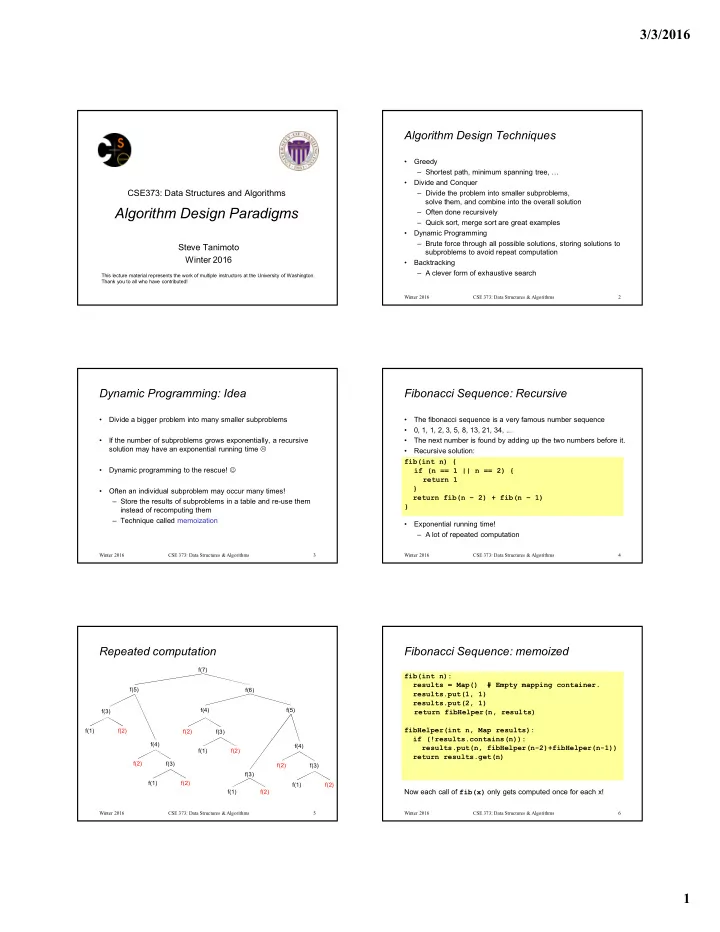
3/3/2016 Algorithm Design Techniques Greedy Shortest path, minimum spanning tree, Divide and Conquer CSE373: Data Structures and Algorithms Divide the problem into smaller subproblems, solve them, and combine into the


slide-1
SLIDE 1

3/3/2016 1

CSE373: Data Structures and Algorithms

Algorithm Design Paradigms

Steve Tanimoto Winter 2016

This lecture material represents the work of multiple instructors at the University of Washington. Thank you to all who have contributed!

Algorithm Design Techniques

  • Greedy

– Shortest path, minimum spanning tree, …

  • Divide and Conquer

– Divide the problem into smaller subproblems, solve them, and combine into the overall solution – Often done recursively – Quick sort, merge sort are great examples

  • Dynamic Programming

– Brute force through all possible solutions, storing solutions to subproblems to avoid repeat computation

  • Backtracking

– A clever form of exhaustive search

Winter 2016 2 CSE 373: Data Structures & Algorithms

Dynamic Programming: Idea

  • Divide a bigger problem into many smaller subproblems
  • If the number of subproblems grows exponentially, a recursive

solution may have an exponential running time 

  • Dynamic programming to the rescue! 
  • Often an individual subproblem may occur many times!

– Store the results of subproblems in a table and re-use them instead of recomputing them – Technique called memoization

Winter 2016 3 CSE 373: Data Structures & Algorithms

Fibonacci Sequence: Recursive

  • The fibonacci sequence is a very famous number sequence
  • 0, 1, 1, 2, 3, 5, 8, 13, 21, 34, ...
  • The next number is found by adding up the two numbers before it.
  • Recursive solution:
  • Exponential running time!

– A lot of repeated computation

Winter 2016 4 CSE 373: Data Structures & Algorithms

fib(int n) { if (n == 1 || n == 2) { return 1 } return fib(n – 2) + fib(n – 1) }

Repeated computation

Winter 2016 5 CSE 373: Data Structures & Algorithms

f(7) f(5) f(3) f(4) f(1) f(2) f(6) f(4) f(5) f(2) f(3) f(3) f(4) f(1) f(2) f(2) f(3) f(1) f(2) f(2) f(3) f(1) f(2) f(1) f(2)

Fibonacci Sequence: memoized

Now each call of fib(x) only gets computed once for each x!

Winter 2016 6 CSE 373: Data Structures & Algorithms

fib(int n): results = Map() # Empty mapping container. results.put(1, 1) results.put(2, 1) return fibHelper(n, results) fibHelper(int n, Map results): if (!results.contains(n)): results.put(n, fibHelper(n-2)+fibHelper(n-1)) return results.get(n)

slide-2
SLIDE 2

3/3/2016 2

7

Comments

  • Dynamic programming relies on working “from the bottom up”

and saving the results of solving simpler problems – These solutions to simpler problems are then used to compute the solution to more complex problems

  • Dynamic programming solutions can often be quite complex

and tricky

  • Dynamic programming is used for optimization problems,

especially ones that would otherwise take exponential time – Only problems that satisfy the principle of optimality are suitable for dynamic programming solutions – i.e. the subsolutions of an optimal solution of the problem are themselves optimal solutions for their subproblems

  • Since exponential time is unacceptable for all but the smallest

problems, dynamic programming is sometimes essential

Winter 2016 CSE 373: Data Structures & Algorithms

Algorithm Design Techniques

  • Greedy

– Shortest path, minimum spanning tree, …

  • Divide and Conquer

– Divide the problem into smaller subproblems, solve them, and combine into the overall solution – Often done recursively – Quick sort, merge sort are great examples

  • Dynamic Programming

– Brute force through all possible solutions, storing solutions to subproblems to avoid repeat computation

  • Backtracking

– A clever form of exhaustive search

Winter 2016 8 CSE 373: Data Structures & Algorithms

  • Backtracking is a technique used to solve problems with a large

search space, by systematically trying and eliminating possibilities.

  • A standard example of backtracking would be going through a maze.

– At some point, you might have two options of which direction to go:

Junction

Portion A

Portion B

Backtracking: Idea

Winter 2016 CSE 373: Data Structures & Algorithms 9

Portion B Portion A One strategy would be to try going through Portion A of the maze. If you get stuck before you find your way out, then you "backtrack" to the junction. At this point in time you know that Portion A will NOT lead you out of the maze, so you then start searching in Portion B

Backtracking

Winter 2016 CSE 373: Data Structures & Algorithms 10

  • Clearly, at a single junction you could

have even more than 2 choices.

  • The backtracking strategy says to try

each choice, one after the other, – if you ever get stuck, "backtrack" to the junction and try the next choice.

  • If you try all choices and never found

a way out, then there IS no solution to the maze. B

C A

Backtracking

Winter 2016 CSE 373: Data Structures & Algorithms 11 12

Backtracking (animation)

start ? ? dead end dead end ? ? dead end dead end ? success! dead end

Winter 2016 CSE 373: Data Structures & Algorithms

slide-3
SLIDE 3

3/3/2016 3

Backtracking

  • Dealing with the maze:

– From your start point, you will iterate through each possible starting move. – From there, you recursively move forward. – If you ever get stuck, the recursion takes you back to where you were, and you try the next possible move.

  • Make sure you don't try too many possibilities,

– Mark which locations in the maze have been visited already so that no location in the maze gets visited twice. – (If a place has already been visited, there is no point in trying to reach the end of the maze from there again.

Winter 2016 CSE 373: Data Structures & Algorithms 13

The neat thing about coding up backtracking is that it can be done recursively, without having to do all the bookkeeping at once. – Instead, the stack of recursive calls does most of the bookkeeping – (i.e., keeps track of which locations we’ve tried so far.)

Backtracking

Winter 2016 CSE 373: Data Structures & Algorithms 14

  • Find an arrangement of 8 queens on a

single chess board such that no two queens are attacking one another.

  • In chess, queens can move all the way

down any row, column or diagonal (so long as no pieces are in the way). – Due to the first two restrictions, it's clear that each row and column of the board will have exactly one queen.

Backtracking: The 8 queens problem

Winter 2016 CSE 373: Data Structures & Algorithms 15

The backtracking strategy is as follows: 1) Place a queen on the first available square in row 1. 2) Move onto the next row, placing a queen on the first available square there (that doesn't conflict with the previously placed queens). 3) Continue in this fashion until either: a) You have solved the problem, or b) You get stuck. When you get stuck, remove the queens that got you there, until you get to a row where there is another valid square to try. Animated Example: http://www.hbmeyer.de/backt rack/achtdamen/eight.htm#u p

Q Q Q Q Q Q Continue…

Backtracking

Winter 2016 CSE 373: Data Structures & Algorithms 16

  • Another possible brute-force algorithm is generate all possible

permutations of the numbers 1 through 8 (there are 8! = 40,320), – Use the elements of each permutation as possible positions in which to place a queen on each row. – Reject those boards with diagonal attacking positions.

  • The backtracking algorithm does a bit better

– constructs the search tree by considering one row of the board at a time, eliminating most non-solution board positions at a very early stage in their construction. – because it rejects row and diagonal attacks even on incomplete boards, it examines only 15,720 possible queen placements.

  • 15,720 is still a lot of possibilities to consider

– Sometimes we have no other choice but to do the best we can 

Backtracking – 8 queens Analysis

Winter 2016 CSE 373: Data Structures & Algorithms 17

Algorithm Design Techniques

  • Greedy

– Shortest path, minimum spanning tree, …

  • Divide and Conquer

– Divide the problem into smaller subproblems, solve them, and combine into the overall solution – Often done recursively – Quick sort, merge sort are great examples

  • Dynamic Programming

– Brute force through all possible solutions, storing solutions to subproblems to avoid repeat computation

  • Backtracking

– A clever form of exhaustive search

Winter 2016 18 CSE 373: Data Structures & Algorithms