paradigms why study paradigms Concerns how can an interactive - - PDF document

paradigms
SMART_READER_LITE
LIVE PREVIEW

paradigms why study paradigms Concerns how can an interactive - - PDF document

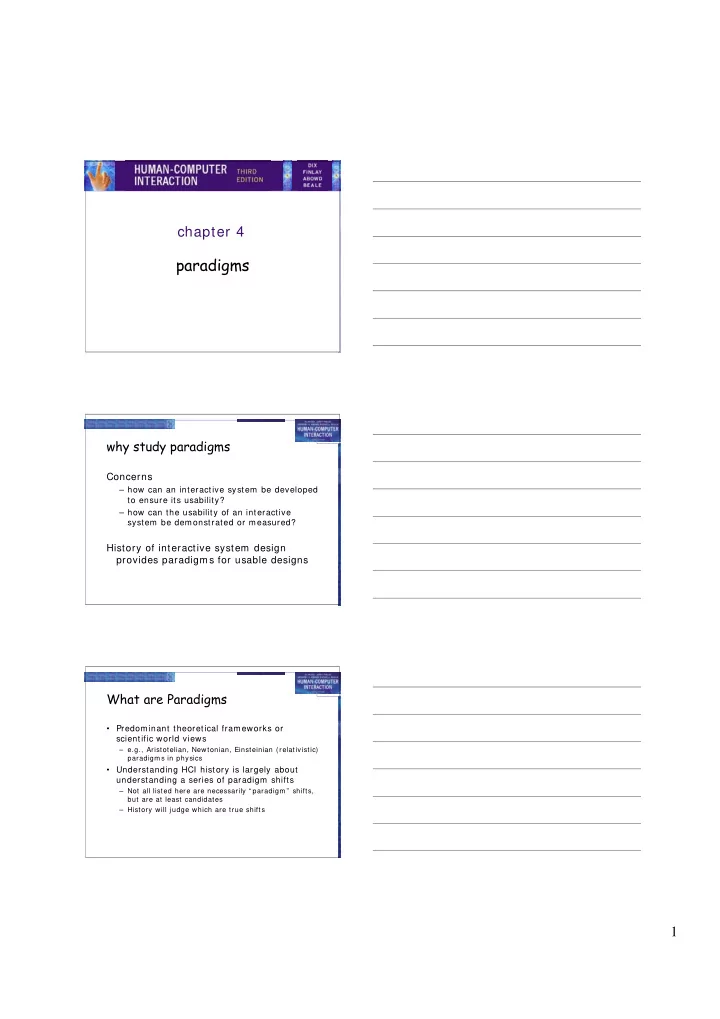
chapter 4 paradigms why study paradigms Concerns how can an interactive system be developed to ensure its usability? how can the usability of an interactive system be demonstrated or measured? History of interactive system design


slide-1
SLIDE 1

1 chapter 4

paradigms

why study paradigms

Concerns

– how can an interactive system be developed to ensure its usability? – how can the usability of an interactive system be demonstrated or measured?

History of interactive system design provides paradigms for usable designs

What are Paradigms

  • Predominant theoretical frameworks or

scientific world views

– e.g., Aristotelian, Newtonian, Einsteinian ( relativistic) paradigm s in physics

  • Understanding HCI history is largely about

understanding a series of paradigm shifts

– Not all listed here are necessarily “ paradigm ” shifts, but are at least candidates – History will judge which are true shifts

slide-2
SLIDE 2

2

Paradigms of interaction

New computing technologies arrive, creating a new perception of the human—computer relationship. We can trace some of these shifts in the history of interactive technologies.

The initial paradigm

  • Batch processing

Impersonal computing

Example Paradigm Shifts

  • Batch processing
  • Time-sharing

Interactive computing

slide-3
SLIDE 3

3

Example Paradigm Shifts

  • Batch processing
  • Timesharing
  • Networking

??? @#$% !

Community computing

Example Paradigm Shifts

  • Batch processing
  • Timesharing
  • Networking
  • Graphical displays

% foo.bar ABORT dumby!!!

C…P… filename dot star… or was it R…M? Move this file here, and copy this to there.

Direct manipulation

Example Paradigm Shifts

  • Batch processing
  • Timesharing
  • Networking
  • Graphical display
  • Microprocessor

Personal computing

slide-4
SLIDE 4

4

Example Paradigm Shifts

  • Batch processing
  • Timesharing
  • Networking
  • Graphical display
  • Microprocessor
  • WWW

Global information

Example Paradigm Shifts

  • A sym biosis of physical

and electronic worlds in service of everyday activities.

  • Batch processing
  • Timesharing
  • Networking
  • Graphical display
  • Microprocessor
  • WWW
  • Ubiquitous

Computing

Time-sharing

  • 1940s and 1950s – explosive technological

growth

  • 1960s – need to channel the power
  • J.C.R. Licklider at ARPA
  • single com puter supporting m ultiple users
slide-5
SLIDE 5

5

Video Display Units

  • m ore suitable medium than paper
  • 1962 – Sutherland's Sketchpad
  • computers for visualizing and manipulating

data

  • one person's contribution could drastically

change the history of com puting

Programming toolkits

  • Engelbart at Stanford Research Institute
  • 1963 – augmenting man's intellect
  • 1968 NLS/ Augment system demonstration
  • the right program m ing toolkit provides

building blocks to producing complex interactive system s

Personal computing

  • 1970s – Papert's LOGO language for simple

graphics programming by children

  • A system is m ore powerful as it becom es

easier to user

  • Future of computing in small, powerful

machines dedicated to the individual

  • Kay at Xerox PARC – the Dynabook as the

ultim ate personal com puter

slide-6
SLIDE 6

6

Window systems and the WIMP interface

  • humans can pursue more than one task at a

tim e

  • windows used for dialogue partitioning, to

“change the topic”

  • 1981 – Xerox Star first commercial windowing

system

  • windows, icons, menus and pointers now

fam iliar interaction m echanism s

Metaphor

  • relating computing to other real-world activity

is effective teaching technique

– LOGO's turtle dragging its tail – file m anagem ent on an office desktop – word processing as typing – financial analysis on spreadsheets – virtual reality – user inside the m etaphor

  • Problem s

– som e tasks do not fit into a given m etaphor – cultural bias

Direct manipulation

  • 1982 – Shneiderman describes appeal of

graphically-based interaction

– visibility of objects – increm ental action and rapid feedback – reversibility encourages exploration – syntactic correctness of all actions – replace language with action

  • 1984 – Apple Macintosh
  • the model-world metaphor
  • What You See Is What You Get (WYSIWYG)
slide-7
SLIDE 7

7

Language versus Action

  • actions do not always speak louder than

words!

  • DM – interface replaces underlying

system

  • language paradigm
  • interface as mediator
  • interface acts as intelligent agent
  • programming by example is both action

and language

Hypertext

  • 1945 – Vannevar Bush and the memex
  • key to success in managing explosion of

inform ation

  • m id 1960s – Nelson describes hypertext as

non-linear browsing structure

  • hypermedia and multimedia
  • Nelson's Xanadu project still a dream today

Multimodality

  • a mode is a human communication

channel

  • emphasis on simultaneous use of

multiple channels for input and output

slide-8
SLIDE 8

8

Computer Supported Cooperative Work (CSCW)

  • CSCW removes bias of single user /

single computer system

  • Can no longer neglect the social aspects
  • Electronic mail is most prominent

success

The World Wide Web

  • Hypertext, as originally realized, was a

closed system

  • Simple, universal protocols (e.g. HTTP)

and mark-up languages (e.g. HTML) made publishing and accessing easy

  • Critical mass of users lead to a

complete transformation of our information economy.

Agent-based Interfaces

  • Original interfaces

– Com m ands given to com puter – Language-based

  • Direct Manipulation/ WIMP

– Com m ands perform ed on “ world” representation – Action based

  • Agents - return to language by instilling

proactivity and “intelligence” in com m and processor

– Avatars, natural language processing

slide-9
SLIDE 9

9

Ubiquitous Computing

“The most profound technologies are those that disappear.” Mark Weiser, 1991 Late 1980’s: computer was very apparent How to make it disappear?

– Shrink and em bed/ distribute it in the physical world – Design interactions that don’t dem and our intention

Sensor-based and Context- aware Interaction

  • Humans are good at recognizing the

“context” of a situation and reacting appropriately

  • Automatically sensing physical

phenomena (e.g., light, temp, location, identity) becoming easier

  • How can we go from sensed physical

measures to interactions that behave as if made “aware” of the surroundings?