Aldo sterone Receptor Blockade in D iastolic H eart F ailure The - - PowerPoint PPT Presentation

aldo sterone receptor blockade in d iastolic h eart f
SMART_READER_LITE
LIVE PREVIEW

Aldo sterone Receptor Blockade in D iastolic H eart F ailure The - - PowerPoint PPT Presentation

ESC Munich, Aug 26, 2012 Hot Line I Press Conference Aldo sterone Receptor Blockade in D iastolic H eart F ailure The Aldo-DHF Trial Frank Edelmann, M.D., Rolf Wachter, M.D., Albrecht Schmidt, M.D., Elisabeth Kraigher- Krainer,M.D., Caterina


slide-1
SLIDE 1

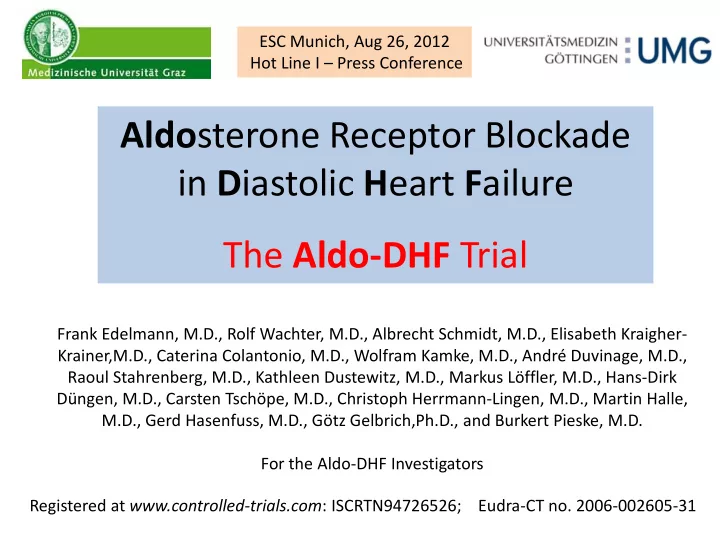
Aldosterone Receptor Blockade in Diastolic Heart Failure The Aldo-DHF Trial

Frank Edelmann, M.D., Rolf Wachter, M.D., Albrecht Schmidt, M.D., Elisabeth Kraigher- Krainer,M.D., Caterina Colantonio, M.D., Wolfram Kamke, M.D., André Duvinage, M.D., Raoul Stahrenberg, M.D., Kathleen Dustewitz, M.D., Markus Löffler, M.D., Hans-Dirk Düngen, M.D., Carsten Tschöpe, M.D., Christoph Herrmann-Lingen, M.D., Martin Halle, M.D., Gerd Hasenfuss, M.D., Götz Gelbrich,Ph.D., and Burkert Pieske, M.D. For the Aldo-DHF Investigators Registered at www.controlled-trials.com: ISCRTN94726526; Eudra-CT no. 2006-002605-31 ESC Munich, Aug 26, 2012 Hot Line I – Press Conference

slide-2
SLIDE 2

Disclosures

No disclosures related to this trial. The trial was funded after peer review by the German Federal Ministry of Education and Research within the Clinical Trials program (Grant No. 01GI0205) The Sponsor of the Trial according to German Drug Law was the University of Göttingen, Germany

slide-3
SLIDE 3

Background

Diastolic Heart Failure (DHF, or Heart Failure with Preserved Ejection Fraction) accounts for over 50% of all heart failure cases. Clinical outcomes are poor in DHF, but no established therapy exists. Aldosterone has been implicated in the pathogenesis of DHF via aldosterone receptor mediated myocardial fibrosis, hypertrophy, and vascular stiffening.

Aldo-DHF was designed to test the efficacy and safety

  • f the aldosterone receptor antagonist Spironolactone

in patients with diastolic heart failure.

slide-4
SLIDE 4

Aldo-DHF Study Design

  • Multicenter, randomised, placebo-controlled double-blind, two-

armed parallel-group study

  • Hypothesis: Spironolactone (25 mg) improves cardiac (diastolic)

function and exercise capacity as compared to placebo after 1 year

  • f therapy
  • Co-Primary endpoints: E/é (echo tissue Doppler derived estimate of

filling pressure) and maximal exercise capacity (peak VO2 on bicycle spiroergometry)

  • Key inclusion criteria: Signs/symptoms of heart failure, EF≥50%,

evidence of diastolic dysfunction, peak VO2 <25ml/kg/min

  • 422 patients were randomised to Spironolactone or Placebo
slide-5
SLIDE 5

Change in E/e‘ 1

  • 1

Baseline 6 months 12 months

p < 0.001 p < 0.001

Placebo Spironolactone Time since randomisation

Co-Primary endpoints

Change in peak VO2 Baseline 6 months 12 months 0.5

  • 0.5

p = 0.57 p = 0.81

Placebo Spironolactone 1

E/é peak VO2

slide-6
SLIDE 6

Secondary endpoints

Change in LVMI (g/m2)

  • 5
  • 10

Baseline 6 months 12 months Placebo Spironolactone

p = 0.16 p = 0.009

Change in Log10 NT-proBNP (ng/L)

  • 0.05
  • 0.15

Baseline 6 months 12 months 0.05

  • 0.10

p = 0.09 p = 0.03

Placebo Spironolactone Time since randomisation

Left ventricular mass index NT-proBNP

slide-7
SLIDE 7

Adverse Events (n,%) Placebo (n=209) Spironolactone (n=213) P-value

Deaths 0 (0) 1 (<1) 1·00 Hospitalisation 50 (24) 60 (28) 0·38 Cardiac 15 (7) 21 (10) 0·38 Non-cardiac 37 (18) 47 (22) 0·27 New/worsening edema 44 (21) 35 (16) 0·26 Worsening renal function 43 (21) 77 (36) <0·001 eGFR <30 mL/min/1·73m2 at last visit 1 (<1) 3 (1) 0·62 New/worsening anaemia 18 (9) 34 (16) 0·03 Gynaecomastia 1 (<1) 9 (4) 0·02 Serum potassium ever increased >5·0 mmol/L 22 (11) 44 (21) 0·005 ever increased >5·5 mmol/L 3 (1) 4 (2) 1·00

Safety endpoints: Adverse events

slide-8
SLIDE 8

Summary and Conclusions

  • 1. Aldo-DHF is the largest mechanistic Phase IIb trial in DHF
  • 2. Spironolactone (25mg/d) improved diastolic function (E/é),

induced structural reverse remodelling (LVMI), and reduced neuroendocrine activation (NT-proBNP)

  • 3. Spironolactone did not improve exercise capacity , NYHA class,
  • r quality of life
  • 4. Spironolactone reduced blood pressure; effects on cardiac

structure and function remained significant after adjusting for blood pressure changes

  • 5. Spironolactone was safe and not associated with severe

adverse events

  • 6. Spironolactone can be considered in patients with diastolic

heart failure for improving cardiac function and blood pressure control