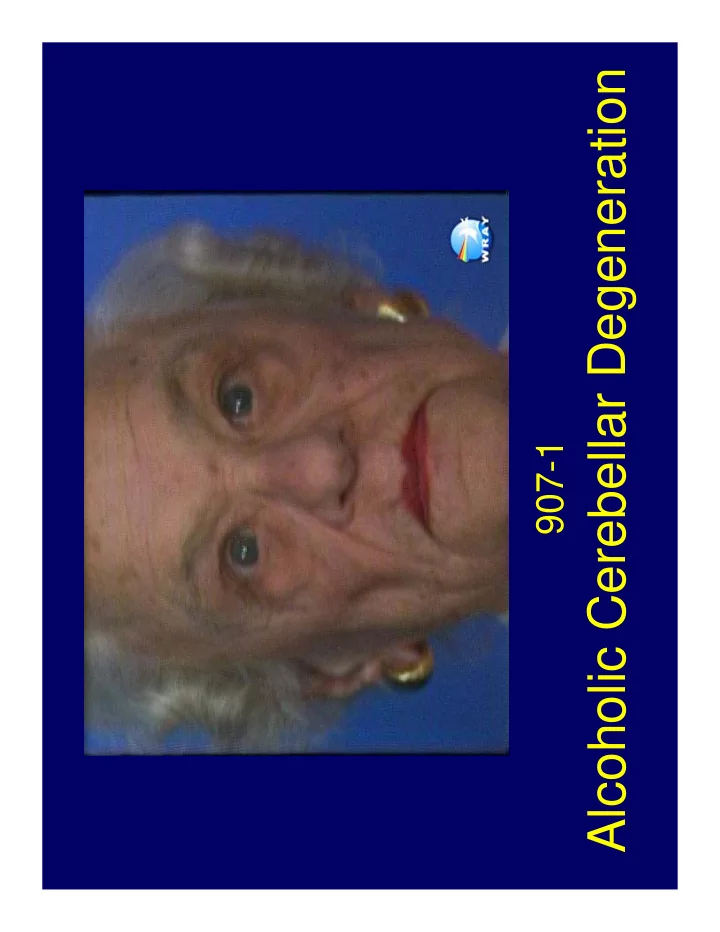
Alcoholic Cerebellar Degeneration 907-1 Clinical Syndrome The - - PDF document

alcoholic cerebellar degeneration
SMART_READER_LITE
LIVE PREVIEW

Alcoholic Cerebellar Degeneration 907-1 Clinical Syndrome The - - PDF document

Alcoholic Cerebellar Degeneration 907-1 Clinical Syndrome The clinical syndrome of alcoholic cerebellar degeneration is remarkably stereotyped. The usual presentation, as in this patient, is a progressive unsteadiness in walking evolving


slide-1
SLIDE 1

Alcoholic Cerebellar Degeneration

907-1

slide-2
SLIDE 2

Clinical Syndrome

The clinical syndrome of alcoholic cerebellar degeneration is remarkably

  • stereotyped. The usual presentation, as in

this patient, is a progressive unsteadiness in walking evolving over months and years.

slide-3
SLIDE 3

Clinical Syndrome

The cerebellar syndrome predominantly affects stance, eye movements, and gait, sometimes with trunkal ataxia and

  • titubation. Dysarthria and upper limb

ataxia are rare.

slide-4
SLIDE 4

Pathophysiology

Ataxia may develop during periods of abstinence. Identical cerebellar degeneration has been

  • bserved in non-alcoholic patients with

severe malnutrition.

slide-5
SLIDE 5

Eye Movements

Square Wave Jerks Horizontal Saccadic Hypermetria Horizontal Gaze Evoked Nystagmus Saccadic Pursuit

slide-6
SLIDE 6

Deficits Caused by Lesions of Dorsal Vermis, Fastigial Nucleus, and Uncinate Fasciculus

Box 12-4. Leigh RJ, Zee DS. The Neurology of Eye Movements 4th Edition. Oxford University Press, New York 2006 with permission.

slide-7
SLIDE 7

Pathological Changes

Selective atrophy of the anterior and superior parts of the cerebellar vermis Involvement of the cerebellar hemispheres less extensive Loss of neurons in the cerebellum involves all types but Purkinje’s cells are the most seriously affected

slide-8
SLIDE 8

MRI

Figure 1: Sagittal

T1WI shows striking atrophy

  • f the superior

vermis.

slide-9
SLIDE 9

MRI Findings

Figure 2: Axial T2WI through the upper midbrain and vermis shows the cerebellar folia are thinned and the CSF spaces increased.

Courtesy Anne Osborn, M.D

slide-10
SLIDE 10

http://library.med.utah.edu/NOVEL