UNIT PERMANENTE ANTICORRUPTION (ANTI-CORRUPTION SQUAD) PRVENIR | - - PowerPoint PPT Presentation

unit permanente anticorruption
SMART_READER_LITE
LIVE PREVIEW

UNIT PERMANENTE ANTICORRUPTION (ANTI-CORRUPTION SQUAD) PRVENIR | - - PowerPoint PPT Presentation

UNIT PERMANENTE ANTICORRUPTION (ANTI-CORRUPTION SQUAD) PRVENIR | VRIFIER | ENQUTER PROCUREMENT, INTEGRITY, MANAGEMENT AND OPENESS FORUM KIEV, MAY 23rd, 2017 OUTLINE OF THE PRESENTATION o Creation of UPAC o History o Why fight


slide-1
SLIDE 1

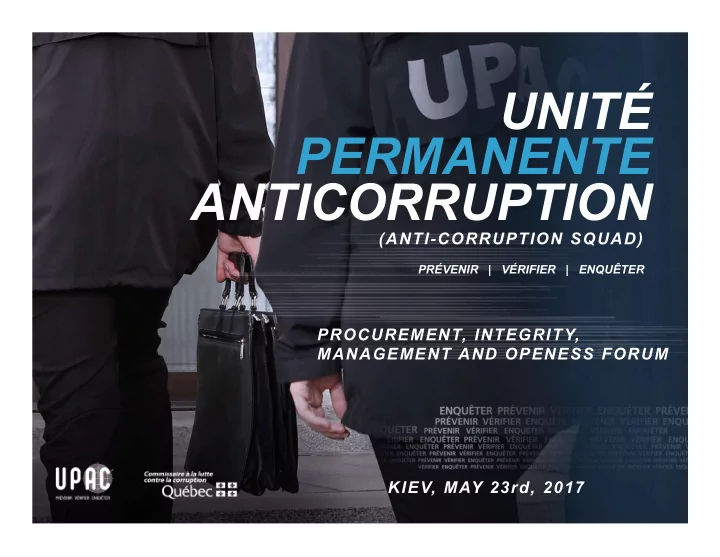
PRÉVENIR | VÉRIFIER | ENQUÊTER

KIEV, MAY 23rd, 2017 PROCUREMENT, INTEGRITY, MANAGEMENT AND OPENESS FORUM

UNITÉ PERMANENTE ANTICORRUPTION

(ANTI-CORRUPTION SQUAD)
slide-2
SLIDE 2

OUTLINE OF THE PRESENTATION

  • Creation of UPAC
  • History
  • Why fight corruption
  • UPAC: status, structure and characteristics
  • Our work and methods
  • Investigation and common infractions
  • UPAC’s results
  • Educating the public
  • Conclusion and challenges
slide-3
SLIDE 3

THE CREATION OF UPAC

UPAC was created February 11th, 2011, and is a powerful tool in the fight against corruption in all its forms, including:

  • Fraud
  • Malfeasance
  • Collusion
  • Breach of trust
  • Influence peddling of officials (municipal or provincial)
  • Bribes, kickbacks, favours, commissions or tips to an

elected official… or to a member of a public

  • rganization
slide-4
SLIDE 4

HISTORY OF ANTI-CORRUPTION INITIATIVES

  • October 2009: Creation of Escouade Marteau
  • A team of investigators from different police squads, Competition

Bureau of Canada and Quebec Revenue agency was created to lead investigations, notably in the construction industry.

  • January 2010: Fact-finding mission to the Department of Investigation

(DOI) in New York.

  • With over 100 years of corruption detection experience, the DOI

inspired the creation and the structure of UPAC. We grouping expertises to prevent, audit and investigate.

  • February 2010: Creation of the Unité anticollusion (UAC)
  • A team of investigators was assembled to detect collusion

stratagems within the Ministère des Transports (investments of more than 4,7 billions $ (CAD) in public contracts for 2016-2017).

slide-5
SLIDE 5

HISTORY OF ANTI-CORRUPTION INITIATIVES (cont’d)

  • February 2011: Announcement of the creation of the Unité permanente

anticorruption (UPAC)

  • Quebec adopts an effective anti-corruption tool inspired by the New York model.
  • March 2011: Robert Lafrenière is appointed as first anti-corruption commissioner
  • May 2011: Creation of the Bureau de lutte à la corruption et à la malversation

(BLCM)

  • This initiative led to the creation of 20 prosecutors positions dedicated to UPAC’s

cases.

  • June 2011: Unanimous adoption of Bill 15 – Anti-Corruption Act
  • regarding the fight against corruption.
  • October 2011: Announcement of the upcoming board of inquiry on the construction

industry

  • presided by the Honourable Justice France Charbonneau. Ended in 2015 with 60

recommendations to the government.

slide-6
SLIDE 6

WHY FIGHT AGAINST CORRUPTION?

  • To promote healthy competition in the markets.
  • To generate investment.
  • To ensure sound management of public funds.
  • To improve the atmosphere on public procurement.
  • Obvious public concern regarding this phenomenon, and a

willingness to take actions to protect public funds.

slide-7
SLIDE 7

UPAC’S PERMANENT STATUS

The advantages of UPAC’s permanent status:

  • Continuously monitor how stratagems evolve
  • Develop unique expertise
  • Maintain constant pressure on criminal elements
  • Prevent wrongdoings in a consistent manner
  • Carry out operations on a permanent basis
  • Share information and knowledge
  • Ensure the sustainability of financial resources
slide-8
SLIDE 8

BUDGET AND STAFF

  • 2011: $31M – 200 EMPLOYEES
  • 2017: $48M – 320 EMPLOYEES
  • Anti-Corruption Commissioner (UPAC): 95 employees
  • Police organizations: 125 employees
  • Quebec Revenue Agency (RQ): 40 employees
  • Building authority of Quebec (RBQ): 4 employees
  • Quebec Construction Commission (CCQ): 7 employees
  • Ministry of Municipal Affairs (MAMOT): 13 employees
  • Director of Criminal and Penal Prosecutions (DPCP)
  • Office of Crime and Special Issues : 40 employees
slide-9
SLIDE 9

STRUCTURE ANTI-CORRUPTION COMMISSIONER

Associate Commissioner

  • f Audits - Corporate

Integrity Audit Service Associate Commissioner

  • f Audits -

Administration and Human Resources

Operations / investigations

slide-10
SLIDE 10

OUR WORK

  • Carrying out investigations – Criminal Code, and penal and fiscal

law.

  • Completing administrative audits of municipalities, licensed

contractors and construction sites.

  • Insure integrity of business that wish to be awarded public

contracts.

  • Advocating prevention – Educating people so they can avoid falling

victim to corruption.

slide-11
SLIDE 11

Penal Investigations Tax-related offences Unlicensed contractors Audits & Inspections Undeclared work

  • Construction

sites Reprisals False statements – authorization application Audits of municipal contracts Business Integrity Treatment – authorization application Audits of Background checks businesses Criminal Investigations Corruption Breach of trust Influence peddling Fraud Collusion Advisory opinions

Prevention & education Public office holders Recommendations to government

slide-12
SLIDE 12

OUR METHODS

  • Investigation
  • Punitive component – Acts on the past
  • Audit
  • Compliance component – Acts on the present
  • Prevention
  • Educational component – Acts on the future
slide-13
SLIDE 13

INVESTIGATING CORRUPTION

  • Corruption-related crimes leave very few or no physical traces
  • r concrete evidence.
  • Corruption takes a variety of forms and spreads by various

means: collusion, bribes, transactions made under the table or behind closed doors, document forgery, invoice falsification, etc.

  • The documents to be studied and the electronic data collected

require an enormous amount of analysis, as in the Faubourg Contrecœur case, for example, where 250 terabytes of electronic data were seized.

slide-14
SLIDE 14

COMMON INFRACTIONS RELATED TO CRIMINAL CODE

  • Act. 121: Frauds on the government
  • Acts of corruption commited by officials and

persons dealing with the government.

  • Act. 122: Breach of trust by public officer
  • Use of one’s public office for a dishonest,

partial corrupt or oppressive purpose.

  • Art. 123: Municipal corruption
  • Bribe to municipal official as consideration

for the official to perform of fail to perform his duty.

slide-15
SLIDE 15

COMMON INFRACTIONS RELATED TO CRIMINAL CODE

(cont’d)

  • Art.366: Forgery and Offences Resembling Forgery
  • Confection of false documents
  • Art.380: Fraud
  • Someone who, by deceit, falsehood or other

fraudulent means defrauds the public or any person of any property, money or any service.

  • Art.467.11-12-13: Gangster
  • Incite or commit a criminal act in a criminal
  • rganization
slide-16
SLIDE 16

RESULTS

SINCE 2011

  • Prevention:
  • 24,000 public office holders made aware of corruption

issues.

  • Mandatory program on managing collusion and corruption

risks (Treasury Board directive).

  • Audits:
  • 56 audits of municipal contracting management processes
  • 3,202 business files audited
  • 439 compliance audits under Bill R-20 at the Turcot site, a

major road reconstruction project of more than 3,67 billions $ (CAD).

slide-17
SLIDE 17

RESULTS

TURCOT SITE

slide-18
SLIDE 18

RESULTS

(cont’d)

SINCE 2011

  • Investigations:
  • 171 arrests
  • 73 convictions (40 criminal and 33 penal)
  • 2 mayors of two of the largest cities in Quebec
  • 28 convictions for tax evasion (17 people and 11

companies.

  • Recommendations to the government:
  • Recommendations filed during the commission of

inquiry into the construction industry;

  • Recommendations issued on management of public

contracting in informatics.

slide-19
SLIDE 19

EDUCATING THE PUBLIC

  • Corruption prevention and collusion detection is a new branch

that was introduced when UPAC was created.

  • Our team has met with more than 24,000 people who work in

the public sector and are connected to the awarding of public contracts.

  • The goal of prevention is to make people more aware of the

potential for corruption in their sector of activity.

  • Fighting corruption has its benefits, but our focus is prevention

in order to work pre-emptively and prevent wrongdoing.

slide-20
SLIDE 20

RISK MANAGEMENT: OUR NEW FOCUS

Divided into four stages:

  • Creation of an organizational risk

management framework

  • Production of a risk management plan
  • Accountability
  • Update of the organizational framework
slide-21
SLIDE 21

CONCLUSIONS AND CHALLENGES

Strategies for fighting corruption and collusion

  • Active approach:
  • Have a database allowing cross-connection of stratagems to forestall

corruption and collusion.

  • Sufficient resources:
  • Over 100 police officers full time
  • 320 employees
  • Team of specialized counsel
  • Budget of $48M (CAD)
  • Treat corruption as a specific field of investigation:
  • as with serious crimes and organized crime
  • do not confine corruption to economic crime, for example
slide-22
SLIDE 22

CONCLUSIONS AND CHALLENGES

(cont’d) Challenges:

  • Cases before the courts:
  • challenges arising from the Jordan case (deadlines, preparation of

evidence)

  • Disclosure of evidence when charges are laid
  • Prevention: obligation for departments and agencies to adopt a program

for managing collusion and corruption risks.

  • Implementation of the recommendations of the Commission of inquiry

(Charbonneau):

  • creation of the Public Contracting Authority (PL-108)
  • more inspection powers when awarding contracts
slide-23
SLIDE 23

QUESTIONS?

slide-24
SLIDE 24
slide-25
SLIDE 25
slide-26
SLIDE 26

ELECTRONIC TENDERING SYSTEM (SEAO)

  • The official tendering web site of the Government of Quebec

since June 2004.

  • Provides access to government contracting opportunities

coming from most of Quebec public agencies.

  • Government of Quebec
  • Municipal market
  • Education network
  • Health and social services network
slide-27
SLIDE 27

ELECTRONIC TENDERING SYSTEM (SEAO)

(cont’d)

  • These public agencies have to use SEAO to publish their

notices, distribute their tender documents and publish information on their contracts.

  • Other agencies may also use SEAO, such as business or

industry-oriented public corporations, non-profit organizations, and other private business enterprises.

  • Suppliers interested in government procurement can use the

site to view published notices and purchase tender documents when they are distributed by SEAO.

slide-28
SLIDE 28

COMPANIES ON THE BLACKLIST

  • Companies must be authorized to bid on public contract
  • 5 million $ (CDN) for construction contracts and

subcontracts.

  • 1 million $ (CDN) for service contracts and

subcontracts.

  • UPAC conduct business Integrity Audits
  • UPAC use Public Procurement Integrity Act to

conduct these audits.

  • UPAC work in collaboration with the financial market

regulation authority (AMF).

slide-29
SLIDE 29

COMPANIES ON THE BLACKLIST

(cont’d)

  • Procurement Integrity Act aims to promote:
  • Public confidence in public procurement.
  • Transparency in contractual processes
  • Accountability.
  • The fair and equitable treatment of

competitors.

slide-30
SLIDE 30

COMPANIES ON THE BLACKLIST

(cont’d) Enterprise AMF UPAC Register of ineligible enterprises (RENA) Register of eligible enterprises (REA)

slide-31
SLIDE 31

COMPANIES ON THE BLACKLIST

(cont’d)

  • Register of eligible enterprises (REA)
  • The autorisation is valid for 3 years.
  • Renewable, following the same analysis as the

initial.

  • Authority to withdraw authorization if the situation

changes.

  • Register of ineligible enterprises (RENA)
  • On the blacklist for 5 years.
  • The company can’t do business with the

government.