ALA Forum 2016 Community based adult learning, health and wellbeing - - PowerPoint PPT Presentation

ala forum 2016
SMART_READER_LITE
LIVE PREVIEW

ALA Forum 2016 Community based adult learning, health and wellbeing - - PowerPoint PPT Presentation

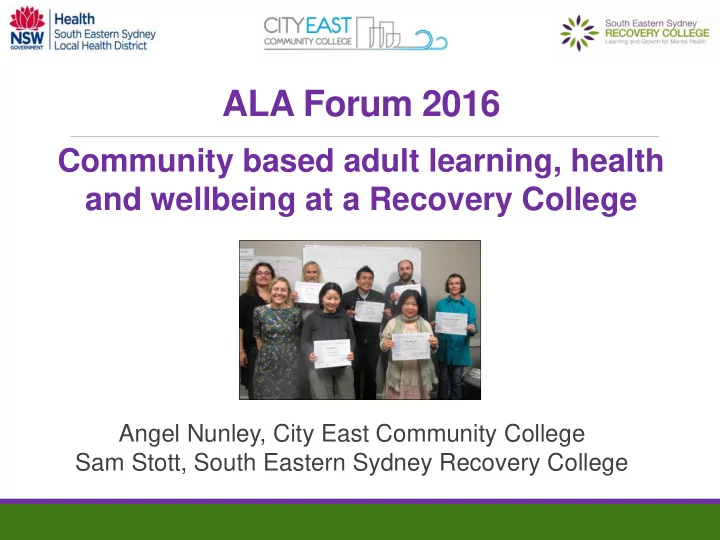
ALA Forum 2016 Community based adult learning, health and wellbeing at a Recovery College Angel Nunley, City East Community College Sam Stott, South Eastern Sydney Recovery College Recovery College Model Origins A new approach to providing


slide-1
SLIDE 1

ALA Forum 2016

Angel Nunley, City East Community College Sam Stott, South Eastern Sydney Recovery College

Community based adult learning, health and wellbeing at a Recovery College

slide-2
SLIDE 2

Recovery College Model Origins

  • A new approach to providing education to

people with mental health issues, carers and workers

  • Originated in the United States in the 1990’s;

a UK Recovery College established in 2009

  • Brings together adult education principles,

readiness to change theory, health promotion and psychiatric rehabilitation processes

2

slide-3
SLIDE 3

Defining Characteristics

  • 1. Educational principles
  • 2. Collaborative
  • 3. Strengths-based
  • 4. Person-centred
  • 5. Progressive
  • 6. Community-facing
  • 7. Inclusive

Reference: Julie Repper and Jane McGregor

3

slide-4
SLIDE 4

Co-Production

4

  • Peer and clinical

educators working together equitably

  • Power is shared from

start to finish

  • Professional and lived

experience are equally valued

slide-5
SLIDE 5

Course Development Process

5

Course Development Agreement Co-Production by Educators Co-Delivery by Educators Co-Learning by Students Co-Evaluation by Researchers

slide-6
SLIDE 6

International Community of Practice

6

  • Members from Recovery Colleges in Australia,

Canada, USA, Uganda, UK and Ireland

  • A central recovery college ‘hub’ creates a

positive atmosphere of learning and connection

  • Courses must be recovery-focused and distinct

from psycho-education, group therapy or popular education

  • Mental health service transformation occurs

through co-production and co-learning

slide-7
SLIDE 7

SESRC Objectives

  • Promote self-determination
  • Life beyond mental health services

Personal Recovery

  • Recovery-oriented service delivery

through co-produced staff training

Service Transformation

  • Skills and knowledge for consumer

workforce development

Capacity Building

  • Vocational pathways
  • Accredited training

Employment

7

slide-8
SLIDE 8

Transformative Learning for Recovery

Adult Education

Professional Expertise

Lived Experience

8

SESRC Partnerships

slide-9
SLIDE 9

Partnerships with Community Colleges

9

  • Both CECC & SGSCC have been partners of

the Recovery College since it was established

  • Use of educational language e.g. students,

enrolments, courses

  • Both community colleges are members of

Recovery College Expert Advisory Committee

  • Courses located in adult education settings
  • Pathways / accredited training
slide-10
SLIDE 10

SESRC Eligibility and Enrolment

Courses are free for:

  • People with mental health issues residing in

SESLHD (with whom we develop an individual student learning plan prior to commencement)

  • Their families, carers and support people
  • Staff and volunteers working for SESLHD
  • Staff from our partner organisations

A fee-for-service option is also available.

10

slide-11
SLIDE 11

SESRC Courses

  • Courses are delivered across the Local Health

District including community colleges, a migrant resource centre and mental health services including Recovery College hub

  • 9 terms completed; 772 students; 74 courses
  • CALD courses: Arabic, Cantonese, Greek,

Mandarin, Nepalese, Russian and Spanish

  • Nationally accredited courses: Foundation Skills

(CECC) & Certificate II Business (SGSCC)

11

slide-12
SLIDE 12

SESRC Key Research Outcomes

  • Qualitative and quantitative research including a

cost-benefit analysis

  • Focus group themes: Breaking down barriers;

reducing stigma; empowering; connecting with

  • thers; inspiring hope; moving beyond mental

illness

  • Course evaluations: 100% had expectations

met; 100% gained valuable knowledge; 100% would recommend course

12

slide-13
SLIDE 13

Focus Group Comments

  • “So different to anything experienced before”
  • “Took me to another level in my understanding of

recovery”

  • “Connecting with others who have successfully

recovered gave me hope that I could recover too”

  • The Recovery College is “changing lives”, giving

back to the consumer “the choice, control, empowerment, strategies and connections to live the life they want”

13

slide-14
SLIDE 14

Conclusion

  • For health services: The Recovery College

model challenges the traditional way people with a lived experience of mental illness, their carers and clinicians view recovery and provides an

  • pportunity to drive service transformation
  • For adult education providers: The Recovery

College model promotes lifelong and life- wide learning as an integral part of recovery from mental distress

14

slide-15
SLIDE 15

Questions?

City East Community College Phone: (02) 9387 7400 Website: www.cityeastcc.com.au South Eastern Sydney Recovery College Phone: (02) 9113 2981 Website: www.seslhd.health.nsw.gov.au/Recovery_College

15