# Let X be a RV with E [ X ] = . Then: 2Xtu2 ) IE [ XZ - MY ] EH X ' - - PowerPoint PPT Presentation

let x be a rv with e x then 2 xtu2 ie xz my eh x i ell ul
SMART_READER_LITE
LIVE PREVIEW

# Let X be a RV with E [ X ] = . Then: 2Xtu2 ) IE [ XZ - MY ] EH X ' - - PowerPoint PPT Presentation

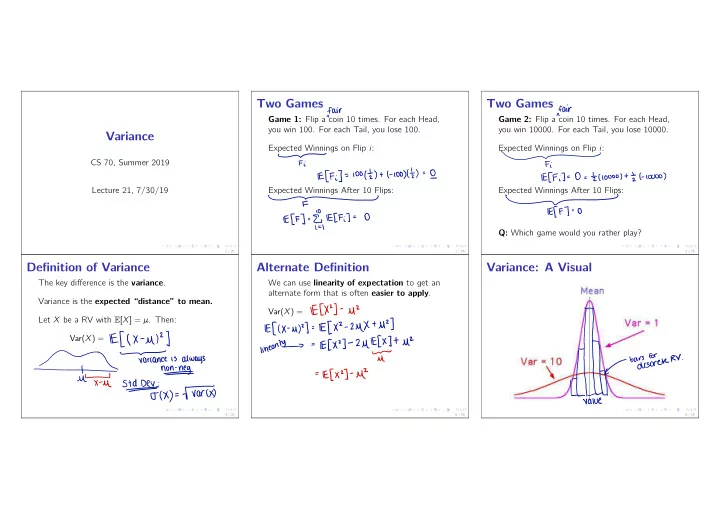
Two Games Two Games fair fair Game 1: Flip a coin 10 times. For each Head, Game 2: Flip a coin 10 times. For each Head, you win 100. For each Tail, you lose 100. you win 10000. For each Tail, you lose 10000. Variance Expected Winnings on Flip


slide-1
SLIDE 1

Variance

CS 70, Summer 2019 Lecture 21, 7/30/19

1 / 26

Two Games

Game 1: Flip a coin 10 times. For each Head, you win 100. For each Tail, you lose 100. Expected Winnings on Flip i: Expected Winnings After 10 Flips:

2 / 26

fair

  • Fi

Effi ]

= 100ft )

t

I

  • too ) ( I )
=

I

I

ECF ]

  • fi,

Effi

]

=

O

Two Games

Game 2: Flip a coin 10 times. For each Head, you win 10000. For each Tail, you lose 10000. Expected Winnings on Flip i: Expected Winnings After 10 Flips: Q: Which game would you rather play?

3 / 26

fair

  • Fi

Effi

]

=

O

=

Ill

0000

)

t

I

C-

NOOO )

  • Eff

7=0

Definition of Variance

The key difference is the variance. Variance is the expected “distance” to mean. Let X be a RV with E[X] = µ. Then: Var(X) =

4 / 26

Ell

x

  • ul

' I

#

Tartan

is

always

  • non-neg-ttfustdD-jgxy.TW

Alternate Definition

We can use linearity of expectation to get an alternate form that is often easier to apply. Var(X) =

5 / 26

IECX

' ]

  • uz

EH X

  • MY ]
=

IE [ XZ

  • 2µXtu2 )

linear#

=

IECXZ ]

  • 2µE[ X

]tµ2

  • U
= Efx

2 ]

  • if

Variance: A Visual

6 / 26

  • #

ftp.aais.irenrr

.

Value

slide-2
SLIDE 2

Variance of a Bernoulli

Let X ∼ Bernoulli(p). Then E[X] = What is X 2? E[X 2]? Var[X] =

7 / 26

p

X'

= {

to

Wwf

Ifp

/ ENT

  • tip

to

. a
  • p)

=p

.

ECXZ]

  • FE

EXT)

2

= F-

( pp

=

ph

  • P )

X

  • Bercp )

it

Ber

"

  • P)

Var CX)

= rare'D

Variance of a Dice Roll

What is the variance of a single 6-sided dice roll? R = What is R2?

8 / 26

value

  • f

a

dice roll

.

{ 1,2 , 3,4 , 5,63

* ÷÷÷÷

.

Variance of a Dice Roll

E[R2] = Var(R) =

9 / 26

f- ( I

t

4

t

9

t

16

t

25+36 ]

÷.ro

=

f- ( 91)

IE [ R2]

  • CIEL

RIB

=

af

  • EF

( Notes

.)

Variance of a Geometric

Know the variance; proof optional, but good practice with manipulating RVs. Let X ∼ Geometric(p). Strategy: Nice expression for p · E[X 2]

10 / 26

Efx

' I

=

I

. p

t

4h

  • p ) p

t

9h

  • ppp

t

. . .
  • I
  • pl Efx

Yf

  • fit

p

t 4

C I

  • PIP]

Subtract

from both sides

.
  • PIE
=

1

  • p

t

3 I I

  • p ) p

t

5

C I

  • PPP

t

. . . =

fz.pt/4l-plpt6CtpTpt

. . .)

t f- p

  • Li
  • P2P
  • ftp.T

Variance of a Geometric II

From the distribution of X, we know: From E[X], we know:

11 / 26

① .€,

  • lP[X=i]=pt(

I

  • p

)pth

  • p )2pt
. . .
  • _

I IECX I

  • I
  • p

1-

2.

Cfp )p

  • 1311
  • p )2pt
. . .

=L

I

z

. ②

(

z.pt/4l-plpt6CtpTpt...)tfp-Ci-p7p-ltP5p.ypIEfX4=2IECX

]

  • 1

ECxy=2

2

solve

for

Efxi

Variance of a Geometric III

Recall E[X] = 1

p.

12 / 26

var

CX)

  • Efx 'T
  • CENT)

'

  • ¥

.

. ¥
  • HEI
slide-3
SLIDE 3

Variance of a Poisson

Same: know the variance; proof optional, but good practice with functions of RVs. Let X ∼ Poisson(λ). Strategy: Compute E[X(X − 1)].

13 / 26

IPCX

=

i ]

  • Efx ( X
  • 1 )]
=

l deft qf iffy

. . e- X

I i

  • E) !
  • E

' Fez

=

e

  • xx

← taywrreen.es

j

22

=e#

I

=

A

Variance of a Poisson II

Use E[X(X − 1)] to compute Var(X).

14 / 26

var ( X)

=

Efxz ]

  • Efx

])

2

=

Efxlx

  • IDTECX ]
  • IFECXIJ
  • =

lastyszu.de

THAY

I

X

  • (#
=

X

Break

Would you rather only wear sweatpants for the rest of your life, or never get to wear sweatpants ever again?

15 / 26

Properties of Variance I: Scale

Let X be a RV, and let c 2 R be a constant. Let E[X] = µ. Var(cX) =

16 / 26

e.

Var ( X) Var

C ex )

=

IE

I

  • FEENY

,

lin

. =

Efe xD

  • Cc EXIT
= CHECK ]
  • CHE

EXT)

'

=

Cz var

( X)

Properties of Variance II: Shift

Let X be a RV, and let c 2 R be a constant. Let E[X] = µ. Then, let µ0 = E[X + c] = Var(X + c) =

17 / 26

Utc

varix )

varcxtc

)

=

Efffxtc

)

  • U

'T

] =EAXtEUXY )

shift

=

'EAX

  • my
  • Vary ,

*

ten

Example: Shift It!

Consider the following RV: X =      1 w.p. 0.4 3 w.p. 0.2 5 w.p. 0.4 What is Var(X)? Shift it!

18 / 26

=

Var CX

  • 3)

*of *

⇒ it

:

::

IEC X

  • 351=4
. 0.8

to

.

0.2=3.2 IEC X

  • 3 ]
= O

Var C C x

  • 3D
=

3.2

slide-4
SLIDE 4

Sum of Independent RVs

Let X1, . . . , Xn be independent RVs. Then: Var(X1 + . . . + Xn) = Var(X1) + . . . + Var(Xn) Proof: Tomorrow! Today: Focus on applications.

19 / 26

Variance of a Binomial

Let X ∼ Bin(n, p). Then, X = Here, Xi ∼ Var(X) =

20 / 26

Xitxzt

. .

.tl/nBerlp)XiiidTfdVarCX,)tVarCXz)t...tVarlXn)--n.VarCXi

)

x

  • Binh

,p )

=µpFpTH

Y

  • Bincnitp

)

  • Vari )
  • VARY )

Sum of Dependent RVs

Main strategy: linearity of expectation and indicator variables Useful Fact: (X1 + X2 + . . . + Xn)2 =

21 / 26

  • 1

Xitxzt

. .

.tl/nKXitXzt.-.tXn)-=CXftXit...tXn2)tCXiXztXiX3t.-.tXn-iXn

)

  • non
  • D
=

Ee

,

Xi

t

jxi

alter

?

'

xix ;

HW Mixups (Fixed Points)

(In notes.) n students hand in HW. I mix up their HW randomly and return it, so that every possible mixup is equally likely. Let S = # of students who get their own HW. Last time: defined Si = Si ∼ Using linearity of expectation: E[S] =

22 / 26

indicator

for student i

getting

  • wn

HW

.

Ber Hn)

ECS ,

t

Sat

. .

tsn I

= Efs , It

Elsie

. . . t ECS . ]
  • = then )

HW Mixups II

Using our useful fact: E[S2] =

23 / 26

Effs

, t

Sat

. . . tsn )

' ]

= Ef En

,

sit

if jsisjl

linearity

: =

Effi ? Si 2)

t IEC

jsisj ]

=

n

. Efs

,2)

t n

In

  • 1) EES , sit

÷

T HW Mixups III

What is S2

i ? E[S2 i ]?

For i 6= j, what is SiSj? E[SiSj]?

24 / 26

si

  • I: If

I

* I Els it

  • t

s

.sit:¥÷÷÷÷

" i ⇒

slide-5
SLIDE 5

HW Mixups IV

Put it all together to compute Var(X).

25 / 26

var

C x )

  • Efx 4
  • CECXD

'

= FEWtncn-DEG.SI =

riff

t

n#n¥n

  • I
=
  • f

Summary

Today:

I Variance measures how far you deviate from

mean

I Variance is additive for independent RVs;

proof to come tomorrow

I Use linearity of expectation and indicator

variables

26 / 26