Air Conditioners They consume lots of electric power They are less - - PDF document

air conditioners
SMART_READER_LITE
LIVE PREVIEW

Air Conditioners They consume lots of electric power They are less - - PDF document

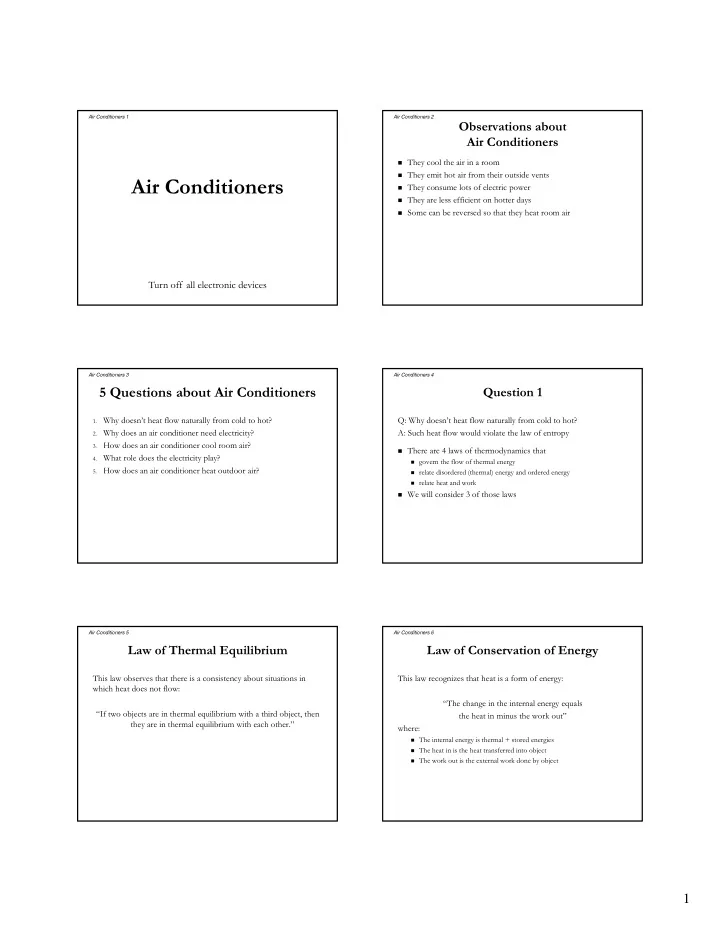
Air Conditioners 1 Air Conditioners 2 Observations about Air Conditioners They cool the air in a room They emit hot air from their outside vents Air Conditioners They consume lots of electric power They are less efficient on


slide-1
SLIDE 1

1

Air Conditioners 1

Air Conditioners

Turn off all electronic devices

Air Conditioners 2

Observations about Air Conditioners

 They cool the air in a room  They emit hot air from their outside vents  They consume lots of electric power  They are less efficient on hotter days  Some can be reversed so that they heat room air

Air Conditioners 3

5 Questions about Air Conditioners

  • 1. Why doesn’t heat flow naturally from cold to hot?
  • 2. Why does an air conditioner need electricity?
  • 3. How does an air conditioner cool room air?
  • 4. What role does the electricity play?
  • 5. How does an air conditioner heat outdoor air?

Air Conditioners 4

Question 1

Q: Why doesn’t heat flow naturally from cold to hot? A: Such heat flow would violate the law of entropy

 There are 4 laws of thermodynamics that

 govern the flow of thermal energy  relate disordered (thermal) energy and ordered energy  relate heat and work

 We will consider 3 of those laws

Air Conditioners 5

Law of Thermal Equilibrium

This law observes that there is a consistency about situations in which heat does not flow: “If two objects are in thermal equilibrium with a third object, then they are in thermal equilibrium with each other.”

Air Conditioners 6

Law of Conservation of Energy

This law recognizes that heat is a form of energy: “The change in the internal energy equals the heat in minus the work out” where:

 The internal energy is thermal + stored energies  The heat in is the heat transferred into object  The work out is the external work done by object

slide-2
SLIDE 2

2

Air Conditioners 7

Order versus Disorder

 Converting ordered energy into thermal energy

 involves events that are likely to occur  is easy to accomplish and often happens

 Converting thermal energy into ordered energy

 involves events that are unlikely to occur  is hard to accomplish and effectively never happens

 Statistically, disordered never becomes ordered

Air Conditioners 8

Entropy

 Entropy

 is the measure of a system’s disorder  includes every type of disorder: energy and structure

 Entropy

 never decreases in a system that is thermally isolated  can be rearranged within a system  can be transferred between systems  is NOT a conserved quantity! Air Conditioners 9

Law of Entropy

This law observes that entropy guides the time evolution of isolated systems: “The entropy of a thermally isolated system never decreases”

Air Conditioners 10

More on the Law of Entropy

 According to the Law of Entropy:

 Entropy of thermally isolated system can’t decrease  but entropy can be rearranged within that system  so part of the system can become colder

as another part becomes hotter!

 Entropy is “exported” from cold part to hot part

 Exporting entropy is like throwing out trash!

Air Conditioners 11

Natural Heat Flow

 One unit of thermal energy is more disordering to a cold object

than to a hot object

 When heat flows from hot object to cold object,

 hot object’s entropy: ↓  cold object’s entropy: ↑↑  so their total entropy: ↑

 Law of Entropy is satisfied

Air Conditioners 12

Hypothetical Energy and Entropy Thermal Energy Entropy 1 4 2 7 3 9 4 10

slide-3
SLIDE 3

3

Air Conditioners 13

Unnatural Heat Flow

 When heat flows from cold object to hot object,

 cold object’s entropy: ↓↓  hot object’s entropy: ↑  so their total entropy: ↓

 Law of Entropy would be violated,

 unless we create of additional entropy!  unless something ordered becomes disordered! Air Conditioners 14

Question 2

Q: Why does an air conditioner need electricity? A: Electricity provides the necessary order

 An air conditioner

 moves heat from cold (room air) to hot (outside air)  would cause total entropy of world to decrease  were it not for the electric power it consumes!

 It turns electric power into thermal power

 so the total entropy of world does not decrease Air Conditioners 15

Heat Machines

 Air conditioners are heat pumps

 use work to transfer heat from cold to hot

 Automobiles are heat engines

 use flow of heat from hot to cold to do work

 Heat machines are governed by law of entropy

Air Conditioners 16

Air Conditioner

 An air conditioner uses a working fluid to

 absorb heat from cold (room air)  release heat to hot (outside air)

 The evaporator (indoors)

 transfers heat from cold (room air) to working fluid

 The condenser (outdoors)

 transfers heat from working fluid to hot (outside air)

 The compressor (outdoors)

 does work on working fluid and produces entropy. Air Conditioners 17

Question 3

Q: How does an air conditioner cool room air? A: Its evaporator absorbs heat from the room air

 Evaporator is wide indoor pipe  Working fluid

 enters evaporator as cool low-pressure liquid  absorbs heat from room air and evaporates  leaves evaporator as a cool low-pressure gas

 Heat has been removed from the room!

Air Conditioners 18

Question 4

Q: What role does the electricity play? A: It powers the compressor and creates entropy

 Compressor increases gas’s pressure and density  Working fluid

 enters compressor as a cool low-density gas  has work done on it by the compressor  leaves compressor as hot high-density gas

 Entropy has been created!

slide-4
SLIDE 4

4

Air Conditioners 19

Question 5

Q: How does an air conditioner heat outdoor air? A: Its condenser releases heat to the outdoor air

 Condenser is narrow outdoor pipe at high pressure  Working fluid

 enters condenser as hot high-pressure gas  releases heat to outdoor air and condenses  leaves condenser as a cool high-pressure liquid

 Heat has been delivered to the outdoors!

Air Conditioners 20

Air Conditioner Overview

 Fluid evaporates in evaporator

 absorbing heat from room air

 Compressor raises pressure

 evaporation → condensation

 Fluid condenses in condenser

 releasing heat to outdoor air

 Constriction lowers pressure

 condensation → evaporation

 and the cycle repeats endlessly…

Air Conditioners 21

Summary about Air Conditioners

 They pump heat from cold to hot  They don’t violate thermodynamics  They convert ordered energy to thermal energy