AgTech Pilot Project 1 Funde ded d by CET ETF California State - - PowerPoint PPT Presentation

agtech pilot project
SMART_READER_LITE
LIVE PREVIEW

AgTech Pilot Project 1 Funde ded d by CET ETF California State - - PowerPoint PPT Presentation

AgTech Pilot Project 1 Funde ded d by CET ETF California State University, Fresno Demonstrate the Value of Broadband for Agriculture. #1 - Help develop a comprehensive approach in utilizing broadband for agriculture. 3 Goals #2 -


slide-1
SLIDE 1

1

AgTech Pilot Project

Funde ded d by CET ETF

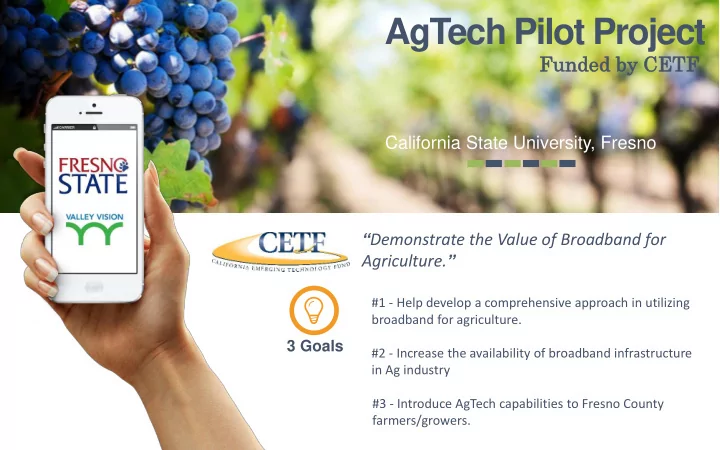
“Demonstrate the Value of Broadband for

Agriculture.”

3 Goals

#1 - Help develop a comprehensive approach in utilizing broadband for agriculture. #2 - Increase the availability of broadband infrastructure in Ag industry #3 - Introduce AgTech capabilities to Fresno County farmers/growers.

California State University, Fresno

slide-2
SLIDE 2

2

Overview of pilot project goal

The Primary goal of the “21st Century Broadband: On Farm Wireless Sensor Network AgTech Pilot Project” was to reduce water usage and increase crop yield by improving automated irrigation systems currently in place through an on farm wireless sensor network.

On Farm Wireles reless s Sensor nsor Netwo twork k AgT gTech ech Pilo lot t Proje ject ct

21st Century Broadband

Crops: Grapes, Almonds, Tomatoes

AgTech Pilot Project, implemented various conceptual design elements and activities that supported 3 land owners growing 3 different crops geographically dispersed in rural Fresno County. Rios Farms (Grapes), Logoluso Farms (Almonds), and Sano Farms (Tomatoes)

slide-3
SLIDE 3

3

AgTech Pilot Project

Imp mplem lementation entation

Implementation of Pilot Project in rural Fresno County

PHASE 1 - Dedicated to project planning, identifying equipment necessary

for purchase and potential broadband infrastructure refinement.

PHASE 2 - training sessions and technical assistance were provided during

the second phase of the project. WiseConn led the trainings in automated irrigation systems, data/control dashboards, wireless telemetry systems and

  • ther crop water status sensor trainings.

PHASE 3 –All data collected from March 2017 to November 2017 was

analyzed as part of the project evaluation and overall data reporting.

slide-4
SLIDE 4

4

AgTech Pilot Project

Implementation of Pilot Project in rural Fresno County

PHASE 4 - an evaluation of the AgTech pilot project was

conducted by the Office of Community and Economic Development (OCED) at Fresno State and input from the Water, Energy and Technology (WET) Center to determine the overall outcomes and success of the project.

Advisory Board – An advisory board of industry experts was created and

provided advice and support throughout the AgTech Pilot Project

Imp mplem lementation entation

slide-5
SLIDE 5

5

 Real-time water sensors and data models that measure specific water flow within a field and help make real-time recommendations, considering all factors affecting growth development and harvest were deployed in identified parcels in 3 farms. All equipment was connected via wireless broadband.  Allow farmers to precisely target their time, limited water and expensive nutrient resources to improve

  • verall yield and quality.

 WiseConn provided the necessary technical assistance and training to install water flow meters, which measured absolute water release to determine which portions of the crops required water and which did not as indicated by ground sensors.  Data collection was managed using a specially designed application on a Smart Phone/iPad and broadband connection.  Test and control parcels were utilized for data analysis. Equipment was strategically placed in certain parcels on each farm, but not in others, allowing data comparison on crop production, yields, water usage, and cost.

AgTech Pilot Project

Equipme uipment nt

slide-6
SLIDE 6

6

DropControl

by Wise seConn

  • nn

How It Works

DropControl consists of a wireless network for monitoring and control, and a Web application. The network is made

  • f nodes, which are connected to

sensors and actuators for monitoring weather conditions, soil moisture, irrigation historic data, and to actuate the irrigation system. The nodes communicate with each other to send the information to the central Gateway, which connects the network with a web server.

slide-7
SLIDE 7

Grapes

As a result of having access to broadband in the Farm, all 3 farmers can monitor and schedule irrigation times (from anywhere) to reduce water usage and energy costs. It also provides real time soil moisture analysis.

slide-8
SLIDE 8

Almonds

As a result of having access to broadband in the Farm, all 3 farmers can monitor and schedule irrigation times (from anywhere) to reduce water usage and energy costs. It also provides real time soil moisture analysis.

slide-9
SLIDE 9

Tomatoes

slide-10
SLIDE 10

Results

slide-11
SLIDE 11
slide-12
SLIDE 12

12

AgTech Pilot Project

Funde ded d by CET ETF

Data Results

Grapes

  • reduced Water usage by 18% to 20%
  • reduced Energy usage by 15%
  • reduced Labor usage by 12%
  • Increased Crop Yield by 18%
  • reduced costs (still analyzing total costs savings)

Almonds

  • reduced Water usage by 10% to 12%
  • reduced Energy usage by 10%
  • reduced Labor usage by 15%
  • Increased Crop Yield by 12%
  • reduced costs (still analyzing total costs savings)

Tomatoes

  • reduced Water usage by 17% to 19%
  • reduced Energy usage by 13%
  • reduced Labor usage by 15%
  • Increased Crop Yield by 14%
  • (still analyzing total costs savings)
slide-13
SLIDE 13

13

AgTech Pilot Project

Funde ded d by CET ETF

Advantages

Advantages of Broadband and wireless sensor technology

  • Field nodes simultaneously monitor and control performance as well as control components like

valves and pumps.

  • Real time and historical data analysis of sensor technology helps growers make profitable

decisions for irrigation.

  • IOT (internet of things) that connects to the cloud from Ethernet, 3g, 4g, LTE, soon LoRa and narrowband
  • Provide a Birdseye view of your operation, showing real time crop events.
  • Saves water, by scheduled irrigation and VRI (variable rate irrigation).
  • Saves energy, by reduction of irrigation time and running off peak.
  • Saves labor, by automation of irrigation sets.
  • Increases and maintains yields with lower cultural costs.
  • Access, Anytime, Anywhere via an App (IOS and Android)
slide-14
SLIDE 14

THANK YOU