Agenda Automated Automated Modeling and Modeling and Forecasting - - PowerPoint PPT Presentation

agenda
SMART_READER_LITE
LIVE PREVIEW

Agenda Automated Automated Modeling and Modeling and Forecasting - - PowerPoint PPT Presentation

Agenda Automated Automated Modeling and Modeling and Forecasting Forecasting Vector Vector Autoregressive Autoregressive Processes Processes 1 Vector Autoregressive Processes Svetlana Unkuri, Svetlana Unkuri, Matthias Fischer


slide-1
SLIDE 1

Automated Modeling and Forecasting Vector Autoregressive Processes Svetlana Unkuri, Matthias Fischer Vector Autoregressive Processes VAR Modeling with AuFVAR Data Initial Analysis Model Settings Selection Structural Breaks Estimation and Forecasting Residual Analysis Empirical Example

Automated Modeling and Forecasting Vector Autoregressive Processes

Svetlana Unkuri, Matthias Fischer

Friedrich Alexander University Erlangen-Nuremberg

June 15, 2006

Automated Modeling and Forecasting Vector Autoregressive Processes Svetlana Unkuri, Matthias Fischer Vector Autoregressive Processes VAR Modeling with AuFVAR Data Initial Analysis Model Settings Selection Structural Breaks Estimation and Forecasting Residual Analysis Empirical Example

Agenda

1 Vector Autoregressive Processes 2 VAR Modeling with AuFVAR

Data Initial Analysis Model Settings Selection Structural Breaks Estimation and Forecasting Residual Analysis

3 Empirical Example: Advertisement Spendings

Automated Modeling and Forecasting Vector Autoregressive Processes Svetlana Unkuri, Matthias Fischer Vector Autoregressive Processes VAR Modeling with AuFVAR Data Initial Analysis Model Settings Selection Structural Breaks Estimation and Forecasting Residual Analysis Empirical Example

VAR Model: Theoretical Basics

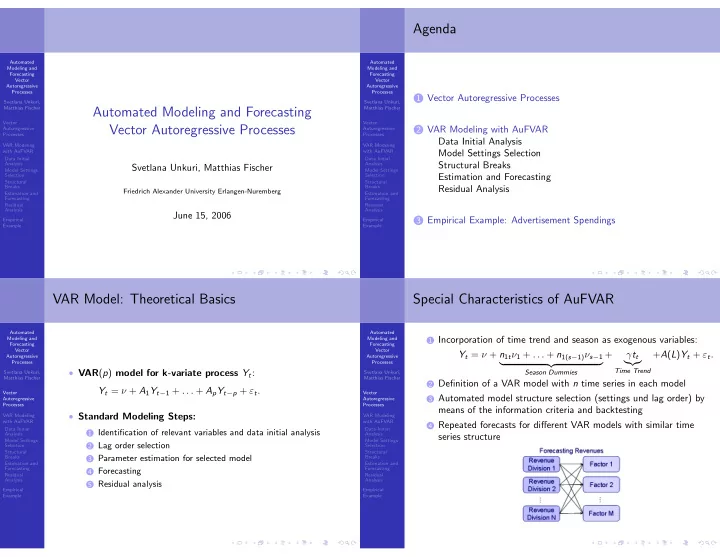
  • VAR(p) model for k-variate process Yt:

Yt = ν + A1Yt−1 + . . . + ApYt−p + εt.

  • Standard Modeling Steps:

1 Identification of relevant variables and data initial analysis 2 Lag order selection 3 Parameter estimation for selected model 4 Forecasting 5 Residual analysis

Automated Modeling and Forecasting Vector Autoregressive Processes Svetlana Unkuri, Matthias Fischer Vector Autoregressive Processes VAR Modeling with AuFVAR Data Initial Analysis Model Settings Selection Structural Breaks Estimation and Forecasting Residual Analysis Empirical Example

Special Characteristics of AuFVAR

1 Incorporation of time trend and season as exogenous variables:

Yt = ν + n1tν1 + . . . + n1(s−1)νs−1

  • Season Dummies

+ γtt

  • Time Trend

+A(L)Yt + εt.

2 Definition of a VAR model with n time series in each model 3 Automated model structure selection (settings und lag order) by

means of the information criteria and backtesting

4 Repeated forecasts for different VAR models with similar time

series structure

slide-2
SLIDE 2

Automated Modeling and Forecasting Vector Autoregressive Processes Svetlana Unkuri, Matthias Fischer Vector Autoregressive Processes VAR Modeling with AuFVAR Data Initial Analysis Model Settings Selection Structural Breaks Estimation and Forecasting Residual Analysis Empirical Example

Data Initial Analysis in AuFVAR

1 Stationarity Test: ADF Test

  • Function: adf .test (modified)

2 Granger Causality Test

  • Function: grangertest (standard)

3 Log Level Transformation

  • Natural Logarithm of Time Series

Automated Modeling and Forecasting Vector Autoregressive Processes Svetlana Unkuri, Matthias Fischer Vector Autoregressive Processes VAR Modeling with AuFVAR Data Initial Analysis Model Settings Selection Structural Breaks Estimation and Forecasting Residual Analysis Empirical Example

Model Selection

Definition the different VAR models (with/without trend/season, lag

  • rder variation) and selection the model with the least criterion value:

1 Information Criteria, e.g.

AIC(p) = ln det( Σε(p)) + 2 T pK 2,

2 Backtesting (out-of-sample):

RMSE =

  • 1

h

h

  • i=1

(yT+h − yt(h))2.

Automated Modeling and Forecasting Vector Autoregressive Processes Svetlana Unkuri, Matthias Fischer Vector Autoregressive Processes VAR Modeling with AuFVAR Data Initial Analysis Model Settings Selection Structural Breaks Estimation and Forecasting Residual Analysis Empirical Example

Test for Structural Breaks

  • Testing for the structural breaks:

Function breakpoints, library strucchange

1 Determining the number of breakpoints 2 Computation of the optimal breakpoints 3 Adjustment of the model definition

Automated Modeling and Forecasting Vector Autoregressive Processes Svetlana Unkuri, Matthias Fischer Vector Autoregressive Processes VAR Modeling with AuFVAR Data Initial Analysis Model Settings Selection Structural Breaks Estimation and Forecasting Residual Analysis Empirical Example

Estimation and Forecasting

1 Estimation of the appropriate model after testing for structural

breaks

  • Function: estVARXls for the models with intercept and lagged

variables (standard)

  • Function: estVARXlsM for the models with additional time

trend and/or season (modified)

2 Forecasting the time series, computation of confidence bounds

and corresponding plots

slide-3
SLIDE 3

Automated Modeling and Forecasting Vector Autoregressive Processes Svetlana Unkuri, Matthias Fischer Vector Autoregressive Processes VAR Modeling with AuFVAR Data Initial Analysis Model Settings Selection Structural Breaks Estimation and Forecasting Residual Analysis Empirical Example

Residual Analysis

1 Portmanteau Test for Autocorrelation:

  • The standard test statistic, if time series length T ≥ 100
  • The modified test statistic otherwise

2 Test for Nonnormality based on Skewness and Kurtosis

(L¨ utkepohl, 1993)

Automated Modeling and Forecasting Vector Autoregressive Processes Svetlana Unkuri, Matthias Fischer Vector Autoregressive Processes VAR Modeling with AuFVAR Data Initial Analysis Model Settings Selection Structural Breaks Estimation and Forecasting Residual Analysis Empirical Example

Example: Time Series and Forecasting

Data

  • Variables to be forecasted:
  • Common Advertisement Earnings (with/without media)
  • Further possible variables for the VAR model:

1 ZEW Index (Centre for European Economic Research) 2 Incoming Orders (Germany) 3 CDAX (Composite DAX)