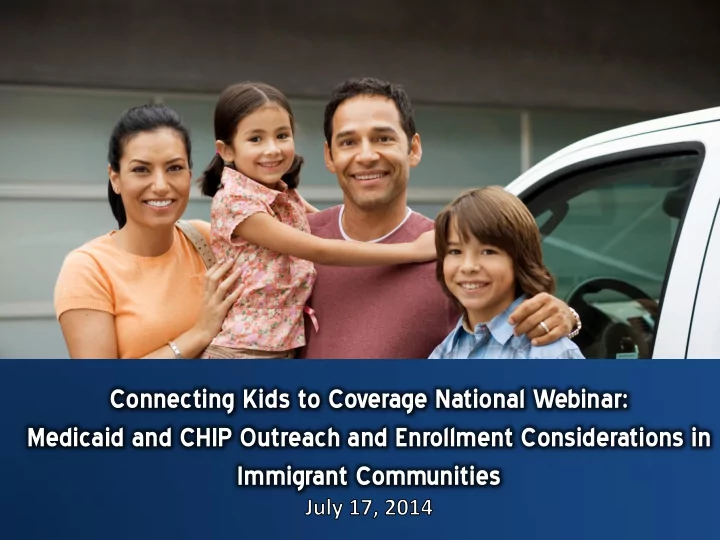
Agenda Topic Overview Eligibility Rules: Enrolling eligible - - PowerPoint PPT Presentation
Connecting Kids to Coverage National Webinar: Medicaid and CHIP Outreach and Enrollment Considerations in Immigrant Communities Agenda Topic Overview Eligibility Rules: Enrolling eligible immigrants and individuals in mixed immigration
Agenda
- Topic Overview
- Eligibility Rules: Enrolling eligible immigrants
and individuals in mixed immigration status families
- Applying the Rules: Enrollment scenarios
- Spotlight on States: Illinois and Washington
- Q&A Sessions
- Connecting Kids to Coverage Campaign
Resources
What Are Special Considerations in Immigrant Communities?
- Enrolling immigrant children or children in
mixed immigration status in Medicaid and CHIP presents unique challenges. You can address some of these challenges through a better understanding of the following:
– Eligibility rules – Enrollment procedures – Effective communication with families
Eligibility Rules for Non-Citizens for Medicaid and CHIP
- Sarah Lichtman Spector, Technical Director
Division of Eligibility, Enrollment and Outreach Children and Adults Health Programs Group Centers for Medicaid and CHIP Services
Overview
Eligibility for Non-Citizens (PRWORA) Lawfully Residing Option for Medicaid/CHIP Eligibility for Medicaid, CHIP, and Marketplace/QHPs Application and Enrollment Tips for Non-Citizens Accessibility/Language Services
Eligibility for Non-Citizens in Medicaid and CHIP
Under Personal Responsibility and Work Opportunity Reconciliation Act (PRWORA):
- The following groups may be eligible for Medicaid and CHIP:
– Qualified non-citizens who entered before 8/96 – Qualified immigrants who reach end of 5-year waiting period (i.e LPRs/green card holders) – Qualified immigrants exempt from 5-year waiting period (e.g., refugees, asylees, Cuban/Haitian entrants, trafficking victims, veteran families)
- There is no federal funding to cover undocumented immigrants, except
for payment for limited emergency services
Who is a “Qualified Non-Citizen”?
- Specific list includes:
– Lawful permanent residents (LPRs or green card holders) – Asylees and refugees – Cuban/Haitian entrants – Parolees for more than 1 year – Battered non-citizens, spouses and children – Victims of trafficking – Veterans and active military, and their spouses and children
- Note: Many of these groups are exempt from the 5-year
waiting period
Option to Cover Lawfully Residing Children and Pregnant Women
- CHIPRA made available a state
- ption to cover children and/or
pregnant women who are: – Lawfully present, and otherwise eligible – Without a 5-year waiting period – Regardless of date of entry into the U.S.
- 29 states, DC and CNMI
“Lawfully Present” includes:
- Qualified non-citizen, regardless of a waiting period
- Humanitarian statuses or circumstances (Temporary
Protected Status, Special Juvenile Status, asylum applicants, Convention Against Torture)
- Valid non-immigrant visa holder
- Legal status conferred by other laws (temporary resident
status, LIFE Act, Family Unity individuals)
- Lawfully present in American Samoa and the Northern
Mariana Islands
Seamless, Streamlined System of Eligibility and Enrollment
Submit single, streamlined application to the Exchange, Medicaid/CHIP
- Online
- Phone
- In Person
Eligibility is determined and verified
- Supported by the
federally-managed data services hub
- Eligibility for:
- Medicaid and CHIP
- Enrollment in a
QHP
- Advance payments
- f the premium tax
credit and cost- sharing reductions Enroll in affordable coverage
- Online plan
comparison tool available to inform QHP selection
- Advance payment
- f the premium tax
credit is transferred to the QHP
- Enrollment in
Medicaid/CHIP or QHP
Minimizing Burden in Application Process
The state may only require an individual to provide the information necessary to make an eligibility determination Applications may ask a non-applicant for certain information necessary to determine eligibility for an applicant (i.e. income, tax filing status, relationship)
Application Process Cont.
- Request for SSN of a non-applicant is permitted if:
– It is voluntary – It is used only to determine eligibility for applicant/beneficiary or for purpose directly connected to Medicaid program – Clear notice is provided to individual
- States should not ask for citizenship/immigration
information from a non-applicant
Public Charge
- Applying for Medicaid or CHIP does not make
someone a “public charge.” – It will not affect someone’s chances of becoming an LPR or U.S. citizen. – The one exception is for individuals receiving long-term care in an institution at government
- expense. These people may face barriers getting a
green card.
Accessibility and Federal Funds for Language Services
- Information must be accessible to individuals who are limited
English proficient and individuals with disabilities.
– Entities receiving federal funds have a responsibility to provide these services and not to discriminate based on national origin for individuals who are limited English proficient under Title VI of Civil Rights Act of 1964 – Based on disability under section 504 of the Rehabilitation Act of 1973
- Federal funds are available for oral interpretation and written
translation to be provided to Medicaid and CHIP applicants and beneficiaries.
Eligibility Options for Non-Citizens
Program Summary of Eligibility Rules Medicaid/CHIP
- Qualified non-citizens
- Must apply the 5-year waiting period to certain non-citizens
- State option to cover lawfully residing children and/or pregnant
women (removes the 5-year waiting period) Marketplace/QHP
- Must be lawfully present to purchase insurance in a Qualified
Health Plan, or to be eligible for an Advance Payment for Premium Tax Credit (APTC) or Cost-Sharing Reduction (CSR)
- Under 100% FPL of household income, may be eligible for APTC
and CSRs, if lawfully present and ineligible for Medicaid due to immigration status
Applying the Rules: Enrollment Scenarios
- Shelby Gonzales, Senior Policy
Analyst
Center on Budget and Policy Priorities
- Jenny Rejeske, Health Policy
Analyst
National Immigration Law Center
Scenario 1:
Nadif, Fatima and Amina
- Nadif and Fatima are married.
- Amina is the daughter of Fatima and
step-daughter of Nadif.
- Nadif became a naturalized citizen last
year.
- Nadif submitted a visa petition for Fatima
and Amina last year which was approved in February, and Fatima and Amina are applying to become lawful permanent residents.
- Nadif earns $18,553 a year.
- Nadif and Fatima file taxes jointly and
claim Amina as a dependent.
Nadif, 27 Fatima, 27 Amina, 5
Eligibility Based only on General Citizenship / Immigration Status Rules
18
Fatima
- Applying for coverage
- Yes
- Citizen
- No
- Immigration status
- Applying for lawful
permanent residency; has approved visa petition
- “Qualified” noncitizen
- No
- Lawfully present
- Yes
MAY BE ELIGIBLE FOR: x Medicaid QHP Enrollment
Amina
- Applying for coverage
- Yes
- Citizen
- No
- Immigration status
- Applying for lawful
permanent residency ; has approved visa petition
- “Qualified” noncitizen
- No
- Lawfully present
- Yes
MAY BE ELIGIBLE FOR: Medicaid (depending
- n state)
CHIP (depending on state) QHP Enrollment
Nadif
- Applying for coverage
- Yes
- Citizen
- Yes
MAY BE ELIGIBLE FOR: Medicaid QHP Enrollment
Eligibility for Tax Credit and Medicaid in Michigan
Medicaid/CHIP Premium Tax Credits Eligible? HH Income FPL Eligible? HH Income FPL Fatima No 3 $18,553 95% Yes 3 $18,553 95% Amina No 3 $18,553 95% Yes 3 $18,553 95% Nadif Yes 3 $18,553 95% No 3 $18,553 95%
Red Red Bl ue
- Fatima and Amina are not eligible for Medicaid
based on their immigration status.
- Fatima and Amina are eligible to enroll in
Marketplace coverage because they are lawfully
- present. Although their income is below 100% FPL,
they are eligible for premium tax credits because they are not eligible for Medicaid based on their immigration status.
- Nadif is eligible for Medicaid. He is a citizen and his
income is below the 133% income limit.
Eligibility for Tax Credit and Medicaid in Virginia
Medicaid/CHIP Premium Tax Credits Eligible? HH Income FPL Eligible? HH Income FPL Fatima No 3 $18,553 95% Yes 3 $18,553 95% Amina No 3 $18,553 95% Yes 3 $18,553 95% Nadif Yes 3 $18,553 95% No 3 $18,553 95%
Red Red
- Fatima is not eligible for Medicaid based on her
immigration status.
- Amina is lawfully present and therefore eligible to enroll in
Marketplace coverage. Although her income is below 100% FPL, she is eligible for premium tax credits because she is not eligible for Medicaid based on her immigration status.
Eligibility for Tax Credit and Medicaid in Virginia, continued
Medicaid/CHIP Premium Tax Credits Eligible? HH Income FPL Eligible? HH Income FPL Fatima No 3 $18,553 95% Yes 3 $18,553 95% Amina No 3 $18,553 95% Yes 3 $18,553 95% Nadif Yes 3 $18,553 95% No 3 $18,553 95%
Red Red
- Amina is eligible for Medicaid because her income is below the 143% FPL
Medicaid limit for children in Virginia and Virginia provides Medicaid and CHIP to lawfully present children.
- Nadif is not eligible for Medicaid because Virginia did not expand
Medicaid and his income is above the 49% FPL limit for parents in Virginia.
- Nadif is a citizen and therefore eligible to enroll in Marketplace coverage.
He is not eligible for premium tax credits or cost sharing subsidies because his income is below 100% FPL.
Important to Know: ID Verification is Required to Set Up an Account
Step 1
The person completing the application is asked to provide information
Step 2
Experian provides customized credit-related questions
Scenario 2:
Rashid, Miriam and Leila
- Rashid and Miriam are married and live with
their daughter, Leila
- Rashid and Miriam:
– Entered the US as refugees 4 years ago – Became Lawful Permanent Residents (LPR) last year
- Leila was born last month
– No Social Security number yet, but applied for one
- Family income: $17,577
- Rashid and Miriam file taxes jointly and claim
Leila as a dependent
- Everyone in the family is interested in getting
health coverage
Rashid, 27 Miriam, 27 Leila, 1 month
Eligibility Based Only on General Citizenship/Immigration Status Rules
24
Rashid
- Applying for coverage
- Yes
- Citizen
- No
- Immigration status
- Refugee
- Lawful Permanent Resident
- “Qualified” noncitizen
- Yes
- Subject to 5 year bar
- No
- Lawfully present
- Yes
MAY BE ELIGIBLE FOR: Medicaid QHP Enrollment
Miriam
- Applying for coverage
- Yes
- Citizen
- No
- Immigration status
- Refugee
- Lawful Permanent Resident
- “Qualified” noncitizen
- Yes
- Subject to 5 year bar
- No
- Lawfully present
- Yes
MAY BE ELIGIBLE FOR: Medicaid QHP Enrollment
Leila
- Applying for coverage
- Yes
- Citizen
- Yes
MAY BE ELIGIBLE FOR: Medicaid CHIP QHP Enrollment
Eligibility for Tax Credit and Medicaid in Oregon
Medicaid/CHIP Premium Tax Credits Eligible? HH Income FPL Eligible? HH Income FPL Rashid Yes 3 $17,577 90% No 3 $17,577 90% Miriam Yes 3 $17,577 90% No 3 $17,577 90% Leila R
B
Yes 3 $17,577 90% No 3 $17,577 90%
R R
- Miriam and Rashid are eligible for Medicaid. They are
“qualified” immigrants and as refugees are not subject to the 5-year waiting period and their income is below the Medicaid income threshold of 133% FPL in Oregon.
- Leila is eligible for Medicaid. She is a citizen and her
income is below the 185% income threshold for infants in Oregon.
Eligibility for Tax Credit and Medicaid in Virginia
Medicaid/CHIP Premium Tax Credits Eligible? HH Income FPL Eligible? HH Income FPL Rashid No 3 $17,577 90% No 3 $17,577 90% Miriam No 3 $17,577 90% No 3 $17,577 90% Leila Yes 3 $17,577 90% No 3 $17,577 90%
R R R R R
- Miriam and Rashid are not eligible for Medicaid. They meet the immigration
status requirements but they are not eligible because their income is above the 49% FPL limit for parents in Virginia.
- Miriam and Rashid are eligible to purchase marketplace coverage because they
are lawfully present. They are not eligible for PTC in the marketplace because their income is below 100% FPL (people with income below 100% FPL, can only get PTC if they are lawfully present but not eligible for Medicaid based on immigration status).
- Leila is eligible for Medicaid. She meets the citizenship
requirement and her income is below the 143% FPL Medicaid.
Scenario 3:
Nina, Tanya and Amelia
- Nina lives with her daughters, Tanya
and Amelia
– Nina is undocumented – Amelia has deferred action under the Deferred Action for Childhood Arrivals (DACA) program – Tanya is a US citizen
- Tanya is applying for coverage
- Nina files taxes using an ITIN and
claims both children as dependents
- Nina earns $37,107 a year
Nina, 42 Tanya, 8 Amelia, 17
Eligibility Based only on General Citizenship / Immigration Status Rules
28
Nina
- Applying for coverage
- No
Amelia
- Applying for coverage
- No
Tanya
- Applying for coverage
- Yes
- Citizen
- Yes
MAY BE ELIGIBLE FOR: Medicaid CHIP QHP Enrollment
Eligibility for Tax Credit and Medicaid
Medicaid/CHIP Premium Tax Credits Eligible? HH Income FPL Eligible? HH Income FPL Nina N/A
- N/A
- Amelia
N/A
- N/A
- Tanya
Yes 3 $37,107 190% No 3 $37,107 190%
R R R
- Nina and Amelia are not applying for coverage,
they would not meet the immigration requirement for insurance affordability programs. (Note: they are not subject to the penalty for going without coverage)
- If Nina or Amelia were to become pregnant, they
may be eligible for CHIP coverage for pregnant women in some states (16 states and DC).
- Tanya is eligible for CHIP.
Important to Know: Some Individuals Have Concerns about Immigration Enforcement
Nina is undocumented and may worry that the government will find out that she is undocumented. She may also be worried about what information she may have to share about herself and if Medicaid or the Marketplace will report her to immigration authorities.
- IT’S SAFE TO APPLY
– Medicaid and the ACA include strong protections for personally identifiable information; some privacy provisions were written to encourage participation of mixed-immigration status families. – Agencies can collect, use, and disclose only that information strictly necessary for enrollment in health coverage. – Information about applicants/household obtained for health insurance eligibility will not be used by ICE/DHS for immigration enforcement.
See resource materials— ICE memo Oct’13 (Spanish), HHS FAQ
Income Verification
- When no SSN is provided, income cannot be verified
through a match with SSA or IRS.
– Consumers may have to mail or upload paper documentation showing income.
- Flexibility is needed to account for immigrants’ circumstances: pay
stub may not be available.
- NOTE: ITINs should not be requested in the application
process and will not be used to match with IRS data.
Concern About Privacy and Confidentiality
- The Marketplaces, Medicaid and CHIP agencies
must require their employees and contractors to follow robust rules protecting privacy.
- Contractors include:
– QHP issuers – Navigators – Certified application counselors – Agents – Brokers
Concern About Discrimination
- Discrimination based on race, ethnicity, and national
- rigin, including language spoken, is prohibited by Title
VI of the Civil Rights Act and ACA Section 1557
- Title VI applies to all entities receiving federal financial
assistance: consumer assisters, clinics, hospitals, insurers, Marketplace agencies, Medicaid and CHIP agencies, contractors, HMOs, and others.
- Applications, processes and procedures that have a
chilling effect -- deterring eligible immigrants from applying -- may violate Title VI and Sec. 1557
Resources
- List of Immigration Statuses that Qualify for Marketplace Coverage:
https://www.healthcare.gov/immigration-status-and-the-marketplace/
- Verification and Documentation: https://www.healthcare.gov/help/citizenship-
and-immigration-status-questions/
- Eligibility Details for Immigrant Families: https://www.healthcare.gov/what-do-
immigrant-families-need-to-know/
- Memo from U.S. Immigration & Customs Enforcement (ICE): “Clarification of
Existing Practices Related to Certain Health Care Information”: http://www.ice.gov/doclib/ero-outreach/pdf/ice-aca-memo.pdf
- Georgetown University’s Center for Children and Families (blog): The
Administration’s New Welcome Mat for Immigrants: “It’s Safe to Apply”
- Immigrants and The Affordable Care Act (in English and Spanish):
http://nilc.org/immigrantshcr.html
- Maps of Health Coverage for Immigrant Children and for Pregnant Women:
http://nilc.org/healthcoveragemaps.html
- Materials in Other Languages:
http://marketplace.cms.gov/getofficialresources/other-languages/other- languages-materials.html
Downloadable Resources
- Overview of Immigrant Eligibility for Federal Programs:
http://www.nilc.org/document.html?id=108 (PDF)
- Quick Guide to Immigrant Eligibility for ACA and Key Federal Means-Tested
Programs: http://www.nilc.org/document.html?id=844 (PDF)
- “Lawfully Present” Individuals Eligible Under the ACA:
http://www.nilc.org/document.html?id=809 (PDF)
- Typical Documents Used by Lawfully Present Immigrants:
http://www.nilc.org/document.html?id=35 (PDF)
- Federal Guidance on Public Charge – When Is It Safe to Use Public Benefits?:
http://www.nilc.org/document.html?id=164 (PDF)
- FAQ – Exclusion of Youth Granted “DACA” from Health Coverage:
http://www.nilc.org/document.html?id=802 (PDF)
- Medical Assistance Programs for Immigrants in Various States:
http://nilc.org/document.html?id=159 (PDF)
- Sponsored Immigrants and Benefits: http://www.nilc.org/document.html?id=166
(PDF)
- FAQ – The Affordable Care Act & Mixed-Status Families:
http://nilc.org/aca_mixedstatusfams.html
Contact
- Jenny Rejeske, National Immigration
Law Center rejeske@nilc.org
- Shelby Gonzales, Center on Budget and
Policy Priorities gonzales@cbpp.org For more information and resources, please visit: www.healthreformbeyondthebasics.org www.nilc.org
37
Questions & Answers
Spotlight on Illinois: Strategies for Reaching and Enrolling Families in Immigrant Communities
- Stephani Becker, Senior Policy Specialist
Sargent Shriver National Center on Poverty Law
Shriver Center’s Engagement with Enrollment Specialists
- HelpHub: Online technical assistance center with
- ver 1,200 enrollment specialists in Illinois
(Navigators, In Person Counselors (IPCs), CACs and
- thers)
- Part of the University of Illinois at Chicago -
led/Illinois Marketplace Training team
- Building Refugee & Immigrant Communities (Project
with Limited English Proficient populations)
- In-person feedback sessions in Winter/Spring 2014
with over 700 enrollment specialists
Illinois is home to over 1.7 million immigrants
“An estimated 539,931 immigrants (30% of total uninsured population in Illinois) are uninsured and about 259,073 (48 %) are eligible for coverage under the ACA.”
Source: Affordable Care Act Implementation in Illinois: Overcoming Barriers to Immigrant Health Care
- Access. Illinois Coalition on Immigrant & Refugee Rights. May 2013
Medicaid Benefits Available in Illinois by Citizenship/Immigrant Status
Program Qualified Non-Citizen Lawfully Present Unauthorized Non-Citizen ACA Adult Medical X Family Care (parents/caretaker relatives) X AllKids (if a child is under 19 or pregnant woman) X X X Aid to the Aged Blind or Disabled (AABD) X Health Benefits for Workers with Disabilities (Medicaid Buy In) X Emergency Medicaid (limited to life threatening care and would have qualified for Medicaid if citizenship status was met) X X
Best Practice: Trusted Messenger
- In Person Counselors (IPCs) chosen from
communities with high uninsured rates and shared similar backgrounds with uninsured
- In Person Counselors speak over 30
languages
- Search function on Get Covered Illinois
allowed you to find an IPC who spoke the most common languages in IL
Best Practice: Trusted Messenger
Bilingual Navigators/staff members present at all events to answer questions, go through the Get Covered Illinois screening tool and schedule follow- up appointments Bilingual call center/partner with language access resource center Partnering with organizations that already serve mixed status and immigrant families (e.g., churches/synagogues/mosques, schools, health departments, tax sites serving low income families, community centers, libraries) Go over ABE - Illinois Medicaid Portal - in Spanish (where relevant)
Best Practice: Community Engagement
- Personal stories
- Respect
- Conversations
- Go to the families/meeting them where
they felt comfortable:
- Schools, health fairs, non-health
related events, religious services, men’s soccer leagues, restaurants, supermarkets, libraries etc.
Best Practice: Know Your Clients
Tailor your communication channels to different populations:
- Social media
- Ethnic newspapers
- Word of mouth
- Simple questions:
- Did you know you might be eligible for
Medicaid?
- Have you heard about the penalty if you
are not covered?
- I have only couple slots left, would you
like to make an appointment now?
Best Practice: Address Fears and Opportunities Up Front (& in Native Language)
Fears
- Explain that Medicaid cannot be considered for public charge issue:
(http://www.uscis.gov/green-card/green-card-processes-and-procedures/public-charge)
- Explain that information provided by applicants won’t be used for immigration enforcement
purposes: http://www.ice.gov/doclib/ero-outreach/pdf/ice-aca-memo.pdf
Opportunities
- Medicaid fact sheets in many languages:
http://illinoishealthmatters.org/languages/ http://getcoveredillinois.gov/fact-sheets/
- Flyers: include fact that children and pregnant women can apply regardless of immigration
status
- Explain that non-applicant can be undocumented and still apply for their child or eligible
spouse.
- ICIRR Resource Guides “Navigating Healthcare Options as an Immigrant in Illinois” (Spanish,
English, Arabic and Polish): http://icirr.org/content/resources
Best Practice: Customer Relations/ Follow Up Matters
- Focus groups in Illinois found that
- nly 44% of immigrants understand
how insurance works
- Fact sheets must include follow up
information:
– What will happen once you have your medical card? – Preventive care – Medicaid managed care – Re-determinations
- Get Covered, Stay Covered
How Did We Do?
Over 380,000 Adults Enrolled in Medicaid since October 2013. IL expects additional 360,000 more are eligible. 177,240 uninsured children eligible for Medicaid/CHIP No data yet on immigration status More work to be done!
Sources: “Setting the Stage for Round 2 Nationally & in Illinois,” Illinois IPC Learning Institute, June 2014; Kaiser Family Foundation
Contact
- Stephani Becker, Senior Policy Specialist:
– stephanibecker@povertylaw.org
- Sargent Shriver National Center on Poverty Law
– Facebook: www.facebook.com/shrivercenter – Twitter: @shrivercenter
Spotlight on Washington: Strategies for Reaching and Enrolling Families in Immigrant Communities
50
- Jesus Bervis, Eligibility Manager
NeighborCare Health
- Maya Berkowitz, ACA Outreach Specialist
NeighborCare Health
Neighborcare Patient Demographics
- Patients at or below 100%
- f poverty: 71%
- Uninsured patients: 2013 -
44% /2014 - 23%
- Patients under age 18: 28%
- Patients of ethnic/racial
minority: 71%
Our Approach to Enrollment and Outreach
- In-clinic program serves
patients and community members within our physical clinics.
- Community outreach
program
- All Eligibility Specialists state
certified as In-Person Assisters/ Navigators
Outreach Strategies
- Building organizational partners
– Cross disciplinary partnerships and partnerships with organizations that serve specific immigrant communities including religious organizations
- Building relationships in immigrant
communities
– Building and maintaining trust
- Culturally appropriate messaging and
marketing
Culturally Appropriate Messaging and Marketing
- Offer translated materials and targeted advertising in
community publications
- Comprehensive community needs assessment
- Address population based concerns
- Never give a ‘no’
- Encourage word-of-mouth
- Offer targeted enrollment events
- Social media in immigrant communities
- Participating in discussions with our state-based exchange and
developing our own language to better market and advertise year-round Medicaid enrollment
Success Since the Implementation of the Affordable Care Act
- Neighborcare enrolled over 13,000 people in the
Affordable Care Act since October 1, 2013
- Neighborcare enrolled or renewed over 5,000
children (under the age of 18) in Medicaid/ CHIP since October 1, 2013
- Worked with the state to develop a process for
enrolling homeless youth and undocumented children online
- Participating in the development of new training
and certification of Navigators to better serve all WA state residents
Contact
- Jesus Bervis, Eligibility Manager; and
– JesusB@Neighborcare.org – 206-548-3019
- Maya Berkowitz, ACA Outreach Specialist
– MayaB@Neighborcare.org – 206-548-3062
57
Questions & Answers
Connecting Kids to Coverage Campaign Resources
- Customizable print
materials
- PSAs
- Web videos
- Social media graphics and
posts
- Web buttons and banners
- Radio Readers
- Template articles
insurekidsnow.gov/professionals/year_round_enrollment.html
Contact our Field Desk
Field Desks Call: 1-855-313-KIDS (5437) Email: InsureKidsNow@fleishman.com
Stay Tuned for Next Webinar
Back to School Outreach and Enrollment: Tactics and Resources for Success Thursday, July 31st 3:00 – 4:15 p.m. EDT
61