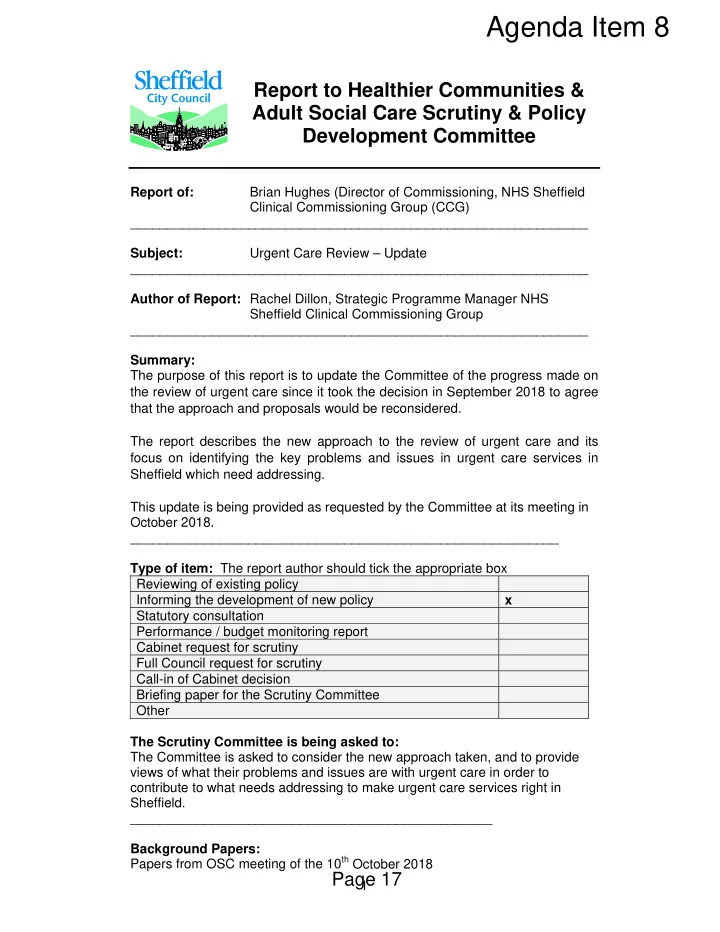
Agenda Item 8 Report to Healthier Communities & Adult Social - - PDF document

agenda item 8
SMART_READER_LITE
LIVE PREVIEW

Agenda Item 8 Report to Healthier Communities & Adult Social - - PDF document

Agenda Item 8 Report to Healthier Communities & Adult Social Care Scrutiny & Policy Development Committee Report of: Brian Hughes (Director of Commissioning, NHS Sheffield Clinical Commissioning Group (CCG)


slide-1
SLIDE 1

1 Report of: Brian Hughes (Director of Commissioning, NHS Sheffield Clinical Commissioning Group (CCG) ______________________________________________________________ Subject: Urgent Care Review – Update ______________________________________________________________ Author of Report: Rachel Dillon, Strategic Programme Manager NHS Sheffield Clinical Commissioning Group ______________________________________________________________ Summary: The purpose of this report is to update the Committee of the progress made on the review of urgent care since it took the decision in September 2018 to agree that the approach and proposals would be reconsidered. The report describes the new approach to the review of urgent care and its focus on identifying the key problems and issues in urgent care services in Sheffield which need addressing. This update is being provided as requested by the Committee at its meeting in October 2018. __________________________________________________________ Type of item: The report author should tick the appropriate box Reviewing of existing policy Informing the development of new policy x Statutory consultation Performance / budget monitoring report Cabinet request for scrutiny Full Council request for scrutiny Call-in of Cabinet decision Briefing paper for the Scrutiny Committee Other The Scrutiny Committee is being asked to: The Committee is asked to consider the new approach taken, and to provide views of what their problems and issues are with urgent care in order to contribute to what needs addressing to make urgent care services right in Sheffield. _________________________________________________ Background Papers: Papers from OSC meeting of the 10th October 2018

Report to Healthier Communities & Adult Social Care Scrutiny & Policy Development Committee

Page 17

Agenda Item 8

slide-2
SLIDE 2

2 Category of Report: OPEN

Page 18

slide-3
SLIDE 3

3

Report of the Director of Commissioning, NHS Sheffield Clinical Commissioning Group Update on the Urgent Care Review

1. Introduction/Context 1.1. The CCG undertook a consultation between September 2017 and January 2018, seeking public input into the proposals to reducing duplication and simplifying access to urgent care services; improving access to urgent care in GP practices; and reducing pressure on A&E. Following the consultation, analysis was undertaken of the feedback, reviewing the vision and objectives, considering the feedback in detail and exploring whether the issues could be mitigated and reviewing the alternative suggestions put forward. A final report and recommendations was taken to the CCG’s Primary Care Commissioning Committee (PCCC) in September 2018. It was agreed that the approach and proposals would be reconsidered. This is because whilst feedback was supportive of:  The vision to ensure the most appropriate responses in the most appropriate setting that is easy to understand and access  More urgent care in practices,  A Children’s’ Urgent Treatment Centre (UTC),  And no negative evidence of the concept of an Adult Urgent Treatment Centre, 1.2. Many did not agree with the way we were proposing to achieve the

  • proposals. There was considerable opposition to the siting of a UTC at

the Northern General Hospital, there were also a number of alternative suggestions put forward worth exploring and possible opportunities to do more to reduce health inequalities. 1.3. Since the PCCC meeting, the CCG have evaluated the approach taken to date to identify lessons learnt and started to undertake a refresh of the work, engaging widely with partners and public, knowing that a do nothing option is not viable. 2. New approach 2.1. We need to be absolutely clear what the problems and issues in urgent care are and to gain the buy in to these, to make urgent care right in Sheffield now and for the future. 2.2. Our new approach is based on the lessons learnt and feedback we received from our partners and public from the last consultation. In summary, these were:  A clearer narrative would have assisted in the understanding of what we wanted to achieve. We covered a range of ideas within the consultation document, including neighbourhoods, primary care

Page 19

slide-4
SLIDE 4

4 extended access hubs and broader primary care access. This meant

  • ur core proposals were somewhat lost and we were challenged for

not being clear enough.  Whilst our pre-engagement and consultation engagement was extensive, there were specific groups we could have engaged further.  The public were keen to see more data and information to help them understand our problems and issues and more could have been done to make it more widely accessible.  More engagement with our partners, stakeholders and public could have been undertaken in the shaping of our options and selection criteria. 3. Progress to date 3.1. Based on the above, the first step has been to develop a collective understanding of the urgent care problems and issues with our partners and public. It is crucial to do this before considering how these might be addressed and what solutions are needed. Since December we have been:  Working together with partners and the public transparently to agree what needs to improve and why  Engaging staff at all levels to bring in their views of urgent care services  Engaging with communities we did not engage with first time round to understand more of their experiences of urgent care.  Seeking public views about why they use the urgent care services they choose to go to.  Making data and information more accessible to public as problems and issues are identified.  Working on developing clear language and communication which is concise and universally understood. 3.2. We have not started from scratch. There is a wealth of information drawn from our pre consultation engagement, engagement during and after the consultation which we are using to inform the review. 3.3. We recognise that the development of our original objectives to address challenges of increasing demand, pressure on services and workforce sustainability was undertaken in the early stages of the Accountable Care Partnership (ACP). These challenges are system wide and therefore we are refreshing our approach and tackling these challenges with partners within the ACP context. Further detail of the work we are doing is in Appendix 1 and 2. A presentation is also provided to share the work we are doing.

Page 20

slide-5
SLIDE 5

5 4. Timeline 4.1. The first phase of the new approach started in December 2018. As described above, this includes gathering data/intelligence/experience from partners and public on what the problems and issues are in urgent care in order to identify the main strategic objectives. The aim is to complete this part of the stage by the end of March. Then as described above, the problems and issues will be taken to system partners and the CCG’s Primary Care Commissioning Committee in April to gain sign up of this stage and agree the approach thereafter. A decision will be made on what the key problems are and which order they are tackled. This will determine the focus of the work going forwards and how it is done. 5. What does this mean for the people of Sheffield? 5.1. The people of Sheffield have another chance to voice their issues with and solutions for urgent care services in Sheffield. We have launched an online survey for the people of Sheffield to voice their views and share why they use the services they do. This will give us a much richer view of why and who uses our urgent care services. 6. Recommendation 6.1. This report provides an update of the urgent care review now in

  • progress. The committee is asked to:

6.1.1. Note the report and refresh of the approach 6.1.2. Comment on anything further we should be doing as part of the review 6.1.3. Provide views of the current problems and issues, they and their communities face in urgent care services.

Page 21

slide-6
SLIDE 6

6 Appendix 1 Engagement Plan Gaps in what we know and gaps in who we have heard from:

  • Views from black, traveller and Roma Slovak communities
  • Views from patients at practices that have highest walk in centre

attendances (eg Darnell)

  • Communities in north and east of the city – main source of feedback was

telephone survey

  • Gleadless Valley and Lowedges – heard lots about these areas from

politicians but not much directly from people living there

  • Areas of greatest deprivation
  • Disability – although views not different from those generally expressed,

need to do more to take into account specific issues of sub-group especially people with physical disability and learning disability and mental health problems

  • Different views heard re homeless in consultation and engagement – need

to explore further

  • Individual GP views
  • Staff working in urgent care services
  • Students
  • People with substance misuse problems
  • CCG staff
  • Face to face engagement of overrepresented and underrepresented urgent

care users, and those underrepresented in previous engagement and consultation. Qualitative - targeted

  • Face to face engagement working with community groups and cross health

working group as identified above

  • In-situ surveys with patients in walk in centre, minor injuries centre, A&E

and the hubs.

  • Alongside this we will engage people from groups we have already reached

to give them an opportunity to share anything else via social media. Quantitative – general population

  • Engagement with general population using social media – surveys

promoted through our Facebook and Twitter

  • Polls on Twitter (and using existing networks to circulate and share).

Co-production

  • Workshops on defining problem and issues

Page 22

slide-7
SLIDE 7

7 Appendix 2 Workshop Programme Update Workshop 1 Partners – 4th December 2018

  • To develop a collective view of the problems the system faces delivering

urgent care and their root causes (case for change)

  • To draft objectives to address the problems that all partners can identify

with and help deliver Workshop 1 Public Reference Group– 11th December 2018

  • To develop a collective view of the problems Sheffield faces regarding

urgent care

  • To draft objectives to solve the problems

Workshop 2 Public Reference Group and Partners – 10th January 2019

  • To continue to develop a collective view of the problems Sheffield faces

regarding urgent care

  • Revisit the draft objectives to solve the problems
  • Gain a common understanding of what urgent care services look like in

Sheffield

  • Map the current patient journey

Workshop 3 Public Reference Group and Partners – 14th February 2019  Continue to identify current pathways/patient journeys – through feedback so far.  Revisiting the problems and issues – have we captured everything from the patient journey information  Urgent Care services – what is available in Sheffield  Which areas are the most important and/or need most improvement.

Page 23

slide-8
SLIDE 8

8 Appendix 3 Information shared with the Public Reference Group on Sheffield demand and need of Urgent Care Services and discussed at Workshop 2.

Page 24

slide-9
SLIDE 9

9

Page 25

slide-10
SLIDE 10

10

Page 26

slide-11
SLIDE 11

Healthier Communities & Adult Social Care Scrutiny and Policy Development Committee 27th February 2019

Urgent Care Review

Page 27

slide-12
SLIDE 12

Inform the Committee on the new approach and current position of the Urgent Care Review To develop a collective view of the problems Committee members face regarding urgent care Aims of presentation

Page 28

slide-13
SLIDE 13

Our work so far

Page 29

slide-14
SLIDE 14

First workshops with Public Reference Group and partners in December

  • Seek issues and problems and what works in Sheffield

Design group – first met 20 December 2 workshops after Christmas (staff and members of the public) to review urgent care – Learn more about patient journeys – why do people chose the services they do. – What do urgent care services look like in Sheffield On line survey for wider public. Engagement in hard to reach communities not captured in first consultation

Work so far to determine the key problems and issues which need to be addressed.

Page 30

slide-15
SLIDE 15

Key Outputs so far.

Page 31

slide-16
SLIDE 16

Workshop Outputs

Page 32

slide-17
SLIDE 17

Definition of Urgent Care

Urgent Care means

  • Advice and treatment for illness and injuries for all

ages thought to be urgent (within 24 hours) - but not life threatening. This does NOT mean Emergency care

  • Which is for people with serious illness or injury or life

threatening conditions that need immediate medical attention. Illness includes mental and physical health

Page 33

slide-18
SLIDE 18

Key Problems so far..

confusing and inconsistent PATHWAYS ineffective use of and lack of RESOURCE inconsistent and lack of KNOWLEDGE issues with CULTURE and BEHAVIOUR

Page 34

slide-19
SLIDE 19

Page 35

slide-20
SLIDE 20

Engagement Outputs

Page 36

slide-21
SLIDE 21

Last 4 weeks

Engagement

  • 77 semi-structured interviews / patient journeys

– 59 from Lowedges, Batemoor and Jordanthorpe which includes people with learning disabilities, with English as a second language, people living with complex mental health conditions and physical impairments – 18 from Darnall – includes people living with mental health conditions, respiratory conditions and physical impairments

  • Online survey launched to target general public and gain quantitative

information Communications

  • Promotion of survey in media and social media, and with student population

via universities

  • Updated web pages
  • Updates to Sheffield Clinical Commissioning Group Patient Engagement,

Experience and Equality Committee meeting

Page 37

slide-22
SLIDE 22

Next 4 weeks

Engagement

  • 30 semi-structured interviews with Roma, Slovak and traveller community
  • Increase number of semi-structured interviews and patient journeys with:

– People who live with respiratory conditions – People with physical impairments and learning disabilities – People with mental health conditions – People in waiting rooms at the WIC, MIU, Children’s A&E, Adult A&E

  • Begin semi-structured interviews and patient journeys with:

– People who are likely to break / dislocate joints – In General Practice waiting rooms – People with sensory impairments – Homeless community (particularly via Nomad) – People with experience of substance misuse

Communications

  • Latest position on review in new CCG stakeholder briefing.
  • Continue to promote online survey
  • PR on extended access hubs
  • Infographics on key themes from each key group
  • Social media/ media on latest workshops

Page 38

slide-23
SLIDE 23
  • Refresh - Problems and Issues?
  • What’s good?
  • Can you help with the engagement into

hard to reach communities?

Over to you…… We need to incorporate your views and your local communities views.

Page 39

slide-24
SLIDE 24
  • Two workshops in February
  • On line Survey for public and staff
  • Patient Journeys
  • Community group engagement
  • Practice engagement
  • Present Findings in March/April to achieve

system collective understanding and sign up.

Summary and next steps

Page 40

slide-25
SLIDE 25
  • Questions
  • https://www.surveymonkey.co.uk/r/sheffieldurgentc

are2019

  • Email us on sheccg.engagementactivity@nhs.net
  • Twitter: @NHSSheffieldCCG
  • Facebook: www.facebook.com/NHSSheffieldCCG
  • Write to us: NHS Sheffield CCG, 722 Prince of

Wales Road, Sheffield S9 4EU

CONTACT US

Page 41

slide-26
SLIDE 26

This page is intentionally left blank