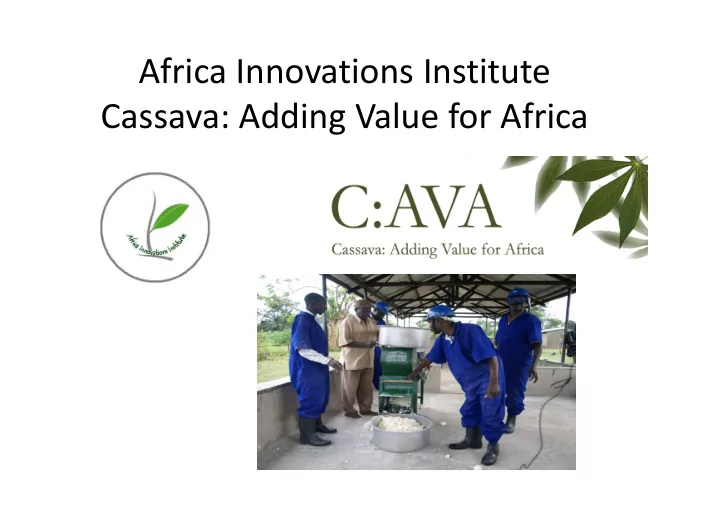
SLIDE 1
Africa Innovations Institute Cassava: Adding Value for Africa
SLIDE 2
Report period: Apr 2011 to Mar 2012
Francis O. Alacho, C:AVA Country Manager, Uganda
SLIDE 3 C:AVA Uganda key milestones
- 2,592 farmers benefitting by an average of $102
per year.
- 2,398 farmer processors benefitting by an
average of $125 per year.
- 792 t of cassava grits/HQCF produced with
consistent quality.
- 792 t of cassava grits/HQCF purchased by end‐
user industries.
SLIDE 4 Cumulative beneficiary targets:
Sn Beneficiary category Target Achieved Achieved (%)
2,592 3,188 108
2,398 2,463 103
SLIDE 5
Beneficiaries segregated by sex
Sn Farmer category Female (%) Male (%) 1. Farmers 55 45 2. Farmer processors 57 43
SLIDE 6
HQCF/cassava grits production (tons) (April 2011 to March 2012)
Sn Intermediary (Association) Cassava grits/HQCF (t) Gari Tapioca 1. PATA 284.9 42 2 2. EAPPA/SOSPPA 416.9 ‐ ‐ 3. P’KWII 103.5 ‐ ‐ Total 805.3 42 2
SLIDE 7 HQCF/cassava grits production (tons) (April 2011 to March 2012)
284.9 416.9 103.5 PATA EAPPA P'KWII
SLIDE 8
Annual industry HQCF market demand
Industry Actual sales Estimated annual demand (MT) Demand met (%) Biscuits 2 2,400 0.08 Paperboard 177 2,400 7.4 Rural bakeries 275.1 1,200 22.9 Agri‐foods 388.9 600 64.8 Total 805.3 6,600 12.2
SLIDE 9
Potential HQCF market demand met
SLIDE 10
Pricing of cassava products
SLIDE 11
Price trends for wheat & HQCF
SLIDE 12
Fuel prices vs dollar exchange rates
SLIDE 13
Price trends of HQCF vs Fresh tubers
SLIDE 14 UNBS lab test results
Test Parameter Test result Specs Status SOSPA PATA Sample 0041 Sample 0042 Sample 0040 Sample 0043 Total plate count (cfu/g) 44,000 44,000 62,000 11,000 100,000 (max) Pass Total coliforms (MFN/g) >1,100 3 240 3.6 NA Pass Escherichia coli (MPN/G) <3 <3 <3 <3 <1 (cfu/g) Pass Salmonella Not detected Not detected Not detected Not detected Shall be absent Pass Yeast and moulds (cfu/g) 4,100 900 2,600 2,400 500 (max) Fail Moisture content (%m/m) 12.4 11.3 10.8 10.6 13.0 (max) Pass Total ash (%m/m on dry basis) 1.1 1.3 1.3 1.4 3.0 (max) Pass Acid insoluble ash (%m/m on dry basis) 0.09 0.1 0.1
0.35 (max) Pass Flavours & odours Normal Normal Normal Normal normal Pass Filth Absent Absent Absent Absent absent Pass
Living insects Absent Absent Absent Absent absent Pass
SLIDE 15 Observations
- Women tend to experiment more?.
- Women tend to take on new innovations
faster ?.
- Women are also the majority members in the
groups.
- Traditionally women process cassava
SLIDE 16 More observations
- In PATA the largest producer is a woman for both
HQCF and exclusively gari, tapioca and starch for a niche market.
- Women also dominate the small baking industry
based on HQCF.
- Bulk of HQCF produced by executive committee
male members of associations who purchase from both members and non‐members.
SLIDE 17 Success stories
cakes, doughnuts, mandazi, chapatti with HQCF to pure wheat by locals in eastern Uganda (customer is king).
- Increased visibility ( TV Dec and Feb 2012, FM
radios).
- Attracted visits from Somalia, Rwanda, South
Sudan, Local & central governments.
SLIDE 18
Trainees during baking course (Dec 2011)
Sn Category Number trained 1. PATA 43 2. EAPPA 44 3. P’KWII 44 4. Women (%) 58.7 5. Men (%) 41.3 6. Rural bakers 16 (12.2 %)
SLIDE 19
Training in baking using HQCF
SLIDE 20
HQCF/cassava grits sales markets (t)
SLIDE 21
Sales by processing sites
SLIDE 22
Model rural HQCF processing site at PATA showing selected features
SLIDE 23
Selected features in a model HQCF processing site.
SLIDE 24 Rural enterprises based on HQCF value chain
- Event management (wedding cakes, graduation
cakes, tents, chairs).
- Harvesting fresh tubers.
- Peeling, water, washing, grating, drying, bagging.
- Milling.
- Fabrication workshop at Soroti.
- Mobile
equipment repair and maintenance workshop.
- Transport by ox carts & buses.
SLIDE 25 Mrs Zainabu Akol’s story
Zainabu in her cassava garden Zainabu feeds turkeys she bought with cassava sales Zainabu in her orange garden with manure from livestock Zainabu with cattle she bought from
SLIDE 26 Michael Ikara’s story
(P’KWI farmer in Bukedea)
Changes in the livelihood and agricultural practices Narration of captions
Ikara plants in rows & weeds promptly at recommended spacing Ikara’s dwelling house before C:AVA project Ikara has sold
and has constructed a dwelling house Ikara in his Ox‐ weeded cassava garden using “magic plough”
SLIDE 27
Joseph Engwedu’s SME story
(owner of Josa investments, baker of Fena bread)
Extract from SME focus New Vision Feb 23rd 2012
“I was surprised by the delicacy of bread I made with the partial substitution of HQCF, now I know that using HQCF will ultimately widen my market base”
Joseph Engwedu with Mrs Ekinyu
SLIDE 28
Eugene Ekinyu’s story
SLIDE 29
Eugene Ekinyu story
(extract from New vision, January 12th 2012 page 30, under “Growing business”) He has so far sold over 45 tons of HQCF and said….”I have managed to educate my children. Other members of the association have been able to construct iron sheet‐roofed homes and educate their children, while others have bought land to expand their farms”
SLIDE 30
Merab Apiny an emerging baker
Merab Apiny a baking course trainee who has initiated a mini‐bakery in Soroti town
SLIDE 31 More Achievements
processors/Associations attended Agricultural shows e.g World food programme show at Serere P’IKWI was best exhibitor, Jinja show.
- Training by Uganda National Bureau of standards
(UNBS) and Ministry of Trade, Tourism and Industry (MTTI) on hygiene and sanitation.
SLIDE 32
P’KWI innovations
SLIDE 33 Development of East African Cassava and sweetpotato standards
- National consultation for East African standards
for cassava and sweetpotato, Kampala, March 28‐ 30th 2012 (AfrII/C:AVA, UNBS, Britannia, Makerere, CIP).
- Regional harmonisation meeting at Arusha April 2‐
4, 2012 (AfrII/C:AVA, Britannia, UNBS, Makerere, CIP to participate).
- ASARECA the coordinator and convener.
- One of the standards is specifically for HQCF.
SLIDE 34 Challenges
Challenge How it has been addressed Governance
associations ‐Involved the District Commercial Officers and Health and Environmental Officers to help streamline the
- perations of associations as per legal requirements.
- Equity.
- Prepared HQCF production rosters involving all
groups having time ring‐fenced.
- Most paid labour is by women.
- Slow
pace
UNBS certification.
- Agreed with Britannia to carry out own quality audit.
- Need to use results from other labs e.g UIRI,
Makerere and NRI.
- Lobbying and advocacy for policies favourable to
small scale processors.
SLIDE 35 Challenges encountered
Challenge How it has been addressed CBSD. ‐Farmers advised to plant Migyera (NASE 3, 4271, NASE 1 ). ‐Partnering with research to verify durable field tolerance of new varieties e.g 4271. Competition
local cassava chips ‐ HQCF is sold in bulk and has a constant upward price. ‐Negotiating with end‐users to increase the prices. ‐ High price of local Cassava chips increases profitability to farmers. Labour and capital intensive ‐Provided oxen and ox‐carts. ‐Process using unpaid group labour except for fuel and equipment operations and association commissions.
SLIDE 36
Challenges continued
Challenge How it has been addressed Reliance on weather ‐Maximised processing during Dec‐March dry period with 2 to 3 rounds of sundrying per day. ‐Trained farmers in Gari processing to convert HQCF that ferments.
SLIDE 37 Lessons learnt
- Sun drying is a viable cost‐effective drying
method for cassava grits.
- Pays to have several market segments.
- Small scale HQCF processors can support HQCF
value chain but would need adequate & sustained coordination and quality control mechanisms.
SLIDE 38 Strategy for sustainability, intensification & scaling out
- AfrII is promoting a buy‐in and mainstreaming of
development
HQCF value chains in the development plans of public agencies.
- Thru Concept notes and MOUs.
- Ministry of Finance Planning and Economic
Development (MFPED) import substitution and youth employment.
Industrial Research Institute (UIRI) Technology Incubation Centre.
SLIDE 39 Strategies
- NAADS to support HQCF value chain in Kole and Soroti.
- Higher and Local governments using Northern Uganda
Social Action Fund (NUSAF) funds to scale out HQCF value chain in Oyam district.
- Non‐governmental organisations such as World Food
programme (WFP), World vision, FAO, Africa Farm Radio to scale out HQCF processing in Soroti.
- Ministry of Agriculture Animal Industry and Fisheries
(MAAIF) Seed system strategy to manage CBSD.
- This calls for a cassava innovation platform.
SLIDE 40 Strategies cont’d
- Involve the private sector agencies in the
production of HQCF.
- Strengthen the current associations in terms of
resource mobilization, networking, business skills, marketing and institutional development and develop an exit strategy as they transform from welfare to commercial entities.
SLIDE 41
Sights of Uganda
SLIDE 42
Thank you