
SLIDE 1
Aerial Lift Safety in Construction
Michael McCann, PhD, CIH
Director of Safety and Ergonomics
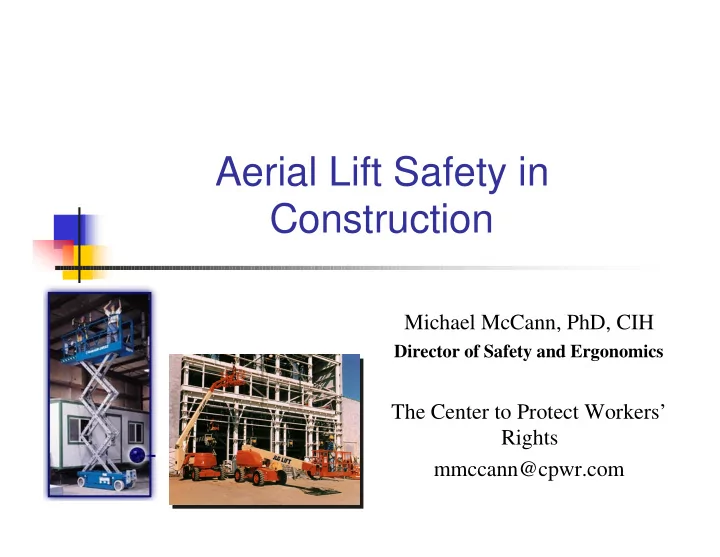
Aerial Lift Safety in Construction Michael McCann, PhD, CIH - - PowerPoint PPT Presentation
Aerial Lift Safety in Construction Michael McCann, PhD, CIH Director of Safety and Ergonomics The Center to Protect Workers Rights mmccann@cpwr.com Deaths from Aerial Lifts in Construction From 1992-99, there were 26 deaths per year
Director of Safety and Ergonomics
From 1992-99, there were 26 deaths per year
18 per year from boom-supported lifts 8 per year from scissor and other vertical
This is 3% of all deaths in construction
Struck by/against Caught in/between Collapses/tipovers Falls Electrocutions 9% 5% 7% 30% 17% 44% 26% 11% 43% Scissor lifts = 64 deaths Boom-supported lifts = 144 deaths
#Data for scissor lifts do not meet Bureau of Labor Statistics publication criteria Source: U.S. Bureau of Labor Statistics data
% of Deaths #
O t h e r t r a d e s * * * I r o n w o r k e r s * * C a r p e n t e r s P a i n t e r s C o n s t r u c t i o n l a b o r e r s E l e c t r i c a l w o r k e r s * 3 8 % 2 9 % 4 % 4 % 1 6 % 7 % 2 3 % 1 2 % 2 2 % 4 5 % S c i s s o r l i f t s B o o m - s u p p o r t e d l i f t s
# D a t a f r o m s c i s s o r l i f t s d o e s n o t m e e t B u r e a u o f L a b o r S t a t i s t i c s p u b l i c a t i o n c r i t e r i a * Electricians, electrician apprentices, power installers, and their supervisors * * S t r u c t u r a l m e t a l w o r k e r s a n d w e l d e r s a n d c u t t e r s * * * I n c l u d e s p l u m b e r s , p i p e f i t t e r s a n d s t e a m f i t t e r s , b r i c k m a s o n s a n d s t o n e m a s o n s , drywall installers S o u r c e : U . S . B u r e a u o f L a b o r S t a t i s t i c s d a t a
# # % o f D e a t h s
Electrocutions – almost all due to overhead power lines
1/2 of electrocutions involved body contact with overhead power lines One-third involved overhead power lines contacting lift booms or
buckets
Falls
1/2 of fatal falls involved ejection from the bucket after worker or lifts
was struck by vehicles, cranes or objects.
1/6 occurred while transferring to or from the bucket at a height
Collapses/tipovers
2/5 of deaths involved collapse of boom Almost one-third were due to tipovers. 1/4 involved collapses of bucket
Caught in /between
Most involved the worker getting caught between the bucket edge
and a roof joist or beam.
Struck by/against
Mostly involved workers being struck by collapsing materials,
girders, etc.
Falls
1/5 of deaths involved ejections, after being struck by object Cause of fall unknown in 3/5 of deaths Other causes included removal of chains, standing on or
leaning over railings
Caused almost 1/3 of scissor lift deaths Mostly while elevated over 15 feet 1/4 of tipovers occurred where lift hit a hole or curb while
moving
1/2 involved overhead power lines
Get maintenance history of aerial lift Get operator’s manual and maintenance manual (if separate) Ensure a detailed maintenance check is done before rental Make sure operator controls are easily accessible and properly
Training must be done by a qualified person experienced
Training must include:
lift
materials, bucket liner, etc.)
aerial lift
OSHA 1926.450(b)
Training of mechanics should be done by qualified person
Maintenance should include:
Insulated aerial lifts have special electrical test
De-energize and lockout/tagout aerial lift before
Do not modify aerial lift without written permission Check safety devices, operating controls before each use Check area in which aerial lift will be used for:
Set outriggers, brakes, wheel chocks
Non-electrical workers must stay at least 10 feet away
Electrical workers must de-energize/insulate power lines or
Use insulated buckets near overhead power lines Regularly check insulation on buckets
Do not exceed manufacturer rated load capacity limits Do not travel to job location with lift in elevated position. Set up proper work zone protection when working near
Positioning of lifts
Avoid excessive horizontal forces when working on
OSHA regulates aerial lifts as scaffolds
with 2-foot lanyard as restraint device)
scissor lifts if there are guardrails
Fall arrest systems (harness plus lanyard to stop a fall)
Always close entrance chains or doors Stand on floor of bucket or lift platform
This research was funded as part of a grant to the Center to Protect Workers’ Rights (CPWR) from the National Institute for Occupational Safety and Health, NIOSH (NIOSH grant CCU310982). The research is solely the responsibility of the authors and does not necessarily represent the official views of NIOSH. CPWR is the research, development, and training arm of the Building and Construction Trades Department, AFL-CIO.