Advection (or Convection) Solute (contaminant) gets transported - - PowerPoint PPT Presentation

advection or convection
SMART_READER_LITE
LIVE PREVIEW

Advection (or Convection) Solute (contaminant) gets transported - - PowerPoint PPT Presentation

IIT Bombay Slide 4 Advection (or Convection) Solute (contaminant) gets transported (seepage velocity) t 0 along with the flowing fluid (water) in response to a gradient (hydraulic). V s = k.i/ t 1 If a mass of solute (non reactive) of


slide-1
SLIDE 1

Advection (or Convection)

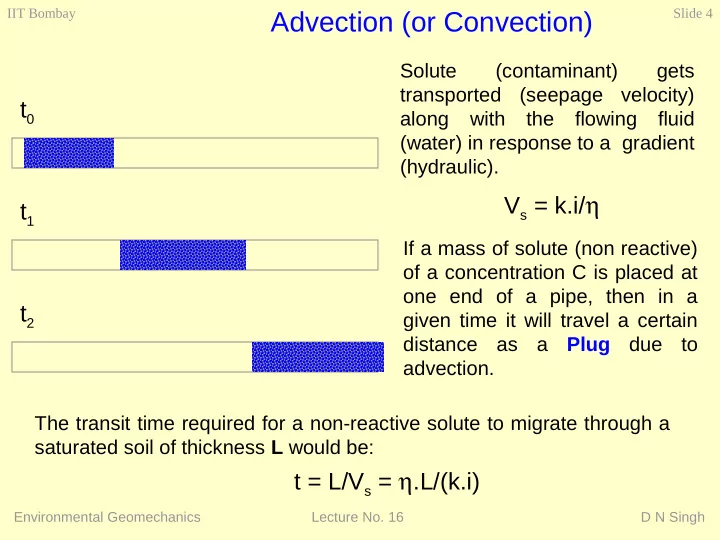
Solute (contaminant) gets transported (seepage velocity) along with the flowing fluid (water) in response to a gradient (hydraulic).

t0 t1 t2 Vs = k.i/η

If a mass of solute (non reactive)

  • f a concentration C is placed at
  • ne end of a pipe, then in a

given time it will travel a certain distance as a Plug due to advection. The transit time required for a non-reactive solute to migrate through a saturated soil of thickness L would be:

t = L/Vs = η.L/(k.i)

Environmental Geomechanics Lecture No. 16 D N Singh IIT Bombay Slide 4

slide-2
SLIDE 2

Description η Soils GC, GP, GM,GS 0.20 SW,SP,SM,SC

  • ML, MH

0.15 CL,OL, CH, OH, PT 0.01 Rocks Non fractured rocks 0.15 Fractured rocks 0.0001

Representative values for effective porosity

The advective mass flux, J, (or the mass flowing through a unit cross sectional area in a unit of time) is:

J =v.C=k.i.C

C = concentration of the solute (i.e., the mass of solute per unit volume

  • f the mixture).

Environmental Geomechanics Lecture No. 16 D N Singh IIT Bombay Slide 5

slide-3
SLIDE 3
  • Solutes (contaminants) migrate due to

their chemical activity in the absence of bulk fluid flow.

  • From higher concentration to lower

concentration area.

  • Difference in contaminant concentration

is the concentration gradient.

  • Diffusion ceases when concentration

gradient becomes negligible.

Contaminant at concentration C0 at t0 Contaminant concentration = 0 at t0

Sample

  • Time after introduction of contaminant

= t

  • Relative contaminant concentration

=Ct/C0

Diffusion

1.0 0.5

to t Ct/C0 < 1.0 Ct / C0 Environmental Geomechanics Lecture No. 16 D N Singh IIT Bombay Slide 6

slide-4
SLIDE 4

Diffusion

  • Add small amount of dye in a fluid
  • Pulse gets spread out

Add continuous dye-- a sharp front

Environmental Geomechanics Lecture No. 16 D N Singh IIT Bombay Slide 7

slide-5
SLIDE 5

Types of Diffusion

  • Steady State Diffusion
  • Diffusion flux constant with time
  • Fick’s First law applicable
  • Non Steady-state Diffusion
  • Concentration gradient non-uniform
  • Follows Fick’s second law

( ) ( ) 

     ∂ ∂ ∂ ∂ = ∂ ∂ x t x C D x t t x C , ,

JD =-D.η.(∆C/∆x)

D = diffusion coefficient [L2/T] η= porosity ∆C/∆x = concentration gradient (i.e., change in concentration with distance)

Environmental Geomechanics Lecture No. 16 D N Singh IIT Bombay Slide 8

slide-6
SLIDE 6

Chemical Energy Field

  • To study the mechanism(s) of contaminant transport –
  • the intact and fractured rock samples (Gurumoorthy 2002)
  • diffusion characteristics of the saturated and unsaturated

soils (Rakesh 2005)

  • Investigations using the Cl-, I+2, Cs+1 and Sr+2 in their active

as well as inactive forms

  • Development of Diffusion Cell

Environmental Geomechanics Lecture No. 16 D N Singh IIT Bombay Slide 9

slide-7
SLIDE 7

CONTAMINANT TRANSPORT MODELING THROUGH THE ROCK MASS

Fractured Rock mass (FRM) Co Ct Intact Rock mass (IRM) C0 Ct Ct

Diffusion cells

Environmental Geomechanics Lecture No. 16 D N Singh IIT Bombay Slide 10

slide-8
SLIDE 8

7 min. 50 days 6 m thick FRM 75 min. 520 days 0.3 m thick IRM (Di)m=(Di)p

( ) ( )

t t x, C α x t x, C D

2 2 i

∂ ∂ = ∂ ∂

      − × = 6V aL LV a D C C

i t

α t a s.L.V Di =

2000 4000 6000 8000 10000 10 20 30 40 Intact rock mass 2000 4000 6000 8000 10000

C

t/C 0 (x10

  • 4)

Fractured rock mass

N 33 50 75 100

Time (s)

1 10 100 10

1

10

2

10

3

10

4

10

5

10

6

y=1.8

Intact rock mass Fractured rock mass

y=1.97

Diffusion time (s)

N

tm=tp.N-2

Diffusion characteristics

Fractured Rock mass (FRM) Co Ct Intact Rock mass (IRM) C0 Ct Ct

Diffusion cells

CONTAMINANT TRANSPORT MODELING THROUGH THE ROCK MASS

Environmental Geomechanics Lecture No. 16 D N Singh IIT Bombay Slide 11

slide-9
SLIDE 9

70

30

U C 60 A A′ B B′

60

Modeling Diffusion in soils using impedance spectroscopy (IS)

Diffusion cell Impedance value of the soil is measured by using LCR meter Diffusion of contaminant can be monitored by determining the change in the impedance of the soil

Environmental Geomechanics Lecture No. 16 D N Singh IIT Bombay Slide 12

slide-10
SLIDE 10
  • Break-through curve
  • The slope of the break-through curve diffusion coefficient, D
  • Archie’s law (D=ξ.ηm) porosity of the geomaterials

Environmental Geomechanics Lecture No. 16 D N Singh IIT Bombay Slide 13