ADVANCED SPORTS TAPING Chemical Reaction Allergic Response Who is - - PDF document

advanced sports taping
SMART_READER_LITE
LIVE PREVIEW

ADVANCED SPORTS TAPING Chemical Reaction Allergic Response Who is - - PDF document

Types of Skin Reactions to Tape Physical Irritation ADVANCED SPORTS TAPING Chemical Reaction Allergic Response Who is at Risk From Tape Preventing Skin Reaction to Tape Reactions? Red hair/ fair skin. Elderly skin.


slide-1
SLIDE 1

ADVANCED SPORTS TAPING

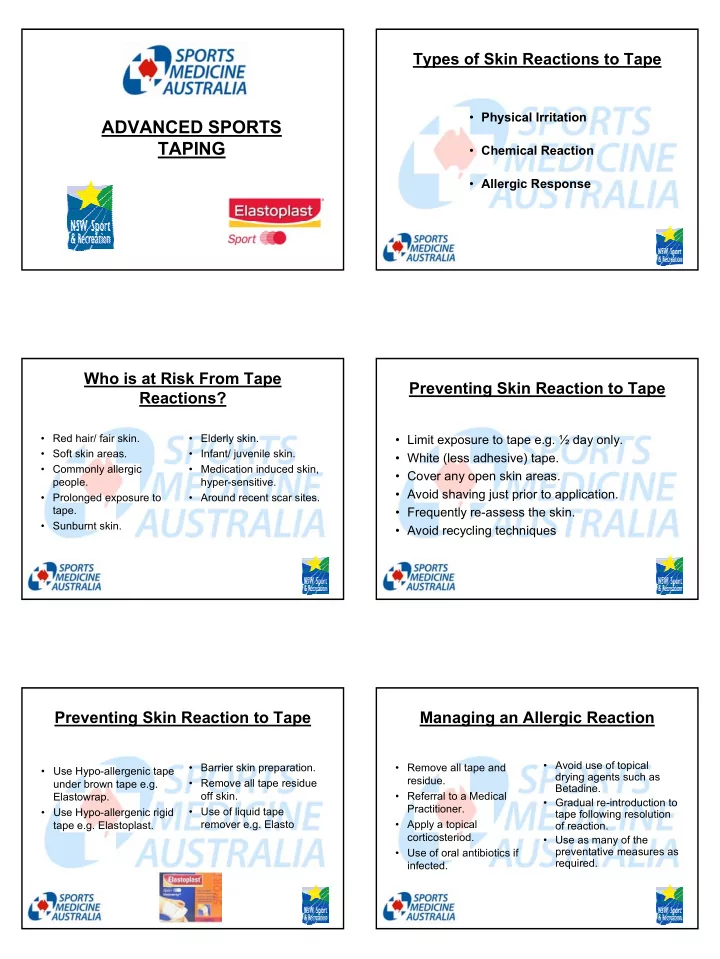
Types of Skin Reactions to Tape

  • Physical Irritation
  • Chemical Reaction
  • Allergic Response

Who is at Risk From Tape Reactions?

  • Red hair/ fair skin.
  • Soft skin areas.
  • Commonly allergic

people.

  • Prolonged exposure to

tape.

  • Sunburnt skin.
  • Elderly skin.
  • Infant/ juvenile skin.
  • Medication induced skin,

hyper-sensitive.

  • Around recent scar sites.

Preventing Skin Reaction to Tape

  • Limit exposure to tape e.g. ½ day only.
  • White (less adhesive) tape.
  • Cover any open skin areas.
  • Avoid shaving just prior to application.
  • Frequently re-assess the skin.
  • Avoid recycling techniques

Preventing Skin Reaction to Tape

  • Use Hypo-allergenic tape

under brown tape e.g. Elastowrap.

  • Use Hypo-allergenic rigid

tape e.g. Elastoplast.

  • Barrier skin preparation.
  • Remove all tape residue
  • ff skin.
  • Use of liquid tape

remover e.g. Elasto

Managing an Allergic Reaction

  • Remove all tape and

residue.

  • Referral to a Medical

Practitioner.

  • Apply a topical

corticosteriod.

  • Use of oral antibiotics if

infected.

  • Avoid use of topical

drying agents such as Betadine.

  • Gradual re-introduction to

tape following resolution

  • f reaction.
  • Use as many of the

preventative measures as required.

slide-2
SLIDE 2

Acromioclavicular (A/C) Joint Sprain

Source: http://www.pueblo.gsa.gov/cic_text/health/sports/shoulder.gif

Shoulder - Acromioclavicular (A/C) Joint Sprain

Preparation: Position the shoulder at a 45 degree angle by resting the forearm on a bed or table.

  • A. Apply Elastowrap stretch (5 or 10cm) as skin
  • protection. Leukofoam pads are cut (Circle and

Rectangle) to protect the nipple and bony prominence

  • f the AC joint.
  • B. Two vertical anchors of Elastoplast rigid tape are

applied over the shoulder girdle.

Shoulder Acromioclavicular (A/C) Joint Sprain (continued)

  • C. Two transverse (horizontal) anchors around the

chest below nipple.

  • D. Two anchors are applied on the humerus at the

level of the Deltoid insertion.

  • E. Tow diagonal strips in one direction are then

applied from the shoulder anchor to the Deltoid anchor. Note: Larger shoulders may need three strips

Shoulder Acromioclavicular (A/C) Joint Sprain (continued)

  • F. Two diagonal strips are repeated in the
  • pposite direction. Extra diagonal strips can

also be applied alternately for added support.

  • G. Locking strips on the anchors reinforce and

complete the procedure by covering the ends of the diagonal strips.

Anterior Shoulder Dislocation Prevention

  • A. Prepare skin. Prepare shoulder with

Fixomull, nipple Orthopaedic Leukofoam Pad and vertical and transverse anchors, as directed for A/C joint taping.

  • B. Position shoulder/ arm at the end of range
  • f desired movement. This position will most

probably be 90 degrees abduction (or just short of), horizontal flexion and internal rotation.

Anterior Shoulder Dislocation Prevention (continued)

  • C. Apply desired number of strips of sports tape

starting from the deltoid anchor, anteriorly and down, around the arm to the back of the upper arm, over the top and front of shoulder finishing at the vertical anchors. At 90 degree abduction the taping should limit/ prevent external rotation and horizontal extension, that is “putting the arm in a coat position”.

  • D. Lock off.
slide-3
SLIDE 3

Foot Taping (Medial Longitudinal Arch)

Applications: Pronation correction, plantar fasciitis, shin soreness and hallux valgus (adapted). Technique: Anchor (proximal to metatarsal heads) Stirrups (Along medial forefoot, around heel, cut under cuboid to support the arch and finish on dorsum to forefoot). Tape: Rigid (38mm) and +/- Fixomull

Elbow Epicondylar Tendonitis Unloading

Applications: Lateral epicondylitis=Tennis elbow, Medial epicondylitis=Golfers elbow Technique: Unload common wrist extensor/ flex or origin or along extensor/ flex or muscle bellies. Unload lateral to medial direction using 2-3 pieces of tape Tape: Rigid (38mm) or smaller, +/- Fixomull underneath rigid

Knee - Anterior Cruciate Ligament (ACL)

  • Maintain the knee joint in 5-10 degrees of flexion.

Protect the popliteal space (back of knee) with a sponge or felt pad.

Knee Anterior Cruciate Ligament (ACL) (continued)

  • Apply 4 spiral tapes of 38mm Elastoplast Sports

Tape from calf to mid-thigh

  • Tape 1: From the posteromedial aspect of the

upper calf over the tibial tubercle to the lateral aspect of the knee, across the popliteal space and around the thigh.

Knee Anterior Cruciate Ligament (ACL) (continued)

  • Tape 2: Spiral on the opposite side from the

posterolateral aspect of the calf to posteromedial thigh.

  • Tape 3: Take the same course as Tape 1 overlapping

by half.

  • Tape 4: Take the same course as Tape 2 overlapping

by half.

  • Complete the strapping with transverse locking tapes

covering the thigh and calf components.

Scenarios to Think About…

  • 1. IRB (Rubber Ducky) NSW SLSA

Championships. IRB Operator dislocates Right Shoulder in competition, which is reduced on site and

  • iced. Devise a shoulder strapping that will

enable the operator to resume competition that day.

slide-4
SLIDE 4

Scenarios to Think About…

  • 2. Basketball player has minor hairline fracture
  • ver the anterior angle of his Right 9th rib. He

needs to play to stay in State qualifiers. Devise a padded rib strapping that will support the area and allow him to compete that day.