Advanced 3D-Data Structures 3D scanner: produces a set of spatial - - PDF document

advanced 3d data structures
SMART_READER_LITE
LIVE PREVIEW

Advanced 3D-Data Structures 3D scanner: produces a set of spatial - - PDF document

Motivation For different data sources and applications different representations are necessary Examples: Advanced 3D-Data Structures 3D scanner: produces a set of spatial points which are not connected to each other Eduard Grller, Martin


slide-1
SLIDE 1

Advanced 3D-Data Structures

Eduard Gröller, Martin Haidacher

Institute of Computer Graphics and Algorithms Vienna University of Technology

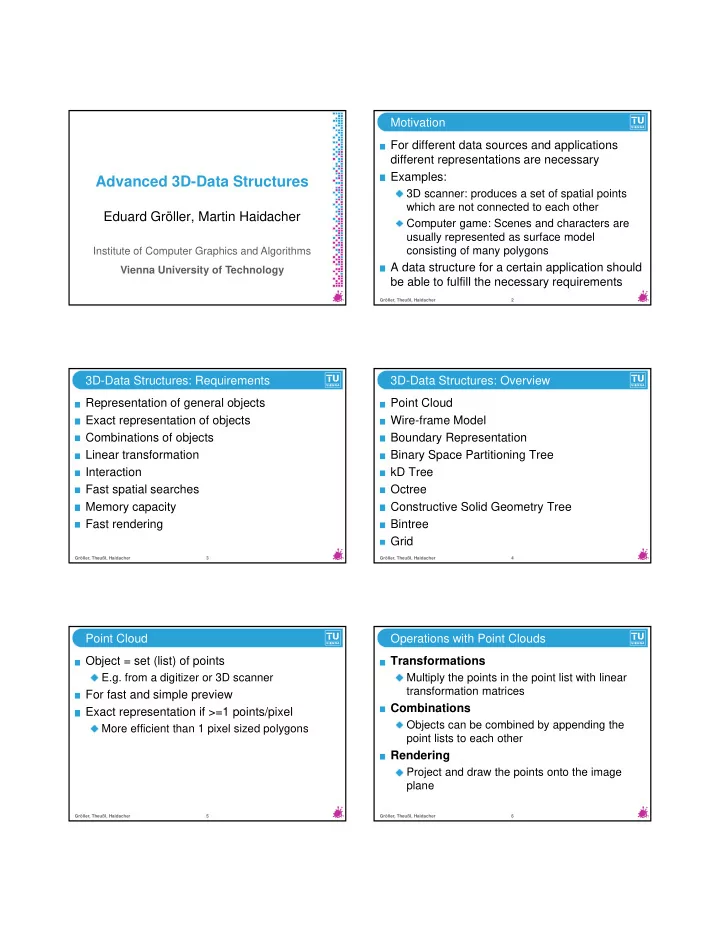
Motivation For different data sources and applications different representations are necessary Examples:

3D scanner: produces a set of spatial points which are not connected to each other Computer game: Scenes and characters are usually represented as surface model consisting of many polygons

A data structure for a certain application should be able to fulfill the necessary requirements

2 Gröller, Theußl, Haidacher

3D-Data Structures: Requirements Representation of general objects Exact representation of objects Combinations of objects Linear transformation Interaction Fast spatial searches Memory capacity Fast rendering

3 Gröller, Theußl, Haidacher

3D-Data Structures: Overview Point Cloud Wire-frame Model Boundary Representation Binary Space Partitioning Tree kD Tree Octree Constructive Solid Geometry Tree Bintree Grid

4 Gröller, Theußl, Haidacher

Point Cloud Object = set (list) of points

E.g. from a digitizer or 3D scanner

For fast and simple preview Exact representation if >=1 points/pixel

More efficient than 1 pixel sized polygons

Gröller, Theußl, Haidacher 5

Operations with Point Clouds Transformations

Multiply the points in the point list with linear transformation matrices

Combinations

Objects can be combined by appending the point lists to each other

Rendering

Project and draw the points onto the image plane

6 Gröller, Theußl, Haidacher

slide-2
SLIDE 2

Properties of Point Clouds Advantages

Fast rendering Exact representation & rendering possible Fast transformations

Disadvantages

Many points (curved obj., exact representation) High memory consumption Limited combination operations

7 Gröller, Theußl, Haidacher

Surfels (SURFace ELementS) http://www.merl.com/projects/surfels/ movies: cab, wasp, salamander with holes, salamander corrected (more movies on web page) QSplat (1/2)

 3D scan of 2.7 meter statue

  • f St. Matthew at 0.25 mm

 102.868.637 points  File size: 644 MB  Preprocessing time: 1 hour  Demo on laptop (PII 366, 128

MB), no 3D graphics hardware

 http://graphics.stanford.edu/so

ftware/qsplat/

9 Gröller, Theußl, Haidacher

QSplat (2/2)

Interactive (8 frames/sec) High quality (8 sec)

10 Gröller, Theußl, Haidacher

3D-Data Structures: Overview Point Cloud Wire-frame Model Boundary Representation Binary Space Partitioning Tree kD Tree Octree Constructive Solid Geometry Tree Bintree Grid

11 Gröller, Theußl, Haidacher

Wire-Frame Model

1 7 I 2 3 4 5 6 8 2 A B C D E F G H J K L

x1 y1 z1 x8 y8 z8 x5 y5 z5 x4 y4 z4 x3 y3 z3 x2 y2 z2 ........

point list

L B

........

edge list

C A 1 2 3 4 5 8

A

Edge list Vertex list

Object is simplified to 3D lines, each edge of the object is represented by a line in the model

12 Gröller, Theußl, Haidacher

slide-3
SLIDE 3

Operations with Wire-Frame Model Transformations

Multiply the points in the point list with linear transformation matrices

Combinations

Objects can be combined by appending the point and edge lists to each other

Rendering

Projection of all points onto image plane and drawing of edges in between

13 Gröller, Theußl, Haidacher

Properties of Wire-Frame Models Advantages

Quick rendering Easy and quick transformations Generation of models via digitization

Disadvantages

High memory consumption Inexact (no surfaces, no occlusion) Restricted combination possibilities Curves are approximated by straight lines

14 Gröller, Theußl, Haidacher

3D-Data Structures: Overview Point Cloud Wire-frame Model Boundary Representation Binary Space Partitioning Tree kD Tree Octree Constructive Solid Geometry Tree Bintree Grid

15 Gröller, Theußl, Haidacher

Boundary Representation (B-Rep)

V1 V2 V3 V4 V5 E1 E2 E3 E4 E5 E6 S1 S2

vertex list edge list face list V1: x1 y1 z1 E1: V1 V2 S1: E1 E2 E3 V2: x2 y2 z2 E2: V2 V3 S2: E2 E4 E5 E6 V3: x3 y3 z3 E3: V3 V1 V4: x4 y4 z4 E4: V3 V4 V5: x5 y5 z5 E5: V4 V5 E6: V5 V2

16 Gröller, Theußl, Haidacher

Lists for B-Reps (1/4) Face list S1 S2

17 Gröller, Theußl, Haidacher

Lists for B-Reps (2/4) Face list S1 S2 E1 E2 E3 E4 E5 E6

18 Gröller, Theußl, Haidacher

slide-4
SLIDE 4

Lists for B-Reps (3/4) Face list

x y z x y z x y z x y z x y z

V1 V2 V3 V4 V5 S1 S2

19 Gröller, Theußl, Haidacher

Lists for B-Reps (4/4) Face list Edge list Vertex list

x y z x y z x y z x y z x y z

V1 V2 V3 V4 V5 S1 S2

20 Gröller, Theußl, Haidacher

Winged Edge Data Structure Alternative for normal hierarchical B-Rep Here the central element is the edge:

Pstart Pend face_cw face_ccw pred_cw succ_ccw pred_ccw succ_ccw edge list faces x y z 1st edge points 1st edge Pend Pstart pred_cw succ_cw pred_ccw face_cw face_ccw succ_ccw edge

21 Gröller, Theußl, Haidacher

Operations with B-Reps (1/2) Transformations

All points are transformed as with wire-frame model, additionally surface equations or normal vectors can be transformed

Rendering

Hidden surface or hidden line algorithms can be used because the surfaces of the objects are known, so that the visibility can be calculated

22 Gröller, Theußl, Haidacher

Operations with B-Reps (2/2) Combinations

  • 1. Split the polygons of object A at the

intersections with the polygons of object B

  • 2. Split the polygons of object B at ... of A
  • 3. Classify all polygons of A as "in B", "outside

B" or "on the surface of B“

  • 4. Classify all polygons of B in the same way
  • 5. Remove the redundant polygons of A and B

according to the operator and combine the remaining polygons of A and B

23 Gröller, Theußl, Haidacher

Combinations of B-Reps (1/4) Every polygon has a box enclosure  simple test if polygons can intersect Use only convex polygons and produce only convex polygons as results  simple intersection tests

A B A B A B

1: 2:  

24 Gröller, Theußl, Haidacher

slide-5
SLIDE 5

Combinations of B-Reps (2/4) A ray is traced in the direction of the normal vector of the polygon to be classified:

Ray hits no polygon of B  "outside B" First polygon of B hit from front  "outside B" First polygon of B hit from back  "in B"

A B A B "outside B" "in B"

25 Gröller, Theußl, Haidacher

Combinations of B-Reps (3/4) Improvement: points of A, which lie on the surface of B, are marked as border points during the dividing process (and vice versa)  only very few polygons have to be classified with the complex method

in B

  • utside A

border point border point

A B

26 Gröller, Theußl, Haidacher

Combinations of B-Reps (4/4) Polygons can be removed according to tables:

  • p.

A or B A and B A sub B in B yes no yes

  • utside B

no yes no NV equal no no yes different yes yes no

  • n B (coplanar)

For polygons

  • f A
  • p.

A or B A and B A sub B in A yes no no

  • utside A

no yes yes NV equal yes yes yes different yes yes yes

  • n A (coplanar)

For polygons

  • f B

27 Gröller, Theußl, Haidacher

Requirements on B-Reps for this Alg. No open (non-closed) objects Only convex polygons No double points Additional links in the vertex list between neighbor points with equal classification

........ xn yn zn x4 y4 z4 x5 y5 z5 x5 y5 z5 x3 y3 z3 x2 y2 z2 x1 y1 z1

vertex list

28 Gröller, Theußl, Haidacher

Partitioning of Object Surfaces Necessary to approximate curved surfaces Surfaces that can be parameterized:

E.g. free form surfaces, quadrics, superquadrics partitioning of parameter space, one patch for every 2D parameter interval

Surfaces that cannot be parameterized:

E.g. implicit surfaces, "bent" polygons  tesselation, subdivision surfaces

29 Gröller, Theußl, Haidacher

Tesselation Divide polygons in smaller polygons (triangles) until the approximation is exact enough

Normal vector criterion as termination condition: Normal vectors of neighboring polygons are similar:

N12  1– N1 N2 Objekt Approximation

30 Gröller, Theußl, Haidacher

slide-6
SLIDE 6

Properties of B-Reps Advantages

General representation Generation of models via digitization Transformations are easy and fast

Disadvantages

High memory requirement Combinations are relatively costly Curved objects must be approximated

31 Gröller, Theußl, Haidacher

3D-Data Structures: Overview Point Cloud Wire-frame Model Boundary Representation Binary Space Partitioning Tree kD Tree Octree Constructive Solid Geometry Tree Bintree Grid

32 Gröller, Theußl, Haidacher

Binary Space Partitioning Tree Special B-Rep for quick rendering with visibility

Especially of static scenes

x1 y1 z1 xn yn zn x5 y5 z5 x4 y4 z4 x3 y3 z3 x2 y2 z2 ........

point list

........ ........

.... .... ....

........

.... .... .... ....

........ ........

.... ....

........ ........ ........ ........

....

........ ........

polygon nodes with surface equation and normal vector polygon vertices

33 Gröller, Theußl, Haidacher

Binary Space Partitioning Tree The base plane of the polygon in a node partitions space in two halves:

In front of and behind the polygon

Left subtree of the node: contains only polygons that are in front of the basis plane Right subtree of the node: contains only polygons that are behind the basis plane Polygons that lie in both halves are divided by the base plane into two parts

34 Gröller, Theußl, Haidacher

Generation of BSP Trees Convex objects: BSP tree is linear list Else: conversion B-Rep  BSP tree Algorithm:

  • 1. Find the polygon who's plane intersects the

fewest other polygons and cut these in two

  • 2. Divide the polygon list in two sets:

in front of that plane / behind that plane

  • 3. The polygon found in 1. is the root of the

BSP tree, the left and the right subtrees can be generated recursively (from two "halves")

35 Gröller, Theußl, Haidacher

BSP Example 2D example: 1 2 3 4 Object BSP-Tree Polygon 1 Polygon 2 Polygon 3 Polygon 4

36 Gröller, Theußl, Haidacher

slide-7
SLIDE 7

More BSP Examples

1 2 3 4 5 6 3 4 1 2 5 6

  • r

1 2 3 4 1a 1b 2 3 4 1 1a 1b 2 3 4

37 Gröller, Theußl, Haidacher

BSP Trees as Solids

Left empty trees represent outside space Right empty trees represent inside volumes

1 2 3 4 1 2 3 4 1a 1b 2 3 4

in

  • ut

in

  • ut
  • ut
  • ut
  • ut
  • ut
  • ut

in in in

  • ut

BSP tree

  • r

38 Gröller, Theußl, Haidacher

Operations with BSP Trees (1/2) Rendering

BSP trees are very good for fast rendering Painter´s Algorithm:

IF eye is in front of a (in A+) THEN BEGIN draw all polygons of A-; draw a; draw all polygons of A+ END ELSE BEGIN draw all polygons of A+; (draw a); draw all polygons of A- END;

39 Gröller, Theußl, Haidacher

Operations with BSP Trees (2/2) Transformations

Points, plane equation and normal vector have to be transformed

Combinations

Perform combination with B-Rep, then generate BSP tree Combine BSP trees directly (faster)

40 Gröller, Theußl, Haidacher

Combination of BSP Trees The structure of one tree has to act as structure for the result  one tree has to be included into the other B A

41 Gröller, Theußl, Haidacher

Combination of BSP Trees:  a A b c d 1 B 2 3 4 1in Bin 3in 4 1out Bout 2 3out aout C Aout  Bout ( = Bout ) Ain  Bin

Aout Ain a aout A 1in 2 4 ain 3out Bout Bin b c d B 1out

3in

42 Gröller, Theußl, Haidacher

slide-8
SLIDE 8

BSP Algorithm for A op B = C: A or B homogeneous (full or empty)  simple rules Else:

  • 1. Divide root polygon a of A at object B in ain,

aout

  • 2. Root node c of C: if op=”and" then c:=ain

else c:=aout (with its plane)

  • 3. Divide B at plane of a in Bin, Bout
  • 4. Recursive evaluation of the subtrees:

Cleft=Aout op Bout Cright=Ain op Bin

43 Gröller, Theußl, Haidacher

Simple BSP Node Combination Rules

  • p
  • r

and sub A inhom. inhom. full empty inhom. inhom. full empty inhom. inhom. full empty B full empty inhom. inhom. full empty inhom. inhom. full empty inhom. inhom. A op B full A full B A empty B empty empty A –B empty

44 Gröller, Theußl, Haidacher

Combination of BSP Trees:  a A b c d 1 B 2 3 4 1out 2 3out aout C

a aout A 1in 2 4 ain 3out Bout Bin b c d B 1out

b c dout 3in 4out 3in

45 Gröller, Theußl, Haidacher

Combination of BSP Trees:  a A b c d 1 B 2 3 4 1in Bin 3in 4 1out Bout 2 3out ain C Aout  Bout ( = {} ) Ain  Bin

Aout Ain a aout A 1in 2 4 ain 3out Bout Bin b c d B 1out

3in

46 Gröller, Theußl, Haidacher

Combination of BSP Trees:  a A b c d 1 B 2 3 4 1in 4in ain C

a aout A 1in 2 4 ain 3 Bout Bin b c d B 1out

(bin and cin are empty) din

47 Gröller, Theußl, Haidacher

Properties of BSP Trees Advantages

Fast rendering Fast transformation Combinations faster than for B-Reps General representation Generation of models via digitization Tree structure (fast search)

48 Gröller, Theußl, Haidacher

slide-9
SLIDE 9

Properties of BSP Trees Disadvantages

Curved objects must be approximated Only convex polygons High memory cost

49 Gröller, Theußl, Haidacher

3D-Data Structures: Overview Point Cloud Wire-frame Model Boundary Representation Binary Space Partitioning Tree kD Tree Octree Constructive Solid Geometry Tree Bintree Grid

50 Gröller, Theußl, Haidacher

kD Tree

 Special case of BSP Tree  Only axes-aligned partitioning planes =>

specified by one value

 Partitioning direction specified either implicitly

(pre-defined order) or explicitly

 1D Tree  binary tree

51 Gröller, Theußl, Haidacher

kD Tree Example: 2-D Tree

52 Gröller, Theußl, Haidacher

3D-Data Structures: Overview Point Cloud Wire-frame Model Boundary Representation Binary Space Partitioning Tree kD Tree Octree Constructive Solid Geometry Tree Bintree Grid

53 Gröller, Theußl, Haidacher

Octree Used to represent solid volumetric objects Each node is subdivided in 8 subspaces Each subspace is either empty, full or further divided The subdivision stops when an object can be represented accurate enough

Gröller, Theußl, Haidacher 54

slide-10
SLIDE 10

Octree Example

Gröller, Theußl, Haidacher 55

Operations with Octrees Transformations

Hard to implement; easy: rotations of 90°

Combinations

Can easily be done by logical operations; both

  • ctrees must be adapted to each other to have

the same depth in each subspace

Rendering

The octree is rendered depending on the view direction starting with the subspace farthest away from the viewer

Gröller, Theußl, Haidacher 56

Properties of Octrees Advantages

Combinations are easy to implement Spatial search is fast due to the tree structure Rendering algortihm is fast

Disadvantages

High storage consumption for approximated

  • bjects

Transformations are not trivial in general General objects cannot be represented exactly

Gröller, Theußl, Haidacher 57

Extended Octrees Additional node types:

Face nodes: contain a surface Edge nodes: contain an edge Vertex nodes: contain a corner point

Vertex-Node Face-Node Edge-Node

58 Gröller, Theußl, Haidacher

Generation of Extended Octrees

  • 1. Generate B-Rep
  • 2. Divide point and surface list at the

subdivision planes into 8 sets

  • 3. For each octant:

Point and surface lists empty full or empty Only one vertexvertex node Only one surface face node Only two surfaces edge node Else: subdivide recursively

59 Gröller, Theußl, Haidacher

Octree as Spatial Directory Octree as search structure for objects in other representations E.g. for B-Reps:

  • ctree of low depth is sufficient

........ ........

  • bject list

face list search octree

60 Gröller, Theußl, Haidacher

slide-11
SLIDE 11

3D-Data Structures: Overview Point Cloud Wire-frame Model Boundary Representation Binary Space Partitioning Tree kD Tree Octree Constructive Solid Geometry Tree Bintree Grid

61 Gröller, Theußl, Haidacher

Constructive Solid Geometry Tree A Constructive Solid Geometry (CSG) Tree consists of simple primitives, transformations and logical operations Useful to describe complex objects with a small number of primitives Examples for primitives

Cube Sphere Cylinder

62 Gröller, Theußl, Haidacher

CSG Tree Example

63 Gröller, Theußl, Haidacher

Operations with CSG Trees Transformations

An object is transformed by adding the transformation to the transformation of each primitive

Combinations

Two objects are simple combined by adding them as children in a new tree

Rendering

Needs to be converted into a B-Rep or it is rendered with raytracing

64 Gröller, Theußl, Haidacher

Properties of CSG Trees Advantages

Minimal storage consumption Combinations and transformations are simple Objects can be represented exactly Tree structure (fast search)

Disadvantages

Cannot be rendered directly; slow rendering Model generation cannot be done through digitization of real objects

65 Gröller, Theußl, Haidacher

3D-Data Structures: Overview Point Cloud Wire-frame Model Boundary Representation Binary Space Partitioning Tree kD Tree Octree Constructive Solid Geometry Tree Bintree Grid

66 Gröller, Theußl, Haidacher

slide-12
SLIDE 12

Bintree

3D Tree Subdivision order xyzxyz... Choose separation plane for

  • ptimized (irregular)

subdivision Fewer nodes than octree

67 Gröller, Theußl, Haidacher

3D-Data Structures: Overview Point Cloud Wire-frame Model Boundary Representation Binary Space Partitioning Tree kD Tree Octree Constructive Solid Geometry Tree Bintree Grid

68 Gröller, Theußl, Haidacher

Grid Regular subdivision Directly addresses cells Simple neighborhood finding O(1)

E.g. for ray traversal

Problem:

Too few/many cells  Hierarchical grid

69 Gröller, Theußl, Haidacher