Administrivia Mini project is graded 1 st place: Justin (75.45) 2 - - PowerPoint PPT Presentation

administrivia
SMART_READER_LITE
LIVE PREVIEW

Administrivia Mini project is graded 1 st place: Justin (75.45) 2 - - PowerPoint PPT Presentation

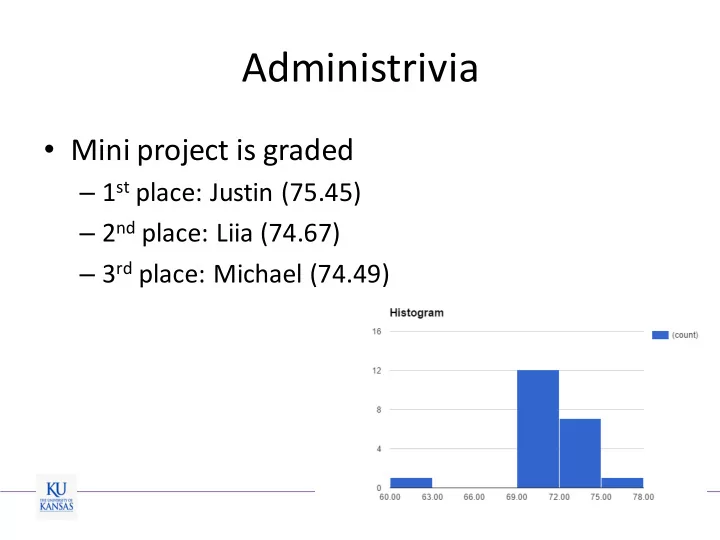
Administrivia Mini project is graded 1 st place: Justin (75.45) 2 nd place: Liia (74.67) 3 rd place: Michael (74.49) 1 Administrivia Project proposal due: 2/27 Original research Related to real-time embedded systems/CPS


slide-1
SLIDE 1

Administrivia

  • Mini project is graded

– 1st place: Justin (75.45) – 2nd place: Liia (74.67) – 3rd place: Michael (74.49)

1
slide-2
SLIDE 2

Administrivia

  • Project proposal due: 2/27

– Original research

  • Related to real-time embedded systems/CPS

– Building a cyber-physical system (robot)

  • Must include real-time performance evaluation on a

selected hardware platform

– Repeating the evaluation of a chosen paper

  • Any one of the suggested papers.

2

slide-3
SLIDE 3

Administrivia

  • Addition presentation schedule

– 2 papers/day on Week 15 (a week before final)

  • eliminate individual meeting

Or – 2 papers/day on Week 11,12,13

  • Keep individual meeting

3

slide-4
SLIDE 4

Real-Time DRAM Controller

Heechul Yun

4

slide-5
SLIDE 5

Memory Performance Isolation

  • Q. How to guarantee predictable memory

performance?

Part 1 Part 2 Part 3 Part 4

5

Core1 Core2 Core3 Core4 DRAM Memory Controller LLC LLC LLC LLC

slide-6
SLIDE 6

How Page Works

* Latency – First Access Latency – Further Accesses Data Cycles for each core

Single Core 35 9 4

  • in clock cycles on a JEDEC-compliant

DDR3 module ACT DATA READ PRE REQUEST #1 ARRIVES close the previous page and load new one Latency of Request #1 REQUEST #1 COMPLETES, REQUEST #2 ARRIVES Latency of Request #2 (with open page) page is already open, just issue read command DATA READ REQUEST #2 COMPLETES

slide-7
SLIDE 7

Effects of Contention

* Latency – First Access Latency – Further Accesses Data Cycles for each core

Single Core 35 9 4 Multiple Cores – same bank/rank 35*N 35*N 4

A D R P A D R P A D R P

ALL REQUESTS ARRIVE AT THE SAME TIME, TARGETED AT SAME BANK AND RANK

slide-8
SLIDE 8

Effects of Contention

* Latency – First Access Latency – Further Accesses Data Cycles used by each access

Single Core 35 9 4 N Cores – same bank/rank 35 + 35*(N-1) 35 + 35*(N-1) 4 N Cores – different ranks 35 + 4*(N-1) 9 + 4*(N-1) 4 ACT DATA R PRE ALL REQUESTS ARRIVE AT THE SAME TIME, TARGETED AT DIFFERENT RANKS DATA DATA ACT R PRE ACT R PRE

slide-9
SLIDE 9

Real-Time Memory Controllers

  • Provided guaranteed performance in

accessing DRAM.

9

slide-10
SLIDE 10

Real-Time Memory Controllers

  • Common techniques

– Command grouping

  • Force to use ALL banks for each memory access

– Private banking

  • Assign private DRAM banks to cores

– Scheduling

  • Use analysis friendly scheduling (e.g., round-robin) over

difficult ones (e.g., FR-FCFS)

10

slide-11
SLIDE 11

Predator

11

slide-12
SLIDE 12

Worst-case

  • 1bank b/w

– Less than peak b/w – How much?

Slow

L3 DRAM DIMM Memory Controller (MC) Bank 4 Bank 3 Bank 2 Bank 1

Core1 Core2 Core3 Core4

slide-13
SLIDE 13

Worst-Case For Single-Bank: Horrible

13

slide-14
SLIDE 14

Bank Interleaving and Groups

14

slide-15
SLIDE 15

Arbitration: CCSP

15

slide-16
SLIDE 16

Controller Architecture

16

slide-17
SLIDE 17

Real-Time Memory Controllers (RTMC)

  • Predator

– Command grouping, CCSP arbitration

  • AMC

– Command grouping, round-robin arbitration

  • PRET-MC

– Private bank, TDMA arbitration

  • DcMc, MEDUSA

– RR + FR-FCFS hybrid, bank partitioning

  • Read/Write Bundling

– Reduce bus turn-around overhead. .

17

slide-18
SLIDE 18

RTMC References

  • Predator: a predictable sdram memory controller”.

CODES+ISSS 2007.

  • An analyzable memory controller for hard real-time CMPs,

IEEE Embedded Systems Letters, 2009

  • PRET DRAM controller: Bank privatization for predictability

and temporal isolation, CODES+ISSS, 2011

  • A dual-criticality memory controller (dcmc): Proposal and

evaluation of a space case study, RTAS, 2015

  • Improved DRAM Timing Bounds for Real-Time DRAM

Controllers with Read/Write Bundling, 2016

  • A Comprehensive Study of DRAM Controllers in Real-Time
  • Systems. Danlu Guo, MS Thesis, University of Waterloo,

2016

18

slide-19
SLIDE 19

Real-Time Multi/Many-Core Architecture

  • Why is it difficult to analyze WCET?
  • Projects on Real-Time CPU Architectures

19

slide-20
SLIDE 20

Worst-Case Execution Time (WCET)

  • Real-time scheduling theory is based on the

assumption of known WCETs of real-time tasks

20

Image source: [Wilhelm et al., 2008]

slide-21
SLIDE 21

Computing WCET

  • Static analysis

– Input: program code, architecture model – output: WCET – Problem: architecture model is hard and pessimistic (recall “Parallelism-aware…” paper)

  • Measurement

– No guarantee on true worst-case – But, widely used in practice

21

slide-22
SLIDE 22

Memory Hierarchies, Pipelines, and Buses for Future Architectures in Time-Critical Embedded Systems

22

slide-23
SLIDE 23

“Problematic” CPU Features

  • Architectures are optimized to reduce average

performance

  • WCET estimation is hard because of

– Pipelining – TLBs/Caches – Super-scalar – Out-of-order scheduling – Branch predictors – Hardware prefetchers – Basically anything that affect processor state

23

slide-24
SLIDE 24

Static Timing Analysis

24

[11]–[13]. control-flo flo first first

  • l-flow

program’ flo control-flo identifies

  • l-flow

processor’ finally control-flo ely—together interactions—to influence influence influence

slide-25
SLIDE 25

Control Flow Graph (CFG)

  • Analyze code
  • Split basic blocks
  • Compute per-block WCET

– use abstract CPU model

25

slide-26
SLIDE 26

Timing Anomalies

  • Locally faster != globally faster

26

Image source: [Wilhelm et al., 2008]

slide-27
SLIDE 27

Timing Anomalies

  • Locally faster != globally faster

27

Image source: [Wilhelm et al., 2008]

slide-28
SLIDE 28

Real-Time CPU Architectures

  • PRET

– UC Berkeley.

  • MERASA/parMERASA project

– EU

  • ACROSS

– EU

  • ARAMIS

– Germany

  • EMC2

– EU

28

slide-29
SLIDE 29

29

slide-30
SLIDE 30

PRET Pipeline

30

FETCH DECOD E REGACC MEM EXECUT E EXCEPT FETCH DECOD E REGACC MEM EXECUT E EXCEPT FETCH DECOD E REGACC MEM EXECUT E EXCEPT FETCH DECOD E REGACC MEM EXECUT E EXCEPT FETCH DECOD E REGACC MEM EXECUT E EXCEPT FETCH DECOD E REGACC MEM EXECUT E EXCEPT FETCH DECOD E REGACC MEM EXECUT E EXCEPT FETCH DECOD E REGACC MEM EXECUT E FETCH DECOD E REGACC MEM FETCH DECOD E REGACC FETCH DECOD E FETCH

t

THREAD#1 THREAD#2 THREAD#3 THREAD#4 THREAD#5 THREAD#6

1 clock Thread 1, Instruction 1 Thread 1, Instruction 2

slide-31
SLIDE 31

FlexPRET Pipeline

31

slide-32
SLIDE 32

MERASA Multicore

32

slide-33
SLIDE 33

33

slide-34
SLIDE 34

Acknowledgement

  • Some slides are from:

– Prof. Rodolfo Pellizzoni, University of Waterloo – Prof. Edward A. Lee, University of Berkeley

34

slide-35
SLIDE 35

Summary

  • Timing anomalies

– Locally fast != globally fast on non-timing compositional architectures (i.e., most architectures)

  • Timing compositional architecture

– Free of timing anomalies

35