Addressing Food Poverty in Children the role of Breakfast Clubs - - PowerPoint PPT Presentation
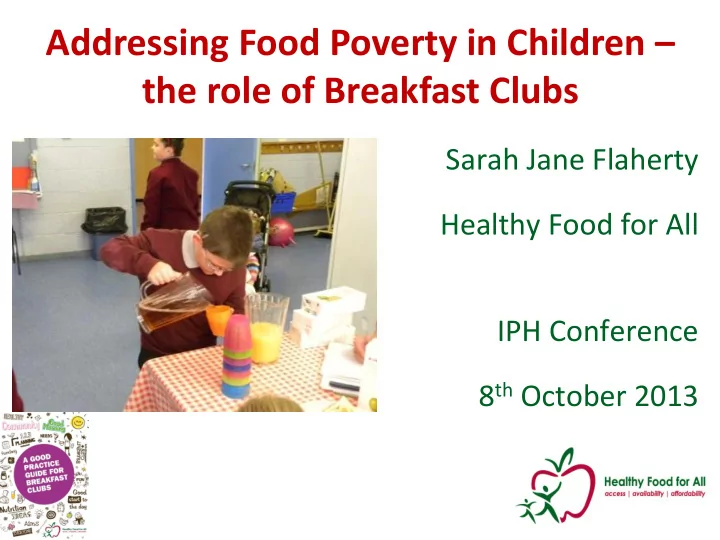
Addressing Food Poverty in Children the role of Breakfast Clubs Sarah Jane Flaherty Healthy Food for All IPH Conference 8 th October 2013 What is Healthy Food for All? HFfA is an all-island charity seeking to combat food poverty by
What is Healthy Food for All?
HFfA is an all-island charity seeking to combat
food poverty by promoting access, availability and affordability of healthy food for low-income groups
What is Food Poverty?
“Inability to have an adequate and nutritious diet due to issues of the affordability of and access to food” (Dowler, 1998)
Food Poverty in Ireland
- One in ten people in Ireland are living in food poverty1
– Increases to one in five (23%) if head of household is unemployed or is a lone parent1
- One in five children (21%) go to school or bed hungry as
there is not enough food in the home2
- 13% of school children never eat breakfast on a weekday2
- 1. Carney C and Maître B, (2012) Constructing a Food Poverty Indicator for Ireland using the Survey on Income and Living
Conditions, Technical Paper No. 3, Dept. of Social Protection (2012)
- 2. Health Behaviour in School-Aged Children Survey (2012)
Why Breakfast Clubs?
- Nutritious breakfast has positive impact on
nutritional intake
- Linked with improved attendance rates
and punctuality
- Improves cognition, memory, and
concentration in class
- Develops social eating habits
- Opportunity to talk with someone in
confidence before school
- Opportunity to engage with families on an
informal basis
- Planning your Breakfast Club
- Funding Your Breakfast Club
- Getting Started
- Running your Breakfast Club
- Developing a Healthy School
Food Policy
- Breakfast Club Activities
- Evaluation
- Different models of breakfast
clubs
- Case studies from across
Ireland
Pilot Programme of Breakfast Clubs
- Four Primary School in North Dublin
– St Catherine’s Infant School, Cabra – St Eithne’s Girls School, Edenmore – Holy Trinity NS, Donaghmede – Holywell ETNS, Swords
- January 2013 – June 2014
- Grants of €5,000
- Funded by Kellogg’s Corporate Citizenship Fund
- Direct advice from HFfA based on experience
- Training workshop
- Networking meeting each term
Evaluation of Pilot Programme
What information are we gathering?
- What are the benefits of setting up a
breakfast club in each school?
- What are the challenges of setting up a
breakfast club? What supports needed?
- What is the cost of setting up a club?
- Explore self-evaluation methods
Who are we talking to?
- Breakfast Club Co-ordinators
- Breakfast Club Staff
- Teachers
- Parents
- Children
Learning so far: Benefits
“Breakfast club has made a huge difference to the school and pupils, it is a great initiative.” (Teacher) “English levels of migrant children have improved as it is an extra opportunity to practice. Teachers have noticed that certain children are more confident when speaking as a result.” (Breakfast Club Co-ordinator) “ ‘John’ has been visibly happier since going to the breakfast club.” (Teacher) “Children are more alert and focused in the classroom” (Teacher)
Learning so far: Challenges
- Time Commitment
- Staff for the Club
- Engaging Volunteers
- Funding
- Food
Are there differences between DEIS & Non-DEIS schools?
What’s Next?
- Work with each school to develop a sustainable action plan
- Identify suitable funding streams for schools
- Build on local (& national) partnerships to support clubs
- Work with each school to engage volunteers
- Continue to share the learning through regular meetings
- Explore impact of clubs on parents, teachers, and children
- Final Report available next Autumn