Adam Sennet (SEP) Readings [Citing the Oxford English Dictionary] - - PowerPoint PPT Presentation

adam sennet sep readings
SMART_READER_LITE
LIVE PREVIEW

Adam Sennet (SEP) Readings [Citing the Oxford English Dictionary] - - PowerPoint PPT Presentation

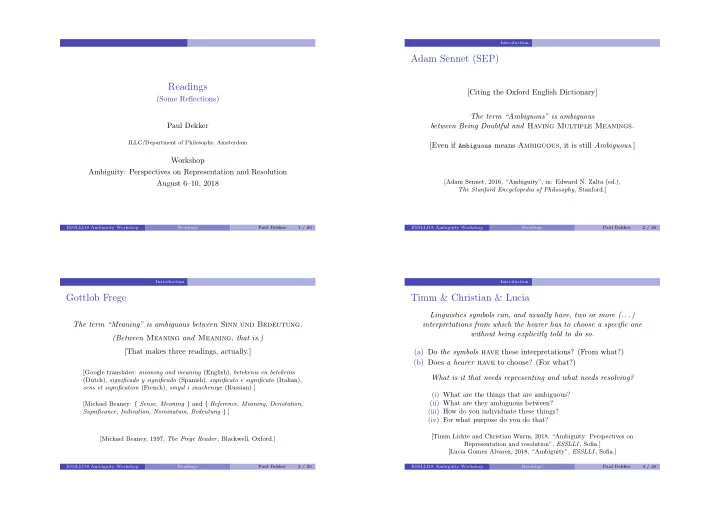
Introduction Adam Sennet (SEP) Readings [Citing the Oxford English Dictionary] (Some Reflections) The term Ambiguous is ambiguous Paul Dekker between Being Doubtful and Having Multiple Meanings . ILLC/Department of Philosophy, Amsterdam


slide-1
SLIDE 1

Readings

(Some Reflections) Paul Dekker

ILLC/Department of Philosophy, Amsterdam

Workshop Ambiguity: Perspectives on Representation and Resolution August 6–10, 2018

ESSLLI18 Ambiguity Workshop Readings Paul Dekker 1 / 26 Introduction

Adam Sennet (SEP)

[Citing the Oxford English Dictionary] The term “Ambiguous” is ambiguous between Being Doubtful and Having Multiple Meanings. [Even if Ambiguous means Ambiguous, it is still Ambiguous.]

[Adam Sennet, 2016, “Ambiguity”, in: Edward N. Zalta (ed.), The Stanford Encyclopedia of Philosophy, Stanford.]

ESSLLI18 Ambiguity Workshop Readings Paul Dekker 2 / 26 Introduction

Gottlob Frege

The term “Meaning” is ambiguous between Sinn und Bedeutung. (Between Meaning and Meaning, that is.) [That makes three readings, actually.]

[Google translates: meaning and meaning (English), betekenis en betekenis (Dutch), significado y significado (Spanish), significato e significato (Italian), sens et signification (French), smysl i znacheniye (Russian).] [Michael Beaney: { Sense, Meaning } and { Reference, Meaning, Denotation, Significance, Indication, Nominatum, Bedeutung }.] [Michael Beaney, 1997, The Frege Reader, Blackwell, Oxford.]

ESSLLI18 Ambiguity Workshop Readings Paul Dekker 3 / 26 Introduction

Timm & Christian & Lucia

Linguistics symbols can, and usually have, two or more (. . . ) interpretations from which the hearer has to choose a specific one without being explicitly told to do so. (a) Do the symbols have these interpretations? (From what?) (b) Does a hearer have to choose? (For what?) What is it that needs representing and what needs resolving?

(i) What are the things that are ambiguous? (ii) What are they ambiguous between? (iii) How do you individuate these things? (iv) For what purpose do you do that?

[Timm Lichte and Christian Wurm, 2018, “Ambiguity: Perspectives on Representation and resolution”, ESSLLI , Sofia.] [Lucia Gomez Alvarez, 2018, “Ambiguity”, ESSLLI , Sofia.]

ESSLLI18 Ambiguity Workshop Readings Paul Dekker 4 / 26

slide-2
SLIDE 2

Introduction

Ludwig Wittgenstein

duck rabbit neither both

[Ludwig Wittgenstein, 1953, Philosophische Untersuchungen II, Blackwell, §xi.]

ESSLLI18 Ambiguity Workshop Readings Paul Dekker 5 / 26 Introduction

Assumptions

There is no such thing as the meaning of a sentence ( / word). We are able to recognize the occurrence of sentences ( / words). We interpret these occurrences in their context and relative to a theory of interpretation. Every interpretation is unique and constitutes a reading. We ignore or disqualify ‘impossible’ readings, and identify and distinguish among the rest.

[Paul Dekker, 2017, “Live Meanings”, in: Kata Balogh and Wiebke Petersen (eds.), Bridging Formal and Conceptual Semantics, D¨ usseldorf UP, pp. 13–37.]

ESSLLI18 Ambiguity Workshop Readings Paul Dekker 6 / 26 Samples

Names and Predicates (Apresjan/Bezuidenhout)

Ron is a student. ronx

i , STUDENT Y J

Y [x] Cases of “homonymy” and “regular polysemy”. Can be contextually resolved, and can remain unresolved. This apple is red. . . . Y [ix]i Alternative ways in which a predicate is applied to a subject may constitute alternative readings. On a real occasion of use, the “ambiguities” are resolved. If not, and if relevant, just ask.

ESSLLI18 Ambiguity Workshop Readings Paul Dekker 7 / 26 Samples

Reference (Kripke)

Smith’s murderer is insane. Jones is raking the leaves. Their “Water” is not H2O.

  • pragmatic ambiguity (Donnellan) • theoretical iden-

tification (Putnam) • intuitive expectations (Kripke)

  • more economical theory (Fodor and Sag) •

jonesx

i

RAKE Y

K

Y [x]

ESSLLI18 Ambiguity Workshop Readings Paul Dekker 8 / 26

slide-3
SLIDE 3

Samples

Existence (Wikipedia)

Vulcan does not exist. ¬ vulcani Possible objects? The Vulcanizer? Scope? “ ‘Vulcan’ may refer to:

I . . . I the god of fire I a fictional race in Star Trek I a gay pornography magazine I a hypothetical planet I . . . ”

. . . , exist, subsist, be there, . . . No Bedeutung, a specific Sinn, many tentative construals, yet fairly unambiguous. [Outside of linguistic-philosophical circles.]

ESSLLI18 Ambiguity Workshop Readings Paul Dekker 9 / 26 Samples

  • Mr. Multi-Famous and Mr. Nobody (Russell)

Ofitin ‚g∞ p‘maton Ídomai metÄ oŸc ·tàroisin, toÃc d' ällouc prÏsjen; Nobody will I eat last, the others first. (Book 9, line 369–70) There is only one way of making sense of this, in the Odyssee. Ofit–c me kte–nei dÏl˙ oŒd‡ b–hfin. Nobody is slaying me by guile, not by force. (Book 9, line 408) The are two ways of making sense of this, in the Odyssee.

ESSLLI18 Ambiguity Workshop Readings Paul Dekker 10 / 26 Samples

Sinn (Aloni)

Ralph believes that Ortcutt is a spy. Pierre believes that London is pretty. S : x . . . MAN WITH HAT[x] . . . Br : zx SPY[z] z = ortcutt We may on occasion negotiate an ambiguity in the Sinn of a name, but preferably we don’t have to. (Frege 1892)

ESSLLI18 Ambiguity Workshop Readings Paul Dekker 11 / 26 Samples

Relativity (McFarlane)

The cake is tasty. This music is country. Marcus is a communist. Henri¨ ette is an expert. The inference is valid. The solar system hosts nine planets. An extremely regular source of ambiguity, which is equally regularly resolved or dismissed.

ESSLLI18 Ambiguity Workshop Readings Paul Dekker 12 / 26

slide-4
SLIDE 4

Samples

Modifiers (Lambek)

superfluous hair remover (Sennet)

  • rdinary language philosophy (Austin)

huge gay fan (Friends) Onder het omstreden vonnis in de rechtszaak over de peperdure grond rond Schiphol ligt de schijn van ordinaire vriendjespolitiek. (Endt) Another systematic source of (structural, potential) ambiguity. Not necessarily distinct, neither necessarily syntactic:

N/N N N\N N [huge • [gay • fan]] ⇒

huge gay fan

huge gay fan fan(huge(gay))

because:

N N\N (N/N)\N [gay • fan] ⇒

gay fan

gay fan λh fan(h(gay))

ESSLLI18 Ambiguity Workshop Readings Paul Dekker 13 / 26 Samples

Construal (Gillon)

A und B oder C It’s in France and in Toulon or in Paris. A and (then/but) B or (excl) C Barwise and Groenendijk or Stokhof proved the theorem first. Groenendijk and Stokhof or Barwise proved the theorem first. The context may indicate how the ambiguity has to be resolved, or even if it has to.

ESSLLI18 Ambiguity Workshop Readings Paul Dekker 14 / 26 Samples

Scope (Pietroski & Hornstein)

Does Every Sentence Like This Exhibit a Scope Ambiguity? The answer is informed by what we know about our (minimalist)

  • grammar. It has to be negative for theoretical reasons.

The question of whether (1) [Every girl pushed some truck] (. . . ) is structurally ambiguous in a way that supports a truth-conditional ambiguity depends on a host of considerations: the intuitions of native speakers about a range of constructions, the constraints imposed by our best theories of syntax, and the particular kind of event analysis that is best overall, etc. (p. 23)

ESSLLI18 Ambiguity Workshop Readings Paul Dekker 15 / 26 Samples

Cumulativity and Collectivity (Scha/Bratman)

Five boys wrote seven poems. The roads cross the lines. The Leitches and the Latches hate each other. The Romans wanted to rule the world. The Greek inspired / educated the Romans. We have been deluding ourselves.

The most obvious readings are surely not designed or defined for the intricate models developed to distinguish among subtle linguistic analyses.

ESSLLI18 Ambiguity Workshop Readings Paul Dekker 16 / 26

slide-5
SLIDE 5

Samples

Indexicality (Sennet)

I am stupid, He is cute and she is smart. Noi man blamed his∅,i,j boss. If a student corrects a professor she should reward him. One can distinguish and identify many readings. “[W]hether this is a semantic, syntactic or pragmatic ambiguity has been the source of heated debate.” (p. 10)

ESSLLI18 Ambiguity Workshop Readings Paul Dekker 17 / 26 Samples

Exhaustivity (Zeevat)

I will tell the truth, the whole truth, and nothing but the truth. One can tell the truth without telling the whole truth? One can tell the truth while including something which is not. Supreme court overrules the language system.

ESSLLI18 Ambiguity Workshop Readings Paul Dekker 18 / 26 Samples

Performativity (Eckardt)

I will be there at nine. A: You promised! B: No, I expected! I promise I will be there. I didn’t break a promise! I told a lie! Acceptability of readings depends on an established practice, a culture.

ESSLLI18 Ambiguity Workshop Readings Paul Dekker 19 / 26 Conclusion

On Meanings (If Any)

Meanings, if anything, are types of interpretation

  • f occurrences of types of expressions.

We can use them to characterize readings and distinguish them, not to define or identify them. The above investigations suggest that:

I every meaning can be ambiguous. I every ambiguity can be spurious.

[Cf, also, Sandra, Vicente and Falkum.]

ESSLLI18 Ambiguity Workshop Readings Paul Dekker 20 / 26

slide-6
SLIDE 6

Conclusion

On Representations (If Any)

A mental or logical representation presents a reading of an expression

  • nly if it is interpreted and if it is interpreted the same way.

Mental and/or logical representations do not by themselves help in providing an answer to the readings problem, although they may help in formulating the outcomes. (Husserl, Wittgenstein.) (Non-)Identity conditions of readings are essentially dependent on their context and the theory of interpretation. There is no limit on what are possible contexts, and what are possible theories of interpretation. So there is no worst case that we can generalize to.

Cf., “(. . . ) the continuous nature of the homonymy–polysemy–monosemy dimension (. . . ).” (Sandra p. 373, cf., also, Apresjan p. 14)

ESSLLI18 Ambiguity Workshop Readings Paul Dekker 21 / 26 Conclusion

On Ambiguities (If Any)

Ambiguity is primarily the phenomenon of

  • ccurrences of sentences having multiple readings,

rather then that of sentences having multiple meanings.

A lexicon and a grammar may postulate or define meanings of types of words and sentences, perhaps as the types of readings that their

  • ccurrences may have, and this may have theoretical linguistic value.

It does not, however, seem very likely that the kind of sentential minimalism of the Formal Semanticists, or the lexical minimalism of the Cognitive Linguists, can provide an explanatory basis for the multiplicity

  • f readings that we actually find and want to account for.

[Lexicon and grammar perhaps tell us what a word or sentence can mean, but never what an occurrence of it does mean.]

ESSLLI18 Ambiguity Workshop Readings Paul Dekker 22 / 26 Conclusion

Conclusions for the Workshop

The practical advice for the applied linguist is to just do your job. We reason about actual readings, and about possible readings, and classify these as similar or distinct. Such classifications cannot be made without a real practical context and a properly specified theory of interpretation. If the workshop participants agree on a context and a theory, there can be a theoretically and practically fruitful discussion. Only if ditto.

ESSLLI18 Ambiguity Workshop Readings Paul Dekker 23 / 26 Conclusion

References

Doty Abrams, 2002, “The One with Joey’s Interview”, in: David Crane and Marta Kauffmann (eds.), Friends 8(19), Warner Bros, Television. Maria Aloni, 005, “Individual Concepts in Modal Predicate Logic”, Journal of Philosophical Logic 34, pp. 1–64. Juri D. Apresjan, 1974, “Regular Polysemy”, Linguistics, 12(142), 5–32. John Langshaw Austin, 1955, How to Do Things with Words, Clarendon, Oxford. Anne Bezuidenhout, 2002, “Truth-conditional pragmatics”, Philosophical Perspectives 16, pp. 105–34. Paul Dekker, 2008, “A multi-dimensional treatment of quantification in extraordinary English”, Linguistics and Philosophy 31, pp. 101–27. Paul Dekker, 2014, “The Live Principle of Compositionality”, in: Daniel Gutzmann and Jan K¨

  • pping and C´

ecile Meier, Approaches to Meaning: Composition, Values, and Interpretation, Brill, Leiden. Keith S. Donnellan, 1966, “Reference and Definite Descriptions”, Philosophical Review LXXV , pp. 281–304. Regine Eckardt, 2012, “Hereby explained”, Linguistics and Philosophy 35,

  • pp. 21–55.

ESSLLI18 Ambiguity Workshop Readings Paul Dekker 24 / 26

slide-7
SLIDE 7

Conclusion

Janet Dean Fodor and Ivan A. Sag, 1982, “Referential and Quantificational Indefinites”, Linguistics and Philosophy 5, pp. 355–98. Gottlob Frege, 1892, “¨ Uber Sinn und Bedeutung”, Zeitschrift f¨ ur Philosophie und philosophische Kritik, pp. 25–50. Brendan S. Gillon, 1990, “Ambiguity, Generality, and Indeterminacy”, Synthese 85, pp. 391–416. Homer, Ulysses, Perseus Digital Library, http://www.perseus.tufts.edu. Edmund Husserl, 1913, Logische Untersuchungen, Niemeyer Verlag, T¨ ubingen. Saul Kripke, 1977, “Speaker’s Reference and Semantic Reference”, in: P.

  • E. French, T. E. Uehling and H.K. Wettstein (eds.), Studies in the Philosophy
  • f Language, University of Minnesota, pp. 255–76.

John MacFarlane, 2014, Assessment Sensitivity, Oxford UP. Michael Moortgat, 1997, “Categorial Type Logics”, in Johan van Benthem and Alice ter Meulen (eds.), Handbook of Logic and Language, Elsevier, Dordrecht. Paul Pietroski and Norbert Hornstein, 2002, in: Wolfram Hinzen and Hans Rottt (eds.), Belief and Meaning, H¨ ansel-Hohenhausen, Frankfurt, pp. 43–72.

ESSLLI18 Ambiguity Workshop Readings Paul Dekker 25 / 26 Conclusion

Hilary Putnam, 1973, “Meaning and Reference”, The Journal of Philosophy 70(19), pp. 699–711. Bertrand Russell, 1905, “On Denoting”, Mind XIV, pp. 479–493. Dominiek Sandra, 1998, “What linguists can and can’t tell you about the human mind”, Cognitive Linguistics 9(4), pp. 361–78. Remko J.H. Scha, 1984, “Distributive, Collective and Cumulative Quantification” in: Jeroen Groenendijk, Theo M.V. Janssen and Martin Stokhof (eds.) Truth, Interpretation and Information, Foris, Dordrecht,

  • pp. 131–58.

Adam Sennet, 2016, “Ambiguity”, in: Edward N. Zalta (ed.), Stanford Encyclopedia of Philosophy, Stanford. Agust´ ın Vicente and Ingrid L. Falkum, 2017, “Polysemy”, in: Oxford Research Encyclopedia of Linguistics. Wikipedia authors, “Vulcan”, 2018, Wikipedia, The Free Encyclopedia. Ludwig Wittgenstein, 1953, Philosophische Untersuchungen, Blackwell, Oxford. Henk Zeevat, 2007, “Exhaustivity, Questions and Plurals in Update Semantics”, in: Maria Aloni, Alastair Butler, and Paul Dekker (eds.), Questions in Dynamic Semantics, Brill, Leiden, pp. 159–92.

ESSLLI18 Ambiguity Workshop Readings Paul Dekker 26 / 26