Actuators: Stepper Motors Mark Lawford, Ph.D., P .Eng. Software - - PowerPoint PPT Presentation

actuators stepper motors
SMART_READER_LITE
LIVE PREVIEW

Actuators: Stepper Motors Mark Lawford, Ph.D., P .Eng. Software - - PowerPoint PPT Presentation

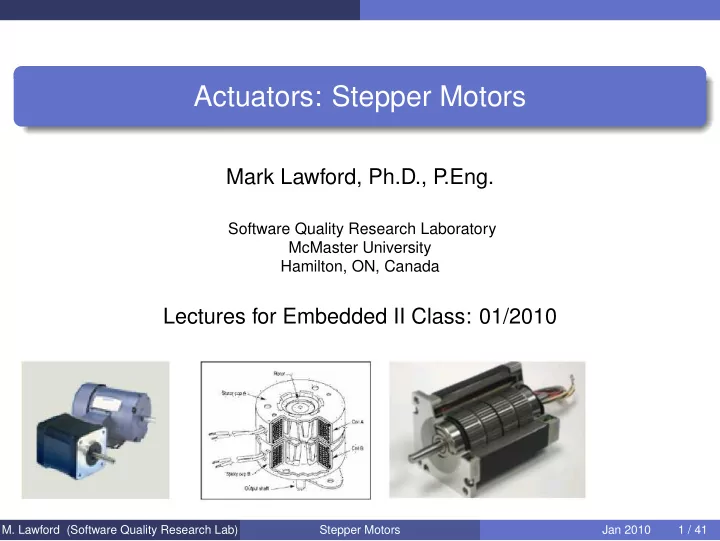
Actuators: Stepper Motors Mark Lawford, Ph.D., P .Eng. Software Quality Research Laboratory McMaster University Hamilton, ON, Canada Lectures for Embedded II Class: 01/2010 university-logo M. Lawford (Software Quality Research Lab) Stepper


slide-1
SLIDE 1

university-logo

Actuators: Stepper Motors

Mark Lawford, Ph.D., P .Eng.

Software Quality Research Laboratory McMaster University Hamilton, ON, Canada

Lectures for Embedded II Class: 01/2010

  • M. Lawford (Software Quality Research Lab)

Stepper Motors Jan 2010 1 / 41

slide-2
SLIDE 2

university-logo

Outline

1

Overview of Stepper Motors Brushed DC Motor Brushless DC (Stepper) Motor

2

Operation of a 2 Phase Stepper motor Full Stepping with 1 Phase Full Step with 2 Phases Active Improving Resolution Half-Stepping Micro-stepping

3

Variable Reluctance Stepper Motor Background Full Step Operation

4

Motor Drive Circuitry: Control and Protection Circuits

  • M. Lawford (Software Quality Research Lab)

Stepper Motors Jan 2010 2 / 41

slide-3
SLIDE 3

university-logo Overview of Stepper Motors

The Big Picture

Electric motors - used for rotary motion Many different kinds - induction (AC), DC, servo, stepper This lecture will cover some details of a stepper motor. Lab 1 deals with control of a stepper motor. So, what is a stepper motor? Stepper motors are DC motors whose position can be changed in discrete steps. In most applications stepper motor moves in steps instead of rotating continuously

  • M. Lawford (Software Quality Research Lab)

Stepper Motors Jan 2010 3 / 41

slide-4
SLIDE 4

university-logo Overview of Stepper Motors Brushed DC Motor

How a DC motor works?

Let us start with a simple DC motor A permanent magnet stator Windings on the rotor (armature) Electromagnet created on the rotor by passing current Direction of current needs to be changed for rotation How to pass current to a rotating body? How to reverse connections? - Brushes!

  • M. Lawford (Software Quality Research Lab)

Stepper Motors Jan 2010 4 / 41

slide-5
SLIDE 5

university-logo Overview of Stepper Motors Brushed DC Motor

Problems with Brushed DC motors

Problems: Brushes have mechanical wear out Cause spark and electromagnetic interference Alternative: Have permanent magnet on the rotor Electromagnet on the stator But how do we rotate the field? Let us see how this alternative works!

  • M. Lawford (Software Quality Research Lab)

Stepper Motors Jan 2010 5 / 41

slide-6
SLIDE 6

university-logo Overview of Stepper Motors Brushless DC (Stepper) Motor

Brushless DC Motor with 1 Winding (phase)

How do we rotate the magnetic field? What happens if we add one more winding (phase) to the stator?

  • M. Lawford (Software Quality Research Lab)

Stepper Motors Jan 2010 6 / 41

slide-7
SLIDE 7

university-logo Overview of Stepper Motors Brushless DC (Stepper) Motor

Brushless DC Motor with 2 Windings (phases)

  • M. Lawford (Software Quality Research Lab)

Stepper Motors Jan 2010 7 / 41

slide-8
SLIDE 8

university-logo Operation of a 2 Phase Stepper motor Full Stepping with 1 Phase

Step 1: Apply Vcc to B1, GND to B2

Figure: Step1: Apply Vcc to B1, GND to B2, (A1, A2 are NC

NOTE: Here NC means “Not Connected”

  • M. Lawford (Software Quality Research Lab)

Stepper Motors Jan 2010 8 / 41

slide-9
SLIDE 9

university-logo Operation of a 2 Phase Stepper motor Full Stepping with 1 Phase

Step 2: Apply Vcc to A2, GND to A1

Figure: Step 2: Apply Vcc to A2, GND to A1, B1=B2=NC

  • M. Lawford (Software Quality Research Lab)

Stepper Motors Jan 2010 9 / 41

slide-10
SLIDE 10

university-logo Operation of a 2 Phase Stepper motor Full Stepping with 1 Phase

Step 3: Apply Vcc to B2, GND to B1

Figure: Step 3: Apply Vcc to B2, GND to B1, A1=A2=NC

  • M. Lawford (Software Quality Research Lab)

Stepper Motors Jan 2010 10 / 41

slide-11
SLIDE 11

university-logo Operation of a 2 Phase Stepper motor Full Stepping with 1 Phase

Step 4: Apply Vcc to A1, GND to A2

Figure: Step 4: Apply Vcc to A1, GND to A2, B1=B2=NC

  • M. Lawford (Software Quality Research Lab)

Stepper Motors Jan 2010 11 / 41

slide-12
SLIDE 12

university-logo Operation of a 2 Phase Stepper motor Full Stepping with 1 Phase

Step 5: Apply Vcc to B1, GND to B2

Figure: Step5: Apply Vcc to B1, GND to B2, A1=A2=NC

NOTE: Step 5 is identical to Step 1!

  • M. Lawford (Software Quality Research Lab)

Stepper Motors Jan 2010 12 / 41

slide-13
SLIDE 13

university-logo Operation of a 2 Phase Stepper motor Full Stepping with 1 Phase

Summary: Stepper Control Sequence (CW)

  • M. Lawford (Software Quality Research Lab)

Stepper Motors Jan 2010 13 / 41

slide-14
SLIDE 14

university-logo Operation of a 2 Phase Stepper motor Full Stepping with 1 Phase

Equivalent Stepper Control Sequence

  • M. Lawford (Software Quality Research Lab)

Stepper Motors Jan 2010 14 / 41

slide-15
SLIDE 15

university-logo Operation of a 2 Phase Stepper motor Full Step with 2 Phases Active

Alternative Full Step Control

Consider what happens when voltage is applied to both windings at the same time? Results in higher torque than energizing only one winding!

  • M. Lawford (Software Quality Research Lab)

Stepper Motors Jan 2010 15 / 41

slide-16
SLIDE 16

university-logo Operation of a 2 Phase Stepper motor Full Step with 2 Phases Active

Full step drive (two phases on)

This is the usual method for full step driving the motor. Both phases are always on. The motor will have full rated torque. Using the first method, the stepper motor will typically have less then the fully rated torque. Exercises

1

Write down the full step sequence when both windings are energized at every step.

2

What is the resolution of both Full Step Controls?

3

How do you reverse direction?

  • M. Lawford (Software Quality Research Lab)

Stepper Motors Jan 2010 16 / 41

slide-17
SLIDE 17

university-logo Operation of a 2 Phase Stepper motor Improving Resolution

Improving Resolution

Current Limitations The motor described above has two poles (one N one S) Its step resolution is 90◦ How can we increase resolution (decrease step size)?

1

Increase number of phases on stator

2

Increase number of permanent magnets on rotor

3

Half Stepping

4

Micro-Stepping

  • M. Lawford (Software Quality Research Lab)

Stepper Motors Jan 2010 17 / 41

slide-18
SLIDE 18

university-logo Operation of a 2 Phase Stepper motor Improving Resolution

Improving Resolution with More Phases on the Stator

3 Phase Stepper Works but has limits: The problem with this approach is that the number of wires (and thus control signals) needed to control the motor has increased. How else can we increase resolution? We can look at increasing rotor magnet poles. The motor above has two poles (one N one S).

  • M. Lawford (Software Quality Research Lab)

Stepper Motors Jan 2010 18 / 41

slide-19
SLIDE 19

university-logo Operation of a 2 Phase Stepper motor Improving Resolution

Improving Resolution with More Permanent Magnets

Advantages and Limitations: The advantage is that we keep same number of control signals with increased resolution. This disadvantage is increased cost of permanent magnets. How do we move (Full Step) this motor? This motor has 6 poles (3 N, 3S) and 2 phases on the stator. The Control is the almost same as before! (How does it differ?)

  • M. Lawford (Software Quality Research Lab)

Stepper Motors Jan 2010 19 / 41

slide-20
SLIDE 20

university-logo Operation of a 2 Phase Stepper motor Improving Resolution

Step 1: Apply Vcc to B1, GND to B2

Figure: Step 1

  • M. Lawford (Software Quality Research Lab)

Stepper Motors Jan 2010 20 / 41

slide-21
SLIDE 21

university-logo Operation of a 2 Phase Stepper motor Improving Resolution

Step 2: Apply Vcc to A2, GND to A1

Figure: Step 2

  • M. Lawford (Software Quality Research Lab)

Stepper Motors Jan 2010 21 / 41

slide-22
SLIDE 22

university-logo Operation of a 2 Phase Stepper motor Improving Resolution

Step 3: Apply Vcc to B2, GND to B1

Figure: Step 3

  • M. Lawford (Software Quality Research Lab)

Stepper Motors Jan 2010 22 / 41

slide-23
SLIDE 23

university-logo Operation of a 2 Phase Stepper motor Improving Resolution

Step 4: Apply Vcc to A1, GND to A2

Figure: Step 4

  • M. Lawford (Software Quality Research Lab)

Stepper Motors Jan 2010 23 / 41

slide-24
SLIDE 24

university-logo Operation of a 2 Phase Stepper motor Improving Resolution

Step 5: Apply Vcc to B1, GND to B2

Figure: Step 5

  • M. Lawford (Software Quality Research Lab)

Stepper Motors Jan 2010 24 / 41

slide-25
SLIDE 25

university-logo Operation of a 2 Phase Stepper motor Improving Resolution

Stepper Motor Full Step Resolution

Resolution is sometimes given in the number of steps required to complete a revolution (360 degrees) 2-pole motor takes 4 steps 6 pole motor takes 12 steps Angular Resolution = 360◦ # of steps 2-pole motor had resolution of 90◦ 6-pole motor had resolution of 30◦. Equation for angular resolution of 2 phase motors is: Angular Resolution = 360◦ 2 × (# of poles)

  • M. Lawford (Software Quality Research Lab)

Stepper Motors Jan 2010 25 / 41

slide-26
SLIDE 26

university-logo Operation of a 2 Phase Stepper motor Improving Resolution

Stepper Motor Full Step Resolution

In general a stepper motor can have more than 2 phases (recall 3 phase stepper above). In this case we can generalize our formula for full step angular resolution to: Equation for angular resolution of an n phase motors is: Angular Resolution = 360◦ n × (# of poles)

  • M. Lawford (Software Quality Research Lab)

Stepper Motors Jan 2010 26 / 41

slide-27
SLIDE 27

university-logo Operation of a 2 Phase Stepper motor Half-Stepping

Half-Stepping

Basic Concept: Alternate 2 phase and single phase Full Step control steps Result: Double the resolution (1/2 the step size) with no change to control wiring. Note though that to keep torque consistent in 1/2 steps you need to increase current in the winding when in a single phase 1/2 step.

  • M. Lawford (Software Quality Research Lab)

Stepper Motors Jan 2010 27 / 41

slide-28
SLIDE 28

university-logo Operation of a 2 Phase Stepper motor Half-Stepping

Half-Stepping Sequence

  • M. Lawford (Software Quality Research Lab)

Stepper Motors Jan 2010 28 / 41

slide-29
SLIDE 29

university-logo Operation of a 2 Phase Stepper motor Half-Stepping

Exercises:

1

Describe the behaviour of a 6-pole stepper motor given the sequence above

2

Consider the torque the stepper motor produces when using half stepping

a) When one winding is on b) When both windings are on

  • Considering this, which 4 steps (out of the 8) would you prefer to

use when performing full steps? Does this depend on the application?

  • M. Lawford (Software Quality Research Lab)

Stepper Motors Jan 2010 29 / 41

slide-30
SLIDE 30

university-logo Operation of a 2 Phase Stepper motor Micro-stepping

Microstepping: Overview

Recall that we turned on one phase then two phases to move a half

  • step. Then turned off one phase to move another half step.

This is Bang-bang control - a phase is either full current, or no current. Question: What if vary the phase currents in smaller steps? Answer: We get microstepping! See this animated at: http://en.nanotec.com/steppermotor_animation.html

  • M. Lawford (Software Quality Research Lab)

Stepper Motors Jan 2010 30 / 41

slide-31
SLIDE 31

university-logo Variable Reluctance Stepper Motor Background

Magnetic Reluctance

Magnetic reluctance Magnetic reluctance, or magnetic resistance, is a concept used in the analysis of magnetic circuits. It is analogous to resistance in an electrical circuit (although it does not dissipate magnetic energy). In likeness to the way an electric field causes an electric current to follow the path of least resistance, a magnetic field causes magnetic flux to follow the path of least magnetic reluctance. The smaller the air gap between ferro-magnetic materials becomes, the lower the magnetic reluctance becomes.

  • M. Lawford (Software Quality Research Lab)

Stepper Motors Jan 2010 31 / 41

slide-32
SLIDE 32

university-logo Variable Reluctance Stepper Motor Full Step Operation

Step 1: Energize Coil 1

Step 1: Energize Top Coil (1) Energizing the top coil creates a magnetic field that causes the rotor gear teeth to align with the top stator’s teeth to minimize the air-gap reduce the magnetic reluctance.

  • M. Lawford (Software Quality Research Lab)

Stepper Motors Jan 2010 32 / 41

slide-33
SLIDE 33

university-logo Variable Reluctance Stepper Motor Full Step Operation

Step 1: Discussion

Energizing Coil 1 attracts the nearest tooth of the gear-shaped iron rotor. With the teeth aligned to electromagnet 1, they will be slightly

  • ffset from electromagnet 2 (next electromagnet CW).

Note the shortest direction the rotor gear has to rotate to align teeth with electromagnet 2! Angular Resolution There are 25 teeth on the rotor gear (Count’em!) There are 4 independent electromagnets What is the resulting (full step) angular resolution?

  • M. Lawford (Software Quality Research Lab)

Stepper Motors Jan 2010 33 / 41

slide-34
SLIDE 34

university-logo Variable Reluctance Stepper Motor Full Step Operation

Step 2: Coil 1 Off Then Energize Coil 2

Step 2: Turn off Coil 1 Then Energize Right Coil (2) The top electromagnet (1) is turned off, and the right electromagnet (2) is energized, pulling the nearest teeth slightly CW. This results in a rotation of 3.6◦ CW in this example.

  • M. Lawford (Software Quality Research Lab)

Stepper Motors Jan 2010 34 / 41

slide-35
SLIDE 35

university-logo Variable Reluctance Stepper Motor Full Step Operation

Step 2: Discussion

With Coil 1 off, Energizing Coil 2 attracts the nearest tooth of the gear-shaped iron rotor. Now with the rotor gear teeth aligned to electromagnet 2, they will be slightly offset from electromagnet 3! Note the shortest direction the rotor gear has to rotate to align teeth with electromagnet 2!

  • M. Lawford (Software Quality Research Lab)

Stepper Motors Jan 2010 35 / 41

slide-36
SLIDE 36

university-logo Variable Reluctance Stepper Motor Full Step Operation

Step 3: Coil 2 Off Then Energize Coil 3

Step 3: Turn off Coil 2 Then Energize Bottom Coil (3) The right electromagnet (2) is turned off, and the right electromagnet (3) is then energized, pulling the nearest teeth slightly CW. This results in a rotation of 3.6◦ CW.

  • M. Lawford (Software Quality Research Lab)

Stepper Motors Jan 2010 36 / 41

slide-37
SLIDE 37

university-logo Variable Reluctance Stepper Motor Full Step Operation

Step 4: Coil 3 Off Then Energize Coil 4

Step 4: Turn off Coil 3 Then Energize Left Coil (4) The bottom electromagnet (3) is turned off, and the left electromagnet (4) is then energized, pulling the nearest teeth slightly CW. This results in a further rotation of 3.6◦ CW.

  • M. Lawford (Software Quality Research Lab)

Stepper Motors Jan 2010 37 / 41

slide-38
SLIDE 38

university-logo Variable Reluctance Stepper Motor Full Step Operation

Steps 1-4: Discussion

When the top electromagnet (1) is again enabled, the teeth in the sprocket will have rotated by one tooth position; since there are 25 teeth, it will take 100 steps to make a full rotation in this example. There is an animation of a more typical 3 phase variable reluctance motor at: http: //www.cs.uiowa.edu/~jones/step/typesf/1anim.html

  • M. Lawford (Software Quality Research Lab)

Stepper Motors Jan 2010 38 / 41

slide-39
SLIDE 39

university-logo Motor Drive Circuitry: Control and Protection Circuits

Control Circuit

Motors need more current than a typical microprocessor can supply Control signals from a microprocessor are connected to a driver circuit Output from the driver circuit is connected to the motor For a bipolar motor, we need to reverse current through windings

  • f the motor

This can be done by suitable switches as shown in figure 11 Electronic equivalent of such switches is called H-bridge Forward / reverse modes

  • M. Lawford (Software Quality Research Lab)

Stepper Motors Jan 2010 39 / 41

slide-40
SLIDE 40

university-logo Motor Drive Circuitry: Control and Protection Circuits

H-Bridge Circuit Equivalent

Figure:

  • M. Lawford (Software Quality Research Lab)

Stepper Motors Jan 2010 40 / 41

slide-41
SLIDE 41

university-logo Motor Drive Circuitry: Control and Protection Circuits

Protection Circuit

Figure:

  • M. Lawford (Software Quality Research Lab)

Stepper Motors Jan 2010 41 / 41