
SLIDE 1
Circle Property Plc Annual Report and Accounts 2019
Actively investing in regional
- ffices
Circle Property Plc Annual Report and Accounts for the year ended 31 March 2019
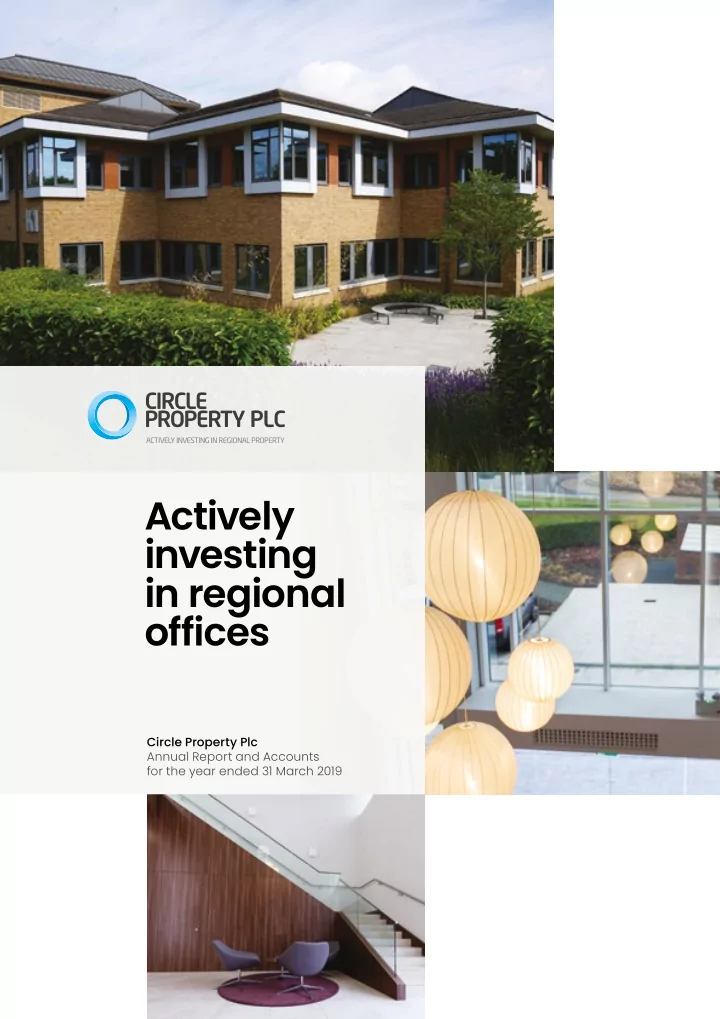
Actively investing in regional offices Circle Property Plc - - PDF document
Circle Property Plc Annual Report and Accounts 2019 Actively investing in regional offices Circle Property Plc Annual Report and Accounts for the year ended 31 March 2019 Circle Property is a UK regional market leading office developer and
Circle Property Plc Annual Report and Accounts 2019
Circle Property Plc Annual Report and Accounts for the year ended 31 March 2019
Strong track record of identifying well located assets, which with our excellent property skills, deliver top quality office accommodation and consistent returns. Delivered NAV growth for the third successive year average increase in excess of 20% per annum.
STRATEGIC REPORT
1 Highlights 2–3 At A Glance 4–5 Chairman’s Statement 6–7 Chief Executive’s Statement 8–9 Commercial Market Backdrop 10–11 Business Model 12–13 Our Growth Strategy 14–23 Portfolio Review 24–25 Principal Risks and Uncertainties
GOVERNANCE
26–27 Board of Directors 28–30 Governance Report 31–32 Audit Committee Report 33–34 Directors’ Report 35–36 Remuneration Committee Report
FINANCIALS
37–39 Independent Auditor’s Report 40 Consolidated Statement
Income 41 Consolidated Statement
42 Consolidated Statement
43 Consolidated Statement
44–59 Notes to the Consolidated Financial Statements 60 Glossary IBC Officers and Professional Advisers For more information please visit: www.circleproperty.co.uk
1 Circle Property Plc Annual Report and Accounts 31 March 2019
Performance
£13.99m
Profit before tax 2019 2018
£15.25m 25.4%
Growth in NAV 2019 2018
20.7%
FINANCIAL STATEMENTS GOVERNANCE STRATEGIC REPORT
Highlights
Portfolio of 15 assets, primarily comprising well-located regional offices
Increase in contracted rental income from YE March 2018 to YE March 2019
Increase in property portfolio value (up £10.525m) from 31 March 2018 to 31 March 2019
Amount the let offices at their contracted rents are under rented against their ERV
Financial highlights
(31 March 2018: £114.075m).
(31 March 2018: £2.30).
(31 March 2018: £3.1m).
(31 March 2018: 0.51p).
the annual dividend to 6.3p.
Operational highlights
rent of £795,729 pa (equating to £20.50 psf overall).
Limited at Kents Hill Park, Milton Keynes removing the tenant’s break options and replacing fixed annual uplifts at 3% pa with annual RPI uplifts between 1% and 5%
to T Systems Limited on a 10 year lease at £214,582 pa equating to £15.09 psf
a refurbished office suite of 5,411 sq ft to ADL Automotive Limited at £77,462 pa equating to £14.32 psf.
Street totalling 6,100 sq ft and producing a combined rental income of £116,444 pa.
10 years on the 3rd floor rear at an initial rent of £156,216 pa (equating to £23 psf overall).
re-gear with the tenant The Co-Operative Group and a sale of the property for £3.5m, reflecting a price 18.64% above YE March 2018 valuation.
Post year end highlights
1st floor at K2, Kents Hill Park, Milton Keynes consisting
for a term of 10 years at headline rent of £352,625 pa (equating to £17.50 psf).
YE March 2019 valuation figure of £4.6m.
2 Circle Property Plc Annual Report and Accounts 31 March 2019
At A Glance
2/4 6 1 3/5
1 / Kents Hill Park Milton Keynes Comprises two elements, a regional conference centre (173,372 sq ft), and a refurbished 70,000 sq ft business park. 2 / Somerset House, Temple Street Birmingham A refurbished city centre mixed use property providing 38,805 sq ft of
restaurant and leisure use. 3 / One Castlepark, Tower Hill Bristol A refurbished multi let city centre office building providing 78,778 sq ft of accommodation. 4 / 36 Great Charles Street Birmingham Refurbished 25,787 sq ft city centre office building located within the Birmingham office core. 5 / Aztec West Business Park Bristol Three reversionary self- contained business park properties providing a total floor area of 34,811 sq ft. 6 / Northampton Business Park Northampton Two office buildings totalling 65,904 sq ft located within Northampton’s well established business park.
Our portfolio
The Group’s portfolio consists of 15 commercial property investments and developments in the UK with a current value at 31 March 2019 of £124.6m. The portfolio totals approximately 642,523 sq ft of accommodation, the majority of which, by floor area, is in the office sector, some of which are outlined below.
3 Circle Property Plc Annual Report and Accounts 31 March 2019
FINANCIAL STATEMENTS GOVERNANCE STRATEGIC REPORT
Like-for-like Contracted rental income uplift equating to 17.96%
YE 31 Mar 2019
YE 31 Mar 2018
Increase in Net Asset Value
well-located regional offices
Portfolio value by location
■ 19.86% Bristol ■ 4.74% Other ■ 6.66% Northampton ■ 2.89% London - City ■ 40.65% Milton Keynes ■ 22.39% Birmingham ■ 2.81% London - Staines
Portfolio value by sector
■ 95.3% Office (incl. conference facility) ■ 1% Warehouse ■ 3.7% Retail warehouse
4 Circle Property Plc Annual Report and Accounts 31 March 2019
Chairman’s Statement
Our Net Asset Value has increased 86% since admission to AIM in February 2016.
Ian Henderson, Chairman
Continued outperformance and strong returns Our strategic focus combined with the demand for regional office space and our proven expertise in the regional office market, makes us confident of continuing to deliver strong returns for our shareholders. The strong performance of the business set out in these results represents a third successive year
increase in NAV of over 20%. In absolute terms NAV has increased 86% since IPO in February 2016 to £78.4m, delivering a NAV Compound Average Growth Rate of 23%; and a total return CAGR of 26%. NAV total returns, combining both NAV growth and dividend payments, since IPO have been 33%. It is by this measure that Circle is the best performing quoted UK real estate company over the last two years (Source: Radnor Capital research, 31 March 2019).
5 Circle Property Plc Annual Report and Accounts 31 March 2019
FINANCIAL STATEMENTS GOVERNANCE STRATEGIC REPORT A successful regional model driven by careful asset management The ability to deliver such strong returns lies in our business model which focuses on the regional office market, and in particular, well-located but under-utilised office space where we can actively manage the asset to add value, rather than just maximising initial yields. Our focus on provincial offices is proving well founded as rental values move upward, largely as a result of the supply constraint as the trend to convert secondary offices into residential units continues. We remain confident that occupational demand in the provinces will continue to improve where well- specified offices in good locations remain attractive. This view is supported by the market where investment yields in the regions are firming as investors see the upward trend in rental values and the reduction in vacancy levels. We will continue to remain focussed
has had an excellent track record since our admission to AIM, and we are unlikely to increase risk exposure and gearing materially until there is an improvement in the political and economic
86%
NAV growth since IPO
Company history
NAV per share
£1.49 £1.53 £1.79 £1.83 £2.11 £2.30 £2.75
2016 16 Feb 2016 31 March 2016 30 Sept 2017 31 March 2017 30 Sept 2018 31 March 2018 30 Sept
£2.77
2019 31 March
Circle continues to offer a value
and capital growth potential Despite consistently delivering market leading returns and
potential, we are aware that
significant discount to NAV, with NAV of £2.77 per share compared to a closing price on 9 July 2019
Our strategy is to continue to deliver attractive total return to investors through further NAV growth and to realise the income growth potential within our portfolio and beyond. The Board remains confident that we are well positioned to do this. This confidence is demonstrated by our decision to advance our progressive dividend policy, which will see our annual dividend increase to 6.3p per share, a rise
I would like to thank shareholders for their support and we remain committed to following our twin
existing portfolio to maximise total returns, and undertaking corporate acquisition or portfolio purchase
Ian Henderson Chairman
6 Circle Property Plc Annual Report and Accounts 31 March 2019
Chief Executive’s Statement
The combination of our development stock and our ability to add value through asset management has enabled us to once again achieve an increase in Net Asset Value (“NAV”) of over 20% for the year. Following the recent strategic disposals of our two shops in Maidstone and a retail warehouse park in Shipley, both of which were achieved at marginally above valuation, our portfolio has no retail
to focus on delivering further strong gains in the regional office sector, as we continue to complete lettings and undertake further asset management initiatives to improve performance.
Well placed to focus on
advantageous business model.
John Arnold, Chief Executive Officer
Growth in contracted rental income, since March 2018 Portfolio of 15 assets primarily comprising well-located regional offices
7 Circle Property Plc Annual Report and Accounts 31 March 2019
FINANCIAL STATEMENTS GOVERNANCE STRATEGIC REPORT Future growth prospects – acquisition opportunities In addition, we have the opportunity to explore attractive buying
£100 million new financing facility agreement with RBS and HSBC, replacing the previous £55 million facility with RBS. This new financing facility provides us with the ability to target value accretive acquisitions, as we continue to focus on developing
well-located but under-utilised
We believe that there are
seeking a rapid sale to a reliable purchaser, and particularly with properties that are too small to appeal to institutional buyers, but are too large for private investors. Equally because we are not a REIT, and therefore we do not have to distribute a set level of income, we have the flexibility to target refurbishment
create future value. This would be a less accessible option to a business with a traditional REIT structure. The focus of each potential acquisition will be the creation of value by utilising the management team’s proven asset management skills and ensuring that they contribute to the strong returns that we are already delivering using our successful model. Outlook We continue to outperform with our focus on the regional office market which continues to yield higher total returns despite current market
ability to offer investors impressive NAV growth, increasing dividends and income growth potential, as well as generating attractive market leading returns. John Arnold Chief Executive Officer Record results for 2019 – NAV, rental income, progressive dividend NAV has increased 86% since IPO to a record level of £78.4m, an increase
equates to a NAV per share of £2.77 (2018: £2.30), which remains at a 30.1% discount to the closing share price on 9 July 2019. Contracted annual rental income has risen 12% to £7.6m (2018: £6.48m) despite the reduction of almost £0.35m in income from the retail properties sold during the period. The successful continuation
be attributed to the additional lettings and maintenance of high
portfolio, which is currently at 92%, excluding buildings recently refurbished or currently undergoing
has increased by 16.2% to £3.66m for the year ended 31 March 2019. Given NAV growth and the dynamic earnings stream created by successfully letting our existing development pipeline, the Board is confident to propose to shareholders a final dividend of 3.3p per share in line with our progressive dividend
dividend to 6.3p per share, a 12.5% increase on the previous year (2018: 5.6p per share). The final dividend of 3.3p per share, subject to shareholder approval, will be paid
gives an ex-dividend date of 18 July 2019. Future growth prospects – growing lettings and reversion uplift Whilst we have delivered strong returns to shareholders to date, we continue to explore opportunities to grow the Company and to maximise total future returns. We remain confident that there is a clear prospect of further growth as we capture the reversion in the portfolio and lease the remaining space across our pipeline of newly refurbished assets. Post period end, we have already generated a further £0.35m of contracted rent, further details of which are provided in the Portfolio Review within the report and
Estimated Rental Values increased by £145,023 per annum (like-for-like), representing a 1.51% increase, underlining strong potential future income growth as this reversion is captured and recently refurbished vacant space is leased.
8 Circle Property Plc Annual Report and Accounts 31 March 2019
Commercial Market Backdrop
The investment market for regional offices located within major conurbations has remained stable over the year, as investors are seeking higher total returns than those achievable from Central London offices. The regional letting market has also continued to be stable for affordable, good quality, well located
being attracted by lower employment costs, business rates and rent, coupled with existing demand from local professional occupiers and SMEs.
Market opportunities With REITs competing for income and institutions restricted by their large asset lot size requirement, there is more opportunity for us to acquire well located, short let or part vacant provincial offices, with asset management potential. Furthermore, major regional cities have experienced the Permitted Development Rights effect, whereby
without planning permission. This has led to a shortage in supply of good quality office accommodation, with little new build on the horizon. Significant trends A reduction in supply for good quality regional offices, along with a stable regional economy, has maintained demand for office space which has led to rental
requirements have continued to change with many seeking something different, such as exposed mechanical services, which are not normally found in regional offices along with enhanced landlord provided
placing an increased priority
Outlook Large occupiers (10,000 sq ft +) have continued their cautious wait and see approach, whilst at the smaller end, the SME market, (which makes up 70% of the total number of lettings), has continued to maintain its momentum and drive rental
placed in the letting market as most
suites from 1,500 to 5,000 sq ft, or are capable of being sub-divided to capture the current demand. With investors now wanting higher total returns rather than just seeking income we are of the view that the appetite for regional
yields are likely to remain stable.
9 Circle Property Plc Annual Report and Accounts 31 March 2019
£64.999m £78.434m
NAV performance
2018 2019 YE March
Growth in NAV
£6.829m £7.629m £9.925m £9.721m
Contracted rental income
■ Contracted income excluding tenant’s incentives YE March 2018 YE March 2019 ■ Estimated rental value
FINANCIAL STATEMENTS GOVERNANCE STRATEGIC REPORT
Growth drivers
Permitted development rights reducing regional
Demand from both local
those relocating
Providing inspiring
tenants want to work
10 Circle Property Plc Annual Report and Accounts 31 March 2019
Business Model
Focus on well-located but under-utilised and good quality offices in key regional centres. The combination
supply constraints and management expertise all point to a positive outlook.
Our portfolio
The portfolio consists of 15 assets, predominantly regional offices (including a regional conference centre), all well located within major conurbations.
Total valuation
Square feet in total
Our Tenants
There are currently 54 tenants within the portfolio ranging from both FTSE 100 and 250 listed companies and national partnerships through to regional and local SMEs.
Total tenants
Total occupancy
Our suppliers/stakeholders
We have extensive investment agency contacts throughout the regions and in London which enable us to secure genuine added value opportunities. This along with our strong project management and contractor contacts mean we can and do deliver refurbishments to the highest of standards.
Resources & relationships Growing our business
Refurbish and actively manage Revalue and re-gear Buy
11 Circle Property Plc Annual Report and Accounts 31 March 2019
FINANCIAL STATEMENTS GOVERNANCE STRATEGIC REPORT This is done by careful asset
buying short let income to drive the rents forward or
we use our proven expertise to provide tenants with the
desire, in locations where there is proven occupier demand. Having successfully re-geared leases or refurbished and let the office building, we revalue the asset and use the equity released by refinancing to start the cycle again. The increased rent feeds our progressive dividend policy. We buy well located regional
reposition the asset and maximise its full value.
Investors
Over the financial year and through asset management we have:
17.66% which will positively feed into our progressive dividend policy; and
uplift of 13.48%; and produced a total return to investors
Returned to shareholders
Total dividend
Our Tenants
By delivering quality refurbishments, we are offering tenants’
tenant’s office provider of first choice.
Community
During the prior year, Circle has completed a £7m refurbishment programme at Kents Hill Park, Great Charles Street and Somerset House, the investment not only benefiting the Company’s assets, but also enhancing the immediate vicinity around each building. In Milton Keynes, we created a new business park, whilst in Birmingham, we were forerunners in the redevelopment of Temple Street.
Delivering value
12 Circle Property Plc Annual Report and Accounts 31 March 2019
Our Growth Strategy
Strategy 2018/19 Objectives 2018/19 Achievements
Acquisitions
We buy well located short let/fully
where we are confident in the letting market.
individual assets or a portfolio.
during the year.
Active management
Our hands-on approach to asset management leads to decreasing letting voids and increasing rental income.
at Somerset House and 36 Great Charles Street, Birmingham along with K2, Kents Hill Park.
further rent reviews and lease renewals within the portfolio.
entire offices at Somerset House in Birmingham at an initial rent of £795,729 pa (equating to £20.50 psf overall).
2 year lease to Compass Contract
Services (UK) Limited at Kents Hill Park, Milton Keynes, initial rent £1,591,804 pa subject to annual RPI uplifts between 1% and 5%.
Kents Hill Park, Milton Keynes, initial rent £214,582 pa.
Park House, Northampton Business Park, initial rent £77,462 pa.
Charles Street totalling 6,100 sq ft and producing a combined rental income of £116,444.50 pa.
Castlepark, Bristol, initial rent of £156,216 pa.
Bridge Retail Park, Shipley, initial rent £51,420 pa.
Recycle capital
We sell non-core assets where we have completed the asset management and recycle the proceeds into new provincial
release equity on completed developments.
re-invest in provincial office with active management/ added value potential.
developments to release equity for further acquisitions.
simultaneous lease re-gear with The Co-Operative Group and a sale of the property for £3.5m, reflecting a price 18.64% above YE March 2018 valuation.
Week Street Maidstone at valuation within a negative retail investment market.
Development programme
We reposition and add value to well located regional offices by undertaking both minor or extensive refurbishments.
within Somerset House and 36 Great Charles Street, Birmingham and K2, Kents Hill Park capturing an additional £1,655,250 pa of rental income.
Temple Street, Birmingham generating a further £795,729 pa.
generating a further £214,582 pa.
Street generating a further £116,444 pa.
13 Circle Property Plc Annual Report and Accounts 31 March 2019
FINANCIAL STATEMENTS GOVERNANCE STRATEGIC REPORT
2019/20 Objectives Key performance indicators
assets or a portfolio.
New financing facility agreement entered into during the year for earnings and portfolio enhancing acquisitions.
within the portfolio and refurbished offices at 36 Great Charles Street, Birmingham and K2, Kents Hill Park. Negotiate and complete further rent reviews and lease renewals within the portfolio.
to lease exchanged on the entire 1st floor at K2, Kents Hill Park, Milton Keynes consisting of 20,462 sq ft to Grand Union Housing Group Limited for a term of 10 years at an initial rent of £352,625 pa (equating to £17.50 psf).
Office portfolio
Amount let offices are under-rented versus ERV
Total portfolio contracted rent vs total ERV
31 March 2019
Contracted rent Total ERV £7.629m £9.721m
re-invest in regional offices with active management/added value potential.
developments to release equity for further acquisitions.
final retail warehouse unit to Sue Ryder, the sale of Baildon Bridge Retail Park at valuation of £4.6m.
Sale of Baildon Bridge post year end
Street, Birmingham capturing an additional £210,500 pa of rental income.
Space available to let within refurbished office building
YE 2017 YE 2018 YE 2019 34.21% 26.43% 4.88%
14 Circle Property Plc Annual Report and Accounts 31 March 2019
+11.71% portfolio rental income increase created primarily by asset management
Total portfolio value
income producing
the office sector
located in Milton Keynes, Bristol and Birmingham
Portfolio Review
We will continue to concentrate on further lettings and active management initiatives having made good progress over the year, along with making further
acquisitions to continue to drive growth forward.
Edward Olins, Chief Operating Officer
15 Circle Property Plc Annual Report and Accounts 31 March 2019
FINANCIAL STATEMENTS GOVERNANCE STRATEGIC REPORT During the year, we continued to increase the portfolio’s income by concentrating on lettings and lease renewals. Contracted rental income increased to £7.629m (31 March 2018: £6.829m), reflecting like-for-like increase of 17.96% over the year. The adjusted constricted rental income increased to £6.789m (31 March 2018: £6.53m), however on a like-for-like basis, increased by 9.72% (including disposals made during the year). Refurbishment works have completed at our three key developments, K2 Kents Hill Business Park, Milton Keynes, and both Somerset House and Charles Street in Birmingham. Each has been well received in the letting market resulting in Somerset House being 100% let, 36 Great Charles Street 56% let and K2 49%
Our strategy of owning buildings capable of subdivision to provide smaller office suites of up to 5,000 sq ft is paying off, as 70% of all lettings in the cities where we are invested are within this size range. The continued uncertainty in the market is giving rise to further
endeavour to exploit, should the returns be sufficiently attractive. As at 31 March 2019, the total portfolio value was £124.6m, an increase of 9.23% from the previous year (31 March 2018: £114.075m), mainly driven by asset management as opposed to yield compression. The portfolio is made up of 15 assets, primarily well located regional offices. By floor area, 91.94% of the portfolio is let and income producing (31 March 2018: 84.98%). Of the remaining vacant 8.06%, 4.96% is held within the three recently refurbished key office developments (31 March 2018: 13.9%). Only 3.10%
remaining buildings. (Post YE 2019, 95.12% let by floor area). Contracted 95.3% of the portfolio by value is in the office (and conference) sector. The remaining 4.7% is split across two sectors, retail warehouse and industrial, which although provide good high yielding income, are likely to be sold once their business plans are complete. (Post YE 2019, the retail warehouse was sold at book valuation). 82.91% of the portfolio by value is located in Milton Keynes, Bristol and Birmingham, an increase of 8% from the previous year end. On the basis of contracted rental income principal tenants within the portfolio include Compass Contract Services Limited (20.89%), B E Group Limited (10.43%), Which? Financial Services Limited (4.34%), Grand Union Housing Group (4.62%), B&M Retail (3.64%), Grant Thornton LLP (3.28%), New World Trading Ltd (3.21%) and T Systems (3.00%). As at March 2019, the weighted average unexpired lease term (‘WAULT’) to first break is 9.65 years, whilst to lease expiry is 10.68 years.
7.24 9.65 10.50 10.68
WAULT comparison
■ Years to break YE March 2018 YE March 2019 ■ Years to lease expiry
16 Circle Property Plc Annual Report and Accounts 31 March 2019
Portfolio Review
In their comprehensive refurbishment of the building, Circle Property excelled in their attention to detail, in particular their design was sympathetic to the building whilst the finishes were to a higher standard than other developers.
David Saul, Managing Director BE Offices Limited
Annual dividend
From 31 March 2018 36 Great Charles Street, Birmingham Offices
– National Governors’ Association (18.26%). – The Shaw Trust (13.94%). – Children’s Liver Decease Foundation (9.08%). – Gas Management Services (4.86%). – Verse Limited (4.86%). – Vectos Microsim (4.86%).
currently vacant and available to let at £18 psf.
– £200,650 per annum (£13.62 psf overall) – Total estimated rental value once fully let of £528,514. Somerset House, 37 Temple Street, Birmingham Offices
leisure accommodation.
let to: – Las Iguanas Ltd (50.49%). – Cameron’s Brewery Limited (49.51%).
let to: – B E Group Limited (100%).
term: – 15.17 years to expiry. – 14.46 years to break.
– £1,231,479 per annum).
17 Circle Property Plc Annual Report and Accounts 31 March 2019
FINANCIAL STATEMENTS GOVERNANCE STRATEGIC REPORT Kents Hill Business Park, Kents Hill, Milton Keynes Conference Centre
Fitness centre accommodation.
– Compass Contract Services (UK) Limited.
term: – 22.5 years to expiry.
– £1,591,804 per annum (£9.96 psf overall). Kents Hill Business Park, Kents Hill, Milton Keynes Offices
– Traffic Master (20.78%). – T Systems Limited (21.10%). – Lundbeck (12.40%). – Linear Building Innovations (8.65%). – IFG Management (6.71%).
term: – 7.84 years to expiry. – 3.71 years to break.
– £720,351 per annum (£15.35 psf overall).
lease completed with Grand Union Housing Group
18 Circle Property Plc Annual Report and Accounts 31 March 2019
Portfolio Review
continued
Cheltenham House, Temple Street, Birmingham Restaurant & Offices
accommodation.
Limited.
term: – 20.49 years to expiry.
– £245,000 per annum (£14.78 psf overall). One Castlepark, Tower Hill, Bristol Offices
being: – Which? Financial Services Ltd (30.1%). – Irwin Mitchell (15.1%). – JISC (8.6%). – IFG Management (8.3%).
term: – 4.5 years to expiry. – 3.3 years to break.
6,351sq ft vacant and being marketed to let (8.06%).
– £1,072,782 per annum (£14.81 psf overall).
19 Circle Property Plc Annual Report and Accounts 31 March 2019
Profit for the year before taxation
From 31 March 2018 FINANCIAL STATEMENTS GOVERNANCE STRATEGIC REPORT Park House, 300 Pavilion Drive, Northampton Business Park Offices
– Grant Thornton (47.9%) – NRG Group UK Ltd, t/a Ricoh (29.5%). – ADL Limited (12.4%).
term: – 4.40 years to expiry. – 3.60 years to break.
sq ft vacant and available to let (10.17%).
– £485,092 per annum (£12.39 psf overall). Elizabeth House, London Road, Staines Offices
being: – Elliot Turbomachinery (30.3%). – Channel 3 Consulting (10.5%). – Citizen Systems (21%). – Hardy & Hewitt (10.2%).
term: – 4.47 years to expiry. – 2.39 years to break.
are ongoing with the tenants.
– £219,924 per annum (£16.56 psf overall). – 1,551 sq ft vacant and being marketed to let.
20 Circle Property Plc Annual Report and Accounts 31 March 2019
Portfolio Review
continued
Powerhouse, Davy Avenue, Milton Keynes Offices
– Steven Eagell Ltd (31%). – IBM (31%). – Urgent Technology Ltd (20%). – Media Hawk (11%). – Strata Business Solutions (3%). – Creativedge Training (3%).
term: – 6.09 years to expiry. – 2.55 years to break.
tenants regarding lease renewals.
– £333,746 per annum (£15.59 psf overall). Victory House, 400 Pavilion Drive, Northampton Business Park Offices
£298,059.
value £314,750.
Regus regarding lease re-gear.
21 Circle Property Plc Annual Report and Accounts 31 March 2019
FINANCIAL STATEMENTS GOVERNANCE STRATEGIC REPORT
Net Asset Value
From 31 March 2018 710 Aztec West, Almondsbury, Bristol Offices
term: – 4.26 years to expiry.
– £208,924 per annum (£15.83 psf overall). 141 Moorgate, London EC2 Offices
being: – Drayton Finch limited (23.02%). – C J Travel Limited (22.84%). – Eximbills Technologies Limited (19.58%). – Genius in 21 Days Limited (11.84%).
term: – 3.75 years to expiry.
are ongoing with the tenants.
sq ft vacant and available to let (22.73%).
– £166,819 per annum. 135 Aztec West, Almondsbury, Bristol Offices
– £175,000 per annum (£13.20 psf overall).
22 Circle Property Plc Annual Report and Accounts 31 March 2019
Portfolio Review
continued
720 Aztec West, Almondsbury, Bristol Offices
term: – 1.2 years to expiry.
– £143,063 per annum (£17.13 psf overall).
23 Circle Property Plc Annual Report and Accounts 31 March 2019
FINANCIAL STATEMENTS GOVERNANCE STRATEGIC REPORT
Units A & B, Chapel Lane, Great Blakenham, Ipswich Industrial
accommodation.
Safety Limited.
term: – 3.35 years to expiry.
– £154,500 per annum (£3.41 psf overall). Baildon Bridge Retail Park, Otley Road, Shipley Retail Warehouse Park
retail warehouse accommodation.
– B&M Retail Limited (78%). – Topps Tiles Plc (13%). – Sue Ryder (9%).
term: – 7.8 years to expiry. – 6.4 years to break.
– £382,005 per annum (£10.28 psf overall).
24 Circle Property Plc Annual Report and Accounts 31 March 2019
Principal Risks and Uncertainties
The Board recognises that effective risk management is essential to Circle Property achieving its objectives and has carried out a robust assessment of the principal risks facing the Group, including those that would threaten its business model, future performance, solvency or liquidity.
RISK IMPACT MITIGATION MOVEMENT Tenant default
(rates voids and service charge shortfalls) until the property is re-let.
tenants accounting for around 30% total rental income, both with limited downside risk.
rent deposits sought if required.
business locations of investment.
management meetings held with all our tenants to assess any
manage potential bad debt risk. Low risk Unchanged Refurbishment
refurbishment cost.
programme.
within portfolio.
programme completed.
each acquisition approved by the Board which covers expected refurbishment cost and overall income/capital returns.
managers to oversee refurbishments, along with weekly site team meetings.
Low risk Unchanged Risk trend Increasing Unchanged Decreasing
25 Circle Property Plc Annual Report and Accounts 31 March 2019
FINANCIAL STATEMENTS GOVERNANCE STRATEGIC REPORT RISK IMPACT MITIGATION MOVEMENT Financing and cash flow
(interest rate cover and loan to value).
strategy.
cash flow to cover interest payments.
lettings complete within refurbished properties.
Company’s lenders, along with quarterly compliance statements on geared assets ensure funding transparency. Medium risk Unchanged Economic and political
the economy, tenant covenant strength and occupier demand.
within the current parliamentary term.
impact the returns generated from the Group’s property portfolio.
and letting vacant development stock. High risk Unchanged Property valuation
portfolio affects its profitability, Net Asset Value and the price of
valued by Savills, an independent valuer, who assess the fair value
Medium risk Unchanged Energy efficiency standards
E and below is required for each asset in order to be let or sold.
an Energy Performance Review of each asset and has planned refurbishment works for the two non-compliant assets. Medium risk Unchanged
26 Circle Property Plc Annual Report and Accounts 31 March 2019
Board of Directors
John Arnold Edward Olins Ian Henderson
Chief Executive Officer Chief Operating Officer Chairman Biography Mr Arnold left St Quintin Chartered Surveyors (now CBRE) after seven years in the management department and joined Hambros plc in January
Director of Berkeley Hambro plc, its property subsidiary, in 1991, where he remained until Investec’s acquisition of Hambros Bank in 1998, when he was appointed Managing Director of Investec Property plc. He left Investec at the end of 1999 and founded Circle in April 2002. Mr Arnold is a Fellow
Chartered Surveyors. Mr Olins joined DE & J Levy LLP as a graduate surveyor and became a salaried partner in 2000. He left the partnership in 2003 to join London & County Estates Limited as Investment
Circle to take control of new business acquisitions and assist Mr Arnold in the running of the Company. Mr Olins is a Member
Chartered Surveyors. Mr Henderson is a consultant to Capital & Counties Properties plc, he was formerly Chairman of the Dolphin Square Foundation and a Trustee of The Natural History Museum as well as being Chief Executive
plc and widely involved in the UK property industry, including being a president of the British Property Federation. Mr Henderson is a Fellow
Chartered Surveyors. Committee membership
27 Circle Property Plc Annual Report and Accounts 31 March 2019
FINANCIAL STATEMENTS GOVERNANCE STRATEGIC REPORT
Damian Jepson James Hambro The Duke of Roxburghe Michael Farrow
Non-Executive Director Non-Executive Director Non-Executive Director Non-Executive Director Mr Jepson, FCCA, qualified as a Certified Accountant in 1996 after training in Sheffield with a number
accounting firms. He spent time at a local audit
to Jersey to join Moore Stephens, and later, J.P. Morgan Trust Company. Mr Jepson spent ten years at a large fiduciary firm as Head of Private Client Accounting gaining considerable experience
net worth individuals. Since joining Oak Group (Jersey) Limited’s Corporate and Fund team in December 2017, he has successfully prepared complex IFRS accounts for a multi-jurisdictional fund structure and worked on listed entities. Mr Hambro is Chairman
Partners he was previously Chairman of Hansteen Holdings PLC, a FTSE 250 industrial property company, and a director
a Chairman of the Henry Smith Charity until 2015. Later that year he became Chairman of The Guide Dogs for the Blind charity. Guy Innes Ker, The Duke of Roxburghe, was previously Non-Executive Director
Investments Limited and The Sport Entertainment & Media Group Limited. The Duke of Roxburghe is involved in the day-to-day running of the Roxburghe Estates, including the
to the public in 1977 and
Golf course in 1997 and is Chairman of the National Stud in Newmarket. Mr Farrow was a founding director of Consortia Partnership Limited now Oak Group (Jersey) Limited which he helped grow to become a successful mid- sized Jersey trust, fund and corporate administrator. Having sold the business in 2016, he has recently retired and now enjoys a portfolio career being, amongst other non- executive appointments, the senior independent director of RDI REIT PLC (LSE Main Market), the chairman of STANLIB Funds Limited (ISE listed) and a director of redT energy plc (AIM quoted). Between 1997 and 2004, Mr Farrow was an Executive Director and Trustee of a substantial family office which held diversified investment and trading portfolios, primarily focused
and California. He has also been Group Company Secretary of Cater Allen Jersey, a banking, fiduciary and investment management group, and formerly a regular Army
a Master of Science in Corporate Governance and is a Fellow of the Chartered Institute of Secretaries and Administrators. James is chairman of the Audit Committee and a member of the Remuneration Committee. Guy is a member of both the Audit Committee and Remuneration Committee. Michael is chairman of the Remuneration Committee and a member
28 Circle Property Plc Annual Report and Accounts 31 March 2019
Governance Report
The Company is quoted on the AIM Market of the London Stock Exchange and is subject to the continuing requirements of the AIM Rules. The Board has adopted the principles set out in the Corporate Governance Code for small and mid-sized companies published by the QCA in April 2018 (“QCA Code”). This section provides general information on the Group’s adoption of the QCA Corporate Governance Code. The Company, whilst wishing to be as transparent as is practicable, recognises the limitations of its internal
develop its policies and procedures but has ensured that it adopted policies which have significant implications, such as a disclosure (conflicts) policy, share dealing code, insider lists and an anti-bribery and corruption policy. As the Company evolves the Board is committed to enhancing the Company’s corporate governance policies and practices appropriate for its size and maturity. The Board of Directors is responsible for the success of the Group and, through the independent oversight of management, is accountable to shareholders for the performance of the business. Leadership The Board of Directors comprises a majority of independent Non-Executive Directors and two Executive Directors, providing the requisite independent oversight, expertise and experience to meet the responsibility of making the business a success. The role of the Board The principal role of the Board is to set the Group’s strategy and to review regularly its performance in relationship to the agreed strategy. In doing this, the Board is able to carry out its corporate governance duties and responsibilities. The Board has established committees which are responsible for audit and remuneration. Nomination issues are addressed by the entire
Officer and Chief Operating Officer. The Board directs and monitors the Group’s affairs within an evolving framework of controls which enable risk to be assessed and managed effectively. The Board has a broad range of skill, with particular experience in the property sector. The Board biographies on pages 26 to 27 give an indication of the breadth of skill and experience of each director. Each member of the Board takes responsibility for maintain his skill set, which includes roles on other boards and
and seminars. The Board recognises that there are no female directors currently appointed to the Board and that the Board composition therefore does not contain the necessary gender balance. The Board continue to keep this issue under review. Board meetings The core activities of the Board are carried out in scheduled quarterly meetings of the Board and its
events in the Company’s corporate calendar and regular reviews of the business are conducted. Additional meetings and conference calls are arranged to address matters which require consideration outside of the scheduled meetings. All meetings are held in Jersey. The Board held four quarterly meetings and six standing Committee meetings during the year. Outside the meetings of the Board, the Directors maintain frequent contact with each other to discuss any issues of concern they may have relating to the Company or their areas of responsibility, and to keep themselves fully briefed on the Group’s operations. Attendance at meetings The Board meets regularly on a quarterly basis, together with further meetings as required. The Audit and Remuneration Committees meet as required, but with a minimum of two meetings each year. The Directors attended the following meetings during the year:
Board Audit Remuneration
John Arnold 4/4 Edward Olins 4/4 Ian Henderson 4/4 The Duke of Roxburghe 4/4 2/2 2/2 James Hambro 3/4 1/2 2/2 Michael Farrow 4/4 2/2 2/2 Damian Jepson (appointed 11 December 2018) 2/4 Timothy Scott Warren (resigned 11 December 2018) 2/4 Independent Non-Executive Directors The independent Non-Executive Directors being all those directors other than the Executive Directors bring a broad range of business and property experience to the Company and have a particular responsibility to monitor and challenge independently and constructively the performance of the executive management team in the delivery of the agreed
Time commitments On joining the board, Non-Executive Directors receive a formal letter, which identifies the terms and conditions
commitment expected of them. A potential Director candidate is required to disclose all significant outside commitments prior to their appointment. The Board is satisfied that both the Chairman and other Non- Executive Directors are able to devote sufficient time to the Group’s business. Delegations of authority Certain other matters are delegated to the Board Committees, namely the Audit and Remuneration Committees.
29 Circle Property Plc Annual Report and Accounts 31 March 2019
FINANCIAL STATEMENTS GOVERNANCE STRATEGIC REPORT The memberships, roles and activities of these Committees are detailed on the Company’s website. Each committee reports to the Board and the issues considered at meetings of the Committees are presented by the respective Committee Chairmen. Other governance matters All of the Directors are aware that independent professional advice is available to them in order to properly discharge their duties. In addition, each Director and Board Committee has access to the advice of the corporate Company Secretary. The Company Secretary The Company Secretary is Oak Secretaries (Jersey) Limited, a limited liability company regulated by the Jersey Financial Services Commission, which provides full secretarial services. Independence The Board has adopted a formal policy for the determination of the independence of the Non- Executive Directors. Among the key criteria of the independence policy are that any director has not been employed by the Group within the last five years, has no close family ties with any of the Group’s advisors, Directors or senior employees, does not hold cross directorships or have significant links with other Directors through involvement in other companies or bodies and does not represent a significant shareholder which could materially interfere with the director’s independence of judgment. Where contracts in the ordinary course of business exist between Circle Property Plc and a company in which a director has declared an interest, these are reviewed for materiality both to the Group, and the
the policy as being where the relationship accounts for more than 10% of either party’s consolidated gross revenue per annum, although the test also takes other circumstances into account. Appointments Directors appointed by the Board are subject to election by shareholders at the following Annual General Meeting of the Company and thereafter are subject to re-election in accordance with the Company’s Memorandum and Articles of Association. Conflict of interest A director has a duty to avoid a situation in which he or she has, or can have, a direct or indirect interest that conflicts, or possibly may conflict with the interests of the Company. The Board has satisfied itself that there is no compromise to the independence of those directors who have appointments on the boards of, or relationships with, companies outside the Company. The Board requires directors to declare all appointments and other situations which could result in a possible conflict of interest. The Company also maintains a register of gifts and no gifts were received in the reporting period although Mr Olins attended the Lambert Smith Hampton Ski Challenge designed to build business relationships in the commercial property sector. Board performance and evaluation The Board is not formally evaluated at present but will consider this at the appropriate juncture. It is envisaged that annual assessments will take place. Accountability The Board is committed to providing shareholders with a clear assessment of the Company’s position and prospects. This is achieved through this report and as required other periodic financial and trading statements. The Board has delegated to the Audit Committee oversight of the relationship with the Company’s auditors. Going concern The Company’s business activities, together with factors likely to affect its future operations, financial position, and liquidity are set out in the Chairman’s Statement and the CEO’s Report in this report. In addition, note 20 to the consolidated financial statements discloses the Company’s financial risk management practices with respect to its capital structure, liquidity risk, interest rate risk, credit risk and other related matters. The Directors’ statement on going concern is set out in
Internal controls The Board of Directors reviews the effectiveness of the Company’s system of internal controls. The internal control system is designed to manage the risk of failure to achieve the Company’s business objectives. This covers internal financial and operational controls, compliance and risk management. The Company has necessary procedures in place and the Directors acknowledge their responsibility for the Company’s system of internal controls and for reviewing its
management of significant risks faced by the Company. The Audit Committee During the year under review, the members of the Audit Committee were Mr Michael Farrow, Mr James Hambro and the Duke of Roxburghe. Mr James Hambro is the Chair of the Audit Committee. The Audit Committee regularly reviews and reports to the Board on the effectiveness of the system of internal
simplicity of the systems, the Board considers that there is no current requirement for an internal audit function. The procedures that have been established to provide internal financial control for the Company are considered appropriate for a company of its size and include controls over expenditure, regular reconciliations and management accounts. The Directors are responsible for taking such steps as are reasonably available to them to safeguard the assets of the Company and to prevent and detect fraud and other irregularities.
30 Circle Property Plc Annual Report and Accounts 31 March 2019
Governance Report continued
Remuneration Committee During the year under review, the members of the Remuneration Committee were Mr Michael Farrow, Mr James Hambro and the Duke of Roxburghe. Mr Michael Farrow is the Chair of the Remuneration
Committee include the following:
remuneration policy for all Directors.
individual remuneration package for Executive Directors.
cash bonus scheme.
long-term incentive plan. Corporate social responsibility The Board recognises the growing awareness of social, environmental and ethical matters and it endeavours to take into account the interest of the Group’s stakeholders, including its investors, employees, suppliers and business partners, when operating the
an economic output and the success of our social unit depends on the values of honesty, trust, loyalty and working together, with a healthy balance of competition and cooperation, just as in any other unit of society. Shareholder relations Open, relevant and transparent communication with shareholders is given high priority. No shareholder or interested party is to be provided information that is not available to all shareholders without restrictive covenants related to trading in equities. The Board has processes to manage disclosures in compliance with all regulations and Company share trading policies. All Directors are kept aware of changes in major shareholders in the Company and are available to meet with shareholders who have specific interests or concerns within the constraints of not placing any party in a position of advantage. The Company issues its results to shareholders promptly and also publishes them on the Company’s
the Company and the status of its assets are included
The Directors are available to meet with shareholders to discuss any issues and gain an understanding of the Company’s business, its strategies and governance. Meetings may also be held with the corporate governance representatives of institutional investors when requested. At every Annual General Meeting shareholders are given the opportunity to put questions to the Chairman, Executive Directors and to other members of the Board that may be present. Ian Henderson Chairman
31 Circle Property Plc Annual Report and Accounts 31 March 2019
FINANCIAL STATEMENTS GOVERNANCE STRATEGIC REPORT
Audit Committee Report
The Audit Committee comprised three Non-Executive Directors for the year 31 March 2019, in compliance with the QCA Corporate Governance Code, James Hambro (Chairman), The Duke of Roxburghe and Michael Farrow. It is scheduled to meet at least twice a year. It is the Audit Committee’s role to provide formal and transparent arrangements for considering how to apply financial reporting under IFRS, The Companies (Jersey) Law 1991, risk and the internal control requirements of the Company and maintaining an appropriate relationship with the independent auditor of the Group. Responsibilities The Audit Committee’s main functions include reviewing and monitoring internal financial control systems and risk management systems on which Circle is reliant, considering annual and interim accounts and audit reports, making recommendations to the Board in relation to the appointment and remuneration of auditors and monitoring and reviewing annually the independence, objectivity, effectiveness and qualifications of the auditors. The main responsibilities of the Committee are:
content of the financial statements
the Company’s internal controls
the Company and assist the Board in ensuring the Annual Reporting and Accounts for 2019, when as taken as a whole, give a true and fair view
audit
considered in relation to the financial statements and how they are addressed
in the Annual Report The committee has undertaken a formal assessment of the auditor’s independence and will continue to do so at least annually. This assessment includes:
related fees
independence of the audit firm and parties and staff involved in the audit
judgement it is independent The Committee’s terms of reference are reviewed annually and a summary of these are available on the Corporate Governance section our website at www. circleproperty.co.uk/investors/corporate-governance Actions undertaken during the year The key activities for the Committee for the year under review are as follows: Presentation of results At the request of the Board, the Committee reviewed the presentation of the Company’s audited results for the year ended 31 March 2018 and the unaudited interim results for the 6 months to 30 September 2018 to ensure they are fair, balanced and understandable for shareholders and other users of the accounts to assess the Company’s position and performance. Risk management Effective risk management and control is key to the delivery of the Company’s business strategy and
designed to identify, assess, mitigate and monitor significant risks, and can only provide reasonable and not absolute assurance. The Board is responsible for
financial, human, legal and regulatory risks are managed and for assessing the effectiveness of the risk management and internal control framework. Internal audit The Company does not have an internal audit function. Safeguards and effectiveness of the external auditor The Committee recognises the importance of safeguarding auditor objectivity. The following safeguards are in place to ensure that auditor independence is not comprised.
the external auditor as to its independence from the Company in all material respects and that it is adequately resourced and technically capable to deliver an objective audit to shareholders.
engaged to provide all taxation services.
related to the annual audit or where the work is of such a nature that detailed understanding of the business is beneficial.
and consultancy services on a regular basis to assess reasonableness and any independence issue that may potential arise in the future.
Committee regarding their independence in accordance with Audit Standards. KPMG Channel Islands Limited policy in line with best practice is that the audit partner rotates every 5 years. The external auditor liaises with the Audit Committee regarding work to be undertaken and complies with the Ethical Standards for Auditors issued by the Auditing Practices Board, prior to commencing the audit work carried out on behalf of the Group and communicates the safeguards in place to ensure its independence and
subject to prior approval by the Audit Committee. The Committee monitors the effectiveness of the external auditor. The auditor presented its audit plan to the Audit Committee at the meeting in March 2019, the plan was reviewed and approved at that meeting with specific areas of focus by the independent auditor discussed in detail for the ensuing audit. The Committee recognises that all financial statements include estimates and judgements by management. The key areas are agreed with management and the external auditors as part of the year-end planning
to ensure that appropriate levels of audit work are completed, the following are areas of judgement that have been considered:
32 Circle Property Plc Annual Report and Accounts 31 March 2019
Valuation of investment properties Investments in property and property-related assets are inherently difficult to value due to the individual nature of each property. As a result, valuations are subject to substantial uncertainty. There is no assurance that the estimates resulting from the valuation process will reflect the actual sales price even where such sales
valuers Savills (UK) Limited were employed to perform valuations of the Group’s investment properties using Royal Institute of Chartered Surveyors (“RICS”) valuation
the valuers used their market knowledge and professional judgement and did not rely solely on comparable historical transactions. There is an inherent degree of uncertainty when using professional judgement in estimating the market values of investment property. Review of accounting policies There were no significant changes in accounting policies applying to the Group for the year ended 31 March 2019. The Group has applied IFRS 15, ‘Revenue from contracts with customers’ for the first time, the adoption of IFRS 15 had no material impact on the recognition, measurement or disclosures relating to its financial statements, as the only contracts are leases with tenants, which are out of scope of the new standard. IFRS 16, ‘Leases’ will apply to the Group from 1 April 2019, the standard is effective for annual periods beginning
being recognised on the statement of financial position, as the distinction between operating and finance leases will be removed. Under the new standard, an asset (the right to use the leased item) and a financial liability to pay rentals are recognised. The only exceptions are short-term and low value leases. The accounting for lessors will not significantly change. In the Directors’ opinion, IFRS 16 will have no material impact on the recognition, measurement or disclosures in the Group’s financial statements. Effective risk management and internal control One of the Board’s key responsibilities is to ensure that management maintains a system of internal control to ensure effective and efficient operations, internal financial controls and compliance with law and
identify key financial and other risks to the Company’s business and reputation and to ensure appropriate controls in place. Consideration is given to the costs and benefit of implementing such controls. Assurance Where appropriate, the Audit Committee ensure that necessary actions have been, or are being taken, to remedy or mitigate significant failings or weaknesses identified during the year whether from internal review
internal controls over the financial reporting and consolidation processes are under supervision of the Audit Committee to ensure the reliability of financial reporting and the preparation and fair presentation of the Company’s published financial statements for external purposes in accordance with IFRS. Because of its inherent limitations, internal control over financial reporting cannot provided absolute assurance and may not prevent or detect all misstatements whether caused by fraud or error.
Audit Committee Report continued
33 Circle Property Plc Annual Report and Accounts 31 March 2019
FINANCIAL STATEMENTS GOVERNANCE STRATEGIC REPORT The Directors present their report and the audited consolidated financial statements of Circle Property Plc and its subsidiaries (“the Group”) for the year ended 31 March 2019. A review of the Group’s business and results for the year is contained within the Chairman’s Statement and Chief Executive’s Statement, which should be read in conjunction with this report. The Directors submit their report together with the Group’s consolidated statement of comprehensive income, consolidated statement of financial position, consolidated statement of changes in equity, consolidated statement of cash flows and related notes for the financial year ended 31 March 2019, which have been prepared in accordance with International Financial Reporting Standards as adopted by the EU (“IFRS”) and are in agreement with accounting records which have been properly kept in accordance with Section 103 of the Companies (Jersey) Law 1991. Principal activity The Group’s principal activity is to invest in commercial property in order to offer the potential for capital appreciation from long term investment yet enjoy strong dividend income. The Directors actively manage the property assets acquired by the Group to enhance rental and capital growth opportunities. Results and dividends The results for the year are set out in the Consolidated Statement of Comprehensive Income on page 40. During the year the Directors paid a dividend of 3.0p on 27 July 2018, in respect of the year ended 31 March 2018. An interim dividend of 3.0p per share, in respect of the year ended 31 March 2019, was paid on 11 January 2019. Subsequent to the year end the Directors recommend the payment of a final dividend in respect of the year ended 31 March 2019 of 3.3p per ordinary share. Directors’ interests in shares Directors’ interests in the shares of the Company, including family interests, were as follows:
Ordinary shares 31 March 2019 Ordinary shares 31 March 2018
John Arnold 1,005,122 977,971 Edward Olins 138,933 128,089 The Duke of Roxburghe 2,483,069 2,483,069 James Hambro 3,217,321 3,217,321 There have been no changes in the Directors’ shareholdings since the year end. Directors’ remuneration and service contracts Ian Henderson is the Non-Executive Chairman and his letter of appointment continues until 15 February 2022 unless it is terminated by either party giving 3 months’ notice. From 1 April 2018 his fees were £60,000 per annum. John Arnold is the Chief Executive Officer and his service agreement continues unless it is terminated by either party giving 12 months’ notice. His salary from 1 April 2018 was £210,125 per annum. Edward Olins is the Chief Operating Officer and his service agreement continues unless it is terminated by either party giving 12 months’ notice. His salary from 1 April 2018 was £189,112 per annum. The letter of appointment of The Duke of Roxburghe continues until 15 February 2022 unless it is terminated by either party giving 3 months’ notice. From 1 April 2018 his fees were £30,000 per annum. The letter of appointment of James Hambro continues until 15 February 2022 unless it is terminated by either party giving 3 months’ notice. From 1 April 2018 his fees were £30,000 per annum. The letter of appointment of Michael Farrow continues until 15 February 2022 unless it is terminated by either party giving 3 months’ notice. From 1 April 2018 his fees were £30,000 per annum. Damian Jepson was appointed as director on 11 December 2018, his letter of appointment continues until 11 December 2021. From 11 December 2018 his fees were £30,000 per annum. Timothy Scott Warren resigned as director on 11 December 2018. The basic salaries and fees paid to the Directors during the year ended 31 March 2018 is shown below:
Fees/salaries 1 April 2018 to 31 March 2019 £ Fees/salaries 1 April 2017 to 31 March 2018 £
Ian Henderson 60,000 51,250 John Arnold 210,125 205,000 Edward Olins 189,112 184,500 The Duke of Roxburghe 30,000 20,500 James Hambro 30,000 20,500 Michael Farrow 30,000 20,500 Damian Jepson 9,041 – Timothy Scott Warren 20,959 10,784 Richard Hebert – 9,716 Details of the remuneration paid to the Directors, including the bonus and other benefits, is included in the Remuneration Committee Report on pages 35-36.
Directors’ Report
34 Circle Property Plc Annual Report and Accounts 31 March 2019
Financial risk management and financial instruments The Group’s policy in relation to financial risk management and use of financial instruments is set out in note 20 to the financial statements. Directors’ responsibilities The Directors are responsible for preparing the financial statements in accordance with applicable law and regulations. Company law requires the Directors to prepare financial statements for each financial year. Under that law they have elected to prepare the financial statements in accordance with International Finance Reporting Standards and applicable law. Under company law the Directors must not approve the financial statements unless they are satisfied that they give a true and fair view of the state of affairs of the Company and of the profit or loss of the Company for that year. In preparing these financial statements, the Directors are required to:
them consistently;
and prudent;
been followed, subject to any material departures disclosed and explained in the financial statements;
concern, disclosing, as applicable, matters related to going concern; and
they either intend to liquidate the Group or to cease
The Directors are responsible for keeping adequate accounting records that are sufficient to show and explain the Company’s transactions and disclose with reasonable accuracy at any time the financial position
financial statements comply with Companies (Jersey) Law 1991. They are responsible for such internal control as they determine is necessary to enable the preparation of financial statements that are free from material misstatement, whether due to fraud or error, and have general responsibility for taking such steps as are reasonably open to them to safeguard the assets of the Company and to prevent and detect fraud and
The Directors are responsible for the maintenance and integrity of the corporate and financial information included on the Company’s website. Legislation in Jersey governing the preparation and dissemination of financial statements may differ from legislation in other jurisdictions. Provision of information to auditors The Directors who held office at the date of approval
are aware:
Group’s auditors are unaware; and
have taken as a Director to make himself aware of any relevant audit information and to establish that the Group’s auditors are aware of that information. KPMG Channel Islands Limited have indicated their willingness to continue in office as auditors and a resolution proposing their reappointment will be proposed at the Annual General Meeting. By order of the Board Oak Secretaries (Jersey) Limited Company Secretary
Directors’ Report continued
35 Circle Property Plc Annual Report and Accounts 31 March 2019
FINANCIAL STATEMENTS GOVERNANCE STRATEGIC REPORT I am pleased to present the Remuneration Committee (“RemCom” or “Committee”) Report for the year ended 31 March 2019. The RemCom comprises only Non-Executive Directors with the Chairman being
the QCA Corporate Governance Code published in 2018 but applies the Code only in so far as it is consistent with the nature of, size and stage of development of the business. Its objective is to design and maintain processes that retain and reward the Executive Directors and senior management in accordance with best practice and to ensure that members of the executive management of the Company are provided with appropriate incentives to encourage enhanced performance and are also, in a fair and reasonable manner, rewarded for their individual contributions to the success of the Company. The RemCom shall agree with the Board the framework
Chairman and Executive Directors. The remuneration
Chairman and the executive members of the Board. It will ensure that failure is not rewarded and that the duty to mitigate loss is fully recognised. It will also determine the policy and scope for pension arrangements for each Executive Director. The Committee will arrange for periodic reviews of its
recommend any changes it considers necessary for Board approval. The Committee is authorised by the Board to obtain, at the Company’s expense, outside legal or other professional advice on any matters within its Terms
Reporting responsibilities The Committee Chairman shall report to the Board
within its duties and responsibilities. The RemCom shall make whatever recommendations to the Board it deems appropriate on any area within its remit where action or improvement is needed. The RemCom shall produce a report of the Company’s remuneration policy and practices to be included in the Company’s annual report and ensure each year that it is put to shareholders for approval at the AGM. Policy Non-Executive Directors The Company’s policy is to pay fees to Non-Executive Directors, including the Chairman, which are at the mid to lower end of peer group companies quoted on AIM. Non-Executive Directors are not currently eligible for bonuses, share options, long term incentives, pensions
expenses made in pursuit of their duties. Executive Directors The Company’s policy is to provide remuneration and
executives of the required calibre. Total remuneration includes salary, performance related bonus, benefits (including pension and health insurance) and long term incentives based on share options. The latter are designed specifically to align shareholder interests within the Company over time. Rewards The Company’s remuneration policy is based on three pillars: an industry competitive salary, a bonus calculated on fixed performance indicators and a Long Term Incentive Share Plan (“LTIP”) with a rolling three year vesting cycle. The bonus and LTIP are scaled to vary awards but each have a cap for this reporting year at 100% of salary. The amounts involved are described in the table on page 36. Salaries The Company has undertaken to increase Executive Director’s salaries in line with inflation and a 2.5% increase has been awarded for the year ending 31 March 2019 (2018: 2.5%). Bonus A bonus may be awarded to an employee of the
comprise the Net Asset Value, Earnings (EBITDA) and dividend policy that aims to be progressive in that it either maintains or increases the annual dividend distribution, each evenly weighted. Such bonus awards, against KPIs, will always take regard of the individual performance of the Executive and of the business as a whole but remain at the absolute discretion of the Board. Due to the exceptional performance of the Company over the year the bonus has achieved the capped amount of 100% of salary. Circle Property 2016 Long term incentive plan (the “LTIP”) A key employee of the Company may be invited to join the LTIP scheme, the purpose of which is to align the longer term objectives of shareholders and
right or nil cost option to acquire Ordinary Shares. There will follow a three year vesting period over which the performance of the Company must satisfy the targets in
The awards currently vest with reference to the Group’s Total Shareholder Return (“TSR”). TSR is a comparison of share price plus dividends paid with a bespoke basket of peer companies and REITs. The quantum of LTIP awards is restricted to 100% of the equivalent salary of the executive which will alter from time to time in line with the salary and share
There are standard good and bad leaver provisions included in the LTIP terms. Where awards vest the beneficiary will be entitled to the notional dividends accrued over the three year period. Standard “claw back” provisions are included as is the absolute discretion of the Board to deal with unvested shares. The awards granted for 2016 have vested at 87.5% at a fair value of £300,657. The Directors have not yet exercised their option to acquire shares under the awards.
Remuneration Committee Report
36 Circle Property Plc Annual Report and Accounts 31 March 2019
The LTIP awards for 2017 and 2018 have been held in abeyance, subject to review and are to be placed before the forthcoming Annual General Meeting for approval by shareholders. It is anticipated that a further performance condition will be introduced to account for 50% of the award being a fixed hurdle rate for NAV. This target will be non-vesting if the NAV return is under 8% and if the NAV return is 14% or above then the shares will vest in full. Where the NAV return falls between 8% and 14% the number of shares that vest will be calculated on a straight line basis between 30% and 100%. An estimate has been made of the fair value of each year and this is disclosed in note 19. Other amendments to the rules of the LTIP are proposed to be made, subject to shareholder approval as the Annual General Meeting, including amending the individual threshold applicable to the value of the awards granted in a financial year from 100% to 200% of basic salary. Further details
are set out in the Notice of Annual General Meeting (accompanying this report and accounts). The LTIP award for 2019 is also to be proposed for approval by shareholders at the forthcoming Annual General Meeting. Defined contribution pension plan The Company operates a defined contribution pension plan for the executives and senior management. Currently only the Executive Directors John Arnold and Edward Olins have been offered this benefit. It has been agreed that the Company contributes 10% of base salary and Executives contribute 5%. John Arnold is excused from contribution as his SIPP is closed, so the Company contributes 8% on his behalf. The Non-Executive Directors Non-Executive Directors’ fees for the year increased by 46.34% (2018: 2.5%). Michael Farrow Committee Chairman Remuneration during the year ended 31 March 2019
Salary
£ Bonus £ LTIP £ Benefits in kind £ Pension contributions £ Total value £
Executive Directors John Arnold 210,125 210,125 158,240 17,708 16,400 612,598 Edward Olins 189,112 189,112 142,417 21,088 18,450 560,179 Non-Executive Directors Ian Henderson 60,000 – – – – 60,000 Duke of Roxburghe 30,000 – – – – 30,000 James Hambro 30,000 – – – – 30,000 Michael Farrow 30,000 – – – – 30,000 Damian Jepson (appointed 11 December 2018) 9,041 – – – – 9,041 Timothy Scott Warren (resigned 11 December 2018) 20,959 – – – – 20,959 Totals 579,237 399,237 300,657 38,796 34,850 1,352,777 Remuneration during the period ended 31 March 2018
Salary
£ Bonus £ LTIP £ Benefits in kind £ Pension contributions £ Total value £
Executive Directors John Arnold 205,000 205,000 – 17,359 16,400 443,759 Edward Olins 184,500 184,500 – 21,731 14,531 405,262 Non-Executive Directors Ian Henderson 51,250 – – – – 51,250 Duke of Roxburghe 20,500 – – – – 20,500 James Hambro 20,500 – – – – 20,500 Michael Farrow 20,500 – – – – 20,500 Timothy Scott Warren 10,784 – – – – 10,784 Richard Hebert 9,716 – – – – 9,716 Totals 522,750 389,500 – 39,090 30,931 982,271
Remuneration Committee Report continued
37 Circle Property Plc Annual Report and Accounts 31 March 2019
FINANCIAL STATEMENTS GOVERNANCE STRATEGIC REPORT
Independent Auditor’s Report to the Members
Our opinion is unmodified We have audited the consolidated financial statements (the “Financial Statements”) of Circle Property Plc (the “Company”) and its subsidiaries (together, the “Group”) which comprise the Consolidated Statement of Financial Position as at 31 March 2019, the Consolidated Statements of Comprehensive Income, Changes in Equity, and Cash Flows for the year then ended, and notes, comprising significant accounting policies and
In our opinion, the accompanying Financial Statements:
the Group as at 31 March 2019, and of the Group’s financial performance and cash flows for the year then ended;
Financial Reporting Standards (“IFRS”) as adopted by the EU; and
requirements of the Companies (Jersey) Law, 1991. Basis for opinion We conducted our audit in accordance with International Standards on Auditing (UK) (ISAs (UK)) and applicable law. Our responsibilities are described below. We have fulfilled our ethical responsibilities under, and are independent of the Company and Group in accordance with, UK ethical requirements including FRC Ethical Standards as applied to listed entities. We believe that the audit evidence we have obtained is a sufficient and appropriate basis for our opinion. Key Audit Matters: Our assessment of the risks of material misstatement Key audit matters are those matters that, in our professional judgment, were of most significance in the audit of the Financial Statements and include the most significant assessed risks of material misstatement (whether or not due to fraud) identified by us, including those which had the greatest effect on: the overall audit strategy; the allocation of resources in the audit; and directing the efforts of the engagement team. These matters were addressed in the context of our audit of the Financial Statements as a whole, and in forming our
above, the key audit matter was as follows:
The risk Our response
Valuation of investment properties £115,320,178; (2018: £106,372,636) Refer to the accounting policy in note 2, and to disclosures in note 12 Basis: Investment properties represent 88% percent
(2018: 89%). The Group measures investment properties at fair value. In the absence of regular transactions in active markets, the Board of Directors is required to estimate fair values at each reporting date. This is achieved through the Group engaging an external property valuation expert to value the investment properties, in accordance with the methodologies, inputs and assumptions described in note 12. Risk: The valuation of investment properties is a key audit matter as those values:
uncertainty; and
majority of the total assets of the Group because of the size of the account. Our audit procedures included: Internal Controls: Evaluated the design and implementation of the review control in place
Evaluating experts engaged by the Group: Assessed the scope, competence, independence and objectivity of the external property valuation expert engaged by the Group. Challenging management’s assumptions and inputs: With the assistance of our own real estate valuation specialist we assessed the valuation methodologies adopted for consistency with accounting standards and industry practice. We challenged key inputs and assumptions used to derive the valuation, such as current and estimated future rental income, initial and equivalent yields, and estimated capital value, including undertaking discussions on key findings with the Group’s external property valuation expert and through comparison to published market data, occupancy and tenancy contracts, other supporting evidence, and knowledge gained through our audit work. Assessing disclosures: Assessed the fair value disclosures in the Financial Statements for compliance with the requirements of IFRS as adopted by the EU.
38 Circle Property Plc Annual Report and Accounts 31 March 2019
Independent Auditor’s Report to the Members
Our application of materiality and an overview of the scope of our audit Materiality for the Group Financial Statements as a whole was set at £1,300,000 determined with reference to a benchmark of Group Total Assets of £130,498,935, of which it represents 1% (2018: 1%). We reported to the Audit Committee any corrected or uncorrected identified misstatements exceeding £65,000 in addition to other identified misstatements that warranted reporting on qualitative grounds. Our audit of the Group was undertaken to the materiality level specified above, which has informed
misstatement and the associated audit procedures performed in those areas as detailed above. The Audit team performed the audit of the Group as if it was a single aggregated set of financial
materiality levels set out above and covered 100%
tax, and total Group assets and liabilities. We have nothing to report on going concern We are required to report to you if we have concluded that the use of the going concern basis of accounting is inappropriate or there is an undisclosed material uncertainty that may cast significant doubt over the use of that basis for a period of at least twelve months from the date of approval of the Financial Statements. We have nothing to report in these respects. We have nothing to report on the other information in the Annual Report The Directors are responsible for the other information presented in the Annual Report together with the Financial Statements. Our opinion on the Financial Statements does not cover the other information and we do not express an audit opinion or any form of assurance conclusion thereon. Our responsibility is to read the other information and, in doing so, consider whether, based on our Financial Statements audit work, the information therein is materially misstated or inconsistent with the Financial Statements or our audit knowledge. Based solely on that work we have not identified material misstatements in the other information presented in the Annual Report. We have nothing to report on other matters on which we are required to report by exception We have nothing to report in respect of the following matters where the Companies (Jersey) Law 1991 requires us to report to you if, in our opinion:
Company; or
the accounting records; or
explanations we require for our audit. Respective responsibilities Directors’ responsibilities As explained more fully in their statement set out on page 34, the Directors are responsible for: the preparation of the Financial Statements including being satisfied that they give a true and fair view; such internal control as they determine is necessary to enable the preparation of Financial Statements that are free from material misstatement, whether due to fraud or error; assessing the Group’s ability to continue as a going concern, disclosing, as applicable, matters related to going concern; and using the going concern basis of accounting unless they either intend to liquidate the Group or to cease operations, or have no realistic alternative but to do so.
39 Circle Property Plc Annual Report and Accounts 31 March 2019
FINANCIAL STATEMENTS GOVERNANCE STRATEGIC REPORT Auditor’s responsibilities Our objectives are to obtain reasonable assurance about whether the Financial Statements as a whole are free from material misstatement, whether due to fraud
Reasonable assurance is a high level of assurance, but does not guarantee that an audit conducted in accordance with ISAs (UK) will always detect a material misstatement when it exists. Misstatements can arise from fraud or error and are considered material if, individually or in aggregate, they could reasonably be expected to influence the economic decisions of users taken on the basis of the Financial Statements. A fuller description of our responsibilities is provided
www.frc.org.uk/auditorsresponsibilities. The purpose of this report and restrictions on its use by persons other than the Company’s members as a body This report is made solely to the Company’s members, as a body, in accordance with Article 113A of the Companies (Jersey) Law 1991. Our audit work has been undertaken so that we might state to the Company’s members those matters we are required to state to them in an auditor’s report and for no other purpose. To the fullest extent permitted by law, we do not accept or assume responsibility to anyone other than the Company and the Company’s members, as a body, for our audit work, for this report, or for the opinions we have formed. Lesley Averell For and on behalf of KPMG Channel Islands Limited Chartered Accountants 37 Esplanade St Helier Jersey JE4 8WQ 9 July 2019
40 Circle Property Plc Annual Report and Accounts 31 March 2019
Consolidated Statement of Comprehensive Income
for the year ended 31 March 2019
Note 1 April 2018 to 31 March 2019 £ 1 April 2017 to 31 March 2018 £
Rental income 4 6,878,912 6,211,820 Other income 4 224,323 142,585 7,103,235 6,354,405 Property expenses 5 (639,440) (831,189) Net rental income 6,463,795 5,523,216 Administrative expenses 6 (2,794,124) (2,368,220) Operating profit 3,669,671 3,154,996 Gain on disposal of investment properties 471,177 1,497 Gains on revaluation of investment properties 12 12,609,968 11,980,810 Operating profit after revaluation of investment properties and goodwill 16,750,816 15,137,303 Finance income 8 2,717 3,620 Finance costs 9 (1,507,471) (1,149,720) Net finance costs (1,504,754) (1,146,100) Profit for the year before taxation 15,246,062 13,991,203 Taxation 10 (291,142) 534,864 Total comprehensive income and profit for the year 14,954,920 14,526,067 Earnings per share 0.53 0.51 There is no comprehensive income other than that included in the profit for the year. All of the profit for the year is attributable to the owners of the Company. All items in the above statement derive from continuing operations. The Company’s loss for the year (non-consolidated) was £1,774,702 (2018: loss £646,617). The notes on pages 44 to 59 form an integral part of these consolidated financial statements.
41 Circle Property Plc Annual Report and Accounts 31 March 2019
FINANCIAL STATEMENTS GOVERNANCE STRATEGIC REPORT
Consolidated Statement of Financial Position
As at 31 March 2019
Note 31 March 2019 £ 31 March 2018 £
Non-current assets Investment properties 12 115,320,178 106,372,636 Property, plant and equipment 59,865 56,287 Trade and other receivables 13 8,310,903 7,201,845 Deferred tax 10 1,603,918 1,727,959 125,294,864 115,358,727 Current assets Trade and other receivables 13 1,553,699 1,141,191 Cash and cash equivalents 14 3,650,372 2,639,783 5,204,071 3,780,974 Total assets 130,498,935 119,139,701 Equity Stated capital 17 42,542,179 42,542,179 Treasury share reserve (79,344) (257,487) Retained earnings 35,971,206 22,714,092 Total equity 78,434,041 64,998,784 Non-current liabilities Loan borrowings 15 49,039,681 51,815,616 49,039,681 51,815,616 Current liabilities Trade and other payables 16 3,025,213 2,325,301 3,025,213 2,325,301 Total liabilities 52,064,894 54,140,917 Total liabilities and equity 130,498,935 119,139,701 The consolidated financial statements were approved and authorised for issue by the Board of Directors on 8 July 2019 and signed on its behalf by: Michael Farrow Director The notes on pages 44 to 59 form an integral part of these consolidated financial statements.
42 Circle Property Plc Annual Report and Accounts 31 March 2019
Consolidated Statement of Changes in Equity
for the year ended 31 March 2019
Share capital £ Treasury share capital £ Treasury shares reserve £ Retained earnings £ Total £
As at 1 April 2017 42,162,178 380,001 (380,001) 9,659,457 51,821,635 Profit for the year – – – 14,526,067 14,526,067 Share-based payments – – 122,514 – 122,514 Dividends – – – (1,471,432) (1,471,432) As at 31 March 2018 42,162,178 380,001 (257,487) 22,714,092 64,998,784 Profit for the year – – – 14,954,920 14,954,920 Share-based payments – – 178,143 – 178,143 Dividends – – – (1,697,806) (1,697,806) As at 31 March 2019 42,162,178 380,001 (79,344) 35,971,206 78,434,041 The notes on pages 44 to 59 form an integral part of these consolidated financial statements.
43 Circle Property Plc Annual Report and Accounts 31 March 2019
FINANCIAL STATEMENTS GOVERNANCE STRATEGIC REPORT
Consolidated Statement of Cash Flows
for the year ended 31 March 2019
1 April 2018 to 31 March 2019 £ 1 April 2017 to 31 March 2018 £
Cash flows from operating activities Profit for the year before taxation 15,246,062 13,991,203 Adjustments for: Finance income (2,717) (3,620) Finance costs 1,507,471 1,149,720 Depreciation 13,296 7,405 Gains on revaluation of investment properties (12,609,968) (11,980,810) Gains on disposal of investment properties (471,177) (1,497) Share based payments 178,143 122,514 Fair value movement on interest rate swaps – 710 Increase in trade and other receivables (1,521,566) (293,097) Increase in trade and other payables 961,902 141,050 Cash generated from operating activities 3,301,446 3,133,578 Interest paid (1,459,030) (1,072,403) Interest received 2,717 3,620 Net cash from operating activities 1,845,133 2,064,795 Cash flows from investing activities Net proceeds from disposal of investment properties 2,228,749 1,497 Cost of refurbishment of investment properties (1,006,634) (4,528,703) Cost of acquisition of investment property – (4,466,652) Cost of additions of property, plant and equipment (16,874) (34,534) Net cash from investing activities 1,205,241 (9,028,392) Cash flows from financing activities Repayment of borrowings (49,358,932) – Drawdown of borrowings 49,016,953 6,181,005 Dividends paid (1,697,806) (1,471,432) Net cash used in financing activities (2,039,785) 4,709,573 Net increase/(decrease) in cash and cash equivalents 1,010,589 (2,254,024) Cash and cash equivalents at the beginning of the year 2,639,783 4,893,807 Cash and cash equivalents at the end of the year 3,650,372 2,639,783 The notes on pages 44 to 59 form an integral part of these consolidated financial statements.
44 Circle Property Plc Annual Report and Accounts 31 March 2019
Notes to the Consolidated Financial Statements
for the year ended 31 March 2019
1 General information These financial statements are for Circle Property Plc (“the Company”) and its subsidiary undertakings (together referred to as the “Group”). Details of the Company’s subsidiary undertakings are outlined in note 21. The Company’s shares are admitted to trading on AIM, a market operated by the London Stock Exchange plc. The Company is domiciled and registered in Jersey, Channel Islands. The address of its registered office is 3rd Floor, Standard Bank House, 47-49 La Motte Street, St Helier, Jersey, JE2 4SZ. The nature of the Company’s operations and its principal activities are that of property investment in the UK. 2 Principal accounting policies The Group financial statements show a true and fair view and have been prepared on a going concern basis and in accordance with International Financial Reporting Standards as adopted by the EU (IFRS) and the Companies (Jersey) Law 1991. The financial statements have been prepared in pound sterling, which is the Group’s functional currency, and under the historic cost convention as modified by the revaluation of investment property and derivative financial instruments which are measured at fair value. Going concern The Group’s business activities, together with the factors likely to affect its future development, performance and position are set out in the Chief Executive’s Statement on pages 6 and 7. The financial position of the Group, its cash flows, liquidity position and borrowing facilities are described in these financial statements. In addition note 20 to the financial statements includes the Group’s financial management objectives, details of its financial instruments and its exposures to credit, liquidity and market risk. The Group’s policy for managing capital is included in note 18. The Group has adequate financial resources together with long term rental contracts with a wide range of tenants. As a consequence, the Directors believe that the Group is well placed to manage its business risks. The Directors have a reasonable expectation that the Company and the Group have adequate resources to continue in operational existence for the foreseeable future. Accordingly, they have adopted the going concern basis in preparing the financial statements. Basis of consolidation and business combinations The consolidated financial statements incorporate the financial statements of the Company and its subsidiaries, as outlined in note 21. Subsidiaries are all entities over which the Group has control. The Group controls an entity when the Group is exposed to, or has variable returns from, its involvement with the entity and has the ability to affect those returns through its power over the entity. Intragroup balances and any unrealised gains and losses arising from intragroup transactions are eliminated in preparing the Consolidated Financial Statements. The results of subsidiaries acquired during the year are included from the effective date of acquisition, being the date on which the Group obtains control. They are deconsolidated on the date that control ceases. If the consideration transferred for the acquisition of a subsidiary is more than the fair value of the assets and liabilities acquired, the difference is recognised as goodwill and is written off directly in the Consolidated Statement
If the consideration transferred for the acquisition of a subsidiary is less than the fair value of the assets and liabilities acquired, the difference is recognised as negative goodwill and is reflected directly in the Consolidated Statement of Comprehensive Income. Acquisition-related costs are expensed as incurred. Adoption of new and revised IFRSs New and amended standards and interpretations The Group has adopted all new standards, amendments to standards and interpretations which came in to effect for the Group’s accounting period starting on 1 April 2018. These changes have not had a significant impact on the preparation of these financial statements. The Group adopted for the first time the following standards during the year: IFRS 9, ‘Financial instruments’, addresses the classification, measurement and recognition of financial assets and financial liabilities and replaces most of the guidance in IAS 39. IFRS 9 requires financial assets to be classified into the following measurement categories: (i) those measured at fair value through profit or loss; (ii) those measured at fair value through other comprehensive income; and, (iii) those measured at amortised cost. The determination is made at initial recognition. Unless the option to designate a financial asset as measured at fair value through profit or loss is applicable, the classification depends on the entity’s business model for managing its financial instruments and the contractual cash flow characteristics of the instrument.
45 Circle Property Plc Annual Report and Accounts 31 March 2019
FINANCIAL STATEMENTS GOVERNANCE STRATEGIC REPORT IFRS 9 also replaces the “incurred loss” model in IAS 39 with an “expected credit loss” model for the measurement of impairment loss. The new model applies to financial assets that are not measured at fair value through profit or loss. For financial liabilities, the standard retains most of the IAS 39 requirements. The main change is that, in cases where the fair value option is taken for financial liabilities, the part of a fair value change due to an entity’s own credit risk is recorded in other comprehensive income rather than the income statement, unless this creates an accounting mismatch. In the Directors’ opinion IFRS 9 does not have material impact on the recognition, measurement or disclosures relating to its financial instruments. IFRS 15, ‘Revenue from contracts with customers’ IFRS 15 is a new standard that introduces the following requirements:
amount to which the company expects to be entitled.
reflects the company’s performance, or at a point in time, when control of the goods or services is transferred to the customer. In the Directors’ opinion, adoption of IFRS 15 had no material impact on the recognition, measurement or disclosures relating to its financial statements, as the only contracts are leases with tenants, which are out of scope of the new standard. New accounting requirements not yet adopted A number of new standards and amendments to standards and interpretations will become effective for future accounting periods and have not been applied in preparing these consolidated financial statements. The most significant changes are noted below. Other changes are not expected to have a significant impact on the Group. IFRS 16, ‘Leases’ was issued in January 2016. For lessees, it will result in almost all leases being recognised on the statement of financial position, as the distinction between operating and finance leases will be removed. Under the new standard, an asset (the right to use the leased item) and a financial liability to pay rentals are recognised. The only exceptions are short-term and low value leases. The accounting for lessors will not significantly change. The standard is effective for annual periods beginning on or after 1 January 2019 and earlier application is
disclosures in the Group’s financial statements. IFRIC 23 “Uncertainty over income tax treatments” clarifies application and measurement requirements in IAS 12 Income taxes when there is uncertainty over income tax treatments. IRFIC 23 will be effective for annual periods beginning on or after 1 January 2019 and may be applicable to the Group. The Directors anticipate that the adoption of these Standards and Interpretations in future periods will have no material impact on the financial statements of the Group. The Group does not intend to apply any of these pronouncements early. Estimates and judgements The preparation of the consolidated financial statements in conformity with IFRS requires management to make estimates and assumptions that affect the amounts reported for assets and liabilities as at the balance sheet date and the amounts reported for revenue and expenses during the period. The nature of the estimation means that actual outcomes could differ from those estimates. Estimates and judgements are continually evaluated and are based on experience and other factors, including expectations of future events that are believed to be reasonable under the circumstances. Revisions to accounting estimates are recognised prospectively. Significant estimates Fair value of investment property Investments in property and property-related assets are inherently difficult to value due to the individual nature
estimates resulting from the valuation process will reflect the actual sales price even where such sales occur shortly after the valuation date. The Directors employed professional valuers Savills (UK) Limited to perform valuations of the investment property using Royal Institute of Chartered Surveyors (“RICS”) valuation standards as at 31 March
judgement and did not rely solely on comparable historical transactions. There is an inherent degree of uncertainty when using professional judgement in estimating the market values of investment property. 2 Principal accounting policies continued
46 Circle Property Plc Annual Report and Accounts 31 March 2019
The significant methods and assumptions used by the valuers in estimating the fair value of investment property are set out in note 12. Significant judgements Operating lease commitments – Group as lessor The Group has entered into commercial property leases on its investment property portfolio. The Group has determined that it retains all the significant risks and rewards of ownership of these properties and therefore accounts for them as operating leases. Revenue recognition Rental income from operating leases is recognised in profit or loss on a straight-line basis over the term of the lease. The term of the lease is the full lease period where there is a reasonable expectation at the inception of the lease that the tenant will not utilise the lease break clause. Lease incentives granted are spread evenly over the term of the lease. Property service charges The properties’ tenants bear the service charge costs under the terms of their lease and therefore the Group considers that it is acting in the capacity of an agent. Service charges receivable from tenants and related costs are not recognised by the Group. Service charge costs in relation to void areas are recognised within property expenses on an accruals basis. Administrative fees, listing costs and other expenses Administrative and other expenses are recognised in profit or loss in the period in which they are incurred. Finance income and finance costs Finance income comprises bank interest income. Finance costs comprise interest expense on borrowings. Finance income and finance costs are recognised on an effective interest rate basis. Investment property Property that is held for long-term rental yields or for capital appreciation or both, is classified as investment property in accordance with IAS 40 ‘Investment Property’. Investment properties, including properties under development, are initially recognised at cost, being the fair value
incurred in improving investment properties is capitalised in the period in which the expenditure is incurred and included in the book cost of the properties. After initial recognition, investment properties are measured at fair value, with unrealised gains and losses recognised in profit or loss in the consolidated statement of comprehensive income. The fair value is based on valuations provided by Savills (UK) Limited at the balance sheet date using recognised valuation techniques. An investment property shall be derecognised on disposal or at a time that no benefit is expected from future use
amount and is recognised in profit or loss in the consolidated statement of comprehensive income. Recognition and derecognition occurs on the completion of a sale between a willing buyer and a willing seller. Any investment properties on which contracts for sale have been exchanged but which had not completed at the year end are disclosed as properties held for sale and stated at fair value. At 31 March 2019 and 31 March 2018 there were no properties classified as held for sale. In accordance with IAS 40 ‘Investment Property’ property that is being constructed or developed for future use as investment property is classified as investment property during its construction or development. At 31 March 2019 and 31 March 2018 there were no properties under construction or development. Technique used for valuing investment properties The traditional method converts anticipated future cash flow benefits in the form of rental income into present
Initial Yield, generally referred to as the ‘All Risks Yield’ approach or ‘Net Initial Yield’ approach. These fair values are based on comparable market prices where possible, adjusted if necessary, for any difference in the nature, location or condition of the specific assets and factors not included in net rental income such as vacancies and lease incentives. The fair value of investment properties is measured based on each property’s highest and best use from a market participant’s perspective and considers the potential uses of the property that are physically possible, legally permissible and financially feasible. 2 Principal accounting policies continued
Notes to the Consolidated Financial Statements continued
for the year ended 31 March 2019
47 Circle Property Plc Annual Report and Accounts 31 March 2019
FINANCIAL STATEMENTS GOVERNANCE STRATEGIC REPORT The ‘Brexit’ process initiated in 2017 consequent to the 2016 referendum, by which the United Kingdom is due to leave the European Union, continues to create economic and other uncertainties about both the process and its consequences which are risks that affect the real estate industry, particularly market values of investment property which are reliant on a pool of investors and availability of financing. Although there is no evidence to 31 March 2019 that Brexit has adversely affected the Group’s activities, as the exit date approaches, and given the lack of a “Brexit deal” to date, the uncertainty in relation to the impact on the UK and EU economies as a result of a no deal Brexit increases and this may impact the valuation of the Group’s investments. Brexit is one of a number of market factors which the independent valuers have taken into consideration in determining their valuations. The valuations are not qualified with regard to Brexit. The Company has 54 tenants with varying degrees of exposure to Brexit. The Board has considered reasonable sensitivities, including potential falls in property valuations arising from, inter alia, Brexit, including that it will remain a going concern for a period
Operating leases Properties leased out under operating leases, where the Group is the lessor, are included in investment property in the consolidated statement of financial position. Please refer to the revenue recognition note for the discussion
Financial Instruments Cash and cash equivalents Cash and cash equivalents comprise cash balances and call deposits with original maturities of 3 months or less. These are carried at cost, which in the opinion of the Directors is a reasonable approximation of fair value. Trade and other receivables Loans and receivables are financial assets with fixed or determinable payments that are not quoted in an active
to initial recognition, loans and receivables are measured at amortised cost using the effective interest method, less any impairment losses. Trade and other receivables are derecognised where the rights to receive cash flows have expired and substantially all risks and rewards of the asset have been transferred. Trade and other payables Trade payables are not interest bearing and are recognised initially at fair value. Subsequent to initial recognition trade and other payables are measured at amortised costs which approximates their fair value. Loan borrowings Loan borrowings are recorded initially at fair value, net of direct issue costs incurred. Loan borrowings are subsequently stated at amortised cost; any difference between the proceeds (net of transaction costs) and the redemption value is recognised, within finance costs, in the income statement over the term of the borrowings using the effective interest rate method. The Group derecognises a financial liability when the obligation under the liability is discharged, cancelled
Derivative financial instruments The Group uses derivative financial instruments to hedge its risk associated with interest rate fluctuations. The Group’s policy is not to trade in derivative instruments. The Group does not apply hedge accounting. Recognition of the derivative financial instruments takes place on the date at which a derivative contract is entered
are included as incurred in the statement of comprehensive income under finance costs. Gains or losses on derivatives are recognised in the statement of comprehensive income in net gain or loss from financial instruments at fair value through profit or loss. Interest expenses on derivative financial liabilities are included as incurred in the statement of comprehensive income in finance costs. Impairment The Group recognises expected credit losses (ECL) on financial assets measured at amortised cost. The Group measures loss allowance at an amount equal to the lifetime ECL except for bank balances for which credit risk (i.e. risk of default occurring over the expected life of the financial instrument) has not increased significantly since initial recognition. An impairment loss is calculated as the difference between an asset’s carrying amount and the present value of the estimated future cash flows discounted at the asset’s original effective interest rate. Losses are recognised in profit or loss and reflected in an allowance account. When the Group considers that there are no realistic prospects
decreases and the decrease can be related objectively to an event occurring after the impairment was recognised, then the previously recognised impairment loss is reversed through profit or loss. 2 Principal accounting policies continued
48 Circle Property Plc Annual Report and Accounts 31 March 2019
Taxation The Company, Circle Property Unit Trust (“CPUT”) and Circle Property (Milton Keynes) Limited (“CPMK”) are registered in Jersey, Channel Islands. The Company and CPMK are taxed at the Jersey company standard rate of 0%. CPUT is not subject to tax in Jersey. The Company is registered under the Non-Resident Landlord Scheme and is liable to United Kingdom taxation at a rate of 20% on net rental income from its investment properties. The Finance (No 3) Bill published in November 2018 set out a number of significant changes to the taxation of UK real estate which are due to come into effect in 2019 and 2020 respectively. Capital gains arising on the disposal of UK commercial property held in non-UK resident structures are currently exempt from tax. Going forward UK corporation tax will be applicable to all gains arising on UK commercial property from 6 April 2019 and after April 2020 non-resident corporate landlords will be subject to UK corporation tax rather than income tax. There are a number of exemptions that may be applied and elections to consider based on the investors composition and status. It is not possible at this stage to determine precisely the impact of these changes on the position of the Company but it is expected that the new rules will result, inter alia, in changes to applicable taxation rates, restrictions on allowable interest and changes in the way losses can be relieved either at the Company and or the tax group or the investor level. The elections made by the investors could have a direct impact on the way the Group is taxed. Deferred taxation Deferred tax is the tax expected to be payable or recoverable on differences between the carrying amounts of assets and liabilities in the financial statements and the corresponding tax bases used in the computation of taxable profit, and is accounted for using the balance sheet liability method. Deferred tax liabilities are generally recognised for all taxable temporary differences and deferred tax assets are recognised to the extent that it is probable that taxable profits will be available against which deductible temporary differences can be utilised. Such assets and liabilities are not recognised if the temporary difference arises from goodwill or from the initial recognition (other than in a business combination) of other assets and liabilities in a transaction that affects neither the tax profit nor the accounting profit. The carrying amount of deferred tax assets is reviewed at each balance sheet date and reduced to the extent that it is no longer probable that sufficient taxable profits will be available to allow all or part of the asset to be recovered. Deferred tax is calculated at the tax rates that are expected to apply in the period when the liability is settled or the asset is realised. Deferred tax is charged or credited in profit or loss, except when it relates to items charged
comprehensive income. Share capital Ordinary share capital is classified as equity. Dividends are recognised as a liability in the year in which they are approved. Treasury shares Treasury shares are ordinary shares of the Company held for the purpose of awarding shares in the Circle Property 2016 Long Term Incentive Plan (“LTIP”). The shares are recorded at cost and are deducted from equity. Share-based payments The Group has applied the requirements of IFRS 2 Share-Based Payment to share options granted under the LTIP. The fair value of the share options are determined at the grant date and are expensed on a straight line basis over the vesting period, based on the Group’s estimate of shares that will eventually vest and adjusted for the effect of non-market based vesting conditions. Provisions Provisions are recognised when the Group has a present obligation (legal or constructive) as a result of a past event and it is probable that an outflow of resources embodying economic benefits will be required to settle the
reimbursement is virtually certain. The expense relating to any provision is presented in the income statement net
pre–tax rate that reflects, where appropriate, the risks specific to the liability. Where discounting is used, the increase in the provision due to the passage of time is recognised as a borrowing cost. Goodwill Goodwill represents the excess of the cost of an acquisition over the fair value of the Group’s share of the net identifiable assets of the acquired subsidiary at the date of acquisition. Goodwill on acquisitions of subsidiaries is included within intangible assets. Goodwill is tested annually for impairment and carried at cost less accumulated impairment losses. Impairment losses on goodwill are not reversed. Gains and losses on the disposal of an entity include the carrying amount of goodwill relating to the entity sold. 2 Principal accounting policies continued
Notes to the Consolidated Financial Statements continued
for the year ended 31 March 2019
49 Circle Property Plc Annual Report and Accounts 31 March 2019
FINANCIAL STATEMENTS GOVERNANCE STRATEGIC REPORT 3 Operating segments The Group has adopted IFRS 8 “Operating segments” which requires operating segments to be identified on the basis of internal reports about components of the Group that are regularly reviewed by the Chief Operating Decision Maker (“CODM”) to allocate resources to the segments and to assess their performance. For the purposes
The CODM considers that there is only one geographical segment, which is the United Kingdom, and one reporting segment, which is investment in commercial property. Therefore no segmental reporting is required. 4 Revenue
1 April 2018 to 31 March 2019 £ 1 April 2017 to 31 March 2018 £
Rental income 6,390,514 5,816,610 SIC 15 adjustment (spreading of lease incentives) 488,398 395,210 6,878,912 6,211,820 Insurance recovery 130,323 99,398 Other income 94,000 43,187 7,103,235 6,354,405 5 Property expenses
1 April 2018 to 31 March 2019 £ 1 April 2017 to 31 March 2018 £
Other void property costs 76,229 318,002 Void property service charges 271,493 259,588 Property repairs and maintenance costs 24,788 29,532 Property insurance 148,893 130,328 Void property rates 118,037 68,739 Lease variation costs – 25,000 639,440 831,189 6 Administrative expenses
Note 1 April 2018 to 31 March 2019 £ 1 April 2017 to 31 March 2018 £
Staff costs 7 1,403,844 1,321,982 Administration fees 321,013 250,309 Legal and professional fees 788,994 504,856 Audit fees 57,084 51,875 Accountancy fees 7,164 7,648 Rent, rates and other office costs 68,521 63,909 Other overheads 134,208 160,236 Depreciation of tangible fixed assets 13,296 7,405 2,794,124 2,368,220 7 Employees‘ and Directors’ Remuneration
1 April 2018 to 31 March 2019 £ 1 April 2017 to 31 March 2018 £
Staff costs during the year were as follows: Non-Executive Directors' fees 180,000 133,000 Wages and salaries 838,475 817,500 Share-based payments 178,143 122,514 National insurance costs 131,580 174,918 Pension contributions 36,850 32,856 Other employment costs 38,796 41,194 1,403,844 1,321,982
50 Circle Property Plc Annual Report and Accounts 31 March 2019
8 Finance income
1 April 2018 to 31 March 2019 £ 1 April 2017 to 31 March 2018 £
Bank interest 2,717 3,620 2,717 3,620 9 Finance costs
1 April 2018 to 31 March 2019 £ 1 April 2017 to 31 March 2018 £
Loan interest 1,347,779 1,073,998 Loan commitment fees 51,219 15,824 Loan arrangement fees 108,473 59,188 Fair value movement on interest rate contracts – 710 1,507,471 1,149,720 10 Taxation
1 April 2018 to 31 March 2019 £ 1 April 2017 to 31 March 2018 £
Current tax 167,101 (77,031) Deferred tax 124,041 (457,833) 291,142 (534,864) A reconciliation of the current tax charge applicable to the results at the statutory income tax rate to the (credit)/ charge for the year is as follows:
1 April 2018 to 31 March 2019 £ 1 April 2017 to 31 March 2018 £
Current taxation Profit for the year before tax 15,246,062 13,991,203 UK income tax at a rate of 20% 3,049,212 2,798,241 Effects of: Non-taxable gains on investment properties (2,593,287) (2,396,461) Non-taxable income (19,343) (9,361) Expenses not deductible for tax purposes 37,118 68,261 Capital expenditure deductible for tax purposes (22,797) (152,831) Utilisation of capital allowances (191,444) (307,849) Utilisation of losses brought forward (92,358) – Over provision of current tax in prior year – (77,031) 167,101 (77,031)
1 April 2018 to 31 March 2019 £ 1 April 2017 to 31 March 2018 £
Deferred taxation Deferred taxes at 31 March relates to the following: Capital allowances available to carry forward 1,603,918 1,727,959 Deferred tax asset brought forward 1,727,959 1,270,126 Under provision of deferred tax credit in prior year – 373,101 Deferred tax charge for the year (124,041) – Deferred tax credit for the year – 84,732 Deferred tax asset carried forward 1,603,918 1,727,959 At 31 March 2019, the Group had capital allowances of £8,019,591 (2018: £8,639,375) available to carry forward against future profits. A deferred tax asset of £1,603,918 (2018: £1,727,959) has been recognised as it is expected to be utilised in the foreseeable future.
Notes to the Consolidated Financial Statements continued
for the year ended 31 March 2019
51 Circle Property Plc Annual Report and Accounts 31 March 2019
FINANCIAL STATEMENTS GOVERNANCE STRATEGIC REPORT 11 Earnings per share Basic earnings per share has been calculated on profit after tax attributable to ordinary shareholders for the year (as shown on the Consolidated Statement of Comprehensive Income) and the weighted average number of
1 April 2018 to 31 March 2019 £ 1 April 2017 to 31 March 2018 £
Profit for the year 14,954,920 14,526,067 Weighted average number of shares (excluding treasury shares) 28,296,762 28,296,762 Earnings per ordinary share: 0.53 0.51 In the opinion of the Board, treasury shares held to satisfy share awards to management, as disclosed in note 19, currently do not have any material value and hence do not have any dilutive effect. Therefore no diluted earnings per share has been presented. 12 Investment properties
31 March 2019 £ 31 March 2018 £
Opening fair value per valuation report 114,075,000 93,025,000 Cost of refurbishment of investment properties 826,634 4,207,328 Cost of acquisition of investment property – 4,466,652 Disposal of investment properties (4,300,000) – Gain on revaluation of investment properties 12,609,968 11,980,810 Lease incentive amortisation 1,388,398 395,210 Fair value of investment properties per valuation report 124,600,000 114,075,000 Unamortised lease incentives recorded within trade and other receivables (9,279,822) (7,702,364) Carrying value 115,320,178 106,372,636 No properties were classified as held for sale at 31 March 2019 and 31 March 2018. As at 31 March 2019 the fair value of investment properties under development included in the above amount was nil (2018: nil). £121,000,000 (31 March 2018: £110,325,000) of the above properties’ value, estimated by the valuer, relate to property held on a freehold basis and £3,600,000 (2018: £3,750,000) on a long leasehold basis, for a peppercorn rent. The fair value of the Group’s investment properties per the Valuation Report amounted to £124,600,000 (2018: £114,075,000). The difference between the fair value of the investment properties per the Valuation Report and the fair value per the balance sheet of £9,279,822 (2018: £7,702,364) relates to unamortised lease incentives which are recorded in the financial statements within non-current and current assets. The Group has pledged all of its investment properties to secure banking facilities granted to the Group as detailed in note 15. The fair value of the Group’s investment properties at 31 March 2019 has been estimated on the basis of valuation carried out by Savills (UK) Limited. The valuation was carried out in accordance with the Practice Statements contained in the Appraisal and Valuation Standards as published by the RICS. In forming their opinion of the fair value, the independent valuers had regard to the current best use of the property, its investment attributes and recent comparable transactions. The valuation was carried out using the “All Risks Yield” method taking into consideration both sales and rental evidence and formulating the opinion of market value taking into account the properties’ locations, specifications and specific characteristics. All investment properties are categorised as Level 3 fair values as they use significant unobservable inputs. There were no transfers between Levels during the year.
52 Circle Property Plc Annual Report and Accounts 31 March 2019
The following table shows the valuation technique used in measuring the fair value of investment properties, as well as the significant unobservable inputs used.
Sector Year Valuation £ Valuation technique Significant unobservable inputs Inter-relationship between key unobservable inputs and fair value measurement
Office 2018 103,325,000 All Risks Yield • Estimated void periods range from 6 months to 24 months after the end of each lease. (2018: no change).
from 6 to 12 months on new
£4 to £40. (2018: £3 to £46).
from 5.50% to 8.39%. (2018: 5.97% to 8.74%).
based on the property’s location. The estimated fair value would increase/ (decrease) if:
shorter/(longer);
higher/(lower);
shorter/(longer);
lower/(higher);
were higher/(lower);
lower/(higher); or
were to improve/ (decline). 2019 118,700,000 Retail warehousing 2018 4,800,000 2019 4,600,000 Retail 2018 1,700,000 2019 – Industrial 2018 1,300,000 2019 1,300,000 Other 2018 2,950,000 2019 – Total 2018 114,075,000 2019 124,600,000 The ranges are based on averages per property. Individual tenancies within properties may fall outside these
according to individual circumstances. 13 Trade and other receivables
31 March 2019 £ 31 March 2018 £
Non-current Lease incentives 8,310,903 7,201,845 Current Lease incentives 968,919 500,519 Amounts due from property agents 20,034 147,689 Amounts due from tenants 275,540 127,930 VAT – 167,227 Other receivables 289,206 197,826 1,553,699 1,141,191 Lease incentives consist of £4,354,622 (2018: £3,477,667) being the prepayments for rent-free periods recognised
14 Cash and cash equivalents
31 March 2019 £ 31 March 2018 £
Royal Bank of Scotland International 3,650,332 2,387,889 National Westminster Bank plc 40 251,894 3,650,372 2,639,783 As at 31 March 2019 £nil (2018: £377,209) of cash was held on blocked accounts. Of this, £nil (2018: £125,315) relates to deposits received from tenants and £nil (2018: £251,894) was held on an interest deposit account in relation to the loan borrowings disclosed in note 15. 12 Investment properties continued
Notes to the Consolidated Financial Statements continued
for the year ended 31 March 2019
53 Circle Property Plc Annual Report and Accounts 31 March 2019
FINANCIAL STATEMENTS GOVERNANCE STRATEGIC REPORT 15 Loan borrowings
31 March 2019 £ 31 March 2018 £
Brought forward 51,815,616 45,590,423 Loan repayments (51,901,360) – Loan drawdowns 49,738,852 6,181,005 Lending costs (721,900) – Amortisation of lending costs 108,473 44,188 49,039,681 51,815,616 On 13 February 2019 the Group entered into a new revolving facility agreement with National Westminster Bank Plc (“NatWest”) and HSBC UK Bank Plc (“HSBC”) and repaid the old facility. The Group is party to a revolving facility, with NatWest and HSBC. The facility is a £60,000,000 revolving facility with accordion option of up to £40,000,000 and has a four year term. The rate of interest is the aggregate of the margin 2.05% and LIBOR and is payable quarterly. There is also a commitment fee payable at 0.82% on the undrawn facility and in relation to the accordion facility. The group paid an arrangement fee of 0.875% of the facility, which along with the cost of arranging the facility including legal costs have been amortised and will be written off over the 4 year term. The facility is secured by a first and only legal charge over the Group’s investment properties, an assignment of rental income, charges over specified bank accounts of the Group and a floating charge granted over all assets of the Group. The facility’s financial covenants are 60% loan to value, 2.00:1 interest cover looking both forward and backward, the Group shall ensure that the total market value of the charged properties does not fall below £50,000,000 at any time and that no single tenant represents more than 25% of the total contracted rents. The undrawn facility as at 31 March 2019 was £10,261,148 (2018: £3,098,640). 16 Trade and other payables
31 March 2019 £ 31 March 2018 £
Trade payables 65,997 430,276 Property improvement costs – 180,000 VAT 267,442 – Wages and salaries 454,333 443,960 Deferred income 1,638,217 810,288 Rental deposit accounts 92,545 129,703 Finance costs 188,339 248,371 Valuation Fee 30,000 37,428 Audit fee 55,080 45,275 Administration fees 66,159 – Current taxation 167,101 – 3,025,213 2,325,301 Deferred income relates to deferred rental income of £1,535,383 (2018: £730,744) and deferred insurance recharges
54 Circle Property Plc Annual Report and Accounts 31 March 2019
17 Stated capital Issued and fully paid share capital is as follows:
31 March 2019 £ 31 March 2018 £
Issued and fully paid shares of no par value 42,542,179 42,542,179 Number of shares in issue Brought forward (£1.49 per share) 28,551,796 28,551,796 Issued in the year – – Carried forward 28,551,796 28,551,796 The Company has one class of Ordinary Share which carry no rights to fixed income. Holders of these shares are entitled to dividends as declared from time to time and are entitled to one vote per share at general meetings of the Company. On admission to AIM, the Company issued 255,034 Ordinary Shares at a price of £1.49 each to be held in treasury subject to award under the LTIP described in note 19. While held in treasury, these shares are not entitled to dividends and have no voting rights. 18 Capital management The Group’s policy is to maintain a strong capital base so as to maintain investor, creditor and market confidence and to sustain future development of the business. The objective is to ensure that it will continue as a going concern and to maximise return to its equity shareholders through appropriate levels of gearing. The Group is not subject to any externally imposed capital requirements with the exception of the loan covenant requirements as disclosed in note 15. The Group’s debt and capital structure comprises the following:
31 March 2019 £ 31 March 2018 £
Total liabilities 52,064,894 54,140,917 Less: cash and cash equivalents (3,650,372) (2,639,783) Net debt 48,414,522 51,501,134 Total equity 78,434,041 64,998,784 Net debt to equity ratio 0.62 0.79 19 Share-based payments Circle Property 2016 Long term incentive plan (the “LTIP”) By a resolution of the Board dated 29 January 2016, the Company adopted the LTIP for the purpose of properly motivating and rewarding key employees of the Group in a manner that aligns their interests with that of the Shareholders by measuring performance against shareholder returns over the three financial years ended 31 March 2019. On admission to AIM, the Company issued 255,034 Ordinary Shares at a price of £1.49 each to be held in treasury subject to award under the LTIP. A key employee of the Company may be invited to join the LTIP scheme, the purpose of which is to align the long longer term objectives of shareholders and management. Awards will take the form of a conditional right or nil cost
Company must satisfy the targets in order that the awards will vest at the end of that period. The awards currently vest with reference to the Group’s Total Shareholder Return (“TSR”). TSR is a comparison of share price plus dividends paid with a bespoke basket of peer companies and REITs. There are standard good and bad leaver provisions included in the LTIP terms. Where awards vest the beneficiary will be entitled to the notional dividends accrued over the three year period. Standard “claw back” provisions are included as is the absolute discretion of the Board to deal with unvested shares.
Notes to the Consolidated Financial Statements continued
for the year ended 31 March 2019
55 Circle Property Plc Annual Report and Accounts 31 March 2019
FINANCIAL STATEMENTS GOVERNANCE STRATEGIC REPORT 19 Share-based payments continued The fair value of the 2016 grant was measured at the grant date using a Black-Scholes pricing model, taking into account the terms and conditions upon which the instruments were granted. The services received and a liability to pay for those services are recognised over the expected vesting period.
Grant date 2016
Award 255,034 Share price £1.49 Exercise price 0p Term 3 years Expected volatility 5% Expected dividend yield 3.36% Risk free rate 0.36% Fair value per option £1.35 During the year 87.50% of the 2016 shares vested (223,154) at a fair value of £300,657. The Directors have not yet exercised their options to acquire. 2017 and 2018 LTIP awards The LTIP awards for 2017 and 2018 have been held in abeyance, subject to review and are to be placed before the forthcoming Annual General Meeting for approval by shareholders. It is anticipated that a further performance condition will be introduced to account for 50% of the award being a fixed hurdle rate for NAV. This target will be non-vesting if the NAV return is under 8% and if the NAV return is 14% or above then the shares will vest in full. Where the NAV return falls between 8% and 14% the number of shares that vest will be calculated on a straight line basis between 30% and 100%. Other amendments to the rules of the LTIP are proposed to be made, subject to shareholder approval as the Annual General Meeting, including amending the individual threshold applicable to the value of the awards granted in a financial year from 100% to 200% of basic salary. Further details of the proposed changes to the rules of the LTIP are set out in the Notice of Annual General Meeting (accompanying this report and accounts). Based on current performance of the 2017 and 2018 awards the following estimates have been made but not provided for in these financial statements:
% vesting Number of shares expected to vest Fair value
31 March 2017 100.00% 261,410 370,485 31 March 2018 100.00% 267,944 169,873 20 Financial risk management The strategy of the Group is to invest in United Kingdom commercial property with a view to holding it for capital appreciation whilst enhancing rental and capital growth opportunities. Consistent with that objective, the Group holds UK commercial property investments. In addition the Group’s financial instruments during the year comprised interest bearing payable loans, cash and cash equivalents and trade receivables and payables that arise directly from its operations. The Group does not have any exposure to any derivative instruments other than the interest rate cap entered into to hedge the interest paid on the interest bearing bank loans. The Group is exposed to various types of risks that are associated with financial instruments. The most important types are credit risk, liquidity risk, interest rate risk and market price risk. There is no foreign currency risk as all assets and liabilities of the Group are maintained in pounds sterling. The Directors review and agree policies for managing its risk exposure. These policies are summarised on the following pages. These disclosures include, where appropriate, consideration of the Group’s investment properties which, whilst not constituting financial instruments as defined by IFRS, are considered by the Board to be integral to the Group’s
Credit risk Credit risk is the risk that an issuer or counterparty to an asset will be unable or unwilling to meet a commitment that it has entered into with the Group. In the event of default by an occupational tenant, the Group will suffer a rental shortfall and incur additional costs including: legal expenses; and in maintaining, insuring, and re-letting the property. The Board produces regular reports on any tenant arrears which are monitored by the Directors in order to anticipate, and minimise the impact
56 Circle Property Plc Annual Report and Accounts 31 March 2019
The Group notes that in excess of 30% of its contracted rents are from 2 major tenants, however one has its lease guaranteed by its parent company and the other operates serviced offices of which the Group would take over the lettings in the case of a tenant default. The carrying amount of financial assets, including cash balances, amounts due from property agents, amounts due from tenants and other receivables recorded in the financial statements represents the Group’s maximum exposure to credit risk. The carrying amount of these assets at 31 March 2019 was £4,235,152 (2018: £3,113,228). There were no financial assets which were past due or considered impaired at 31 March 2019 and 31 March 2018. All of the Group’s cash is placed with financial institutions with a Moody’s long-term credit rating of Baa2 or better. Bankruptcy or insolvency of such financial institutions may cause the Group’s ability to access cash placed on deposit to be delayed or limited. Should the credit quality or the financial position of the banks currently employed significantly deteriorate, cash holdings would be moved to another bank. Liquidity risk Liquidity risk is the risk that the Group will encounter in realising assets or otherwise raising funds to meet financial
in which the Group invests are not traded in an organised public market and may be illiquid. As a result, the Group may not be able to liquidate quickly its investments in these properties at an amount close to their fair value in
The Group’s liquidity risk is managed on an ongoing basis by the Directors. In order to mitigate liquidity risk the Group aims to have sufficient cash balances (including the expected proceeds of any property sales) to ensure that the Group is able to meet its obligations for a period of at least twelve months. At the reporting date, the maturity profile of the Group’s financial assets and financial liabilities were (on a contractual basis):
Contractual value Carrying amount £ Within one year £ 1–2 years £ 2–5 years £ More than 5 years £ Total £
31 March 2019 Financial assets Trade and other payables 584,780 584,780 – – – 584,780 Cash and cash equivalents 3,650,372 3,650,372 – – – 3,650,372 4,235,152 4,235,152 – – – 4,235,152 Financial liabilities Trade and other payables 1,386,995 1,386,995
1,386,995 Loan borrowings 49,039,681 1,410,285 1,236,415 52,563,287 – 55,209,987 50,426,676 2,797,280 1,236,415 52,563,287 – 56,596,982
Contractual value Carrying amount £ Within one year £ 1–2 years £ 2–5 years £ More than 5 years £ Total £
31 March 2018 Financial assets Trade and other receivables 473,445 473,445 – – – 473,445 Cash and cash equivalents 2,639,783 2,639,783 – – – 2,639,783 3,113,228 3,113,228 – – – 3,113,228 Financial liabilities Trade and other payables 1,515,013 1,515,013 – – – 1,515,013 Loan borrowings 51,815,616 1,329,713 52,200,090 – – 53,529,803 53,330,629 2,844,726 52,200,090 – – 55,044,816 Interest rate risk Some of the Group’s financial instruments are interest bearing. They are variable rate instruments with differing
market rate. The Group’s exposure to interest rate risk relates primarily to the Group’s bank borrowings. 20 Financial risk management continued
Notes to the Consolidated Financial Statements continued
for the year ended 31 March 2019
57 Circle Property Plc Annual Report and Accounts 31 March 2019
FINANCIAL STATEMENTS GOVERNANCE STRATEGIC REPORT As a result the Group is exposed to changes in prevailing interest rates on the remaining balance of its borrowing detailed in note 15. Having assessed the level of risk the Directors have concluded that it is within acceptable limits. The interest profile of the Group’s financial assets and financial liabilities after the impact of the interest rate contracts held at the year end are as follows:
Floating rate £ Fixed rate £ Interest free £ Total £
31 March 2019 Financial assets Trade and other receivables – – 584,780 584,780 Cash and cash equivalents 3,650,372 – – 3,650,372 Financial liabilities Trade and other payables – – 1,386,995 1,386,995 Loan borrowings 49,738,852 – – 49,738,852
Floating rate £ Fixed rate £ Interest free £ Total £
31 March 2018 Financial assets Trade and other receivables – – 473,445 473,445 Cash and cash equivalents 2,639,783 – – 2,639,783 Financial liabilities Trade and other payables – – 1,515,013 1,515,013 Loan borrowings 51,901,360 – – 51,901,360 When the Group retains cash balances, they are ordinarily held on interest bearing deposit accounts. The benchmark which determines the interest income received on interest bearing cash balances is the bank base rate which was 0.75% as at 31 March 2019 (2018: 0.5%). The Group’s policy is to hold cash on variable rate bank accounts. The Group has borrowings amounting to £49,738,852 (2018: £51,901,360) which have interest rates linked to the 3 month LIBOR interest rates. A 1% increase in the LIBOR rate will have the effect of increasing interest payable by £497,389 (2018: £519,013). A decrease of 1% would have an equal but opposite effect. Market price risk The Group holds a portfolio of UK commercial properties. The Group invests in properties which the Directors believe will generate a combination of long-term growth in income and capital for shareholders. Investment decisions are based on analysis of, amongst other things, prospects for future income and capital growth, sector and geographic prospects, tenant covenant strength, lease length and initial and equivalent yields. Investment risks are spread through letting properties to low risk tenants. The management of market price risk is part of the investment management process and is typical of commercial property investment. The portfolio is managed with an awareness of the effects of adverse valuation movements through detailed analysis, with an
inherently difficult to value due to the individual nature of each property. As a result, valuations are subject to substantial uncertainty. There is no assurance that the estimates resulting from the valuation process will reflect the actual sales price even where such sales occur shortly after the valuation date. Such risk is managed through the appointment of independent external property valuers, Savills (UK) Limited. Any changes in market conditions will directly affect the profit or loss reported through the Consolidated Statement
considered in note 2. Details of the Group’s investment properties held at the balance sheet date are disclosed in note 12. 20 Financial risk management continued
58 Circle Property Plc Annual Report and Accounts 31 March 2019
Fair values Accounting standards recognise a hierarchy of fair value measurements for financial instruments which gives the Accounting standards recognise a hierarchy of fair value measurements for financial instruments which gives the highest priority to unadjusted quoted prices in active markets for identical assets or liabilities (Level 1) and the lowest priority to unobservable inputs (Level 3). The classification of fair value measurements depends on the lowest significant applicable input, as follows: – Level 1: Unadjusted, fully accessible and current quoted prices in active markets for identical assets or liabilities. – Level 2: Quoted prices for similar assets and or liabilities, or other directly or indirectly observable inputs which exist for the duration of the period of investment. – Level 3: External inputs are unobservable. Value is the Directors’ best estimate, based on advice from relevant knowledgeable experts, use of recognised valuation techniques and on assumptions as to what inputs other market participants would apply in pricing the same or similar instruments. All investments in property would be included in level 3. All of the Group’s investment properties are classified as level 3. There have been no transfers of investment properties in or out of level 3 during the year. The Group determines transfers between levels at the end of each accounting period. A table reconciling opening and closing balances of level 3 properties is included in note 12 of the financial statements. The fair values of the Group’s financial instruments are not materially different from their carrying values. 21 Investment in subsidiaries
Principal activity Country of incorporation Ownership interest 31 March 2019 31 March 2018
Circle Property Unit Trust Property holding Jersey 100% 100% Circle Property (Milton Keynes) Limited Property holding Jersey 100% 100% The Group has no connection to the company Circle Property Management Limited which was incorporated on 25 October 2017 under UK company number 11032234. 22 Capital expenditure commitments As at 31 March 2019 the Group had contracted capital expenditure on existing properties of £198,154 (2018: £33,182). This was committed but not yet provided for in the financial statements. 23 Operating leases The Group leases out its investment properties under operating leases. As at the reporting date, the future minimum lease payments under non-cancellable leases are receivable as follows (based on annual rentals):
31 March 2019 £ 31 March 2018 £
Less than one year 6,128,074 6,021,899 Between two and five years 20,881,970 18,686,590 Over five years 51,993,629 29,155,902 Total 79,003,673 53,864,391 The amounts disclosed above represent total rental income receivable up to the next lease break point on each
shortfall in rental income received. The largest single tenant at the year end accounted for 20.86% (2018: 26.2%) of the current annual rental income. Operating lease payments in respect of rents payable on leasehold properties were payable as follows:
31 March 2019 £ 31 March 2018 £
Less than one year 51,360 28,860 Between two and five years 125,607 79,385 Total 176,967 108,245 20 Financial risk management continued
Notes to the Consolidated Financial Statements continued
for the year ended 31 March 2019
59 Circle Property Plc Annual Report and Accounts 31 March 2019
FINANCIAL STATEMENTS GOVERNANCE STRATEGIC REPORT 24 Ultimate controlling party In the opinion of the Directors there is no ultimate controlling party as no one individual or entity is deemed to satisfy this definition. 25 Related party disclosures Oak Group (Jersey) Limited (“OG(J)L”) and Oak Trustees (Jersey) Limited (“OT(J)”) are joint Trustees of CPUT and provide administration and accounting services to the Group. Michael Farrow is a Director of OG(J)L and OT(J)L. During the year OG(J)L and OT(J)L charged a total of £321,013 (2018: 252,309) for administration and accountancy services, at the year end £66,159 was outstanding (2018: £nil). Directors’ interests in the shares of the Company, including relevant family interests:
Ordinary shares
John Arnold 1,005,122 Edward Olins 138,933 The Duke of Roxburghe 2,483,069 James Hambro 3,217,321 There have been no changes in the Directors’ shareholdings since the year end. The remuneration of the Directors who are key management personnel of the group, is set out below in aggregate. Further information about the remuneration of individual directors is provided in the Remuneration report on pages 35 to 36. Key personnel of the Group are those persons who have responsibility for planning, directing and controlling the activities of the Group either directly or indirectly, including any director, whether executive or
1 April 2018 to 31 March 2019 £ 1 April 2017 to 31 March 2018 £
Directors remuneration 1,352,778 982,271 A bonus was awarded to the Executive Directors (“Executives”) of the Company for the year ended 31 March 2019. The Key Performance Indicators (“KPIs”) comprise the Net Asset Value, Earnings (EBITDA) and maintenance of a progressive dividend policy, each evenly weighted. The bonus awards, against KPIs, takes regard of the individual performance of the Executives and of the business as a whole but remain at the absolute discretion of the Board. Due to the performance of the Group over the year the bonus has achieved the capped amount of 100% of salary. The options granted for 2016 under the LTIP and proposed to be granted for 2017 and 2018 subject to approval by shareholders, to the directors are as follows:
Granted Vested
John Arnold 31-Mar-16 134,228 87.50% 31-Mar-17 137,584 0.00% Edward Olins 31-Mar-18 141,023 0.00% 31-Mar-16 120,805 87.50% 31-Mar-17 123,826 0.00% 31-Mar-18 126,921 0.00% 26 Subsequent events Subsequent to the year the Group disposed of the property at Baildon Bridge for gross proceeds of £4,600,000.
60 Circle Property Plc Annual Report and Accounts 31 March 2019
Glossary
Adjusted Contracted Rental Income – Contracted rental income with allowance for the value of incentives granted at lease commencement. Contracted Rental Income – Rent receivable as at 31 March 2019 under the terms of a lease, less ground rent, with no allowance for the value of incentives granted at lease commencement. Earnings Per Share(EPS) – Profit after taxation attributable to ordinary shareholders divided by the weighted average number of ordinary shares in issue during the year. Estimated Rental Value (ERV) – Is the external valuers’
valuation, could reasonably be expected to be obtained
External Valuer – An independent external valuer of
Limited and information regarding the valuation of the Group’s properties is included in Note 12 to the Consolidated Financial Statements. IPD – Investment Property Databank. Leading provider
property sector. Lease – A legally binding contract between a landlord and a tenant which sets out the basis on which the tenant is permitted to occupy a property, including the Lease length. Lease Incentive – A payment used to encourage a tenant to take on a new Lease, for example by a landlord paying a tenant a sum of money to contribute to the cost of a tenant’s fit-out of a property or by allowing a rent free period. LIBOR – Is the London Interbank Offered Rate, the interest rate charged by one bank to another for lending money. Loan to Value (LTV) – Drawn debt divided by the value
Like-For-Like Contracted Rental Income – Contracted rental income excluding properties acquired during the year. Like-For-Like Adjusted Contracted Rental Income – Adjusted contracted rental income excluding properties acquired during the year. NAV Compounded Average Growth Rate – This is calculated as the mean annual growth rate of an investment over a specified period longer than
NAV Total Return (NAVTR) – The increase in the Group’s Net Asset Value during the financial year. Net Asset Value (NAV) – This is calculated as the value
cash and debtors, less borrowings and any other
a point in time. Net Asset Value (NAV) per Share – This is calculated as the net assets of the Group divided by the number of shares in issue, excluding those shares held in treasury. Net Rental Income – The net income from a property after deducting ground rent and non-recoverable expenditure. Portfolio Value – The fair value of the Group’s investment properties as determined by the external valuers. Reversion – Increase in rent estimated by the Group’s External Valuer, where the passing rent is below the ERV. The increases to rent arise on rent reviews and lettings. SIC 15 – The IFRS treatment in respect of lease incentives. It requires the Group to offset the value of incentives granted to lessees against the total rent due over the length of the lease, or to a break clause if earlier. Total Return Compounded Average Growth Rate (CAGR) – This is calculated as the mean annual growth rate of an investment including dividends over a specified period longer than one year. Total Shareholder Return (TSR) – Is calculated by the growth in capital from purchasing a share in the Company assuming that the dividends are reinvested each time they are paid. Voids or Vacancy – The amount of rent relating to properties which are unoccupied and generating no rental income. Stated as a percentage of ERV. Weighted Average Unexpired Lease Term (WAULT) – This is the average lease term remaining to first break,
clauses are exercised at the earliest date, as stated.
Directors Ian Henderson Non-Executive Chairman John Arnold Chief Executive Edward Olins Chief Operating Officer The Duke of Roxburghe Non-Executive Director James Hambro Non-Executive Director Michael Farrow Non-Executive Director Damian Jepson Non-Executive Director (appointed 11 December 2018) Timothy Scott Warren Non-Executive Director (resigned 11 December 2018) Company Secretary Oak Secretaries (Jersey) Limited (formerly Consortia Secretaries Limited) Registered Office 3rd Floor Standard Bank House 47–49 La Motte Street St Helier Jersey JE2 4SZ Independent Auditor KPMG Channel Islands Limited 37 Esplanade St Helier Jersey JE4 8WQ Nominated Adviser and Broker Cenkos Securities Plc 6-8 Tokenhouse Yard London EC2R 7AS Independent Property Valuer Savills 33 Margaret Street London W1G 0JD Independent Tax Advisers Lubbock Fine Paternoster House 65 St Paul’s Churchyard London EC4M 8AB Administrator Oak Group (Jersey) Limited (formerly Consortia Partnership Limited) 3rd Floor Standard Bank House 47-49 La Motte Street St Helier Jersey JE2 4SZ UK Legal Advisers Charles Russell Speechlys LLP 5 Fleet Place London EC4M 7RD Jersey Legal Advisers Pinel Advocates 32 Commercial Street Jersey JE2 3RU Registrars Computershare Investor Services (Jersey) Limited Queensway House Hillgrove Street St Helier Jersey JE1 1ES
Officers and Professional Advisers
Registered Office Circle Property Plc c/o Oak Group (Jersey) Limited 3rd Floor Standard Bank House 47-49 La Motte Street St Helier Jersey JE2 4SZ Tel: 01534 834 600 Representative Office Circle Property Plc 15 Duke Street St James’s London SW1Y 6DB Tel: 020 7930 8503 Circle Property Plc Annual Report and Accounts 2019