Action perception in common coding (Van der Wel, Sebanz & - - PowerPoint PPT Presentation

action perception in common coding
SMART_READER_LITE
LIVE PREVIEW

Action perception in common coding (Van der Wel, Sebanz & - - PowerPoint PPT Presentation

Action perception in common coding (Van der Wel, Sebanz & Knoblich, 2013) Proposed alternative to symbolic view: Perception, cognition, action NOT as separate processes Grounded cognition: Action does affect perception, and/or


slide-1
SLIDE 1

1

Grounded cognition:

Common coding theory of perception and action

Igor Farkaš Centre for cognitive science, DAI FMFI Comenius University in Bratislava

Príprava štúdia matematiky a informatiky na FMFI UK v anglickom jazyku ITMS: 26140230008 2

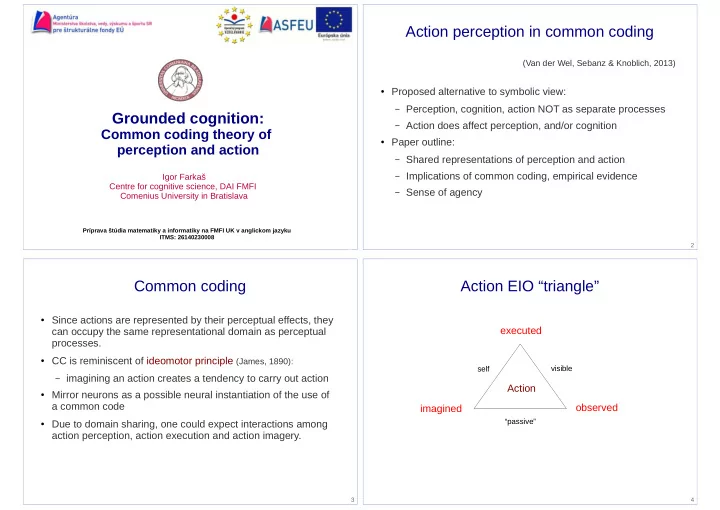
Action perception in common coding

(Van der Wel, Sebanz & Knoblich, 2013)

  • Proposed alternative to symbolic view:

– Perception, cognition, action NOT as separate processes – Action does affect perception, and/or cognition

  • Paper outline:

– Shared representations of perception and action – Implications of common coding, empirical evidence – Sense of agency

3

Common coding

  • Since actions are represented by their perceptual effects, they

can occupy the same representational domain as perceptual processes.

  • CC is reminiscent of ideomotor principle (James, 1890):

– imagining an action creates a tendency to carry out action

  • Mirror neurons as a possible neural instantiation of the use of

a common code

  • Due to domain sharing, one could expect interactions among

action perception, action execution and action imagery.

4

executed imagined

self visible “passive”

  • bserved

Action

Action EIO “triangle”

slide-2
SLIDE 2

5

Action observation induces action simulation

  • Experiments with

2 sessions

– recording, – testing

  • dart throwing
  • handwriting
  • Better score

for own than

  • ther's

(Knoblich & Flach, 2001)

6

Action expertise influences action observation

  • shaping auditory perception (tritone paradox)
  • shaping visual perception (badminton, basketball, ballet dance)
  • When do these (better prediction) effects arise?
  • EEG evidence (stronger mu-rhythm desynchronization)
  • fMRI evidence: activity in PM and IPL areas scales with

competence

  • Problem with interpretation: not only more motor expertise but

also more visual expertise (potential confound in explanation).

7

Event-related desynchronization (ERD)

Executed action Imagined action

(Trejo, Rosipal, & Matthews, 2006)

Motor resonance disrupted Mu rhythms: 8-12 Hz

8

EEG spectrum during motor actions

Mirror neurons may down modulate motor cortex (leading to mu-rhythm desynchronization)

(Oberman et al, 2007)

(Farkas et al, 2011)

slide-3
SLIDE 3

9

Constraints for action production in action

  • bservation
  • => action production influences action perception and vice versa
  • Further support: to show that principles that govern action execution

also govern action observation

  • 2/3 power law (velocity-curvature inverse rel.)

– also in action observation – in prediction of observed actions

  • Fitts's law indicates that effects go beyond 2/3 power law

– Timing is important (moving between targets) – It applies also for action imagination and action perception

=> relates to an abstract, representational level of action planning,

– Supported by neurological evidence

10

Fitts's law in action perception

(Grosjean, Shiffrar & Knoblich, 2007)

11

Agency and common coding

  • How to differentiate b/w execution and perception?
  • Apparent mental causation account (Wegner, 2002)
  • Role of forward model
  • Perceptual accounts (cerebellum)
  • Who-system (parietal) (Jeannerod et al.)
  • Role of timing cues
  • Relative contribution of perceptual cues and sensorimotor

cues (Knoblich & Repp, 2007)

  • Applies also for action observation?
  • Agency in joint actions

12

Mental state inference via visual feedback

(Oztop, Wolpert, Kawato, 2005)