Action for Red Clay Creek (ARCC) By: Alyssa Baker, Cate Blachly, - - PowerPoint PPT Presentation

action for red clay creek arcc
SMART_READER_LITE
LIVE PREVIEW

Action for Red Clay Creek (ARCC) By: Alyssa Baker, Cate Blachly, - - PowerPoint PPT Presentation

Action for Red Clay Creek (ARCC) By: Alyssa Baker, Cate Blachly, Erica Rossetti, Megan Safranek Background Overview History Mission Statement Three Problems, Goals, and their Solutions Existing Organizations and Regulations


slide-1
SLIDE 1

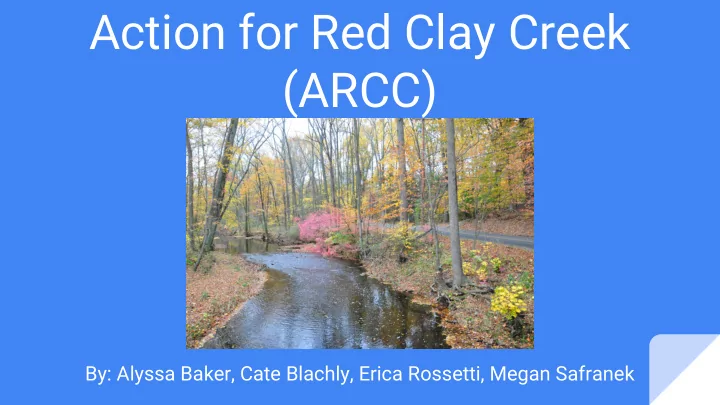
Action for Red Clay Creek (ARCC)

By: Alyssa Baker, Cate Blachly, Erica Rossetti, Megan Safranek
slide-2
SLIDE 2

Overview

  • Background
  • History
  • Mission Statement
  • Three Problems, Goals, and their

Solutions

  • Existing Organizations and

Regulations to aid us

  • Conclusion/Timeline
slide-3
SLIDE 3

Red Clay Creek: Background

  • 54 square miles
  • Part of Christina River Basin

(in Delaware River Basin)

  • Location:

○ New Castle County, DE ○ Chester County, PA

  • Population: 47,000
  • Five subwatersheds
  • Hoopes Reservoir
slide-4
SLIDE 4

History

  • Population increase
  • Urbanization
  • Flooding
  • Land use changes
slide-5
SLIDE 5

Mission Statement

The goals of the Action for Red Clay Creek plan (ARCC) are:

  • Attain the acceptable levels of TMDLs
  • Improve water quality such that each water body is removed from the EPA

303d list of impaired streams

  • Reduce flooding in the Red Clay Creek watershed by 50%
  • Accomplish all goals by the year 2030
slide-6
SLIDE 6

Problem 1: Contaminants

  • High levels of PCBs, dioxins, and chlorinated pesticides
  • Toxic to humans and wildlife and bioaccumulate in fatty tissue
  • Degrade water quality
  • Sources:

○ point source discharges ○ Industrial land runoff ○ Agricultural lands

slide-7
SLIDE 7

Goal 1: Contaminants

  • Reduce the presence of contaminants
  • Meet fishable standards
  • Identify point and nonpoint sources
  • Enforce local, state, and federal regulations
slide-8
SLIDE 8

Riparian Buffers

  • Vegetative barrier separating water body from

agricultural and industrial runoff

  • Prevents contaminants from entering water

body and absorbs excess nutrients

  • Trees planted in plastic tubes to protect from

wildlife and provide forested buffer

Tree seedlings utilized to create buffer

slide-9
SLIDE 9

Problem 2: Nutrients

slide-10
SLIDE 10

Problem 2: Nutrients

Non-point nutrient sources:

  • Agriculture: pastures and mushroom farms
  • Silviculture
  • Lawn Fertilization

Nutrient of Concern Concentration Historical Trend Zinc Exceeds chronic and acute state levels 85% of the time Decreasing Phosphorus Exceeds EPA levels 90% of the time Decreasing Nitrogen Does not exceed standard Increasing

slide-11
SLIDE 11

Goal 2: Nutrients

Reduce nutrient concentrations to state and EPA water quality standards by:

  • Eutrophication education

○ Encourage reduction of fertilizer and use of alternative methods

  • Incentive programs

○ Encourage farmers to implement best management solutions...

slide-12
SLIDE 12

Precision Farming & Cover Crops

Precision Farming

  • Only apply fertilizer to crops that need it
  • Decreases nutrient pollution in runoff

Cover Crops

  • Crops planted that remain through the winter
  • Absorb excess nutrients and stabilize soil

Seeder used for precision farming

slide-13
SLIDE 13

Problem 3: Stormwater Runoff & Flooding

  • Increase in development
  • Historical increase in impervious area
  • Issues with designated water use

Red Clay Creek Flooding, October 1st 2010

slide-14
SLIDE 14

Goal 3: Stormwater Runoff & Flooding

  • Encouraging better municipal

stormwater management and planning

  • Educate the public on ways they can

encourage infiltration

slide-15
SLIDE 15

Bioretention Areas & Constructed Wetlands

Bioretention Areas

  • Shallow depressions that collect and filter

runoff

  • Promote infiltration and reduce overall runoff

Constructed Wetlands

  • Mimic natural wetlands
  • Water contained as standing water on surface
  • r saturated water just below soil surface
slide-16
SLIDE 16

Existing Organizations*

1. Local municipalities (Five PA townships + New Castle County) 2. Brandywine Red Clay Alliance 3. Christina Basin Clean Water Partnership (CBCWP) 4. Delaware River Basin Commission (DRBC) 5. U.S. Environmental Protection Agency (EPA)

*not an exclusive list

slide-17
SLIDE 17

Existing Regulations

  • Christina Basin TMDL Implementation Partnership Plan (CTIP)
  • Total Maximum Daily Load (TMDLs)
  • National Pollutant Discharge Elimination System (NPDES)
  • Stormwater Management Act (PA Act 167)
slide-18
SLIDE 18

Tentative Deadline Action(s) to be completed December 31st, 2017 (Preliminary)

  • Compile list of necessary sources, contacts,

regulations, and standards

  • Begin compiling data

December 31st, 2020 (Identification)

  • Identify, locate, and assess all point and

nonpoint pollution sources and stormwater management systems

  • Identify other areas of highest concern

December 31st, 2025 (Interim goals)

  • Have all programs in place, up, and running in
  • rder to meet ultimate requirements
  • Reverse increasing nitrogen trends
  • Have at least half of streams removed from

EPA 303d list of impaired streams

  • Reduce flooding by 25%

December 31st, 2030 (Final goals)

  • Attain proper concentrations for TMDLs
  • Reduce flooding by 50%
  • Have each water body removed from EPA 303d

list of impaired streams

Tentative Schedule