SLIDE 3 2
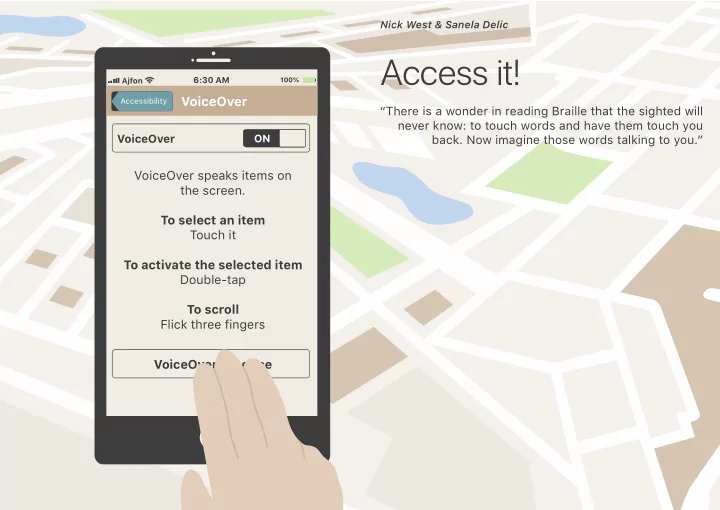
Because VoiceOver is integrated in iOS, it works with all the built-in iPhone apps as well as third-party apps. VoiceOver is controlled using a simple set
- f gestures. Touching or dragging a finger
around the screen and VoiceOver can tell what’s there. Tapping will describe it and double-tap will select it. Flicking left and right moves from one element to the next. With VoiceOver text input enabled, each character on the keyboard is read aloud as it’s touched, and again when entered. A flick up or down moves the cursor for precise editing. VoiceOver image recognition can now describe images with three fingers tap. VoiceOver includes system-wide support for braille chords in six- and eight-dot braille, enabling direct braille entry without the need for a physical braille keyboard. iPhone is fully compatible with more than 70 refreshable braille displays. VoiceOver will play movies with detailed audio descriptions of every scene on the
- iPhone. Movies with audio descriptions are
displayed with the AD icon in the iTunes. Zoom is a built-in screen magnifier that works anywhere in iOS. And it works with all apps from the App Store. Magnifier works like a digital magnifying
- glass. It uses the camera on the iPhone
to increase the size of anything camera is pointed at. If reading the text on the iPhone is difficult, Speak Screen will read the emails, web pages and books by swiping down from the top of the screen with two fingers, or just telling Siri to Speak Screen and have all the content on the page read back aloud. Siri can send messages and make phone calls, schedule meetings or tell where the nearest restaurant is. Dictation allows talking where needs to be typed by tapping the microphone button
- n the keyboard, saying what needs to be
written and the iPhone converts the words into text. In libraries all over Sydney you can see how common the use of this technology is. They use it as an extension of their own body. It’s inspiring how much more effectively the blind can function in society with the use
- f screen reader technology. No longer do
they have to rely so much on those around them, such as friends and family.
References: Rose Hinson and Sayaka Yamamoto. Braille: Facilitating the Lives of the Blind. Retrieved from http://brailleproject.weebly.com/index.html Léonie Watson.(2005). What is a screen reader?. Retrieved from https://www.nomensa.com/ blog/2005/what-screen-reader. Alberto Cairo. (2013). The Functional Art: An introduction to information graphics and
- visualization. Berkeley, CA : New Riders.
Apple!
Face Document Scene
Irvine Danielle ; Zemke Alex ; Pusateri Gregg ; Gerlach Leah ; Chun Rob ; Jay Walter M. (2014). Tablet and Smartphone Accessibility Features in the Low Vision Rehabilitation. Neuro- Ophthalmology, Vol.38(2), p.53-59. Taylor & Francis Review Article. Edward R. Tufte . (1990). Envisioning information. Cheshire, Conn. : Graphics Press. Apple Inc. (2018). Accessibility. Retrieved from https://www.apple.com/accessibility/
- WebAIM. (2017). Screen Reader User Survey. Retrieved from https://webaim.org/projects/
screenreadersurvey7/.