
SLIDE 1
Abstract Session D2: Medical Education Scholarship and Professional Development Moderator: Dominique L. Cosco, MD
This session is part of a pilot project investigating shorter presentation times. Your attendance and feedback will be appreciated by the investigators.
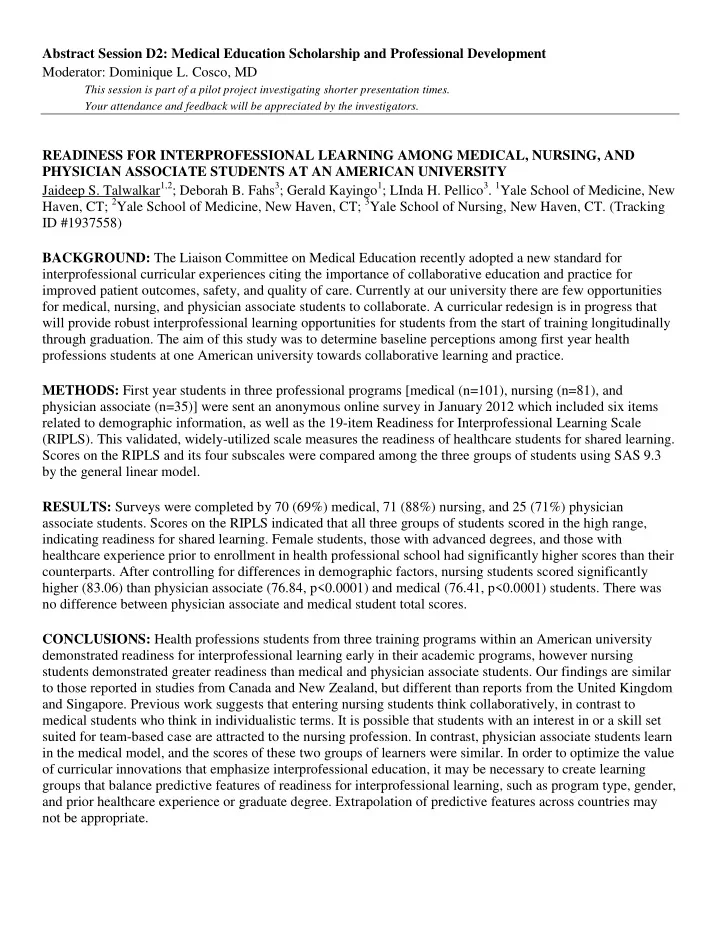
READINESS FOR INTERPROFESSIONAL LEARNING AMONG MEDICAL, NURSING, AND PHYSICIAN ASSOCIATE STUDENTS AT AN AMERICAN UNIVERSITY Jaideep S. Talwalkar1,2; Deborah B. Fahs3; Gerald Kayingo1; LInda H. Pellico3. 1Yale School of Medicine, New Haven, CT; 2Yale School of Medicine, New Haven, CT; 3Yale School of Nursing, New Haven, CT. (Tracking ID #1937558) BACKGROUND: The Liaison Committee on Medical Education recently adopted a new standard for interprofessional curricular experiences citing the importance of collaborative education and practice for improved patient outcomes, safety, and quality of care. Currently at our university there are few opportunities for medical, nursing, and physician associate students to collaborate. A curricular redesign is in progress that will provide robust interprofessional learning opportunities for students from the start of training longitudinally through graduation. The aim of this study was to determine baseline perceptions among first year health professions students at one American university towards collaborative learning and practice. METHODS: First year students in three professional programs [medical (n=101), nursing (n=81), and physician associate (n=35)] were sent an anonymous online survey in January 2012 which included six items related to demographic information, as well as the 19-item Readiness for Interprofessional Learning Scale (RIPLS). This validated, widely-utilized scale measures the readiness of healthcare students for shared learning. Scores on the RIPLS and its four subscales were compared among the three groups of students using SAS 9.3 by the general linear model. RESULTS: Surveys were completed by 70 (69%) medical, 71 (88%) nursing, and 25 (71%) physician associate students. Scores on the RIPLS indicated that all three groups of students scored in the high range, indicating readiness for shared learning. Female students, those with advanced degrees, and those with healthcare experience prior to enrollment in health professional school had significantly higher scores than their
- counterparts. After controlling for differences in demographic factors, nursing students scored significantly
higher (83.06) than physician associate (76.84, p<0.0001) and medical (76.41, p<0.0001) students. There was no difference between physician associate and medical student total scores. CONCLUSIONS: Health professions students from three training programs within an American university demonstrated readiness for interprofessional learning early in their academic programs, however nursing students demonstrated greater readiness than medical and physician associate students. Our findings are similar to those reported in studies from Canada and New Zealand, but different than reports from the United Kingdom and Singapore. Previous work suggests that entering nursing students think collaboratively, in contrast to medical students who think in individualistic terms. It is possible that students with an interest in or a skill set suited for team-based case are attracted to the nursing profession. In contrast, physician associate students learn in the medical model, and the scores of these two groups of learners were similar. In order to optimize the value
- f curricular innovations that emphasize interprofessional education, it may be necessary to create learning