Abstract [-pro-drop] [+pro-drop] L1 Greek L2 English L2 Spanish - - PowerPoint PPT Presentation

abstract
SMART_READER_LITE
LIVE PREVIEW

Abstract [-pro-drop] [+pro-drop] L1 Greek L2 English L2 Spanish - - PowerPoint PPT Presentation

Acquisition of Spanish as an L2 and L3: knowledge of pronouns by Greek and English learners of Spanish An experiment was designed to compare sensitivity to the OPC, Cristbal Lozano Department of Language & Linguistics firstly, in speakers


slide-1
SLIDE 1

Acquisition of Spanish as an L2 and L3: knowledge of pronouns by Greek and English learners of Spanish

Doc: Cambridge workshop presentation May 2001

page 1 Cristóbal Lozano Department of Language & Linguistics University of Essex, England Webpage: http://privatewww.essex.ac.uk/~clozan

Abstract

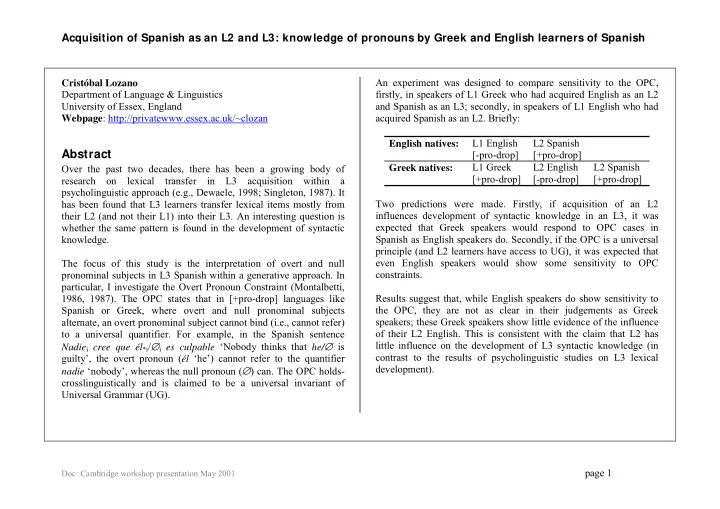
Over the past two decades, there has been a growing body of research on lexical transfer in L3 acquisition within a psycholinguistic approach (e.g., Dewaele, 1998; Singleton, 1987). It has been found that L3 learners transfer lexical items mostly from their L2 (and not their L1) into their L3. An interesting question is whether the same pattern is found in the development of syntactic knowledge. The focus of this study is the interpretation of overt and null pronominal subjects in L3 Spanish within a generative approach. In particular, I investigate the Overt Pronoun Constraint (Montalbetti, 1986, 1987). The OPC states that in [+pro-drop] languages like Spanish or Greek, where overt and null pronominal subjects alternate, an overt pronominal subject cannot bind (i.e., cannot refer) to a universal quantifier. For example, in the Spanish sentence Nadiei cree que él*i/∅i es culpable ‘Nobody thinks that he/∅ is guilty’, the overt pronoun (él ‘he’) cannot refer to the quantifier nadie ‘nobody’, whereas the null pronoun (∅) can. The OPC holds- crosslinguistically and is claimed to be a universal invariant of Universal Grammar (UG). An experiment was designed to compare sensitivity to the OPC, firstly, in speakers of L1 Greek who had acquired English as an L2 and Spanish as an L3; secondly, in speakers of L1 English who had acquired Spanish as an L2. Briefly: English natives: L1 English [-pro-drop] L2 Spanish [+pro-drop] Greek natives: L1 Greek [+pro-drop] L2 English [-pro-drop] L2 Spanish [+pro-drop] Two predictions were made. Firstly, if acquisition of an L2 influences development of syntactic knowledge in an L3, it was expected that Greek speakers would respond to OPC cases in Spanish as English speakers do. Secondly, if the OPC is a universal principle (and L2 learners have access to UG), it was expected that even English speakers would show some sensitivity to OPC constraints. Results suggest that, while English speakers do show sensitivity to the OPC, they are not as clear in their judgements as Greek speakers; these Greek speakers show little evidence of the influence

  • f their L2 English. This is consistent with the claim that L2 has

little influence on the development of L3 syntactic knowledge (in contrast to the results of psycholinguistic studies on L3 lexical development).

slide-2
SLIDE 2

Acquisition of Spanish as an L2 and L3: knowledge of pronouns by Greek and English learners of Spanish

Doc: Cambridge workshop presentation May 2001

page 2 Cristóbal Lozano University of Essex, England Workshop: “Looking at Language Acquisition II”, University of Cambridge (RCEAL), 8th May 2001

1 Assumptions

!Perlmutter (1971), then Chomsky (1981) and Rizzi (1997): [+pro-drop] languages

(1)

  • a. Yo voy al cine

(Spanish)

  • b. pro voy al cine

(2)

  • a. Ego pao sto sinema

(Greek)

  • b. pro pao sto sinema

BUT: [-pro-drop] languages

(3)

  • a. I go to the cinema

(English)

  • b. * pro go to the cinema

!Conclusion: overt and null pronouns seem to be in free alternation in Spanish and Greek languages…BUT is this really so?? !There are several constrains.

2 Overt Pronoun Constrain (OPC)

!Montalbetti (1984, 1986): Overt Pronoun Constrain (OPC):

!Context: The government has published a report about students’ financial situation. The report concludes that... (a) cada estudiantei dice que él * i tiene poco dinero. each student says that he has little money (b) cada estudiantei dice que pro i tiene poco dinero. ! each student says that has little money

(a) QDPi . . . . . . . . . .OVERT *i (b) QDPi . . . . . . . . . .NULL i

3 Topic/ Focus constraints

!Context: Mr Lópezj and Ms Garcíak work at the university and at a famous

  • publishers. However...

(a) cada estudiantei dice que élj tiene poco dinero. ! (b) cada estudiantei dice que pro* j tiene poco dinero.

(a) QDPi . . . . . . . . . .OVERT j (b) QDPi . . . . . . . . . .NULL *j !Avoid Pronoun Principle (Chomsky, 1981:65), follows from Economy Principle (Chomsky, 1995): choose least restricted pronoun if not ambiguity: pro [±masc] él ‘he’ [+masc] ella ‘she’ [-masc]

slide-3
SLIDE 3

Acquisition of Spanish as an L2 and L3: knowledge of pronouns by Greek and English learners of Spanish

Doc: Cambridge workshop presentation May 2001

page 3

4 Previous studies

!Abundant studies on the use of overt/null pronouns in Spanish L2 (e.g., Al-Kasey & Pérez-Leroux, 1998; Liceras, 1989; Pérez-Leroux & Glass, 1997, 1999; Phinney, 1987; Roebuck et al, 1999)"findings: learners recognise from earliest stages that null pronouns are possible in Spanish. !However, very little on OPC and Topic/Focus constraints.

5 Subjects

!3 groups: Control: Spanish natives (n=10) L1 Spanish +pro-drop Experimental 1 English natives (n=22) L1 English

  • pro-drop

L2 Spanish +pro-drop Experimental 2 Greek natives (n=10) L1 Greek +pro-drop L2 English

  • pro-drop

L3 Spanish +pro-drop !Learners: all advanced level; two standardised placement tests:

  • ne in Spanish (Wisconsin, 1998), another in English (Allan, 1992).

6 Predictions

!Syntactic transfer (both groups behave differently): L1 English L2 Spanish L1 Greek L2 English L3 Spanish !Recall that previous studies on lexical transfer found that: L1 Greek L2 English L3 Spanish

7 Method

!Grammaticality judgement test:

The government has published a report about students’ financial situation. The report concludes that... (a) cada estudiante dice que él tiene poco dinero. –2 –1 0 + 1 + 2 (b) cada estudiante dice que tiene poco dinero. –2 –1 0 + 1 + 2

!2 different versions of the test: version 1, version 2. Order of presentation of items varies in each test to avoid presentational effects. !Sentences were randomised following Cowart’s (1997) ‘blocking’ procedure. !Vocabulary was controlled. !Sentence length was controlled.

8 Results

(see next page)

slide-4
SLIDE 4

Acquisition of Spanish as an L2 and L3: knowledge of pronouns by Greek and English learners of Spanish

Doc: Cambridge workshop presentation May 2001

page 4 OPC

Group

Natives Greek English

Mean

2.0 1.0 0.0

  • 1.0
  • 2.0

*[QDPi...OVERTi] [QDPi...NULLi]

!Within group: each grammatical vs ungrammatical condition is statistically significant for each group (p<0.05) !Between groups: !Grammatical [QDPi … NULLi] "no difference between groups (p>0.05) !Ungrammatical *[QDPi … OVERTi] " between groups: English ≠ Natives different (p=0.02) Greek = Natives not different (p=0.82) Topic/Focus

Group

Natives Greek English

Mean

2.0 1.0 0.0

  • 1.0
  • 2.0

[QDPi...OVERTj] *[QDPi...NULLj]

!Within group: each grammatical vs ungrammatical condition is statistically significant for each group (p<0.05) !Between groups: !Grammatical [QDPi … OVERTj] "no difference between groups (p>0.05) !Ungrammatical *[QDPi … NULLj] " between groups: English ≠ Natives different (p=0.02) Greek = Natives not different (p=0.27)

slide-5
SLIDE 5

Acquisition of Spanish as an L2 and L3: knowledge of pronouns by Greek and English learners of Spanish

Doc: Cambridge workshop presentation May 2001

page 5

9 Conclusion

!Even though Greeks and English distinguish grammatical vs. ungrammatical constructions: (i) Greek speakers do not differ in their knowledge from Spanish natives. POSSIBLE REASON: L1"L3?? Their knowledge could have been influenced by L2 Eng (they would have rejected less *QDPi … OVERTi ) (ii) English speakers differ in their knowledge from Spanish

  • natives. POSSIBLE REASON: L1"L2?? (Pérez-Leroux &

Glass, 1997, 1999, similar findings). !OPC"Poverty of stimulus: OPC constructions are not… (i) instantiated in English. (ii)

  • perative in the Spanish L2/L3 input.

(iii) taught in class or explained in textbooks. !Top/Foc" Possible scenarios: L1 English L2 Spanish L1 Greek L2 English L3 Spanish !Feature underspecification (English group) Focused context: Mr Lopez Ms Garcia Target: * pro tiene dinero pro has money ‘he/she has money’ FocP ... [+masc] Mr Lopez [-masc] Ms Garcia TP T’ pro [±masc] [3] [sing] ... T tiene [3] [sing] [-interp] Greeks, English [+interp] Greeks only !In line with Hawkins & Chan (1997): L1 influence in L2 development: IF features L1≠L2 IF features L1=L2 THEN (i) constrained by UG THEN (i) constrained by UG (ii) divergent from natives (ii) native-like !Hawkins (2001:163): “These findings are consistent with modulated

structure building … learners first establish representations for local relations like head-complement selection and only subsequently for non-local relations… andthat L1 influence occurs at points of development where the cognate property in the L2 emerges.”

!Learners (English group) show divergent mental representations (Sorace, 1993).

slide-6
SLIDE 6

Acquisition of Spanish as an L2 and L3: knowledge of pronouns by Greek and English learners of Spanish

Doc: Cambridge workshop presentation May 2001

page 6

10 References

Allan, D. (1992): Oxford Placement Test. Oxford: OUP. Chomsky, N. (1981): Lectures on Government and Binding. Dordrecht: Foris. Chomsky, N. (1995). The Minimalist Program. Cambridge, Mass.: MIT Press. Cowart, W. (1997). Experimental Syntax: Applying Objective Methods to Sentence Judgments. Thousan Oaks, CA.: SAGE. Dewaele, J.-M. (1998). Lexical inventions: French interlanguage as L2 versus L3. Applied Linguistics, 19(4): 471-490. Hawkins, R. (2001). Second Language Syntax: A Generative Introduction. Oxford: Blackwell Montalbetti, M. (1984). After binding. PhD dissertation, MIT. Montalbetti, M. (1986). How pro is it? In O. Jaeggli and C. Silva-Corvalán (eds). Studies in Romance linguistics. Dordrecht: Foris. pp. 137-152. Pérez-Leroux, A. T. and Glass, W. R. (1997). OPC effects on the L2 acquisition

  • f Spanish, pp. 149-165. In A. T. Pérez-Leroux and W. R. Glass

(Eds). Contemporary perspectives on the acquisition of Spanish, volume 1: Developing grammars. Somervile, MA: Cascadilla Press. Pérez-Leroux, A. T. and Glass, W. R. (1999). Null anaphora in Spanish second language acquisition: probabilistic versus generative approaches. Second Language Research, 15(2): 220-249. Perlmutter, D. (1971). Deep and surface structure constraints in syntax. New York: Holt, Rinehart and Winston. Rizzi, L. (1997). A parametric approach to comparative syntax. In L. Haegemand (ed). The New Comparative Syntax. London: Longman. Singleton, D. (1987). Mother and other tongue influence on learner French. Studies in Second Language Acquisition, 9: 327-346. Sorace, A. (1993). Incomplete vs. divergent representations of unaccusativity in non-native grammars of Italian. Second Language Research, 9(1):22- 47. University of Wisconsin (1998). The University of Wisconsin College-level Placement Tests (Form 96M). Madison, Wisconsin: University of Wisconsin Press.