Abstract How do you ensure your applications meet the expectations - - PDF document

abstract
SMART_READER_LITE
LIVE PREVIEW

Abstract How do you ensure your applications meet the expectations - - PDF document

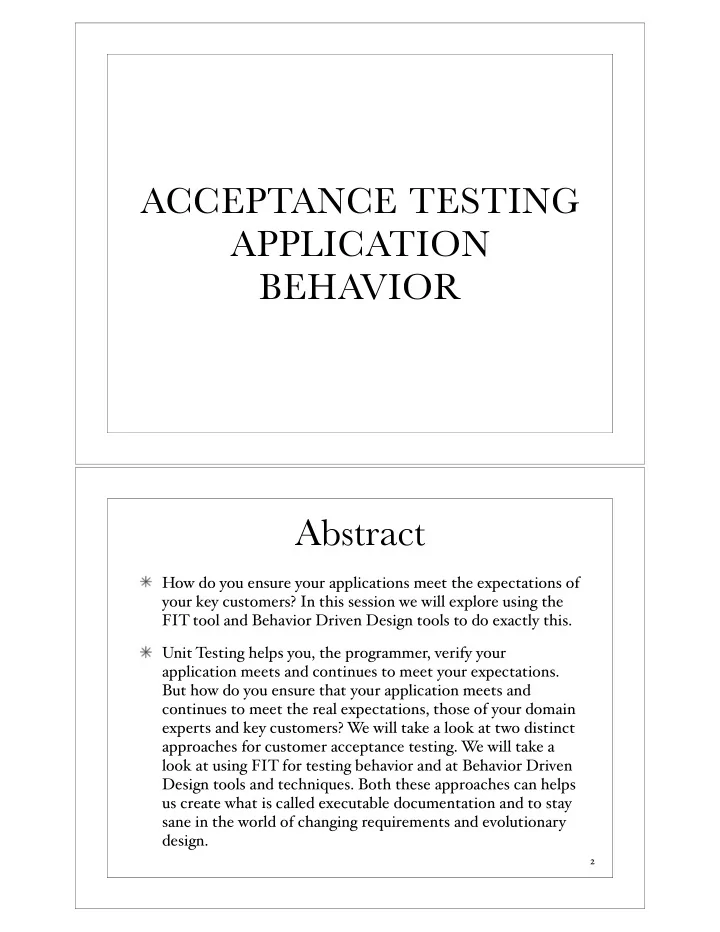
ACCEPTANCE TESTING APPLICATION BEHAVIOR Abstract How do you ensure your applications meet the expectations of your key customers? In this session we will explore using the FIT tool and Behavior Driven Design tools to do exactly this. Unit


slide-1
SLIDE 1

ACCEPTANCE TESTING APPLICATION BEHAVIOR

Abstract

How do you ensure your applications meet the expectations of your key customers? In this session we will explore using the FIT tool and Behavior Driven Design tools to do exactly this. Unit Testing helps you, the programmer, verify your application meets and continues to meet your expectations. But how do you ensure that your application meets and continues to meet the real expectations, those of your domain experts and key customers? W e will take a look at two distinct approaches for customer acceptance testing. W e will take a look at using FIT for testing behavior and at Behavior Driven Design tools and techniques. Both these approaches can helps us create what is called executable documentation and to stay sane in the world of changing requirements and evolutionary design.

2

slide-2
SLIDE 2

Agile Development

What’s Agility? It’s all about Building relevant working software By constantly getting feedback

3

“Feeling the Rhythm” Practices of an Agile Developer

Essence of Agility

To create relevant working software Developing software is hard business How can you succeed? Feedback is essential Two kinds of feedback

Code Meets Customer’s Expectations

Code Meets Y

  • ur

Expectations

4

slide-3
SLIDE 3

A Key Ingredient

Testing is a key ingredient in Agile development Black box testing Tester does not know or does not care implementation and design details White box testing Tester is aware of and is interested in design/ implementation details Unit Testing falls under this

5

Types of Tests and Levels

Code Meets Customer’s Expectations

Code Meets Y

  • ur

Expectations

Classes/Models/... Controls/Services/... UI/Presentation/...

Unit Testing FIT

BDD

Selenium W atir

slide-4
SLIDE 4

Unit Vs. Integration Tests

Unit Tests often carried out in isolation on a unit of code without its dependencies or mocking those Integration tests often carried out in full mode of operation

  • f the functionality with system dependencies

7 Code under Test

Code

Mock Test Integration Tests Unit Tests

Unit Test Not Sufficient

Unit Testing is essential, but not sucient Unit Tests help assert code meets developer’s expectations How do you know if that meets users’ expectations? It’s the dierence between building software right and building right software

8

slide-5
SLIDE 5

Gathering Requirements

Capturing requirements is a challenge W e’ve seen several approaches Use Case helps, but often tends to be heavy weight and in eective beyond certain point of diminishing returns Agile Developers use User Stories

9

Dev ? ? What to build? Did we build it

Express as Tests

3 Cs of User Stories

When creating User Stories, you focus on 3 Cs Card Feature expressed in an index card Conversation Use short description as starting point for useful discussions that promote exploration and understanding Confirmation Helps you know when you’re donetests are written as a way to confirm completion of feature development

10

"User Stories Applied: For Agile Software Development"Mike Cohn

slide-6
SLIDE 6

INVEST in User Stories

Independent Negotiable Valuable

11

"User Stories Applied: For Agile Software Development"Mike Cohn

Estimable Small Testable

Expressing Requirements

12

Writing tests help communicate the “What’s” of an application by way of concrete examples It helps to make sure the application is doing what’s expected Keeps an eye on it as system continues to evolve

slide-7
SLIDE 7

Ubiquitous Language

13

Domain Driven Design emphasizes focus on Domain/ Business Ubiquitous Language is used as a means of communication among domain experts, developers, and between the two groups Tests serve as an Ubiquitous language that promotes such communication in a precise manner

Fit

14

Framework for Integration Testing "General purpose openended framework for expressing tests"Developed in 2002 by W ard Cunningham Helps focus on business perspectives Tables represent testseasy for nonprogrammers to use Automated checking and reporting of results Useful for Business Rules related to Business Calculations Business Rules related to Business Process/W

  • rkflow
slide-8
SLIDE 8

Why Fit?

15

Promotes communication Precise way to express expectations Helps know when you’re done Keeps an eye on it as system evolves Instant alert when things fall apart

Who’s fit for (F)it?

16

Business Analyst Testers Developers Architects, team leads, programmers,...

slide-9
SLIDE 9

Strength in Simplicity

17

Simple tables to express examples of expectations Easy for just about anyone to use Fosters communication

Strength in Simplicity

18

Simple tables to express examples of expectations Easy for just about anyone to use Fosters communication

slide-10
SLIDE 10

How does it fit together?

19

Table of Tests Expresses expectations by way of examples Fixture Checks that the system satisfied the given tests

Fixture Fixture

System

Order of tests may be important to reader, but Fit treats them independent of each other except for ActionFixture

Fixtures

20

Column Fixture Helps test calculations Action Fixture Helps test events or actions Row Fixture Helps test collections

slide-11
SLIDE 11

Table

21 FixtureName given1 given2 given3 ... calculated1 calculated2 ...

Test Results

22

Passed Failedmore info provided Part of test not complete or something messed up Part of table not processed ignored

slide-12
SLIDE 12

ColumnFixture

23

Useful to check business logic that calculates something Y

  • u will have to isolate the business logic in order to test it

That’s a good thing!

Creating Table & Fixture

24

price.html Fixture: Glue code

slide-13
SLIDE 13

Running FIT

25

Fixing Code

26

slide-14
SLIDE 14

Fixing Code...

27

reFITing it

28

slide-15
SLIDE 15

ActionFixture

29

Tests the eect of one or more sequence of actionsDevice to control tests First cell is a command to ActionFixture start

Specifies the Actor derived from fit.Fixture class to instantiate and send subsequent actions to until another start

enter

Second cell specifies name of method, with one parameter third cell, on actor

press

Second cell specifies name of method to call on actor

check

Second cell specifies name of method to call on actor Third cell represents expected value from this call

Creating Table & Fixture

30

collectCoin.html

slide-16
SLIDE 16

Creating Table & Fixture

31

Fixing Code

32

slide-17
SLIDE 17

FITting it

33

RowFixture

34

Tests results of a query is as expected Result is expected to be a list or collection May be treated as ordered or unordered Rows together form a single group

slide-18
SLIDE 18

Creating Table & Fixture

35

productList.html

Creating Table & Fixture

36

slide-19
SLIDE 19

Fixing Code

37

V endingMachine.Java

FITting it

38

slide-20
SLIDE 20

Running Multiple Tests

39

Y

  • u can mix and run multiple tables of tests

They may be of dierent types Y

  • u may group tests into folders

Creating Table & Fixture

40

purchase.html

slide-21
SLIDE 21

Creating Table & Fixture

41

Creating Table & Fixture

42

slide-22
SLIDE 22

Fixing Code

43

V endingMachine.Java

FITting it

44

slide-23
SLIDE 23

FitNesse

45

In Fit, you’ve gotta create HTML table, run fit, open browser to view result Can it be easier? FitNesse provides a single web based UI for developing, running and viewing results of test A Wiki based system Developed by Micah D. Martin and Robert C. Martin with contributions from a number of others

Starting Server

46

slide-24
SLIDE 24

FitNesse Default Page

47

Click to Edit Page to add Test

Add A Test Page

48

Click to Edit Page

slide-25
SLIDE 25

Add Test

49

Run Test

50

slide-26
SLIDE 26

Behavior Driven Design

It is a TDD approach It is a ubiquitous language It is an executable documentation It promotes communication Helps develop common vocabulary and metaphor Help you to get the "words" right Can be used by programmers, testers, business analysts, domain experts, and customers.

51

Behavior and Story

Y

  • u can use BDD to express Stories and Behaviors

Story Framework and Spec Framework Stories correspond to User Storiesto express behavior at application level Spec or Behavior correspond to expectations at class levelto express behavior at service/component level These can help express requirements that can be specified, understood, and negotiated by developers, testers, business analysts, and business customers.

52

slide-27
SLIDE 27

Behavior

Each behavior is expressed as a test/exercis method It tells what the object should do Notice the keyword "should"that's a main focus in BDDthe shoulds and the shouldn’s

53

Building Stories

Y

  • u may define user stories as a series of acceptance

criteria as scenarios It has the givens, events, and outcomes That is Give some initial conditions, Whe events occurs, The ensure some outcomes

54

slide-28
SLIDE 28

Tools for BDD

Java JBehave, JDave, beanSpec, Instinct Groovy GSpect, easyb

55

easyb

Started by Andy Glover Express Story and Spec using Groovy Based Domain Specific Language DSL Highly expressive Can be used for Java and Groovy applications

56

slide-29
SLIDE 29

References

http://fit.c2.com http://www.fitnesse.org http://behaviordriven.org http://jbehave.org/ http://codeforfun.wordpress.com/gspec/ http://www.easyb.org/

57

You can download examples and slides from http://www.agiledeveloper.com - download