Abstract Interpretation + Impure Catalysts Our Sparrow Experience YI - - PowerPoint PPT Presentation

abstract interpretation impure catalysts our sparrow
SMART_READER_LITE
LIVE PREVIEW

Abstract Interpretation + Impure Catalysts Our Sparrow Experience YI - - PowerPoint PPT Presentation

Abstract Interpretation + Impure Catalysts Our Sparrow Experience YI Jhee, MS Jin, YB Jung, DH Kim, SH Kong, HJ Lee, HJ Oh, DJ Park, Kwangkeun Yi Programming Research Laboratory Seoul National University Korea 30 Years of Abstract


slide-1
SLIDE 1

Abstract Interpretation + Impure Catalysts Our Sparrow Experience

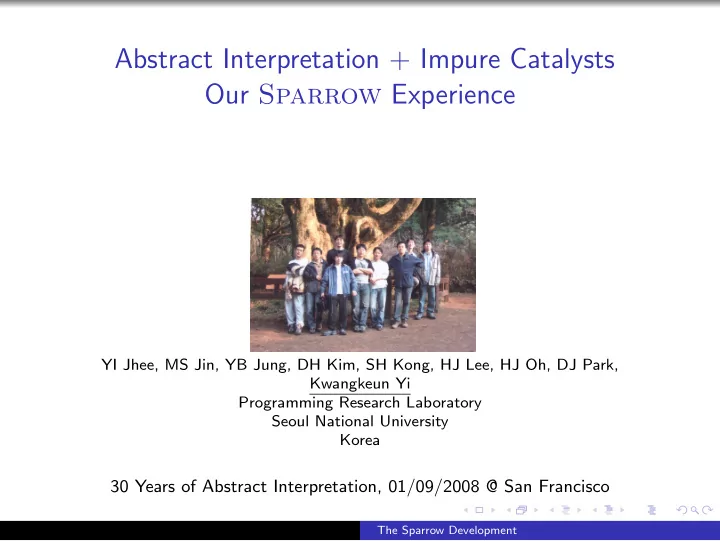
YI Jhee, MS Jin, YB Jung, DH Kim, SH Kong, HJ Lee, HJ Oh, DJ Park, Kwangkeun Yi Programming Research Laboratory Seoul National University Korea

30 Years of Abstract Interpretation, 01/09/2008 @ San Francisco

The Sparrow Development

slide-2
SLIDE 2

What We’ve Been Doing

Developing the Sparrow system an effort to commercialize static bug-finders shallow property, full automation, scalable

buffer overrun, memory leak, null dereference, uninitialized access, divide by zero, etc.

for non domain-specific C code Motivation prove by ourselves that static analysis is “useful in real world” curious about “extra miles” from academia to industry

The Sparrow Development

slide-3
SLIDE 3

What We’ve Been Doing

Developing the Sparrow system an effort to commercialize static bug-finders shallow property, full automation, scalable

buffer overrun, memory leak, null dereference, uninitialized access, divide by zero, etc.

for non domain-specific C code Motivation prove by ourselves that static analysis is “useful in real world” curious about “extra miles” from academia to industry Of course, the reality has been challenging us a lot, and we’ve been struggling to respond to.

The Sparrow Development

slide-4
SLIDE 4

spa-arrow.com

The Sparrow Development

slide-5
SLIDE 5

Performance Numbers (1/3)

Memory leak detection (SPEC2000 and open sources) (as of 01/04/2008) Programs Size Time True False KLOC (sec) Alarms Alarms art 1.2 0.68 1 equake 1.5 1.03 mcf 1.9 2.77 bzip2 4.6 1.52 1 gzip 7.7 1.56 1 4 parser 10.9 15.93 ammp 13.2 9.68 20 vpr 16.9 7.85 9 crafty 19.4 84.32 twolf 19.7 68.80 5 mesa 50.2 43.15 9 vortex 52.6 34.79 1 gap 59.4 31.03 gcc 205.8 1330.33 44 1 gnuchess-5.07 17.8 9.44 4 tcl8.4.14 17.9 266.09 4 4 hanterm-3.1.6 25.6 13.66 sed-4.0.8 26.8 13.68 29 31 tar-1.13 28.3 13.88 5 3 grep-2.5.1a 31.5 22.19 2 3

  • penssh-3.5p1

36.7 10.75 18 4 bison-2.3 48.4 48.60 4 1

  • penssh-4.3p2

77.3 177.31 1 7 fftw-3.1.2 184.0 15.20 httpd-2.2.2 316.4 102.72 6 1 net-snmp-5.4 358.0 201.49 40 20 binutils-2.13.1 909.4 712.09 228 25 The Sparrow Development

slide-6
SLIDE 6

Performance Numbers (2/3)

In comparison with other published memory leak detectors Number of bugs: Sparrow finds consistently more bugs than

  • thers

Analysis speed: 785LOC/sec, next to the fastest FastCheck. False-alarm ratio: 21% Efficacy (TrueAlarms/KLOC × 1/FalseAlarmRatio): biggest Tool C size Speed True False Alarm Efficacy KLOC LOC/s Alarms Ratio(%) Saturn ’05 (Stanford) 6,822 50 455 10% 1/150 Clouseau ’03 (Stanford) 1,086 500 409 64% 1/170 FastCheck ’07 (Cornell) 671 37,900 63 14% 1/149 Contradiction ’06 (Cornell) 321 300 26 56% 1/691 Sparrow 2,543 785 433 21% 1/123

Table: Overall comparison

C program Tool True False Alarm Alarms Count SPEC2000 Sparrow 81 15 benchmark FastCheck ’07 (Cornell) 59 8 binutils-2.13.1 Sparrow 246 29 & Saturn ’05 (Stanford) 165 5

  • penssh-3.5.p1

Clouseau ’03 (Stanford) 84 269

Table: Comparison for the same C programs The Sparrow Development

slide-7
SLIDE 7

Performance Numbers (3/3)

Buffer overrun detection (SPEC2000 and open sources) (as of 01/04/2008) Programs Size Time True False KLOC (sec) Alarms Alarms art 1.2 0.45 equake 1.5 2.89 1 mcf 1.9 0.33 bzip2 4.6 10.90 23 29 gzip 7.7 3.38 18 24 parser 10.9 260.94 4 13 twolf 19.7 8.59 ammp 13.2 10.20 6 vpr 16.9 11.15 3 crafty 19.4 139.80 1 5 mesa 50.2 47.88 2 10 vortex 52.6 40.12 2 gap 59.4 28.48 2 gzip-1.2.4 9.1 8.55 17 gnuchess-5.07 17.8 179.58 1 8 tcl8.4.14/unix 17.9 585.99 1 14 hanterm-3.1.6 25.6 52.25 34 1 sed-4.0.8 26.8 49.34 2 11 tar-1.13 28.3 57.98 1 10 grep-2.5.1a 31.5 47.26 1 bison-2.3 48.4 281.84 18

  • penssh-4.3p2

77.3 97.69 9 fftw-3.1.2 184.0 102.17 9 4 httpd-2.2.2 316.4 265.43 10 33 net-snmp-5.4 358.0 899.73 3 36 The Sparrow Development

slide-8
SLIDE 8

Steps of Sparrow

Sparrow is a one-button solution with four steps: understanding the code genetics parsing and distilling the code analyzing the code’s run time behaviors reporting detected bugs

The Sparrow Development

slide-9
SLIDE 9

User Interface: Scored Alarms + Navigating Explanation

The Sparrow Development

slide-10
SLIDE 10

Customers under negotiation

Domestic market at the moment Samsung, LG, etc.: personal devices’ sw developers network switching system sw developers

  • ther embedded sw developers

bank system sw developers etc. Complementing others (such as Coverity, GrammaTech, Klockworks, Polyspace). BMT at a site (a network device OS, ∼ 700KLOC):

The Sparrow Development

slide-11
SLIDE 11

Outline

  • 1. Sparrow’s Examples
  • 2. Our Approach
  • 3. A Wish

The Sparrow Development

slide-12
SLIDE 12

Sparrow’s Examples

The Sparrow Development

slide-13
SLIDE 13

Note

Some bugs may look simple (after a posteriori slicing), but

  • nly few bug paths

among the exponential jungle of paths

must beat all the paths

no prior knowledge possible

such prior knowledge? very rough, or a catch-22 situation

The Sparrow Development

slide-14
SLIDE 14

Note

Some bugs may look simple (after a posteriori slicing), but

  • nly few bug paths

among the exponential jungle of paths

must beat all the paths

no prior knowledge possible

such prior knowledge? very rough, or a catch-22 situation

Pattern-based approach?

not tolerant to variations of “patterns” variations should be ample in real code a collection of patterns will always fall short

The Sparrow Development

slide-15
SLIDE 15

Sparrow-detected Overrun Errors (1/3)

The Sparrow Development

slide-16
SLIDE 16

Sparrow-detected Overrun Errors (1/3)

in Linux Kernel 2.6.4

625 for (minor = 0; minor < 32 && acm_table[minor]; minor++); ... ... 713 acm_table[minor] = acm; The Sparrow Development

slide-17
SLIDE 17

Sparrow-detected Overrun Errors (1/3)

in Linux Kernel 2.6.4

625 for (minor = 0; minor < 32 && acm_table[minor]; minor++); ... ... 713 acm_table[minor] = acm;

in a proprietary code

if (length >= NET_MAX_LEN) return API_SET_ERR_NET_INVALID_LENGTH; ... buff[length] |= (num << 4); The Sparrow Development

slide-18
SLIDE 18

Sparrow-detected Overrun Errors (1/3)

in Linux Kernel 2.6.4

625 for (minor = 0; minor < 32 && acm_table[minor]; minor++); ... ... 713 acm_table[minor] = acm;

in a proprietary code

if (length >= NET_MAX_LEN) return API_SET_ERR_NET_INVALID_LENGTH; ... buff[length] |= (num << 4);

in a proprietary code

index = memmgr_get_bucket_index(block_size); ... mem_stats.pool_ptr[index] = prt The Sparrow Development

slide-19
SLIDE 19

Sparrow-detected Overrun Errors (1/3)

in Linux Kernel 2.6.4

625 for (minor = 0; minor < 32 && acm_table[minor]; minor++); ... ... 713 acm_table[minor] = acm;

in a proprietary code

if (length >= NET_MAX_LEN) return API_SET_ERR_NET_INVALID_LENGTH; ... buff[length] |= (num << 4);

in a proprietary code

index = memmgr_get_bucket_index(block_size); ... mem_stats.pool_ptr[index] = prt

in a proprietary code

imi_send_to_daemon(PM_EAP, CONFIG_MODE, set_str, sizeof(set_str)); ... imi_send_to_daemon(int module, int mode, char *cmd, int len) { ... strncpy(cmd, reply.str, len); cmd[len] = 0; The Sparrow Development

slide-20
SLIDE 20

Sparrow-detected Leak Errors (2/3)

The Sparrow Development

slide-21
SLIDE 21

Sparrow-detected Leak Errors (2/3)

in sed-4.0.8/regexp internal.c

948: new_nexts = re_realloc (dfa->nexts, int, dfa->nodes_alloc); 949: new_indices = re_realloc (dfa->org_indices, int, dfa->nodes_alloc); 950: new_edests = re_realloc (dfa->edests, re_node_set, dfa->nodes_alloc); 951: new_eclosures = re_realloc (dfa->eclosures, re_node_set, 952: dfa->nodes_alloc); 953: new_inveclosures = re_realloc (dfa->inveclosures, re_node_set, 954: dfa->nodes_alloc); 955: if (BE (new_nexts == NULL || new_indices == NULL 956: || new_edests == NULL || new_eclosures == NULL 957: || new_inveclosures == NULL, 0)) 958: return -1; The Sparrow Development

slide-22
SLIDE 22

Sparrow-detected Leak Errors (2/3)

in sed-4.0.8/regexp internal.c

948: new_nexts = re_realloc (dfa->nexts, int, dfa->nodes_alloc); 949: new_indices = re_realloc (dfa->org_indices, int, dfa->nodes_alloc); 950: new_edests = re_realloc (dfa->edests, re_node_set, dfa->nodes_alloc); 951: new_eclosures = re_realloc (dfa->eclosures, re_node_set, 952: dfa->nodes_alloc); 953: new_inveclosures = re_realloc (dfa->inveclosures, re_node_set, 954: dfa->nodes_alloc); 955: if (BE (new_nexts == NULL || new_indices == NULL 956: || new_edests == NULL || new_eclosures == NULL 957: || new_inveclosures == NULL, 0)) 958: return -1;

in proprietary code

line = read_config_read_data(ASN_INTEGER, line, &StorageTmp->traceRouteProbeHistoryHAddrType, &tmpint); ... line = read_config_read_data(ASN_OCTET_STR, line, &StorageTmp->traceRouteProbeHistoryHAddr, &StorageTmp->traceRouteProbeHistoryHAddrLen); ... if (StorageTmp->traceRouteProbeHistoryHAddr == NULL) { config_perror (‘‘invalid specification for traceRouteProbeHistoryHAddr’’); return SNMPERR_GENERR; } The Sparrow Development
slide-23
SLIDE 23

Sparrow-detected Leak Errors (3/3)

in mesa/osmesa.c(in SPEC 2000)

276:

  • smesa->gl_ctx = gl_create_context( osmesa->gl_visual );

... 287: gl_destroy_context( osmesa->gl_ctx );

  • 1164: GLcontext *gl_create_context( GLvisual *visual,

GLcontext *share_list, void *driver_ctx ) { ... 1183: ctx = (GLcontext *) calloc( 1, sizeof(GLcontext) ); ... 1211: ctx->Shared = alloc_shared_state();

  • 476: static struct gl_shared_state *alloc_shared_state( void )

477: { ... 489: ss->Default1D = gl_alloc_texture_object(ss, 0, 1); 490: ss->Default2D = gl_alloc_texture_object(ss, 0, 2); 491: ss->Default3D = gl_alloc_texture_object(ss, 0, 3);

  • 1257: void gl_destroy_context( GLcontext *ctx )

1258: { ... 1274: free_shared_state( ctx, ctx->Shared ); The Sparrow Development

slide-24
SLIDE 24

Our Approach

The Sparrow Development

slide-25
SLIDE 25

Pure Soup + Impure Catalysts

pure soup: simple & “sound” abstract interpreter impure catalysts: unorthodox & unsound techniques to refine the bug-finding performance

The Sparrow Development

slide-26
SLIDE 26

Pure Soup + Impure Catalysts

pure soup: simple & “sound” abstract interpreter impure catalysts: unorthodox & unsound techniques to refine the bug-finding performance Rationale: ( ˆ A + ˆ B)3 versus ˆ A3 + βθ( ˆ

A)

(cf. (x + y)3 = x3 + y3 + 3x2y + 3xy2)

sound analysis components: ˆ A and ˆ B their costly composition: ( ˆ A + ˆ B)3 economical by impure catalysts: ˆ A3 + βθ( ˆ

A)

pragmatic approach to find prevalent true cases lose rare true cases, reduce many false alarms

The Sparrow Development

slide-27
SLIDE 27

Unsoundness: Necessary Evil

no complete source, C’s flat/linear memory, unknown libraries, dialect extensions, embedded assembly code naive soundness ⇒ too many alarms of little relevance accurate soundness ⇐

global analysis (impossible), or sound separate analyser and linker (unknown), or domain-dependency (limited code)

The Sparrow Development

slide-28
SLIDE 28

The Pure, Underpinning Engine ˆ A3

A “sound” abstract interpreter non-relational, state transition, program-point fixpoint analysis

with the interval domain for 2Z with the lexical abstractions (malloc, access expr) for locations

lots of engineering: worklist order, economical widening points, partial join, enlarged program point, context pruning, state localization, inlining, and etc.

The Sparrow Development

slide-29
SLIDE 29

The Pure, Underpinning Engine ˆ A3

A “sound” abstract interpreter non-relational, state transition, program-point fixpoint analysis

with the interval domain for 2Z with the lexical abstractions (malloc, access expr) for locations

lots of engineering: worklist order, economical widening points, partial join, enlarged program point, context pruning, state localization, inlining, and etc. What about relational analysis, context sensitivity, path sensitivity?

The Sparrow Development

slide-30
SLIDE 30

The Impure Catalysts βθ( ˆ

A)

To reduce false alarms and to find more bugs,

The Sparrow Development

slide-31
SLIDE 31

The Impure Catalysts βθ( ˆ

A)

To reduce false alarms and to find more bugs, no blind collection & abstraction at program point

loop unrolling, if constantly bounded loop unrolling, bounded by θ( ˆ A): unsound ˆ ai, bj ⊑ ˆ ai+1, bj+1 whenever ˆ ai ⊑ ˆ ai+1 loop unrolling, always up to k: unsound

The Sparrow Development

slide-32
SLIDE 32

The Impure Catalysts βθ( ˆ

A)

To reduce false alarms and to find more bugs, no blind collection & abstraction at program point

loop unrolling, if constantly bounded loop unrolling, bounded by θ( ˆ A): unsound ˆ ai, bj ⊑ ˆ ai+1, bj+1 whenever ˆ ai ⊑ ˆ ai+1 loop unrolling, always up to k: unsound

path sensitivity for effect-paths only: unsound e.g. paths with malloc/free effects dominates (within procedure boundary)

The Sparrow Development

slide-33
SLIDE 33

The Impure Catalysts βθ( ˆ

A)

To reduce false alarms and to find more bugs, no blind collection & abstraction at program point

loop unrolling, if constantly bounded loop unrolling, bounded by θ( ˆ A): unsound ˆ ai, bj ⊑ ˆ ai+1, bj+1 whenever ˆ ai ⊑ ˆ ai+1 loop unrolling, always up to k: unsound

path sensitivity for effect-paths only: unsound e.g. paths with malloc/free effects dominates (within procedure boundary) context sensitivity by parameterized procedural summarization: ai per procedure then from post-state e.g. λα1, α2.malloc(α1->y), free(α2->x)

The Sparrow Development

slide-34
SLIDE 34

A Wish

The Sparrow Development

slide-35
SLIDE 35

Theory about Unsoundness?

Unsound things are necessary evils in reality. Are they just implementation issues, independent of the theory? Can there be a theoretical framework to reason about the degree of unsoundness? Can there be a systematic way to lessen the unsoundness?

The Sparrow Development

slide-36
SLIDE 36

Theory about Unsoundness?

Unsound things are necessary evils in reality. Are they just implementation issues, independent of the theory? Can there be a theoretical framework to reason about the degree of unsoundness? Can there be a systematic way to lessen the unsoundness? Maybe, Prof. Cousots have already had an answer 30 years ago.

The Sparrow Development

slide-37
SLIDE 37

Theory about Unsoundness?

Unsound things are necessary evils in reality. Are they just implementation issues, independent of the theory? Can there be a theoretical framework to reason about the degree of unsoundness? Can there be a systematic way to lessen the unsoundness? Maybe, Prof. Cousots have already had an answer 30 years ago. Thank you.

The Sparrow Development