abp_kinematicspresentation for 1819.notebook September 13, 2018 2 A - - PDF document

abp kinematics presentation for 1819 notebook september
SMART_READER_LITE
LIVE PREVIEW

abp_kinematicspresentation for 1819.notebook September 13, 2018 2 A - - PDF document

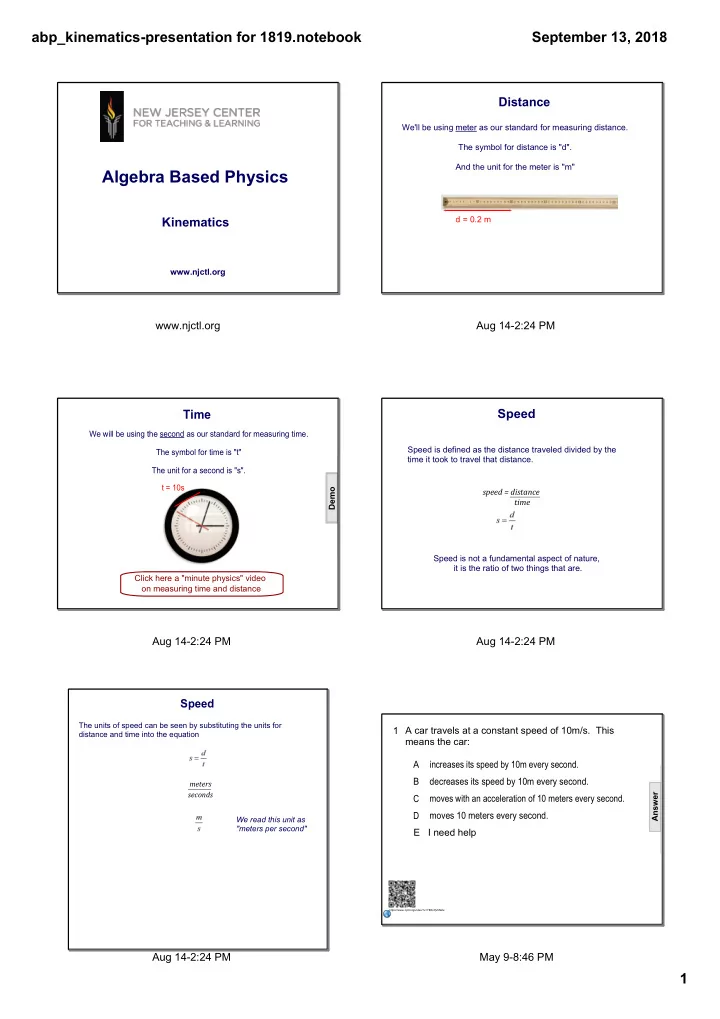
abp_kinematicspresentation for 1819.notebook September 13, 2018 Distance We'll be using meter as our standard for measuring distance. The symbol for distance is "d". And the unit for the meter is "m" Algebra Based Physics


slide-1
SLIDE 1

abp_kinematics­presentation for 1819.notebook 1 September 13, 2018

www.njctl.org

Algebra Based Physics

Kinematics

www.njctl.org

Aug 14­2:24 PM

Distance

We'll be using meter as our standard for measuring distance. The symbol for distance is "d". And the unit for the meter is "m" d = 0.2 m

Aug 14­2:24 PM

Time

We will be using the second as our standard for measuring time. The symbol for time is "t" The unit for a second is "s". t = 10s Click here a "minute physics" video

  • n measuring time and distance

Demo

Aug 14­2:24 PM

Speed

Speed is defined as the distance traveled divided by the time it took to travel that distance. speed = distance time Speed is not a fundamental aspect of nature, it is the ratio of two things that are.

Aug 14­2:24 PM Speed

meters seconds The units of speed can be seen by substituting the units for distance and time into the equation We read this unit as "meters per second"

May 9­8:46 PM

1 A car travels at a constant speed of 10m/s. This means the car: A

increases its speed by 10m every second. B decreases its speed by 10m every second. C moves with an acceleration of 10 meters every second. D moves 10 meters every second.

https://www.njctl.org/video/?v=7E8c3jVbN2w

E I need help

Answer

slide-2
SLIDE 2

abp_kinematics­presentation for 1819.notebook 2 September 13, 2018

Aug 14­2:24 PM

2 A rabbit runs a distance of 60 meters in 20 s; what is the speed of the rabbit?

https://www.njctl.org/video/?v=XrtRbPudROU

A 0.3 m/s B 0.6 m/s C 3 m/s D 4 m/s E I need help

Answer

Aug 14­2:24 PM

3 An airplane on a runway can cover 500 m in 10 s; what is the airplane's average speed?

https://www.njctl.org/video/?v=OJNi1GsWnuI

A 0.02 m/s B 50 m/s C 100 m/s D 5000 m/s E I need help

Answer

Aug 14­2:24 PM

4 A car travels at a speed of 40 m/s for 4.0 s; what is the distance traveled by the car?

https://www.njctl.org/video/?v=CWvo93CQnNI

A 4 m B 10 m C 160 m D 320 m E I need help

Answer

Aug 14­2:24 PM

5 You travel at a speed of 20m/s for 6.0s; what distance have you moved?

https://www.njctl.org/video/?v=mPMcjq1CNxA

A 6 m B 20 m C 120 m D 160 m E I need help

Answer

Aug 14­2:24 PM

6 You travel at a constant speed of 20 m/s; how much time does it take you to travel a distance of 120m?

https://www.njctl.org/video/?v=_8JNZyQXze4

A 6 s B 12 s C 20 s D 60 s E I need help

Answer

Aug 14­2:24 PM

7 You travel at a constant speed of 30m/s; how much time does it take you to travel a distance of 150m?

https://www.njctl.org/video/?v=k7od93faZ3E

A 0.2 s B 5 s C 15 s D 30 s E I need help

Answer

slide-3
SLIDE 3

abp_kinematics­presentation for 1819.notebook 3 September 13, 2018

Jun 29­2:17 PM

Return to Table of Contents

Average Speed

Demo

https://www.njctl.org/video/?v=Ry­IJYdAYhk

Sep 8­4:20 PM

Average Speed

The speed we have been calculating is a constant speed over a short period of time. Another name for this is instantaneous speed. If a trip has multiple parts, each part must be treated

  • separately. In this case, we can calculate the average speed

for a total trip. Determine the average speed by finding the total distance you traveled and dividing that by the total time it took you to travel that distance.

Jul 13­10:15 AM

In physics we use subscripts in order to avoid any confusion with different distances and time intervals. For example: if an object makes a multiple trip that has three parts we present them as d1, d2, d3 and the corresponding time intervals t1, t2, t3.

Distance and Time Intervals

Jul 13­10:15 AM

The following pattern of steps will help us to find the average speed: Find the total distance dtotal = d1+ d2+ d3 Find the total time ttotal = t1 + t2 + t3 Use the average speed formula

Average Speed & Non­Uniform Motion

savg = dtotal ttotal

Sep 8­4:20 PM

Average Speed ­ Example 1

You ride your bike home from school by way of your friend’s house. It takes you 7 minutes (420 s) to travel the 2500 m to his house. You spend 10 minutes there, before traveling 3500 m to your house in 9 minutes (540 s). What was your average speed for this trip?

Jun 14­8:50 AM

It takes Sean 10 minutes to walk 1 km from his house to Wawa. He stays at Wawa for 5 minutes and then continues on to Shane's

  • house. Shane's house is 2.5 km past Wawa.

It takes Sean 15 minutes to get from Wawa to Shane's house. Calculate Sean's average speed over the entire trip.

slide-4
SLIDE 4

abp_kinematics­presentation for 1819.notebook 4 September 13, 2018

Jun 29­2:17 PM

Return to Table of Contents

Position and Reference Frames

https://www.njctl.org/video/?v=5mPK2E2GkzA

Aug 14­2:24 PM

Position and Reference Frames

Speed, distance and time didn't require us to define where we started and where we ended up. They just measure how far we traveled and how long it took to travel that far. However, much of physics is about knowing where something is and how its position changes with time. To define position we have to use a reference frame.

Aug 14­2:24 PM

Position and Reference Frames

A reference frame lets us define where an object is located, relative to other objects. For instance, we can use a map to compare the location of different cities, or a globe to compare the location of different continents. However, not every reference frame is appropriate for every problem.

Aug 14­2:24 PM

Reference Frame Activity

Send a volunteer out of the classroom to wait for further instructions. Place an object somewhere in your classroom. Write specific directions for someone to be able to locate the object Write them in a way that allows you to hand them to someone who can then follow them to the object. Test your directions out on your classmate, (who is hopefully still in the hallway!)

Remember: you can't tell them the name of something your object is near, just how they have to move to get to it. For instance 'walk to the SmartBoard' is not a specific direction.

Aug 14­2:24 PM

Reference Frame Activity ­ Reflection

In your groups, make a list of the things you needed to include in your directions in order to successfully locate the

  • bject in the room.

As a class, discuss your findings.

Aug 14­2:24 PM

You probably found that you needed: A starting point (an origin) A set of directions (for instance left­right, forward­backward, up­down) A unit of measure (to dictate how far to go in each direction)

Results ­ Reference Frames

slide-5
SLIDE 5

abp_kinematics­presentation for 1819.notebook 5 September 13, 2018

Aug 14­2:24 PM

You'll probably find that you need a starting point (an origin) A set of directions (for instance left­right, forward­backward, up­ down) A unit of measure (how far to go in each direction) Usually we'll: Define the origin as a location labeled "zero" Three axes: x, y and z for direction The meter as our unit of measure In this course, we will be solving problems in one­dimension. Typically, we use the x­axis for that direction. +x will usually be to the right ­x would then be to the left We could define it the opposite way, but unless specified

  • therwise, this is what we'll assume. We also can think about

compass directions in terms of positive and negative. For example, North would be positive and South negative. The symbol for position is "x".

The Axis

+x ­ x

May 9­9:30 PM

8 All of the following are examples of positive direction except:

https://www.njctl.org/video/?v=JnzoLC8tbAE

A to the right B north C west D up E I need help

Answer

May 9­9:30 PM

9 All of the following are examples of negative direction except:

https://www.njctl.org/video/?v=Wm­YzMopcY8

A to the right B south C west D down E I need help

Answer

Jun 29­2:17 PM

Return to Table of Contents

Displacement

https://www.njctl.org/video/?v=yXc9uj­Qolc

Aug 14­2:24 PM

Displacement

Now that we understand how to define position, we can talk about a change in position; a displacement. The symbol for "change" is the Greek letter "delta" "Δ". So "Δx" means the change in x or the change in position

Aug 14­2:24 PM

­x +y ­y +x

Displacement

Displacement describes how far you are from where you started, regardless of how you got there.

slide-6
SLIDE 6

abp_kinematics­presentation for 1819.notebook 6 September 13, 2018

Aug 14­2:24 PM

­x +y ­y +x

Displacement

For instance, if you drive 60 miles from Pennsylvania to New Jersey...

x0

(In physics, we label the starting position x0)

Aug 14­2:24 PM

­x +y ­y +x

Displacement

and then 20 miles back toward Pennsylvania.

x0 xf

(We also label the final position xf )

Aug 14­2:24 PM

­x +y ­y +x

Displacement

You have traveled: a distance of 80 miles, and a displacement of 40 miles, since that is how far you are from where you started

x0 xf

we can calculate displacement with the following formula: Δx = Xf ­ Xo

Aug 14­2:24 PM

Displacement

Measurements of distance can only be positive values (magnitudes) since it is impossible to travel a negative distance. Imagine trying to measure a negative length with a meter stick...

Aug 14­2:24 PM

xf xo ­x +y ­y +x xo xf ­x +y ­y +x

Displacement

However, displacement can be positive or negative since you can end up to the right or left of where you started. Displacement is positive. Displacement is negative.

Sep 12­2:26 PM

Vectors and Scalars

Scalar ­ a quantity that has only a magnitude (number or value) Vector ­ a quantity that has both a magnitude and a direction

Quantity Vector Scalar Time Distance Displacement Speed

Which of the following are vectors? Scalars?

slide-7
SLIDE 7

abp_kinematics­presentation for 1819.notebook 7 September 13, 2018

May 9­9:35 PM

10 How far your ending point is from your starting point is known as:

https://www.njctl.org/video/?v=vxIWZ9_rQFo

A distance B displacement C a positive integer D a negative integer E I need help

Answer

Aug 14­2:24 PM

11 A car travels 60m to the right and then 30m to the left. What distance has the car traveled?

+x ­ x

https://www.njctl.org/video/?v=HxpHVhVbGF4

A 30 m B 60 m C 90 m D 0 m E I need help

Answer

Aug 14­2:24 PM

12 You travel 60m to the right and then 30m to the left. What is the magnitude (and direction) of your displacement?

+x ­ x

https://www.njctl.org/video/?v=DOIpNF9Rdz0

A ­30 m B 0 m C 30 m D 60 m E I need help

Answer

May 9­9:38 PM

13 Starting from the origin, a car travels 4km east and then 7 km west. What is the total distance traveled?

https://www.njctl.org/video/?v=vl2i9fvhOVE

A 3 km B ­3 km C 7 km D 11 km E I need help

Answer

May 9­9:38 PM

14 Starting from the origin, a car travels 4km east and then 7 km west. What is the net displacement from the original point?

https://www.njctl.org/video/?v=iYNfUacg­9A

A 3 km west B 3 km east C 7 km west D 11 km east E I need help

Answer

Aug 14­2:24 PM

15 You run around a 400m track. At the end of your run, what is the distance that you traveled?

https://www.njctl.org/video/?v=Zh­BoXNwIDo

A 0 m B 100 m C 200 m D 400 m E I need help

Answer

slide-8
SLIDE 8

abp_kinematics­presentation for 1819.notebook 8 September 13, 2018

Aug 14­2:24 PM

16 You run around a 400m track. At the end of your run, what is your displacement?

https://www.njctl.org/video/?v=GtCTnmgkkXQ

A 0 m B 100 m C 200 m D 400 m E I need help

Answer

Jun 29­2:17 PM

Return to Table of Contents

Average Velocity

https://njctl.org/video/?v=js6ZL6kBcsw

Lab

Aug 14­2:24 PM

Average Velocity

Speed is defined as the ratio of distance and time Similarly, velocity is defined as the ratio of displacement and time

s = d t

Δx Δt v =

Average velocity = time elapsed displacement Average speed = distance traveled time elapsed

Aug 14­2:24 PM

Average Velocity

Speeds are always positive, since speed is the ratio of distance and time; both of which are always positive. But velocity can be positive or negative, since velocity is the ratio of displacement and time; and displacement can be negative or positive.

s = d t

Δx Δt v =

Usually, right is positive and left is negative. Average speed = distance traveled time elapsed Average velocity = time elapsed displacement

May 9­9:43 PM

17 Which of the following is a vector quantity?

https://www.njctl.org/video/?v=ZL8OmtS4m8E

A time B velocity C distance D speed E I need help

Answer

May 9­9:46 PM

18 Average velocity is defined as change in ______

  • ver a period of ______.

https://www.njctl.org/video/?v=eIAG7H40utw

A distance, time B distance, space C position, time D position, space E I need help

Answer

slide-9
SLIDE 9

abp_kinematics­presentation for 1819.notebook 9 September 13, 2018

Aug 14­2:24 PM

19 You travel 60 meters to the right in 20 s; what is your average velocity?

https://www.njctl.org/video/?v=IMTx61aMxPo

A ­3 m/s B +0.3 m/s C +3 m/s D +6 m/s E I need help

Answer

Aug 14­2:24 PM

20 An elephant travels 60 meters to the left in 20 s; what is the average velocity?

https://www.njctl.org/video/?v=0UbmRkIJWwU

A ­3 m/s B 0 m/s C +3 m/s D +6 m/s E I need help

Answer

Aug 14­2:24 PM

21 You run completely around a 400 m track in 80s. What was your average speed?

https://www.njctl.org/video/?v=doZMr5s0mgo

A 0 m/s B 4 m/s C 5 m/s D 8 m/s E I need help

Answer

Aug 14­2:24 PM

22 You run completely around a 400 m track in 80s. What was your average velocity?

https://www.njctl.org/video/?v=YxRzc­Tg7mA

A 0 m/s B +4 m/s C +5 m/s D +8 m/s E I need help

Answer

Aug 14­2:24 PM

23 You travel 160 meters in 60 s; what is your average speed?

https://www.njctl.org/video/?v=5gN0etcCHTI

A 0 m/s B 2.7 m/s C 6.3 m/s D 16.7 m/s E I need help

Answer

Jun 29­2:17 PM

Return to Table of Contents

Instantaneous Velocity

https://www.njctl.org/video/?v=3VtT9A5parI

slide-10
SLIDE 10

abp_kinematics­presentation for 1819.notebook 10 September 13, 2018

Jul 13­10:58 AM

Instantaneous Velocity

Sometimes the average velocity is all we need to know about an object's motion. For example: A race along a straight line is really a competition to see whose average velocity is the greatest. The prize goes to the competitor who can cover the displacement in the shortest time interval. But the average velocity of a moving object can't tell us how fast the object moves at any given point during the interval Δt.

Aug 21­2:52 PM

Instantaneous Velocity

Average velocity is defined as change in position over time. This tells us the 'average' velocity for a given length or span

  • f time.

Watch what happens when we look for the instantaneous velocity by reducing the amount of time we take to measure displacement. If we want to know the speed or velocity of an

  • bject at a specific point in

time (with this radar gun for example), we want to know the instantaneous velocity...

Jul 13­11:43 AM

To describe the motion in greater detail, we need to define the velocity at any specific instant of time or specific point along the

  • path. Such a velocity is called instantaneous velocity.

Note that the word instant has somewhat different meaning in physics than in everyday language. Instant is not necessarily something that is finished quickly. We may use the phrase "It lasted just an instant" to refer to something that lasted for a very short time interval.

Instantaneous Velocity

Jul 13­11:43 AM

In physics an instant has no duration at all; it refers to a single value of time. One of the most common examples we can use to understand instantaneous velocity is driving a car and taking a quick look

  • n the speedometer.

Instantaneous Velocity

At this point, we see the instantaneous value of the velocity.

Jun 29­2:01 PM

v (m/s) t (s)

The graph below shows velocity versus time. How do you know the velocity is constant?

Velocity Graphing Activity

Answer

Jun 29­2:01 PM

v (m/s) t (s)

The graph below shows velocity versus time. When is the velocity increasing? Decreasing? Constant? Discuss.

Velocity Graphing Activity

slide-11
SLIDE 11

abp_kinematics­presentation for 1819.notebook 11 September 13, 2018

Jun 29­2:03 PM

Use the graph to determine the Average Velocity of (a)

Velocity Graphing Activity

b.)

1 1 3 2 2 4 6 4

v (m/s) t (s) v (m/s) t (s)

1 3 2 4 2 4 6

a.) Answer

Jun 29­2:03 PM

v (m/s) t (s)

1 3 2 4 2 4 6

a.) b.)

1 1 3 2 2 4 6 4

v (m/s) t (s)

Use the graph to determine the Average Velocity of (b) from 0s to 1s from 1s to 3s from 3s to 4s from 4s to 5s from 3s to 5s

Velocity Graphing Activity

Answer

Jun 29­2:03 PM

v (m/s) t (s) v (m/s) t (s)

a.) b.) Use the graph to determine the Instantaneous Velocity of (a) at 2 seconds

1 3 2 4 2 4 6 1 1 3 2 2 4 6 4

Velocity Graphing Activity

Answer

Jun 29­2:03 PM

v (m/s) t (s) v (m/s) t (s)

a.) b.) Use the graph to determine the Instantaneous Velocity of (b) at 2 seconds

1 3 2 4 2 4 6 1 1 3 2 2 4 6 4

Velocity Graphing Activity

Answer

Aug 14­2:24 PM

Instantaneous Velocity

(a) When the velocity of a moving object is a constant the instantaneous velocity is the same as the average.

v (m/s) t (s) v (m/s) t (s)

These graphs show (a) constant velocity and (b) varying velocity. (b) When the velocity of a moving object changes its instantaneous velocity is different from the average velocity.

Jun 29­2:17 PM

Return to Table of Contents

Acceleration

https://www.njctl.org/video/?v=jGbVA3e9Op4

Demo

slide-12
SLIDE 12

abp_kinematics­presentation for 1819.notebook 12 September 13, 2018

Aug 14­2:24 PM

Acceleration

Acceleration is the rate of change of velocity.

a = Δv

Δt

a = v ­ vo t

acceleration = change of velocity elapsed time

Aug 14­2:24 PM

Acceleration

Acceleration is a vector, although in one­dimensional motion we

  • nly need the sign.

Since only constant acceleration will be considered in this course, there is no need to differentiate between average and instantaneous acceleration.

a = v ­ vo t

Aug 14­2:24 PM

Units for Acceleration

Units for acceleration You can derive the units by substituting the correct units into the right hand side of these equations.

=

m/s s m/s2

a = Δv

Δt May 9­9:50 PM

24 Acceleration is the rate of change of _________ .

https://www.njctl.org/video/?v=4tmNAmswOd0

A displacement B distance C speed D velocity E I need help

Answer

May 9­9:51 PM

25 The unit for velocity is:

https://www.njctl.org/video/?v=D­h5qV2Plys

A m B m/s C m/s

2

D ft/s

2

E I need help

Answer

May 9­9:51 PM

26 The metric unit for acceleration is:

https://www.njctl.org/video/?v=EMkc2W5u6vw

A m B m/s C m/s2 D ft/s2 E I need help

Answer

slide-13
SLIDE 13

abp_kinematics­presentation for 1819.notebook 13 September 13, 2018

May 9­9:55 PM

27 A horse gallops with a constant acceleration of 3m/s2 . Which statement below is true?

https://www.njctl.org/video/?v=CbtjHuAk­Ew

A The horse's velocity doesn't change. B The horse moves 3m every second. C The horse's velocity increases 3m every second. D The horse's velocity increases 3m/s every second. E I need help

Answer

Aug 14­2:24 PM

Solving Problems

After you read the problem carefully:

  • 1. Draw a diagram (include coordinate axes).
  • 2. List the given information.
  • 3. Identify the unknown (what is the question asking?)
  • 4. Choose a formula (or formulas to combine)
  • 5. Rearrange the equations to isolate the unknown variable.
  • 6. Substitute the values and solve!
  • 7. Check your work. (You can do the same operations to the units to

check your work ... try it!)

https://www.njctl.org/video/?v=mAeQP2Q00As

Aug 14­2:24 PM

28 Your velocity changes from 60 m/s to the right to 100 m/s to the right in 20 s; what is your average acceleration?

https://www.njctl.org/video/?v=7HM0imp3Q_Y

A ­2 m/s2 B 0 m/s2 C +2 m/s2 D +4 m/s2 E I need help

Answer

Aug 14­2:24 PM

29 Your velocity changes from 60 m/s to the right to 20 m/s to the right in 20 s; what is your average acceleration?

https://www.njctl.org/video/?v=Dm5nPrPW_v4

A ­2 m/s2 B 0 m/s2 C +2 m/s2 D +4 m/s2 E I need help

Answer

Aug 14­2:24 PM

30 Your velocity changes from 50 m/s to the left to 10 m/s to the right in 15 s; what is your average acceleration?

https://www.njctl.org/video/?v=qG­r5XcIzaY

A ­3 m/s2 B 0 m/s2 C +4 m/s2 D +5 m/s2 E I need help

Answer

Aug 14­2:24 PM

31 Your velocity changes from 90 m/s to the right to 20 m/s to the right in 5.0 s; what is your average acceleration? A ­14 m/s2 B ­7 m/s2 C 0 m/s2 D +14 m/s2 E I need help

Answer

slide-14
SLIDE 14

abp_kinematics­presentation for 1819.notebook 14 September 13, 2018

May 25­1:13 PM

vo = initial velocity m/s v = final velocity m/s a = acceleration m/s2 t = time s x = final position (displacement) m xo = initial position (displacement) m

Jun 29­2:17 PM

Return to Tabe of Contents

Kinematics Equation 1

v = v o + at This equation tells us how an objects velocity changes as a function of time

Kinematics Equation 2

x = xo + vot + ½at2

This equation will tell us the position

  • f an object as a function of time

Kinematics Equation 3

v2 = vo2 + 2a(x ­ xo)

This equation will tell us how the final velocity of an object is related to its position without time.

Aug 14­2:24 PM

32 Starting from rest, you accelerate at 4.0 m/s2 for 6.0s. What is your final velocity?

https://www.njctl.org/video/?v=my2wda8jQn0

A +4 m/s B +16 m/s C +24 m/s D +32 m/s E I need help

Answer

Sep 6­10:47 PM

33 Beginning with a velocity of 25m/s, you accelerate at a rate of 2.0m/s2. During that acceleration you travel 200m; what is your final velocity?

https://www.njctl.org/video/?v=x7iGi9eGtn0

A 2.1 m/s B 25.3 m/s C 37.7 m/s D 50.4 m/s E I need help

Answer

Sep 6­10:41 PM

34 You accelerate from 20m/s to 60m/s while traveling a distance of 200m; what was your acceleration?

https://www.njctl.org/video/?v=z2Y9RQqk_l0

A 2 m/s2 B 4 m/s2 C 8 m/s2 D 20 m/s2 E I need help

Answer

Aug 14­2:24 PM

35 How much time does it take to come to rest if your initial velocity is 5.0 m/s and your acceleration is ­2.0 m/s2?

https://www.njctl.org/video/?v=1EQ_eMYq9pQ

A 1.5 s B 2 s C 2.5 s D 5 s E I need help

Answer

slide-15
SLIDE 15

abp_kinematics­presentation for 1819.notebook 15 September 13, 2018

Aug 14­2:24 PM

36 An object accelerates at a rate of 1.5 m/s2 for 4 s until it reaches a velocity of 10 m/s. What was its initial velocity?

https://www.njctl.org/video/?v=­q­YF4pzxBM

A 0 m/s B 2 m/s C 4 m/s D 6 m/s E I need help

Answer

Feb 7­7:01 PM

37 An arrow is projected by a bow vertically up with a velocity of 40 m/s, and reaches a target in 3 s. How high is the target located? The acceleration due to gravity on earth is ­9.8 m/s2.

https://www.njctl.org/video/?v=OVCqcjGQEwY

A 12.7 m B 60.6 m C 75.9 m D 120.2 m E I need help

Answer

x = xo + vot + ½at2 x = vot + ½at2 x = (40m/s)3s + ½(­9.8m/s2)(3s)2 x = 120m + (­44.1m) x = 75.9m

Aug 14­2:24 PM

38 An object accelerates at a rate of 3 m/s2 for 6 s until it reaches a velocity of 20 m/s. What was its initial velocity?

https://www.njctl.org/video/?v=cQ58qrtCejU

A 0 m/s B 2 m/s C 8 m/s D 18 m/s E I need help

Answer

Sep 3­8:12 PM

39 A Greyhound bus traveling at a constant velocity starts to accelerate at a constant 2.0 m/s2. If the bus travels 500 meters in 20 seconds, what was its initial velocity?

https://www.njctl.org/video/?v=MQxR6xG­AiM

A 2 m/s B 2.5 m/s C 5 m/s D 24 m/s E I need help

Answer

Sep 3­8:03 PM

40 An airplane starts from rest and accelerates at a constant rate of 3.0 m/s2 for 30.0 s before leaving the ground. How far did it move along the runway?

https://www.njctl.org/video/?v=OhB6n5VNJpA

A 90 m B 270 m C 1350 m D 2700 m E I need help

Answer

Aug 14­2:24 PM

41 How much time does it take to accelerate from an initial velocity of 20m/s to a final velocity of 100m/s if your acceleration is 1.5 m/s2?

https://www.njctl.org/video/?v=J4FZ8vf_RSw

A 20.7 s B 32.4 s C 53.3 s D 80.1 s E I need help

Answer

slide-16
SLIDE 16

abp_kinematics­presentation for 1819.notebook 16 September 13, 2018

Feb 7­6:57 PM

42 An object accelerates from rest to a velocity of 34 m/s

  • ver a distance of 70 m. What was its acceleration?

https://www.njctl.org/video/?v=bmQkTIhu5u4

A 8.3 m/s2 B 10 m/s2 C 17 m/s2 D 36 m/s2 E I need help

Answer

Feb 7­6:59 PM

43 An object accelerates from rest, with a constant acceleration of 8.4 m/s2, what will its velocity be after 11s?

https://www.njctl.org/video/?v=D7wd9ctbXkM

A 81.1 m/s B 84.9 m/s C 92.4 m/s D 198.3 m/s E I need help

Answer

Sep 6­10:41 PM

44 A dropped ball falls ­8.0m; what is its final velocity? The acceleration due to gravity on earth is ­9.8 m/s2.

https://www.njctl.org/video/?v=v7dJTLjftrE

A 8.2 m/s B 10.3 m/s C 12.5 m/s D 17.2 m/s E I need help

Answer

Sep 3­8:10 PM

45 A car has an initial velocity of 45 m/s. It accelerates for 4.8 seconds. In this time, the car covers 264 meters. What is its rate of acceleration?

https://www.njctl.org/video/?v=Kcw5NEHp2zg

A 0.52 m/s2 B 1.0 m/s2 C 2.1 m/s2 D 4.2 m/s2 E I need help

Answer

Sep 6­10:41 PM

46 A car accelerates from rest to 30m/s while traveling a distance of 20m; what was its acceleration?

https://www.njctl.org/video/?v=RNQxw3­mQCU

A 22.5 m/s2 B 30 m/s2 C 45 m/s2 D 90 m/s2 E I need help

Answer

Sep 3­8:09 PM

47 A train pulling out of Grand Central Station accelerates from rest at a constant rate. It covers 800 meters in 20 seconds. What is its rate of acceleration?

https://www.njctl.org/video/?v=A2YjfXJW1pA

A 4 m/s2 B 5 m/s2 C 10 m/s2 D 20 m/s2 E I need help

Answer

slide-17
SLIDE 17

abp_kinematics­presentation for 1819.notebook 17 September 13, 2018

Sep 6­10:41 PM

48 A ball with an initial velocity of 25m/s is subject to an acceleration of ­9.8 m/s2; how high does it go before coming to a momentary stop?

https://www.njctl.org/video/?v=ReTH6IKoUYs

A 25.4 m B 31.9 m C 62.5 m D 248.8 m E I need help

Answer

Aug 14­2:24 PM

https://www.njctl.org/video/?v=X_jWqMS3myk

49 You have an initial velocity of 5.0 m/s. You then experience an acceleration of ­1.5 m/s2 for 4.0s; what is your final velocity? A ­6 m/s B ­1 m/s C +1 m/s D +11 m/s E I need help

Answer

Sep 3­8:08 PM

50 A motorcycle starts out from a stop sign and accelerates at a constant rate of 20 m/s2. How long will it take the motorcycle to go 300 meters?

https://www.njctl.org/video/?v=Uh87­Cgt6ak

A 5 s B 5.5 s C 17.3 s D 30 s E I need help

Answer

Sep 6­10:47 PM

51 You accelerate, from rest, at 10m/s

2 for a distance of

100m; what is your final velocity?

https://www.njctl.org/video/?v=kZBFio3GHFY

A 20.3 m/s B 44.7 m/s C 84.3 m/s D 100 m/s E I need help

Answer

Sep 3­8:03 PM

52 A Volkswagen Beetle moves at an initial velocity

  • f 12 m/s. It coasts up a hill with a constant

acceleration of –1.6 m/s2. How far has it traveled after 6.0 seconds?

https://www.njctl.org/video/?v=Iv8l_­RG_fY

A 2.4 m B 28.8 m C 43.2 m D 60 m E I need help

Answer

Jun 29­2:17 PM

Return to Table of Contents

Free Fall: Acceleration Due to Gravity

https://www.njctl.org/video/?v=rB95M_Rgmq8

Demo

slide-18
SLIDE 18

abp_kinematics­presentation for 1819.notebook 18 September 13, 2018

Sep 15­10:22 AM

Free Fall

All unsupported objects fall towards Earth with the same acceleration. We call this acceleration the "acceleration due to gravity" and it is denoted by g. g = 9.8 m/s2 Keep in mind, ALL objects accelerate towards the earth at the same rate. g is a constant!

free fall demo sheet

Click here to watch Galileo's famous experiment performed

  • n the moon

Sep 22­1:01 PM

It speeds up (negative acceleration) g = ­9.8 m/s2 It stops momentarily. v = 0 g = ­9.8 m/s2 It slows down. (negative acceleration) g = ­9.8 m/s2 What happens when it goes up? What happens when it goes down? What happens at the top? It returns with its

  • riginal velocity.

What happens when it lands?

Free Fall

An object is thrown upward with initial velocity, v

  • (Click on question for answer.)

Jun 9­11:13 PM

It speeds up. (negative acceleration) g = ­9.8 m/s2 It stops momentarily. v = 0 g = ­9.8 m/s2 An object is thrown upward with initial velocity, vo It slows down. (negative acceleration) g = ­9.8 m/s2 It returns with its

  • riginal velocity.

Free Fall Answers

Jun 30­11:38 AM

a v0 On the way up: a

v1 v1

a

v2 v2

a a

v

a a

v0

On the way down: v1 v1 v2 v2 v v t = 0 s t = 1 s t = 2 s t = 3 s t = 0 s t = 1 s t = 2 s t = 3 s

Free Fall

Jun 30­12:07 PM

v (m/s) t (s)

An object is thrown upward with initial velocity, vo It stops momentarily. v = 0 g = ­9.8 m/s2 It returns with its

  • riginal velocity but in the
  • pposite direction.

For any object thrown straight up into the air, this is what the velocity vs. time graph looks like.

Free Fall

May 9­10:00 PM

53 A ball is dropped from rest and falls (do not consider air resistance). Which is true about its motion?

https://www.njctl.org/video/?v=lqrx6I6fFPo

A acceleration is constant B acceleration is decreasing C speed is constant D speed is descreasing E I need help

Answer

slide-19
SLIDE 19

abp_kinematics­presentation for 1819.notebook 19 September 13, 2018

Sep 15­10:20 AM

54 An acorn falls from an oak tree. You note that it takes 2.5 seconds to hit the ground. How fast was it going when it hit the ground?

https://www.njctl.org/video/?v=ZjGTOtqx7Fk

A 2.5 m/s B 4.8 m/s C 9.8 m/s D 25 m/s E I need help

Answer

Sep 15­1:38 PM

55 A rock falls off a cliff and hits the ground 5 seconds later. What velocity did it hit the ground with?

https://www.njctl.org/video/?v=qSo50sEyALQ

A ­23 m/s B ­49 m/s C ­98 m/s D ­496 m/s E I need help

Answer

Sep 15­1:38 PM

56 A ball is thrown down off a bridge with a velocity

  • f 5 m/s. What is its velocity 2 seconds later?

https://www.njctl.org/video/?v=_ush_fkVoyk

A ­4.8 m/s B ­14.8 m/s C ­19.6 m/s D ­24.6 m/s E I need help

Answer

Sep 15­1:42 PM

57 An arrow is fired into the air and it reaches its highest point 3.0 seconds later. What was its velocity when it was fired?

https://www.njctl.org/video/?v=6CXXQIqCZro

A +9.8 m/s B +29.4 m/s C +58.4 m/s D +98 m/s E I need help

Answer

Sep 15­1:44 PM

58 A rocket is fired straight up from the ground. It returns to the ground 10 seconds later. What was its launch speed?

https://www.njctl.org/video/?v=tJybBb09Uos

A 9.8 m/s B 49 m/s C 98 m/s D 147 m/s E I need help

Answer

Jul 13­2:07 PM

Analyzing Position vs Time Graphs

Recall earlier in this unit that slope was used to describe motion. The slope in a position vs. time graph is Δx/Δt, which is equal to velocity. Therefore, slope is equal to velocity on a position vs. time graph.

x (m) t (s)

Δx Δt v = Δx/Δt

slide-20
SLIDE 20

abp_kinematics­presentation for 1819.notebook 20 September 13, 2018

Jul 13­2:07 PM

Analyzing Position vs Time Graphs

A positive slope is a positive velocity, a negative slope is a negative velocity, and a slope of zero means zero velocity.

x (m) t (s) x (m) t (s) x (m) t (s)

positive slope v > 0 negative slope v < 0 zero slope v = 0

A positive velocity means moving in the positive direction, a negative velocity means moving in the negative direction, and zero velocity means not moving at all.

Sep 6­10:41 PM

  • a. Describe, in

words, the velocity of each

  • f the cars. Make

sure you discuss each car’s speed and direction. Position (m) Time (s)

The position versus time graph, below, describes the motion

  • f three different cars moving along the x­axis.

Answer

Sep 6­10:41 PM

  • b. Calculate the

velocity of each of the cars.

The position versus time graph, below, describes the motion

  • f three different cars moving along the x­axis.

Position (m) Time (s) Answer

https://www.njctl.org/video/?v=0z2PvzGoFGo

Jul 6­12:40 PM

59 When is velocity zero? A 0s B 2s C 3s D 4s E I need help

v (m/s) t (s)

1 1 3 2 2 4 6 4

https://www.njctl.org/video/?v=W3YyvDwwBbc

The velocity vs time graph, below, describes the motion

  • f an object moving along the x­axis.

Feb 6­7:01 PM

v (m/s) t (s)

1 1 3 2 2 4 6 4

The velocity vs time graph, below, describes the motion

  • f an object moving along the x­axis.

Describe in words what is happening to the speed during the following intervals. a) 0s to 1s b) 1s to 3s c) 3s to 4 sec d) 4s to 5s e) 5s to 6s

Answer

Jun 8­4:54 PM

60 The velocity vs time graph, below, describes the motion of an object moving along the x­axis.

v (m/s) t (s)

1 1 3 2 2 4 6 4

Determine the average speed during the following intervals. a) 0s to 1s b) 1s to 3s c) 3s to 4 sec d) 4s to 5s e) 5s to 6s f) 3s to 5s

https://www.njctl.org/video/?v=Lqhl24yBB0E

Answer

slide-21
SLIDE 21

abp_kinematics­presentation for 1819.notebook 21 September 13, 2018

Feb 6­7:01 PM

v (m/s) t (s)

1 1 3 2 2 4 6 4

The velocity vs time graph, below, describes the motion

  • f an object moving along the x­axis.

Determine the displacement during the following intervals. a) 0s to 1s b) 1s to 3s c) 3s to 4 sec d) 4s to 5s e) 5s to 6s

Answer

https://www.njctl.org/video/?v=oQ_FqdWsOfQ

Feb 7­7:51 PM

61 Determine the net displacement during the first four seconds of travel.

v (m/s) t (s)

1 1 3 2 2 4 6 4

The velocity vs time graph, below, describes the motion

  • f an object moving along the x­axis.

Answer

https://www.njctl.org/video/?v=eZAznYcQQ7s

A 0 m B 4 m C 8 m D 12 m E I need help

Aug 14­2:24 PM

Summary

  • Kinematics is the description of how objects move with respect

to a defined reference frame.

  • Displacement is the change in position of an object.
  • Average speed is the distance traveled divided by the time it

took; average velocity is the displacement divided by the time.

https://www.njctl.org/video/?v=iyQH4q1hbUU

Feb 7­11:32 AM

  • Instantaneous velocity is the limit as the time becomes

infinitesimally short.

  • Average acceleration is the change in velocity divided by the

time.

  • Instantaneous acceleration is the limit as the time interval

becomes infinitesimally small.

Summary (continued)

Aug 14­2:24 PM

Summary (continued)

  • There are four equations of motion for constant acceleration, each

requires a different set of quantities.

v2 = vo2 + 2a(x ­ xo) x = xo + vot + ½at2 v = vo + at v = v + vo 2