
SLIDE 1
ABILITÀ LINGUISTICHE PER IL CORSO DI LAUREA IN BIOLOGIA (1° anno, A.A. 2018-19)
POWER POINT PRESENTATION 6 (12 e 15 aprile)
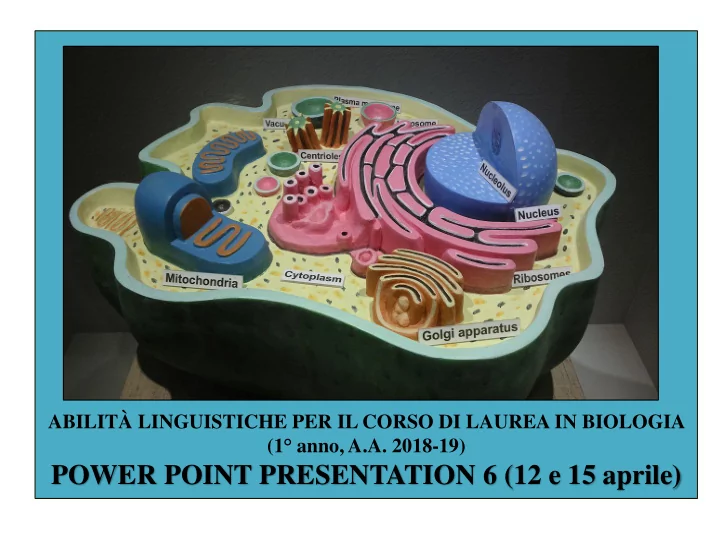
ABILIT LINGUISTICHE PER IL CORSO DI LAUREA IN BIOLOGIA (1 anno, A.A. - - PowerPoint PPT Presentation
ABILIT LINGUISTICHE PER IL CORSO DI LAUREA IN BIOLOGIA (1 anno, A.A. 2018-19) POWER POINT PRESENTATION 6 (12 e 15 aprile) Information about course on my home page: unica.it Facolt Facolt di Studi Umanistici Elenco docenti
ABILITÀ LINGUISTICHE PER IL CORSO DI LAUREA IN BIOLOGIA (1° anno, A.A. 2018-19)
POWER POINT PRESENTATION 6 (12 e 15 aprile)
Information about course on my home page: unica.it Facoltà Facoltà di Studi Umanistici Elenco docenti (cerca GRAY) Didattica Materiale Didattico http://people.unica.it/geoffreymichaelgray/di dattica/materiale-didattico/
Il seguente libro di testo, che contiene spiegazioni in lingua italiana, esempi ed esercizi, è un punto di riferimento indispensabile per il corso: New Get Inside Language A1-B2+ Levels, M. Vince, G. Cerulli, M. Muzzarelli e D. Morini, Macmillan Education, 2017, ISBN: 978-1-380-00688-2. Non è disponibile su Amazon.it. Può essere acquistato o
Non acquistare versioni di questo libro con ISBN diverso da quello citato sopra.
Il seguente libro non è essenziale ma è molto utile e divertente: Beppe Severgnini: L’inglese: Lezioni semiserie Rizzoli. Disponibile su Amazon.it.
ASK 3 QUESTIONS: PRESENT, PAST AND FUTURE TIME PRESENT SIMPLE: What do you usually do on Tuesday /Saturday? I play tennis / go to the gym PRESENT CONTINUOUS: What are you studying /doing at the moment? I’m studying biology. I’m listening to the teacher. PRESENT PERFECT (= unfinished period of time): Which parts
PAST SIMPLE: What did you do last Saturday / Sunday? What school did you go to? I went to the beach / I watched a film. FUTURE: (intention) What are you going to do tomorrow / in August /after you graduate? I’m going to… (future fact) When will you graduate? When will you next see your parents? I’ll graduate in…. / I’ll see my parents on Saturday /this weekend
TODAY’S LESSON 1) Pronuniciation: vowels and consonants 2) General English Lexis: (i) Presenting facts, trends, figures and percentages, (ii) numbers, dates and time (book 564- 565, 41-43) 3) Grammar: countable / uncountable quantities, articles, infinitive and ing- form (book 286-314, 318-23, 262-63, 275-76) 4) Lexis for Biology: cell structure
Write and say these words: “The top five songs”
Lexis for English (book 564-65)
You do an experiment in the laboratory. How do you present the results? Translate:
UPWARD TRENDS:
DOWNWARD TRENDS:
Lexis for General English (book 564-65)
You do an experiment in the laboratory. How do present the results?
UPWARD TRENDS
DOWNWARD TRENDS
STABLE TRENDS
DESCRIBING CHANGES (adverbs)
STABLE TRENDS
DESCRIBING CHANGES (adverbs)
PRECENTAGES
Translate:
3% ||a tiny fraction/an insignificant amount
15% || a small proportion 26% || roughly one quarter 32% || nearly a third 49% || just under half 50% || exactly half 51% || just over half 70% || a large proportion / a significant majority 77% || approximately three quarters
USEFUL EXPRESSIONS Translate:
Come si può vedere dal grafico/tabella… La tabella mostra che…. Secondo i dati….. C’è stato/a un/a lieve /calo/ riduzione / diminuzione... La maggior parte dei animali…
USEFUL EXPRESSIONS
Come si può vedere dal grafico/tabella… As you can see from the graph / chart … La tabella mostra che…. The table shows that… Secondo i dati….. According to the data…. C’è stato/a un/a lieve calo/ riduzione / diminuzione... There has been a slight drop / decrease /decline La maggior parte dei animali… The majority of animals...
NUMBERS, DATES AND TIME (book 41-43) Cardinal numbers (one / seventeen) and ordinal numbers (first/ seventeenth) To SAY the date use ORDINAL numbers: What day is it today? It’s Monday the sixteenth of April. To WRITE the date use CARDINAL numbers: 16 April 2018 / 16th April 2018 Gli anni si leggono due cifre per volta: 1945 = nineteen forty-five 1800 = eighteen hundred 2001-09 = two thousand and one / and nine 2010-18 = twenty ten / twenty eighteen
Could you tell me the time please? / What time is it? / What’s the time? (book 41-43) 17:00 five o’clock || 17.05 five past five || 17.15 quarter past five || 17.20 twenty past five || 17.30 half past five || 17.45 quarter to six || 17.55 five to six Say these times: 09.00 || 14.05 || 13.10 || 16.15 || 08.20 || 09.25 || 10.30 || 11.35 || 12.45 || 18 .55
In English use the numbers 13 to 24 only for
The train leaves at 20.55 / 19.30 / 10.15 / 18.20 /07.10 The train leaves at twenty fifty five/ nineteen thirty… The plane arrives at 16:35 / 15.05 / 04.45 / 12.25 The plane arrives at sixteen thirty-five, fifteen o five…
GRAMMAR: (book 286-314, 318-23, 262-76)
GRAMMAR: countable / uncountable quantities (book 286 -314) Uncountable (= a mass) No plural and no indefinite article (a /an).
A fruit is cheap. || I don’t have a sugar. But you can use ‘the’, ‘some’, ‘any’ and ‘much’ Pass me the sugar. (specific reference) I’ll buy some fruit / sugar (indefinite reference) We don’t have any sugar in the house. We don’t have much fruit /sugar in the house.
GRAMMAR: countable / uncountable quantities Countable (= units) The apples in this shop are expensive. Some apples are expensive Would you like an apple? How many apples are there? You can use the plural, the definite article (the) and the indefinite article (a /an), and many.
Some words that are countable in Italian are non- countable in English: consiglio: Do you want some _____ ? mobili: I like the _____ in this room. capelli: She has black _____ . compiti a casa: When you return home from school you must do your _____ . faccende domestiche Unfortunately, I’ve got to do the _____ this evening. informazioni: Can I ask you some _____ ? rifiuti: Don’t drop _____ on the ground. bagagli: You shouldn’t leave your _____ unattended at the airport. soldi: Oh no? I’ve lost all my _____ ! notizie: There isn’t much _____ on TV tonight.
Some words that are countable in Italian are non- countable in English: consiglio: Do you want some advice? mobili: I like the furniture in this room. capelli: She has black hair. compiti a casa: When you return home from school you must do your homework. faccende domestiche Unfortunately, I’ve got to do the housework this evening. informazioni: Can I ask you some information? rifiuti: Don’t drop litter on the ground. bagagli: You shouldn’t leave your luggage unattended at the airport. soldi: Oh no? I’ve lost all my money ! notizie: There isn’t much news on TV tonight.
Choose the correct option (book 288)
accommodation.
/researches.
Choose the correct option (book 288)
accommodation.
/researches.
GRAMMAR: articles (book 286 -314) zero article (no definite or indefinite article): Would you like milk and biscuits for breakfast? Human beings are superior to animals in that they use language to convey thoughts Each word in red here refers to a concept in general and not to a specific example of it. This is different from Italian: La pace è una buona cosa Peace is a good thing
GRAMMAR: articles (book 286 -314) BUT: Pass me the milk and the biscuits please. The animals we have chosen to talk about this evening are the cats and dogs that are our pets. Here, ‘the’ refers to a specific thing. It communicates that the listener/reader already knows, or will know, which specific member of a class the speaker is referring to.
GRAMMAR: articles (book 286 -314) Compare the two meanings of ‘exams’ in: Exams can be easy, but the exams that university students have to do can be very difficult. ‘Exams’ = generic reference (reference in general) ‘the exams’ = ‘the’ refers to a specific thing. It communicates that the listener/reader already knows, or will know, which specific member of a class the speaker is referring to.
GRAMMAR: articles (book 318-23)
a/an (= indefinite article): I would like to eat an orange / learn a foreign language Here, ‘a /an’ denotes an UNSPECIFIED member of a class.
Use ‘THE’ (= DEFINITE ARTICLE) to denote a specified member of a class when : a) when you refer to something you have already mentioned: A doctor and a policewoman were there. The doctor told the policewoman that … b) when you refer to someone / something you are going to specify: The teacher in the room was Peter Smith The man who came here yesterday is not here today
c) there is a SUPERLATIVE or an ORDINAL number: Peter Smith is the best teacher in this school He lives in the fourth house on the right
Choose the correct option (book 319)
telling me about?
Museum / a National Science Musuem this afternoon.
Minister will give her speech tomorrow.
Choose the correct option (book 319)
telling me about?
Science Museum this afternoon.
her speech tomorrow.
Fill in the gaps if necessary (book 320) _____ Volga river is _____ longest river in _____ Europe.
Fill in the gaps if necessary (book 320) The Volga river is the longest river in _____ Europe.
GRAMMAR: the infinitive and the ing-form (book 262-76).
The ‘A’ sentences = a new action /an action done for the first time. / an action in general. The ‘B’ sentences = an activity in progress.
Practice: the infinitive and the ing-form (Test intermediario / Intermediary Test)
appropriate questions for the following five
Example: It’s half-past nine. What time is it, please?
Write appropriate questions for the following five answers:
tomorrow.
Write appropriate questions for the following five answers:
studying?
tomorrow?
Ask your partner these questions.
Lexis for biology (read Scientific American) Cell structure
Lexis for biology (read Scientific American) Cell structure
A cell is the smallest part of an organism that performs all the functions of an entire organism. For example, a cell can take in food or f_____ (= a source of heat or power), convert it into k_____ energy of motion or chemical p_____ energy (= energy that’s stored in the bonds of molecules). Cells can also e_____ wastes, just like the
perform all the functions of life, the cell is the smallest unit of life.
Lexis for biology (read Scientific American) Cell structure
A cell is the smallest part of an organism that performs all the functions of an entire organism. For example, a cell can take in food or fuel (= a source of heat or power), convert it into kinetic energy of motion or chemical potential energy (= energy that’s stored in the bonds of molecules). Cells can also eliminate wastes, just like the
perform all the functions of life, the cell is the smallest unit of life.
Lexis for biology (read Scientific American)
Cells can be categorized a_____ to structure, function or in terms of their e_____ relationships. In terms of structure (= internal organization) cells can be categorized as prokaryotes that don’t have a true n_____ in their cells and e_____ that do.
Lexis for biology (read Scientific American)
Cells can be categorized according to structure, function or in terms of their evolutionary relationships. In terms of structure (= internal organization) cells can be categorized as prokaryotes that don’t have a true nucleus in their cells and eukaryotes that do.
Lexis for biology (read Scientific American) The majority of prokaryotes, which include b_____ and archaea, have the following characteristics: a p_____ membrane that forms a barrier around the cell, a rigid cell wall o_____ this membrane, an area called the n_____ that houses DNA, r_____ that make proteins, and the ability to break down food using cellular r_____ (which requires
Lexis for biology (read Scientific American) The majority of prokaryotes, which include bacteria and archaea, have the following characteristics: a plasma membrane that forms a barrier around the cell, a rigid cell wall outside this membrane, an area called the nucleoid that houses DNA, ribosomes that make proteins, and the ability to break down food using cellular respiration (which requires oxygen) and fermentation which doesn’t require oxygen.
Lexis for biology (read Scientific American)
Eukaryotic cells, which include humans animals and plants, have the following characteristics: a nucleus that stores genetic information, a plasma membrane that e _____ the cell, internal membranes such as the G_____ apparatus, and a cy_____ made of proteins that reinforces a cell’s structure and controls cellular movements.
Lexis for biology (read Scientific American)
Eukaryotic cells, which include humans animals and plants, have the following characteristics: a nucleus that stores genetic information, a plasma membrane that encloses the cell, internal membranes such as the Golgi apparatus, and a cytoskeleton made of proteins that reinforces a cell’s structure and controls cellular movements.
Lexis for biology (read Scientific American)
Eukaryotic cells can also have two types of
energy, and c_____ that transfer energy from the sun into the chemical energy in food. This second type of organelles is f_____ only in plants and a_____. Mitochondria supply cells with energy by b_____ down food molecules into an energy-storing molecule called ATP, which is an abbreviation for ad_____ tr_____ .
Lexis for biology (read Scientific American)
Eukaryotic cells can also have two types of
transfer energy, and chloroplasts that transfer energy from the sun into the chemical energy in
cells with energy by breaking down food molecules into an energy-storing molecule called ATP, which is an abbreviation for adenosine triphosphate.
Lexis for biology (read Scientific American)
All cells have a plasma membrane (or cell membrane). Its function is to separate the chemical reactions o _____ inside the cell from the chemicals outside the cell. Metaphorically, the plasma membrane functions as a kind of international border that controls what enters
inside a cell membrane is called the cytoplasm. Cyto means _____ and plasm means _____ so cytoplasm means _____ _____’.
Lexis for biology (read Scientific American)
All cells have a plasma membrane (or cell membrane). Its function is to separate the chemical reactions occurring inside the cell from the chemicals outside the cell. Metaphorically, the plasma membrane functions as a kind of international border that controls what enters or leaves a particular
called the cytoplasm. Cyto means cell and plasm means shape so cytoplasm means cell shape.
Lexis for biology (read Scientific American)
Chemical reactions in cells occur w_____ (= ogni volta che) the molecules in cells change. They are usually part of a cycle or p _____ that has separate reactions at each step. Each reaction of a pathway or cycle requires a specific enzyme to act as a c _____ , something that speeds up the rate of chemical reactions. Enzymes are recycled: they are the same at the end of a reaction as they were at the b _____. It is wrong to think that enzymes add energy to reactions to make them h_____.
Lexis for biology (read Scientific American)
Chemical reactions in cells occur whenever (=
They are usually part of a cycle or pathway that has separate reactions at each step. Each reaction
to act as a catalyst, something that speeds up the rate of chemical reactions. Enzymes are recycled: they are the same at the end of a reaction as they were at the beginning. It is wrong to think that enzymes add energy to reactions to make them happen.
Lexis for biology (read Scientific American)
Enzymes don’t add a_____ to a reaction. They just help the r_____ to have enough energy on their own to combine in the right
controlling their enzymes via ‘f_____ inhibition’, a process in which a reaction pathway proceeds normally until the final product is produced at too high a level. The final product then binds to the a_____ site of
shutting it down.
Lexis for biology (read Scientific American)
Enzymes don’t add anything to a reaction. They just help the reactants to have enough energy on their own to combine in the right way. Cells manage their activity by controlling their enzymes via ‘feedback inhibition’, a process in which a reaction pathway proceeds normally until the final product is produced at too high a level. The final product then binds to the allosteric site of one of the initial enzymes in the pathway, shutting it down.