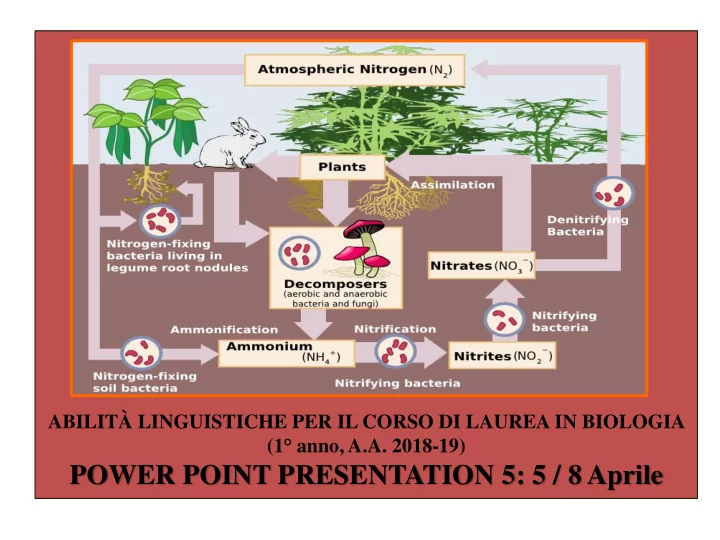
SLIDE 1 ABILITÀ LINGUISTICHE PER IL CORSO DI LAUREA IN BIOLOGIA (1° anno, A.A. 2018-19)
POWER POINT PRESENTATION 5: 5 / 8 Aprile
SLIDE 2
Information about course on my home page: unica.it Facoltà Facoltà di Studi Umanistici Elenco docenti (cerca GRAY) Didattica Materiale Didattico http://people.unica.it/geoffreymichaelgray/di dattica/materiale-didattico/
SLIDE 3 Il seguente libro di testo, che contiene spiegazioni in lingua italiana, esempi ed esercizi, è un punto di riferimento indispensabile per il corso: New Get Inside Language A1-B2+ Levels, M. Vince, G. Cerulli, M. Muzzarelli e D. Morini, Macmillan Education, 2017, ISBN: 978-1-380-00688-2. Non è disponibile su Amazon.it. Può essere acquistato o
- rdinato presso la libreria SUKKA, Via G. Deledda 36,
- Cagliari. Tel. 070/6848476. Email: books@sukka.it
Non acquistare versioni di questo libro con ISBN diverso da quello citato sopra.
SLIDE 4
Il seguente libro non è essenziale ma è molto utile e divertente: Beppe Severgnini: L’inglese: Lezioni semiserie Rizzoli. Disponibile su Amazon.it.
SLIDE 5 CONVERSATION: PRESENT, PAST AND FUTURE TIME PRESENT SIMPLE: What do you usually do on Tuesday /Saturday? I play tennis / go to the gym PRESENT CONTINUOUS: What are you studying /doing at the moment? I’m studying biology. I’m listening to the teacher. PRESENT PERFECT (= unfinished period of time): Which parts
- f Europe / Italy / Sardinia have you visited? I’ve visited….
PAST SIMPLE: What did you do last Saturday / Sunday? What school did you go to? I went to the beach / I watched a film. FUTURE: (intention) What are you going to do tomorrow / in August /after you graduate? I’m going to… (future fact) When will you graduate? When will you next see your parents? I’ll graduate in…. / I’ll see my parents on Saturday /this weekend
SLIDE 6
TODAY’S LESSON 1) Pronuniciation: consonants 2) General English Lexis: (i) Leisure and sports, (ii) names of endangered animals (book 546-47) 3) Grammar: modal verbs for ability, permission, requests, advice, obligation (book 198-217, 225) 4) Lexis for Biology: Biodiversity and Ecosystems
SLIDE 7
SLIDE 8
SLIDE 9 Lexis for General English (book 546-47)
Write a word or expression that means:
- the activity of running at a slow, steady speed
- to jump into the water with your head first
- stare insieme con / incontrare gli amici
- the sport or business of catching fish
- the attempt to obtain sensitive information on
the internet for malicious reasons
SLIDE 10 Write a word or expression that means:
- the activity of running at a slow, steady speed
jogging
- to jump into the water with your head first to
dive
- stare insieme con / incontrare gli amici hang out
with / meet up with friends
- the sport or business of catching fish fishing
- the attempt to obtain sensitive information on
the internet for malicious reasons phishing fishing / phishing: different spelling, same pronunciation.
SLIDE 11
- a person who trains a sports player or team
- to ride on waves in the sea on a board (= a flat
piece of wood)
- navigare sul web
- regular physical exercise designed to make your
muscles bigger. Usually the exercises involve lifting, pulling and pushing weights
- somebody who makes sure that players obey the
rules in tennis, baseball and cricket.
- somebody who makes sure that players obey the
rules in football and rugby
SLIDE 12
- a person who trains a sports player or team a
coach
- to ride on waves in the sea on a board (= a flat
piece of wood) surf the waves
- navigare sul web surf the internet
- regular physical exercise designed to make your
muscles bigger. Usually the exercises involve lifting, pulling and pushing weights body building
- somebody who makes sure that players obey the
rules in tennis, baseball and cricket an umpire
- somebody who makes sure that players obey the
rules in football and rugby a referee
SLIDE 13
- Talk about your favourite sport /
hobby.
- What do you do in your free time?
- What sports do you /don’t you like?
- How often do you practise your
favourite sport or hobby?
- How long have you played tennis /
football // watched American films?
SLIDE 14
Lexis for General English: What are the names of these endangered species? (= species that could become extinct)
What’s the habitat? What’s the habitat?
SLIDE 15
Blue throated macaw: tropical jungle Giant otter: freshwater in a wood
SLIDE 16
Lexis for General English: What are the names of these endangered species?
What’s the habitat? What’s the habitat?
SLIDE 17 Green sea turtle: warm
Iberian lynx: forests
SLIDE 18
Lexis for General English: What are the names of these endangered species?
What’s the habitat? What’s the habitat?
SLIDE 19
Red panda: wood / forest
Snow leopard: mountains with snow
SLIDE 20
Lexis for General English: What are the names of these endangered species?
What’s the habitat? What’s the habitat?
SLIDE 21
Toque macque: tropical jungle Blue whale: ocean
SLIDE 22
Talk about animals or your pets
What’s your favourite animal / pet? Do you think exotic animals (e,g, baby crocodiles) make good pets? Yes / No because….. I would like to have a _______ because……. I don’t like _____ because ……. Have you got a ______ in your home?
SLIDE 23 GRAMMAR: PLAN OF COURSE
Lesson: 1: overview of exam
- 2. verbs to talk about the present
3: verbs to talk about the past 4: verbs to talk about the future 5: TODAY: modal verbs: certainty, obligation, ability, permission, advice, etc. 6: countable / uncountable quantities, articles and comparisons 7: zero, first and second conditionals (= periodo ipotetico) 8: Word order, relative clauses and subordinate clauses
SLIDE 24 Dear Alan, Just a quick letter to tell you that I'm enjoying life here in London because I can play football in the evenings and I am able to go cycling at weekends. When I was younger I could cycle 80 kilometres without stopping but now I need to have a break. You ought to come to London to see me. But since you have to work every day in a bar you must be very busy. I’m not sure but I might come to Sardinia next month. We must speak to each other
- soon. You don’t need to write to me. Instead, you
can/could phone me. Best, David.
SLIDE 25 Dear Alan, (use modal verbs to complete this text) Just a quick letter to tell you that I'm enjoying life here in London because I c_____ play football in the evenings and I a_____ able to go cycling at
- weekends. When I was younger I c_____ cycle 80
kilometres without stopping but now I n_____ to have a break. You o____ to come to London to see
- me. But since you h ____ to work every day in a
bar you m____ be very busy. I’m not sure but I m_____ come to Sardinia next month. We m_____ speak to each other soon. You d____ n_____ to write to me. Instead, you c____ phone me. Best, David.
SLIDE 26
Grammar:
Ability: (book 198-99) I can / could play football. Future: I will be able to play football. For ability on a specific occasion, use ‘managed’ I managed to pass my exam yesterday Lucy finally managed to find her car keys. Necessity: (book 198-201) I need / needed a coffee. Future: I will need a coffee.(= a simple future fact)
SLIDE 27
Permission: (book 198-201) You can't smoke in here. You aren't allowed to smoke here. Requests: (book 202-03) Can I use your smartphone? (more formal) May I /Could I use your smartphone? Suggestions (book 202-03) How about going out for dinner? (more formal) Would you like to go out for dinner?
SLIDE 28
Obligation (book 204-08) I must /have to catch the bus at 17.00. Use ‘must’ for obligation imposed by the speaker: I must give up smoking, I tell myself. I must get up earlier in the mornings. Use ‘have to’ for obligation imposed by something or someone who is not the speaker: The doctor told me that I have to give up smoking. My father has to work on Sundays.
SLIDE 29
Mustn’t / Don’t have to: different meanings (book 204-05) Mustn’t = obligation You musn’t smoke here You mustn’t waste your money Don’t have to = no obligation You don’t have to do the shopping. I’ve done it. Today is a national holiday so I don’t have to go to work.
SLIDE 30
Advice, deductions and suppositions (book 209-17)
You can’t drive? You should take driving lessons. If you’re not well, you ought to / had better see a doctor. The phone’s ringing. It must be Peter. He doesn’t speak Italian. He must be a foreigner. Where’s Mary? She may / might / could be in the garden.
SLIDE 31 Test intermediario / Intermediary Test
- 1. VERB FORMS (5 points). Give the correct
forms of the verbs and, when required, pronouns or adverbs. You may have to use auxiliary verbs as well as main verbs. Look at the example below. Example: When the telephone _____ (RING) I _____ (WATCH) television. When the telephone rang I was watching television.
SLIDE 32
- 1. When John was younger, he _____
(CAN) run quite fast but now he _____ (HAVE) to stop after 20 minutes.
- 2. She _____ (MANAGE, negative ) to pass
her exam last week. When I spoke to her yesterday I _____ (CAN) see she was unhappy.
- 3. _____ (W……) you like me to do the
shopping now? No, you _____ (HAVE, negative) to do it now. You can do it tomorrow.
SLIDE 33
- 1. When John was younger, he could (CAN)
run quite fast but now he has (HAVE) to stop after 20 minutes.
- 2. She didn’t manage (MANAGE, negative )
to pass her exam last week. When I spoke to her yesterday I could (CAN) see she was unhappy.
- 3. Would you like me to do the shopping
now? No, you don’t have (HAVE, negative) to do it now. You can do it tomorrow.
SLIDE 34
- 4. If you haven’t eaten anything all day, you
_____(M…..) be feeling very hungry. _____ (S….) I cook you a meal?
- 5. A: Where is Anne? B: She _____ (M…..)
be at the shops or she _____ (C…..) be at home.
- 6. You look tired. You really _____ (O…..)
to go to bed earlier. You _____ (S….., negative) stay out so late at night.
SLIDE 35
- 4. If you haven’t eaten anything all day, you
must (M…..) be feeling very hungry. Shall (S….) I cook you a meal?
- 5. A: Where is Anne? B: She might (M…..)
be at the shops or she could (C…..) be at home.
- 6. You look tired. You really ought (O…..)
to go to bed earlier. You shouldn’t (S….., negative) stay out so late at night.
SLIDE 36
- 7. A: It’s Jenny’s birthday next week. Do you
think we _____ (S…..) have a party? B: No, I think we _____(O…..) to go out for a quiet drink.
- 8. He _____(M……) have passed his chemistry
exam but I doubt it. He _____(O…..) to study more.
- 9. We _____(HAVE) better leave now. Otherwise,
we _____(C…..) be late for the appointment.
- 10. He _____ (HAVE, negative) to pay for the
water but he _____ (HAVE) to pay for the wine.
SLIDE 37
- 7. A: It’s Jenny’s birthday next week. Do you
think we should (S…..) have a party? B: No, I think we ought (O…..) to go out for a quite drink.
- 8. He might (M……) have passed his chemistry
exam but I doubt it. He ought (O…..) to study more.
- 9. We had (HAVE) better leave now. Otherwise,
we could (C…..) be late for the appointment.
- 10. He doesn’t have (HAVE, negative) to pay for
the water but he has (HAVE) to pay for the wine.
SLIDE 38
- 3. SENTENCE TRANSFORMATION (5
points). Complete the second sentence so that it has the same meaning as the first. Do not use more than three words. Look at the example below. Example: You are too young to drive a car. You are __not old enough__ to drive a car.
SLIDE 39
- 1. It’s not necessary to telephone John now.
You __________ to telephone John now.
- 2. Can I help you carry that? __________
me to carry that for you?
- 3. This can’t be right. __________ be
wrong.
- 4. Can I use your computer? __________
use your computer?
- 5. You are not allowed to smoke here.
You __________ smoke here.
SLIDE 40
- 1. It’s not necessary to telephone John now.
You don’t have to telephone John now.
- 2. Can I help you carry that? Would you
like me to carry that for you?
- 3. This can’t be right. It must be wrong.
- 4. Can I use your computer? May I use
your computer?
- 5. You are not allowed to smoke here.
You can’t / mustn’t smoke smoke here.
SLIDE 41 Tell your partner one thing that:
- 1. you must do every day.
- 2. you shouldn’t do every day
- 3. you shouldn’t do every day that
you do every day
- 4. you don’t need to do every day
- 5. you would like to do every day
- 6. you might do every day in the
future Invent! It doesn’t have to be true!
SLIDE 42 Lexis for biology (read Scientific American) Biodiversity and ecosystems The diversity of living things on E _____ is called biodiversity. Whether or not you appreciate biodiversity, it is important for a number of reasons. First, it maintains b_____ (= equilibrium) in a particular
- environment. Each type of living thing plays
a role in its environment, and the loss of even one s_____ in a particular environment can have widespread effects.
SLIDE 43 Lexis for biology (read Scientific American) Biodiversity and ecosystems The diversity of living things on Earth is called biodiversity. Whether or not you appreciate biodiversity, it is important for a number of reasons. First, it maintains balance (= equilibrium) in a particular
- environment. Each type of living thing plays
a role in its environment, and the loss of even one species in a particular environment can have widespread effects.
SLIDE 44 Second, human medicines come from other living things. For example, the anti-cancer drug Taxol comes from the b_____ (= corteccia) of a particular tree and the medicine Digitalin comes from a particular
- plant. As the human population g_____ and
uses more of the Earth’s r_____, it poses more threats to biodiversity. For example, when people convert land for their own use, they destroy the h_____ of other species.
SLIDE 45 Second, human medicines come from other living things. For example, the anti-cancer drug Taxol comes from the bark (= corteccia) of a particular tree and the medicine Digitalin comes from a particular
- plant. As the human population grows and
uses more of the Earth’s resources, it poses more threats to biodiversity. For example, when people convert land for their own use, they destroy the habitats of other species.
SLIDE 46 This is called habitat fragmentation. It has the biggest impact on large animals, such as gorillas and tigers, that need big habitats in which to r_____ . Biodiversity is also t_____ by the overharvesting of species to provide food and other materials for human
- consumption. For example, when trees and
fish are harvested more quickly than they can reproduce themselves, the number of trees and fish decline. They can become e______ species.
SLIDE 47
This is called habitat fragmentation. It has the biggest impact on large animals, such as gorillas and tigers, that need big habitats in which to roam. Biodiversity is also threatened by the overharvesting of species to provide food and other materials for human consumption. For example, when trees and fish are harvested more quickly than they can reproduce themselves, the number of trees and fish decline. They can become endangered species.
SLIDE 48 Second, the movement of people around the g_____ (= world /Earth) can carry a species into a new environment. It can then attack crop plants and cause human diseases. When species have great effects on the balance of
- ther species in their environment, they are
called keystone species. If a keystone species dies, this m_____ have negative effects on the other species living in the same environment.
SLIDE 49 Second, the movement of people around the globe (= world /Earth) can carry a species into a new environment. It can then attack crop plants and cause human diseases. When species have great effects on the balance of
- ther species in their environment, they are
called keystone species. If a keystone species dies, this may have negative effects
- n the other species living in the same
environment.
SLIDE 50 In order to study the similarities and differences between living things, biologists compare their physical and cellular structures, their biochemical components and their g_____ information. For example, some types of organisms produce unique
- chemicals. Bacteria are the only cells that
make a hybrid s_____ -protein molecule called peptidoglycan. If biologists discover an organism that produces this molecule, they can safely c _____ it as a type of bacteria.
SLIDE 51 In order to study the similarities and differences between living things, biologists compare their physical and cellular structures, their biochemical components and their genetic information. For example, some types of organisms produce unique
- chemicals. Bacteria are the only cells that
make a hybrid sugar-protein molecule called
- peptidoglycan. If biologists discover an
- rganism that produces this molecule, they
can safely classify it as a type of bacteria.
SLIDE 52
An e_____ is a group of living and nonliving things that interact with each other in a particular environment. The living parts, called biotic factors, are all the organisms that live in that ecosystem. The nonliving parts, called a_____ factors are things such as air, sunlight and the s_____. All the living things in an ecosystem form a c _____ called a b_____ .
SLIDE 53
An ecosystem is a group of living and nonliving things that interact with each other in a particular environment. The living parts, called biotic factors, are all the organisms that live in that ecosystem. The nonliving parts, called abiotic factors are things such as air, sunlight and the soil. All the living things in an ecosystem form a community (note spelling ‘mm’). called a biome.
SLIDE 54 There are six major types of biomes. F_____ biomes include ponds, rivers, streams, lakes and
- wetlands. They are home to plants, algae, fish and
- insects. M _____ biomes contain saltwater and
include oceans, coral reefs and estuaries. They cover 75% of the Earth’s s_____ and include algae, fish, o_____ and w _____. D_____ biomes receive minimal amounts of rainfall and cover 20% of the Earth’s surface. Plants and animals that live here, such as cacti and camels, have special adaptions such as the ability to store w_____ or to grow only in the rainy season.
SLIDE 55 There are six major types of biomes. Freshwater biomes include ponds, rivers, streams, lakes and
- wetlands. They are home to plants, algae, fish and
- insects. Marine biomes contain saltwater and
include oceans, coral reefs and estuaries. They cover 75% of the Earth’s surface and include algae, fish, octopuses and whales. Desert biomes receive minimal amounts of rainfall and cover 20% of the Earth’s surface. Plants and animals that live here, such as cacti and camels, have special adaptions such as the ability to store water
- r to grow only in the rainy season.
SLIDE 56 F_____ biomes, such as trees, cover about 30% of the world’s surface and are important for global carbon balance. They pull carbon d_____ through the process of p ______. G_____ biomes cover about 30% of the world’s surface and contain species such as birds, zebras, giraffes and lions. T_____ biomes cover about 15% of the planet’s
- surface. S _____ they are very cold and have
very little liquid water, nutrients are scarce and the growing seasons are short.
SLIDE 57 Forest biomes, such as trees, cover about 30%
- f the world’s surface and are important for
global carbon balance. They pull carbon dioxide through the process of photosynthesis. Grassland biomes cover about 30% of the world’s surface and contain species such as birds, zebras, giraffes and lions. Tundra biomes cover about 15% of the planet’s surface. Since they are very cold and have very little liquid water, nutrients are scarce and the growing seasons are short.
SLIDE 58 In an ecosystem, the energy that living things need to grow flows from one
- rganism to another through f_____. Some
very important p_____ of energy govern the interaction of organisms in ecosystems. First, energy can’t be created or destroyed (= the First Law of T_____ . No living thing makes the energy it needs all by itself. Energy is captured from the environment and stored in food.
SLIDE 59 In an ecosystem, the energy that living things need to grow flows from one
- rganism to another through food. Some
very important principles of energy govern the interaction of organisms in ecosystems. First, energy can’t be created or destroyed (= the First Law of Thermodynamics.) No living thing makes the energy it needs all by
- itself. Energy is captured from the
environment and stored in food.
SLIDE 60 Second, when energy is changed from one form to another, it is t _____. For example, when plants do p_____ , they absorb light energy from the sun and transform it into chemical energy, which is stored in c _____. Third, when energy is transferred in living systems, some of the energy is transferred into h_____ energy. This is called the Second Law
SLIDE 61 Second, when energy is changed from one form to another, it is transformed. For example, when plants do photosynthesis, they absorb light energy from the sun and transform it into chemical energy, which is stored in
- carbohydrates. Third, when energy is
transferred in living systems, some of the energy is transferred into heat energy. This is called the Second Law of Thermodynamics.
SLIDE 62 An important scientific fact about the Earth is that almost all matter h_____ been here s_____ the earth first formed. Ecologists say that matter is recycled through ecosystems. Atoms are recycled through four important biogeochemical cycles. First, the h_____ cycle refers to plants that obtain water by absorbing it from the s_____ and animals that obtain water by d_____ it or by eating
SLIDE 63 An important scientific fact about the Earth is that almost all matter has been here since the earth first formed. Ecologists say that matter is recycled through ecosystems. Atoms are recycled through four important biogeochemical cycles. First, the hydrologic cycle refers to plants that obtain water by absorbing it from the soil and animals that
- btain water by drinking it or by eating other
animals.
SLIDE 64 Second, the c_____ cycle involves plants taking carbon dioxide from the atmosphere, and using it to build carbohydrates via
- photosynthesis. Third, the p_____ cycle
involves plants obtaining phosphorus when they absorb inorganic phosphate water from the soil, and animals obtaining phosphorus when they eat plants or other animals. Fourth, the n _____ cycle involves important processes of fixation, ammonification, nitrification and d _____
SLIDE 65 Second, the carbon cycle involves plants taking carbon dioxide from the atmosphere, and use it to build carbohydrates via
- photosynthesis. Third, the phosphorus cycle
involves plants obtaining phosphorus when they absorb inorganic phosphate water from the soil, and animals obtaining phosphorus when they eat plants or other animals. Fourth, the nitrogen cycle involves important processes of fixation, ammonification, nitrification and denitrification.
SLIDE 66
The nitrogen cycle (1)
SLIDE 67
The nitrogen cycle (2)