AB Sugar: Sweetening the footprint Presentation to the St. Georges - - PowerPoint PPT Presentation

ab sugar sweetening the footprint
SMART_READER_LITE
LIVE PREVIEW

AB Sugar: Sweetening the footprint Presentation to the St. Georges - - PowerPoint PPT Presentation

Associated British Foods plc AB Sugar: Sweetening the footprint Presentation to the St. Georges House Consultation on Climate change: Green growth 10 th / 11 th April 2012 Dr. Mark Carr Group Chief Executive AB Sugar, a division of


slide-1
SLIDE 1

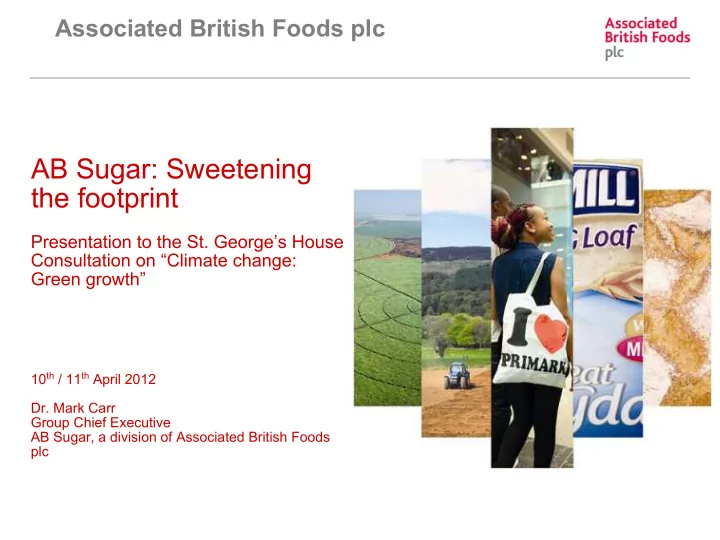
AB Sugar: Sweetening the footprint

Presentation to the St. George’s House Consultation on “Climate change: Green growth”

10th / 11th April 2012

  • Dr. Mark Carr

Group Chief Executive AB Sugar, a division of Associated British Foods plc

Associated British Foods plc

slide-2
SLIDE 2

Associated British Foods is a diversified international food, ingredients and retail group with sales of £11.1 billion and 102,000 employees in 46 countries. The Group operates through five strategic business segments: Sugar; Agriculture; Retail; Grocery; and Ingredients

ABF – a global presence

slide-3
SLIDE 3
  • Twin financial goals:
  • Sustainable real profit growth
  • Long-term cash generation
  • Focus energies on market segments where we can establish strong, sustainable leadership

positions

  • Grow organically and by acquisition in complementary activities
  • Achieve high levels of operating efficiency
  • Operate through a focused divisional structure in which each business:
  • has an influential market position
  • has sufficient scale to attract highest quality management
  • has differentiated features for leveraging added value
  • has potential for sustained revenue and profit growth or cash flow

Corporate objectives

slide-4
SLIDE 4
  • The ABF culture has always been to play a positive role in contributing to the quality of people’

s lives by providing food and clothing in ways that are socially and environmentally responsible

  • Commitment to sustainability is manifest in four overarching business principles which govern

what we do and how we act:

  • managing our environmental impact;
  • taking care of our people;
  • fostering ethical business relationships; and
  • being good neighbours
  • Each business is required to deliver their responsibilities while paying attention to local

circumstances and by being innovative

What Corporate Responsibility means to ABF

slide-5
SLIDE 5

+31% +10%

Change 240 Operating profit £m 1,941 Revenue £m 2011 2010

Sugar

One of the world’s largest sugar producers operating in 10 countries (Europe, Africa, China), employing 42,000 people, with a capacity of ~ 5.5mtpa; current production c. 4.1 – 4.4 mtpa In China, 5 cane sugar mills and 7 beet sugar factories have a capacity to produce 850kt of sugar Africa’s largest sugar producer with agricultural and production operations in 6 countries and annual production capacity of some 1.8mt

Where does sugar fit in ABF?

2,134 315 Our UK beet sugar factories typically produce over 1mt of beet sugar annually. Azucarera in Spain produces approx 400kt of beet sugar each year with a further refining capacity of 400kt

slide-6
SLIDE 6

Green growth: The example of sugar

slide-7
SLIDE 7

Leveraging our advanced manufacturing capabilities in both beet…

British Sugar’s Wissington bio-refinery is the gold standard

slide-8
SLIDE 8

Page The world’s leading sugar business

slide-9
SLIDE 9

Page The world’s leading sugar business

slide-10
SLIDE 10

…leverages our advanced manufacturing capabilities…in beet

Wissington – our integrated biorefinery

Page The world’s leading sugar business

slide-11
SLIDE 11

…and cane…

slide-12
SLIDE 12

…deliver sustainable outcomes… for example in British Sugar through…

Responsible and efficient use of raw materials

  • Reduced energy requirements pt/sugar by 25% since 1990. Export 700,000 MWh of

electricity

  • Carbon Trust certified carbon footprints (0.6 g CO2 per gram of granulated sugar).

Agriculture accounts for around 38% of this. British Sugar has targeted a 10% reduction by 2020

Supporting improvements throughout the supply chain

  • Work with around 4,000 growers on sustainable intensification – jointly investing over £1.8

m p.a. in R&D

  • Since 1982: Pesticide usage reduced by 60%, N by 40% and P by 70%
  • Average beet yields have increased by 60% to an average of 11 tonnes of sugar

per hectare

Co-product development

  • First UK bioethanol plant (70 m litres) – GHG lifecycle savings of 70% relative to petrol

Energy consumption GJ%WE Relative Yield Increase 1986-2011

slide-13
SLIDE 13

…for example in our African operations through…

Focus on renewables

  • Bagasse (fibrous residue left after sugar extraction) used as boiler fuel at all Illovo’s sugar factories
  • Invested in cane trash handling to enable use of 33,000 tonnes of additional biomass feedstock in Swaziland and

Malawi

  • 89% of Illovo’s energy requirements is now produced from renewable sources
  • Produces a range of downstream co-products including furfural, ethanol and lactulose.

Social Investment

  • Illovo is a long-term partner in the communities in which it operates with a well-developed social investment

programme e.g.

  • Access to health care to all employees and their dependents through network of 24 primary health care

clinics and 4 hospitals

  • 27 schools in 5 countries benefit from direct support
slide-14
SLIDE 14

Sustainability – part of the bigger picture

The Ubombo case study

  • Everything But Arms agreement (2001) allowed duty-

free imports of raw sugar to the EU from the Least Developed Countries from 1 October 2009

  • The EU identified that many LDCs lacked the

infrastructure to let them seize these new trading

  • pportunities
  • EU invested in the Lubovane dam and canal system,

linked to the Lower Usuthu Smallholder Irrigation Project to enable agricultural development

  • In tandem, we worked closely with local farmers to

grow cane and expand the Ubombo sugar factory’s capacity by 100kt to over 300kt

  • This investment included new boilers, which produce

more power from biomass, and is planned to feed 55 GWh to Swaziland’s national grid each year. The combination of the Lower Usuthu Smallholder Irrigation Project and the Ubombo factory expansion has already created 1,500 jobs and is expected to provide economic benefits to 28,000 people

slide-15
SLIDE 15

Thank you