A1 A2 A3 A4 A6 C1 C2 C3 C5 Effect of electron precipitation - - PowerPoint PPT Presentation

a1 a2 a3 a4 a6 c1 c2 c3 c5
SMART_READER_LITE
LIVE PREVIEW

A1 A2 A3 A4 A6 C1 C2 C3 C5 Effect of electron precipitation - - PowerPoint PPT Presentation

A1 A2 A3 A4 A6 C1 C2 C3 C5 Effect of electron precipitation on Winter time surface temperature and North Atlantic oscillation 30-100 keV D1 vs. NAO 100-300 keV D2 vs. NAO Correlation Range of between D1 temperature and variation


slide-1
SLIDE 1

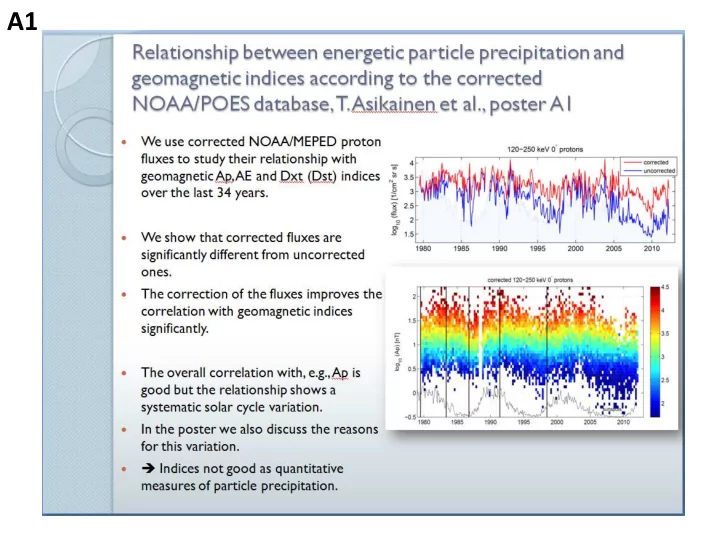
A1

slide-2
SLIDE 2

A2

slide-3
SLIDE 3

A3

slide-4
SLIDE 4

A4

slide-5
SLIDE 5

A6

slide-6
SLIDE 6
slide-7
SLIDE 7

C1

slide-8
SLIDE 8

C2

slide-9
SLIDE 9

C3

slide-10
SLIDE 10

Effect of electron precipitation on Winter time surface temperature and North Atlantic oscillation

30-100 keV 100-300 keV D1 vs. NAO D2 vs. NAO

Correlation between D1 and temperature Correlation between D2 and temperature Range of temperature variation caused by D2 Range of temperature variation caused by D1

C5

slide-11
SLIDE 11

C6

slide-12
SLIDE 12

Projection of the 11-yr solar cycle signal on internal modes of the tropical Pacific decadal variability Stergios Misios and Hauke Schmidt Observations Ensemble simulations with MAECHAM5/MPIOM

  • In observations there is a Tropical Pacific Quasi-Decadal Oscillation (TPQDO).
  • We simulate a similar Tropical Pacific Quasi-Decadal Oscillation that synchronizes

with the solar cycle forcing (decadal predictability?).

  • Come to the poster for the mechanism…

C7

slide-13
SLIDE 13

Question: What (if any) are solar cycle signals in SST and SLP in Pacific – taking account of climate change ?

  • 1. SLP: solar signal using SSN peak year compositing

Solar cycle signals in the Pacific and the issue of timings

  • Signal S. Pacific (v.L. and Meehl (2011)) sensitive to years chosen for composites.
  • Signal in N. Pacific, near Aleutian Low is strong, independent of choices of years.

Indrani Roy1 and Joanna D. Haigh, Imperial College London

1Current : University of Exeter, UK

  • 2. Solar signal in SST: the issue of timings

Solar cycle signals in the Pacific and the issue of timings

  • No consistent ENSO-like variation in tropical SSTs following peak yrs of sunspot cycle.
  • 9 cycles cold at peak SSN year, 4 remain cold for the following two years and 5 warm.
  • ‘Lagged warm response’ occurs during 5 of 14 cycles, when ENSO activity higher.

Solar cycle signals in the Pacific and the issue of timings

  • Marked overall association of higher solar activity with colder temperatures

in E. tropical Pacific; weakened during 1950s – 1997 (left)

  • SLP signal in N. Pacific weaker during latter period (right).
  • During 1958-1997, solar effect was masked by more dominant ENSO.
  • 3. Solar signal in SLP and “climate change”

1856-1957 Regression Scatter Plot 1958-1997

C8

slide-14
SLIDE 14

On the Controversy of Extreme Solar Particle Event Signatures in Arctic Ice Cores: Sun to Ice?

Harlan E. Spence (University of New Hampshire) and the NSF-funded “Sun-to-Ice” Science team, with special “HEPPA” thanks to J. Dibb, C. Jackman, K. Duderstadt, D. Marsh, C. Randall, and S. Solomon

  • Over past two decades, space science and glaciochemistry communities presented conflicting

arguments over whether SEPs can/do produce nitrate signatures in polar ice cores

  • Debate over SEP-source has sharpened in last five years
  • Better articulation of issues and broader data sets have begun to resolve elements of controversy
  • Controversy still remains about if any and how SEPs can produce any nitrate signal
  • Regardless, latest Wolff result demonstrates that (even if SEP-related) spikes could not likely be

used to create a meaningful statistical history because of low reproducibility of nitrate signature in multiple cores

  • Sun-to-Ice Project is a multipronged effort to resolve remaining questions with respect to nitrates
  • Combination of data mining, broader data sets, revisiting techniques and dating, and new

experimental studies

  • Hope to resolve remaining controversies in next few years
  • Will also address many other science topics, including HEPPA effects, too!!

C9

slide-15
SLIDE 15

C10