snow/rain timing, storm frequency and intensity, land management) to - - PowerPoint PPT Presentation

snow rain timing storm frequency and intensity land
SMART_READER_LITE
LIVE PREVIEW

snow/rain timing, storm frequency and intensity, land management) to - - PowerPoint PPT Presentation

Question 1: What is the relative importance of endogenous in- lake processes (e.g. internal loading, ice cover, hydrodynamics) versus exogenous to-lake processes (e.g. land use change, snow/rain timing, storm frequency and intensity, land


slide-1
SLIDE 1

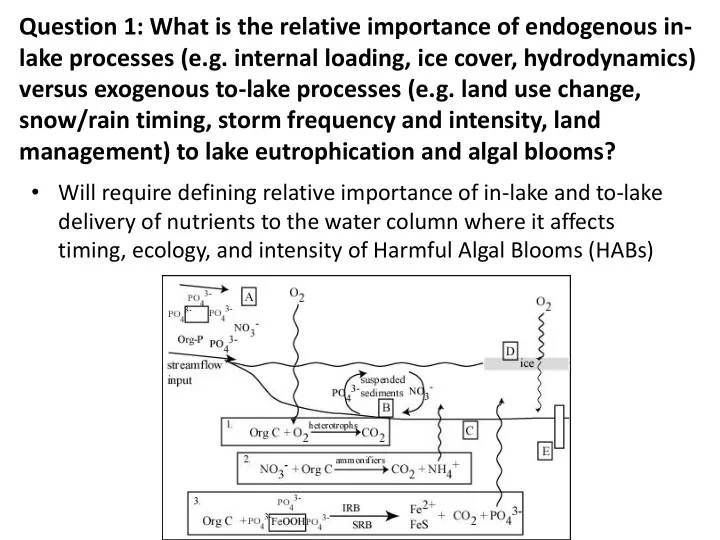
Question 1: What is the relative importance of endogenous in- lake processes (e.g. internal loading, ice cover, hydrodynamics) versus exogenous to-lake processes (e.g. land use change, snow/rain timing, storm frequency and intensity, land management) to lake eutrophication and algal blooms?

  • Will require defining relative importance of in-lake and to-lake

delivery of nutrients to the water column where it affects timing, ecology, and intensity of Harmful Algal Blooms (HABs)

slide-2
SLIDE 2

H1: Watershed land use and stream bank morphology determine sediment load and P- N speciation sensitive to timing, frequency, and intensity of rain-snow events.

  • Q1: What is the relative contribution of

sediment, P, and N from watersheds of varying landuse as a function of precipitation form (i.e. rain, snow, rain-

  • n-snow), intensity and duration?
  • Q2: How do land use and soils interact to

affect the distribution and availability of P and N species in space and time?

  • Q3: What are the temporal and spatial

dynamics of stream bank failures, and what is their relative contribution to catchment sediment and nutrient budgets?

  • Q4: What are the dynamics of sediment

transport and N and P transformations along the river continuum to lowland floodplains to lake inlet?

slide-3
SLIDE 3
  • Identify a set of 12 catchments within the

Winooski and Missisquoi watersheds, and a set of specific plots within subbasins, representing primarily forested, agricultural or urban land cover to develop water, sediment and nutrient budgets that can be scaled to comparable catchments across the watersheds.

  • Sample during spring snowmelt and during rain

events - collect overland flow and stream samples, collect soil samples

H1: Watershed land use and stream bank morphology determine sediment load and P- N speciation sensitive to timing, frequency, and intensity of rain-snow events.

slide-4
SLIDE 4

Analytical – Collected samples

  • Latchat-colorimetry: Total phosphorus (TP), total dissolved

phosphorus (TDP), soluble reactive phosphorus (SRP), total nitrogen (TN), total dissolved nitrogen (TDN), nitrate (NO3

  • ),

ammonium (NH4

+), and total suspended solids (TSS). Johnson

State

– Estimated 1000 samples per year for each parameter – protocols to be managed by Bob Gentry in coordination with Greg, Breck, and Mary

  • Coordinate for replicate samples for more detailed organic

phosphorus and nitrogen speciation in sediments and waters. UVM

– 31P NMR at Chemistry facility – Org. P speciation in detail – Enzyme digest colorimetry with plate reader at Rube lab – Org. P speciation, high throughput, detail correlated with NMR results – HPLC at Rube lab – organic N speciation

  • Total and reactive P, Fe, Mn, Ca, Al on sediment samples. UVM

– Ross Lab ICP-OES

– Estimated 500 samples per year for each parameter ($7500-10,000)
slide-5
SLIDE 5
  • Reconstruct channel change history to quantify lateral

migration, gravel bar formation and migration, and lateral channel change relative to storm intensity

  • Use regional hydraulic geometry curves and stream

bank soil nutrient sampling to estimate the sediment, N, and P mobilized by bank failures

  • Conduct field-based studies of bank geophysical

properties to characterize soil strength at historically stable and unstable river reaches within catchments to develop a physically-based bank stability model.

H1: Watershed land use and stream bank morphology determine sediment load and P- N speciation sensitive to timing, frequency, and intensity of rain-snow events.

slide-6
SLIDE 6

H2: Sediment and nutrient delivered from the watershed is redistributed across a basin through a combination of specific hydrodynamic processes affected by input rates, weather events, and basin physical characteristics

  • Q1: What is the small scale current

and wave perturbation activity over time as it relates to redox conditions at the sediment-water interface and nutrient speciation and flux between sediments and the water column?

  • Q2: How do the Missisquoi Bay and

Winooski Bay currents and internal seiche distribute sediments and nutrients once they exit the rivers and enter the receiving bays?

  • Q3: How does the bathymetry and

channel morphology of Missisuoi Bay affect sediment and nutrient transport between the bay and the Inland Sea/Main Lake?

slide-7
SLIDE 7

Lake sensors, hydrologic

  • Deployed at main site, operating in concert with

chemical sensor network and sampling

– Acoustic doppler to measure bottom current (pointed towards SWI), measure mid column current (pointed up), and surface current (?) – Thermistor strings to measure T profile, internal seiche – Pressure sensors to measure wave activity – In-situ particle sizing in the water column to measure sediment delivery dynamics

slide-8
SLIDE 8

H3: P and N speciation and association with sediment and the water column at different times affect the bioavailability of nutrients that controls the initiation, propagation, sustenance, and senescence of a Harmful Algal Bloom

  • Q1: What are the physicochemical

controls triggering a HAB?

  • Q2: Does a positive-feedback loop exist

between HABs and sediment-bound nutrients and if so, what conditions start and stop this process?

  • Q3: Do controlling physicochemical

parameters affect the flux of different nutrient P-N species differently?

  • Q4:Are different nutrient P-N species

differentially bioavailable in a way that may affect HAB ecology?

slide-9
SLIDE 9
  • Instrumentation of lake water column and sediment water

interface at main site to determine, in situ, redox, temperature, pH, light levels over time controlling fluxes of P and N species

  • High-density sampling of sediment and water column over

time at main site to determine detailed P-N speciation

  • High-density sampling of HAB populations across the water

column

  • Modeling of parameters and HABs to determine

predominant sets of physicochemical factors controlling HABs; development of models to describe nutrient cycling and speciation links to HAB ecology

  • Controlled hypothesis testing with mesocosm experiments

H3: P and N speciation and association with sediment and the water column at different times affect the bioavailability of nutrients that controls the initiation, propagation, sustenance, and senescence of a Harmful Algal Bloom

slide-10
SLIDE 10

Lake Sensors, chemical

  • Donation from YSI of profiler buoy system, we

have refurbished this, purchase of sonde and sensor array next. This will be able to profile, via a winch system, the water column automatically. Couple with iSCO sampler array to automate water column sampling, met station for wind, temp monitoring

  • Sediment-water

interface redox monitoring with deployed AIS datalogger for ORP, pH, T, PAR, ISE

slide-11
SLIDE 11

H4: Food web structure mediates the impacts of nutrient loading and environmental conditions on HABs.

  • Q1: What does a food web that is resilient to

HABs look like? What is (are) the mechanism(s) linking food web structure to HABs? Are species-level responses more important than biomass-level responses in how trophic cascades impact HABs?

  • Q2: What is the role/interplay between

traditional food webs (fish-zoo-phyto) and microbial food webs (ciliates-flagellates- bacteria) in determining HAB formation, and how do these change across N/P ratios?

  • Q3: Does phenology of food web structure

across seasons play a role in HAB dynamics?

  • Q4: How do invasive species (e.g., alewife,

white perch, zebra mussels) short circuit trophic

slide-12
SLIDE 12

– Sampling and determination of microbes, phytoplankton, zooplankton, benthos, and fish concurrent with HAB and nutrient sampling (H3) – Sampling and determination of microbes, phytoplankton, zooplankton, benthos, and fish concurrent with overwinter monitoring (H5) – Conduct food web experiments to link traditional- microbial food webs – Use modeling to examine how data describing both eutrophication and HAB community composition with time is related to food web structure

H4: Food web structure mediates the impacts of nutrient loading and environmental conditions on HABs.

slide-13
SLIDE 13

H5: Ice cover affects the chemical, physical, biological conditions

  • f the system controlling HAB development in summer.

Q1: How does overwintering affect cyanobacterial species distribution and selection in summer blooms? Q2: How does ice control oxygen supply and redox conditions in sediment to affect the distribution of N-P species after thaw?

slide-14
SLIDE 14

– Deployment of hydrology and geochemistry sensor arrays under ice for monitoring conditions through ice-over and thaw. – Periodic sampling of water column to determine nutrient speciation in water column – Periodic sampling of sediment to determine how ice-

  • ver conditions affect the distribution and speciation
  • f P and N near the SWI

– Development of a model describing O2 diffusion through ice and subsequent reducing conditions at SWI – Periodic sampling of cyanobacteria in water column and sediment surface

H5: Ice cover affects the chemical, physical, biological conditions

  • f the system controlling HAB development in summer.
slide-15
SLIDE 15

Year 1 Year 2 Year 3 Year 4 Year 5 Missisquoi watershed land use-sediment- nutrient delivery X X X Winooski watershed land use-sediment- nutrient delivery X X Hydrodynamics in Missisquoi Bay X X X Sediment transport in Missisquoi Bay X X X Hydrodynamics and sediment delivery – Winooski delta X X Sampling for fish, zooplankton in Missisquoi Bay X X X Assessing redox chemistry, T, light, pH on Missisquoi nutrient cycling and HABs X X X Overwinter redox chemistry and nutrient mobility X X Modeling of nutrient – HAB links to identify key triggering parameters X X