WASHINGTON SUBURBAN SANITARY COMMISSION COMMISSION SUMMARY AGENDA - - PDF document

washington suburban sanitary commission commission summary
SMART_READER_LITE
LIVE PREVIEW

WASHINGTON SUBURBAN SANITARY COMMISSION COMMISSION SUMMARY AGENDA - - PDF document

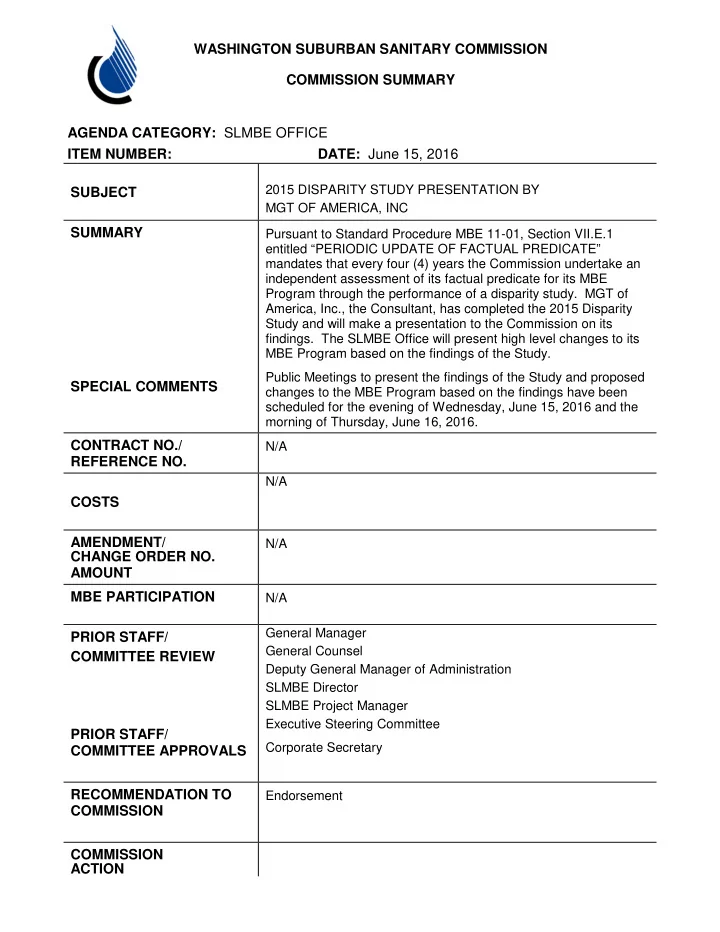
WASHINGTON SUBURBAN SANITARY COMMISSION COMMISSION SUMMARY AGENDA CATEGORY: SLMBE OFFICE ITEM NUMBER: DATE: June 15, 2016 2015 DISPARITY STUDY PRESENTATION BY SUBJECT MGT OF AMERICA, INC SUMMARY Pursuant to Standard Procedure MBE 11-01,


slide-1
SLIDE 1

WASHINGTON SUBURBAN SANITARY COMMISSION COMMISSION SUMMARY AGENDA CATEGORY: SLMBE OFFICE ITEM NUMBER: DATE: June 15, 2016 SUBJECT

2015 DISPARITY STUDY PRESENTATION BY MGT OF AMERICA, INC

SUMMARY SPECIAL COMMENTS

Pursuant to Standard Procedure MBE 11-01, Section VII.E.1 entitled “PERIODIC UPDATE OF FACTUAL PREDICATE” mandates that every four (4) years the Commission undertake an independent assessment of its factual predicate for its MBE Program through the performance of a disparity study. MGT of America, Inc., the Consultant, has completed the 2015 Disparity Study and will make a presentation to the Commission on its

  • findings. The SLMBE Office will present high level changes to its

MBE Program based on the findings of the Study. Public Meetings to present the findings of the Study and proposed changes to the MBE Program based on the findings have been scheduled for the evening of Wednesday, June 15, 2016 and the morning of Thursday, June 16, 2016.

CONTRACT NO./ REFERENCE NO.

N/A

COSTS

N/A

AMENDMENT/ CHANGE ORDER NO. AMOUNT

N/A

MBE PARTICIPATION

N/A

PRIOR STAFF/ COMMITTEE REVIEW PRIOR STAFF/ COMMITTEE APPROVALS

General Manager General Counsel Deputy General Manager of Administration SLMBE Director SLMBE Project Manager Executive Steering Committee Corporate Secretary

RECOMMENDATION TO COMMISSION

Endorsement

COMMISSION ACTION

slide-2
SLIDE 2
slide-3
SLIDE 3
slide-4
SLIDE 4

2

Introduction by Towanda R. Livingston Director, SLMBE Office Wednesday, June 15, 2016

Small, Local and Minority Business Enterprise (SLMBE) Programs

slide-5
SLIDE 5

3

  • Minority Business Enterprise (MBE)
  • Designed to promote greater availability, capacity development and

contract participation for Minority and Women-Owned Business Enterprise (M/WBE) firms (Sections 20-203 through 20-208 of the

Public Utilities Article, Md. Code Ann.).

  • Small Local Business Enterprise (SLBE)
  • Designed to encourage the utilization of small local firms located in

Prince George’s County and Montgomery County. The SLBE Program is a race-and-gender neutral program (Sections 20-301 through 20- 304 of the Public Utilities Article, Md. Code Ann.).

The SLMBE Programs

slide-6
SLIDE 6

The Four Pillars of Excellence - Paving the Road to Supplier Diversity

Supplier Advocacy Compliance Extensive Outreach

Supplier Development

Mission and Strategy

The SLMBE Office is dedicated to creating an inclusive purchasing environment while building sustainable relationships; expanding

  • pportunities; and cultivating the growth of small, local and minority

business enterprises which adds value to the Commission and the community we serve.

slide-7
SLIDE 7

5

  • WSSC 2010 Disparity Study- Completed 12/31/10
  • New MBE Program (SP MBE 11-01) - Effective 5/1/11
  • New SLBE Program (SP SLBE 12-01) - Effective 8/26/11
  • Re-authorization of the MBE Program - Effective 7/1/12
  • New Web-Based Compliance System – Launched

10/30/12

  • Kick-off for the 2015 Disparity Study – 3/18/15

Evolution of the SLMBE Programs

slide-8
SLIDE 8

6

Performance Fiscal Year-To-Date (FYTD)

Since FY 2011 through May 2016 FYTD, WSSC contract payments to SLBE firms were $87,295,546.00; and WSSC contract awards to SLBE firms were $260,380,316.00.

Fiscal Year M/WBE Contract Awards MBE % of Total Contract Awards M/WBE Contract Payments MBE % of Total Contract Payments 2011 133,211,249.00 $ 31% 66,853,578.00 $ 27% 2012 129,037,973.00 $ 18% 102,281,071.00 $ 28% 2013 186,250,875.00 $ 25% 92,133,148.00 $ 20% 2014 228,579,268.00 $ 23% 99,965,604.00 $ 20% 2015 187,869,377.00 $ 28% 134,409,006.00 $ 25% May 2016 YTD 114,853,280.00 $ 24% 108,638,105.00 $ 20%

Total 979,802,022.00 $ 604,280,512.00 $

slide-9
SLIDE 9

The Disparity Study was conducted to establish a “Factual Predicate” for the continuation of the MBE Program that is:

  • Legally Sufficient
  • Narrowly Tailored
  • Relevant

7

Why A Disparity Study?

slide-10
SLIDE 10

8

Introducing

slide-11
SLIDE 11

9

Current State To Future State of SLMBE Programs’ Preferences

slide-12
SLIDE 12
  • Endorse the 2015 Disparity Study
  • Approve the revised MBE and SLBE Program policies - FY

2017

  • Approve the MBE Program Legislation for the 2017

Legislative Session - FY 2017

  • Advocate for the reauthorization of MBE Program/Statute
  • (Current Statute expires July 1, 2017)

10

Your Continuous Support is Paramount…Road Ahead

slide-13
SLIDE 13

11

A Special Thank You!

slide-14
SLIDE 14

WASHINGTON SUBURBAN SANITARY COMMISSION

2015 Disparity Study Report June 15, 2016

slide-15
SLIDE 15

 MGT of America

− Executive Vice President/Technical Advisor Dr. Fred Seamon − Executive-in-Charge (EIC) Reggie Smith − Project Director Vernetta Mitchell − Technical Advisor Dr. Vince Eagan, J.D., Ph.D. − Data Manager Marilyn Wiley, Ph.D., ABD

 MGT’s Subconsultants

− McMillon Communications, Inc. Doris McMillon (MBE, Ft. Washington, MD) − Transformation Consultants Lee Brazzell (MBE, Richmond, VA) − Oppenheim Research Anneliese Oppenheim (WBE, Tallahassee, FL)

2

slide-16
SLIDE 16

3

1.

The primary objective is to assess, quantify, and evaluate the prevalence, magnitude, and extent of marketplace discrimination, if any, against minority-and women-business enterprises (M/WBE).

2.

The Study is necessitated in part by the 1989 U.S. Supreme Court’s decision in the case of J.A. Croson v. City of Richmond for M/WBE Programs that imposed legal requirements on jurisdictions to establish a “compelling interest” to support the establishment or continuation of a M/WBE Programs.

slide-17
SLIDE 17

4

  • Must show a compelling interest with factual

predicate evidence.

  • Remedy must be narrowly-tailored.

Strict Scrutiny

  • Recommendations linked to findings.
  • Goals linked to availability.
  • Limit burden on 3rd parties.

Narrow-Tailoring

  • Private sector disparities linked to public sector can

provide a compelling interest.

Passive Participant

slide-18
SLIDE 18

5

slide-19
SLIDE 19

1.

Determine whether the WSSC, either in the past or currently, engages in discriminatory practices in the solicitation and award of contracts in Construction, Architecture and Engineering, Professional Services, and Goods and General Services to minority- and women-owned business enterprises (M/WBEs).

2.

Determine if a legally justified need exists for the establishment of an M/WBE program in accordance with the guidelines set forth by the Supreme Court and relevant subsequent cases.

6

slide-20
SLIDE 20

7

Established Legal Framework

 Reviewed legal

framework for disparity studies, particularly in the 4th Circuit. Assessed & Collected Data

 Assessed the

availability of WSSC’s prime and subcontractor study- related data.

 Collected all available

data, included Procurement Cards Determined Relevant Geographic Market

 Analyzed expenditure

data to determine WSSC’s Relevant Market Area.

slide-21
SLIDE 21

8

Conducted Availability Analysis

 Identified the

percentage of firms who:

  • Conducted business

with WSSC,

  • Were interested in

doing business, and/or

  • Could potentially do

business with WSSC.

Conducted Utilization Analysis

 Calculated the

percentage of M/WBE utilization based on dollars paid to M/WBE firms in the WSSC Relevant Market Area. Calculated Disparity

 Used the percentage

  • f availability and

percentage of utilization to calculate disparity for M/WBE and non-M/WBE firms.

slide-22
SLIDE 22

9

Collected Anecdotal Evidence

 Anecdotal evidence

included:

  • Stakeholder

Interviews

  • Focus Groups
  • Surveys
  • Community Meetings

Conducted Private Sector Analysis

 Analyzed the

presence (or absence)

  • f passive

discrimination. Provided Findings & Recommendations

 Provided conclusions

drawn from the study.

 Provided narrowly-

tailored remedies.

slide-23
SLIDE 23

1.

Study Period July 1, 2009 through June 30, 2014

2.

Procurement Categories

− Architecture and Engineering − Construction − Professional Services − Goods and General Services

3.

Utilization analyses based on expenditures or dollars paid to firms.

10

slide-24
SLIDE 24

 M/WBE Groups

− African American − Asian American − Hispanic American − Native American − Nonminority Women

 Statistical Significance – the likelihood that a result or relationship is caused by

something other than mere random chance. Statistical hypothesis testing is traditionally employed to determine if a result is statistically significant or not. This provides a "p-value" representing the probability that random chance could explain the result. In general, a 5% or lower p-value is considered to be statistically significant.

11

slide-25
SLIDE 25

 Disparity Index – the ratio of the percentage of business utilization and

percentage of business availability for a particular demographic group times 100.

 Underutilization – term used to indicate that there is disparity and the

disparity index is less than 100.

 Overutilization – term used to indicate that there is no disparity and the

disparity index is greater than 100.

 Total utilization – the combined utilization of primes and subcontractors.

12

slide-26
SLIDE 26

1.

Washington-Arlington-Alexandria, DC-VA-MD-WV Metropolitan Statistical Area (MSA) plus Anne Arundel County, MD; Baltimore County, MD; Carroll County, MD; City of Baltimore, MD; and Howard County, MD.

2.

Spending with all firms located inside the WSSC Relevant Market Area totaled $1.2 billion.

13

slide-27
SLIDE 27

14

Study period July 1, 2009 – June 30, 2014

slide-28
SLIDE 28

Architecture & Engineering:

  • Prime

− M/WBE primes received $18.57 million or 7.77 percent of $239.08 million. (Ch. 4,

  • Fig. 4B)

− Statistical significant disparity for all M/WBE firms. (Ch. 4, Tab. 4-6)

  • Total

− M/WBE primes and subcontractors received $79.88 million or 33.40 percent of

the total dollars spent in Architecture and Engineering. (Ch. 5, Fig. 5A)

− Statistical significant disparity for all M/WBE firms. (Ch. 5, Tab. 5-5)

15

Study period July 1, 2009 – June 30, 2014

slide-29
SLIDE 29

16

No prime utilization for Hispanic and Native American firms.

Prime

Total

No utilization for Native American firms.

slide-30
SLIDE 30

Construction:

  • Prime

− M/WBEs primes received $91.17 million or 16.84 percent of $541.55 million. (Ch. 4, Fig. 4C) − Statistical significant disparity for all M/WBE firms except Hispanic Americans. (Ch. 4, Tab. 4-7)

  • Total

− M/WBE primes and subcontractors received $198.52 million or 36.66 percent of

the total dollars spent in Construction. (Ch. 5, Fig. 5B)

− Statistical significant disparity for all M/WBE firms except Hispanic American

  • firms. (Ch. 5, Tab. 5-6)

17

Study period July 1, 2009 – June 30, 2014

slide-31
SLIDE 31

18

Prime

No prime utilization for Asian, and Native American firms.

Total

Native American utilization $660,555 or 0.12%

slide-32
SLIDE 32

Professional Services:

  • Prime

− M/WBE primes received $22.92 million or 22.54 percent of $101.73 million. (Ch. 4,

  • Fig. 4D)

− Statistical significant disparity for all M/WBE firms except Hispanic Americans. (Ch.

4, Tab. 4-8)

  • Total

− M/WBEs primes and subcontractors received $34.55 million or 33.96 percent of

the total dollars spent in Professional Services. (Ch. 5, Fig. 5C)

− Statistical significant disparity for all M/WBE firms except Hispanic Americans. (Ch. 5,

  • Tab. 5-7)

19

Study period July 1, 2009 – June 30, 2014

slide-33
SLIDE 33

20

Prime

No prime utilization for Native American firms.

Total

No utilization for Native American firms.

slide-34
SLIDE 34

Goods & General Services:

  • Prime

− M/WBE primes received $164.49 million or 47.86 percent of $343.69 million. (Ch. 4, Fig. 4E) − Statistical significant disparity African American, Hispanic American, and Native American firms. There was

disparity for minority firms as a whole. (Ch. 4, Tab. 4-9)

− No disparity for Asian American and Nonminority Women firms, and no disparity for the M/WBE group as

a whole. (Ch. 4, Tab. 4-9)

  • Total

− M/WBEs primes and subcontractors received $217.42 million or 63.26 percent of the total dollars spent in

Goods and Services. (Ch. 5, Fig. 5D)

− Statistical significant disparity African American, Hispanic American, and Native American firms. There was

disparity for minority firms as a whole. (Ch. 5, Tab. 5-8)

− No disparity for Asian American and Nonminority Women firms, and no disparity for the M/WBE group as

a whole. (Ch. 5, Tab. 5-8)

21

Study period July 1, 2009 – June 30, 2014

slide-35
SLIDE 35

22

Prime

Native American utilization $25,750 or 0.01%

Total

Native American utilization $224,187 or 0.07%

slide-36
SLIDE 36

 The biggest concern for prime contractors was competing with larger firms

(58 or 21.7% of M/WBEs).

 M/WBE subcontractors stated their biggest barrier working with primes on

WSSC projects is competing with large firms (35 or 13.1% of M/WBEs).

 With respect to disparate treatment, M/WBE subcontractor respondents

reported:

− Seldom or never solicit firms on projects (private or public) without M/WBE goals – 28.1 percent or 75 respondents. − An informal network precluded their firms from obtaining work in the private sector – 26.2 percent or 70 respondents − Selected to satisfy good faith efforts requirements and then dropped on other public sector/private sector projects – 13.5 percent or 36 respondents.

23

slide-37
SLIDE 37

 Requires the reporting of MBE and SLBE utilization.  Validates M/WBE subcontractor utilization through the use of compliance

reporting tools.

 Produces comprehensive annual legislative reports on MBE and SLBE

utilization and the activities of the WSSC Small Local and Minority Business Enterprise (SLMBE) office.

 Accepts certifications from other organizations

24

slide-38
SLIDE 38

 Establish Two-Tier Size Standards.

− Contracts can be set aside for small and very small firms and goals that included very large SLBEs and M/WBEs can be established on large projects. A standard approach is to use the SBA size standard for small firms and a percentage of the SBA size standard (e.g., 25 or 50 percent) for very small firms.

 Improve prime contractor compliance with entering non-M/WBE subcontractor

data in WSSC’s web-based compliance system.

 Update the WSSC’s supplier registration system data, at minimum, every two

years.

25

slide-39
SLIDE 39

26

MGT of America, Inc. 3800 Esplanade Way, Suite 210 Tallahassee, Florida 32311 850.386.3191 www.mgtamer.com

slide-40
SLIDE 40

DRAFT

Executive Summary

WSSC 2015 Disparity Study

slide-41
SLIDE 41

WASHINGTON SUBURBAN SANITARY COMMISSION DRAFT Report | June 2, 2016 P A G E ES-1

EXECUTIVE SUMMARY

  • 1. STUDY OVERVIEW

STUDY TEAM

In April 2015, the Washington Suburban Sanitary Commission (WSSC) contracted with MGT of America, Inc. (MGT) to conduct a Disparity

  • Study. MGT subcontracted with:

McMillon Communications, Inc., based in the Washington, D.C. Metropolitan area developed and implemented the Community Outreach Plan tailored to inform the business community about WSSC’s Disparity Study, coordinated and managed the focus groups, and conducted in-depth interviews with area business owners.

Transformation Consultants, a Richmond, VA-based firm coordinated and managed the public meetings, and conducted data verification of area firms.

Oppenheim Research, a Tallahassee, FL-based firm conducted the survey of vendors and conducted the custom census surveys.

STUDY OBJECTIVES

The objectives of this study were:

Determine whether the WSSC, either in the past or currently, engages in discriminatory practices in the solicitation and award of contracts in Construction, Architecture and Engineering, Professional Service, and Goods and General Services to minority- and women-owned business enterprises (M/WBEs).

Determine if a legally justified basis exists for the establishment of an M/WBE program in accordance with the guidelines set forth by the Supreme Court and relevant subsequent cases.

STUDY DEFINITIONS

Study Period. MGT analyzed expenditures between July 1, 2009, and June 30, 2014. Procurement Categories. MGT analyzed Construction, Architecture and Engineering, Professional Services, and Goods and General Services expenditures. ETHNIC GENDER GROUPS

African Americans: an individual having origins in any of the black racial groups of Africa.

American Indians/Native Americans: an individual having origins in any of the original peoples

  • f North America and who is a documented member of a North American tribe, band, or

CHAPTER SECTIONS

  • 1. Study Overview
  • 2. Methodology
  • 3. Important Findings
  • 4. Commendations and

Recommendations

slide-42
SLIDE 42

EXECUTIVE SUMMARY

WASHINGTON SUBURBAN SANITARY COMMISSION DRAFT Report | June 2, 2016 P A G E ES-2

  • therwise has a special relationship with the United States or a state through treaty, agreement,
  • r some other form of recognition. This includes an individual who claims to be an American

Indian/Native American and who is regarded as such by the American Indian/Native American community of which the individual claims to be a part, but does not include an individual of Eskimo or Aleutian origin.

Asian Americans: an individual having origins in the Far East, Southeast Asia, or the Indian subcontinent, and who is regarded as such by the community of which the person claims to be a part.

Hispanic Americans: an individual of Mexican, Puerto Rican, Cuban, Central or South American,

  • r other Spanish culture or origin, regardless of race, and who is regarded as such by the

community of which the person claims to be a part. Hispanics of African ancestry are not counted among the African American group.

Nonminority Woman (Female): a woman, regardless of race or ethnicity, unless she is also a member of an ethnic or racial minority group and elects that category in lieu of the gender category.

Non-M/WBE Firms. Firms that were identified as nonminority male or majority-owned were classified as non-M/WBE firms. If there was no indication of business ownership, these firms were also classified as non-M/WBE firms. RELEVANT MARKET

Most WSSC contract payments were made to firms located in the following cities and counties in Maryland, Virginia, West Virginia, and the District of Columbia: Anne Arundel, MD

Anne Arundel, MD City of Fredericksburg, VA, Howard County, MD Arlington County, VA City of Manassas, VA Jefferson County, WV Baltimore County, MD Clarke County, VA Loudoun County, VA Calvert County, MD District of Columbia, DC, Montgomery County, MD Carroll County, MD Fairfax County, VA Prince George's County, MD Charles County, VA Fauquier County, VA Prince William County, VA City of Baltimore, MD City of Fredericksburg, VA Spotsylvania County, VA City of Fairfax, VA City of Manassas Park, VA Stafford County, VA City of Falls Church, VA Fredrick County, VA Warren County, VA

STUDY DATA The study used the following sources:

  • 1. MAPS – WSSC’s financial account system that stores vendor payment information.
  • 2. PRISM – a secure, web-based portal that tracks WSSC’s spend with subcontractors working with

primes on WSSC projects.

  • 3. CBR – Centralized Bidder Registration is a mandatory web-based system where all prospective

bidders, contractors, vendors, and subcontractors that provide the goods and services procured by WSSC must register.

slide-43
SLIDE 43

EXECUTIVE SUMMARY

WASHINGTON SUBURBAN SANITARY COMMISSION DRAFT Report | June 2, 2016 P A G E ES-3

  • 4. SLMBE Approval/Certification Database – the listing of MBE-certified firms and WSSC approved

small local business enterprises (SLBEs). Thus, electronic data on awards and payment transactions at the prime level were extracted from MAPS, and subcontractor payment data was extracted from PRISM. In terms of WSSC vendor data, electronic data was extracted from CBR and MAPS. Custom census, used as a source for subcontractor availability, involves using Dun & Bradstreet as a source of business availability. A short survey is conducted on a random sample of firms supplied by Dun & Bradstreet, asking ethnic and gender status, had they bid or considered bidding on projects by the WSSC, had they bid or considered bidding as a prime contractor, subcontractor, or both, and had they worked as a prime contractor, subcontractor, or both.

  • 2. METHODOLOGY

The study is driven by the following research questions: These research questions are embedded in relevant chapters throughout this report.

1. Is there factual predicate evidence to support a race‐ and gender‐conscious M/WBE program for the WSSC? 2. How does case law inform the research methodology in a particular region for a particular client? 3. Are there disparities between the availability and utilization of M/WBE primes and subcontractors? If there are disparities, what are the most relevant causal factors that contribute directly or indirectly to the disparities between the availability and utilization of M/WBE primes and subcontractors? 4. Does the WSSC passively engage in practices that result in disparities? 5. Are there statistically significant disparities in the utilization of M/WBEs by prime contractors

  • n projects where there are no M/WBE goals?

6. Is there qualitative/anecdotal evidence of disparate treatment of M/WBE subcontractors by prime contractors?

RESEARCH QUESTIONS

slide-44
SLIDE 44

EXECUTIVE SUMMARY

WASHINGTON SUBURBAN SANITARY COMMISSION DRAFT Report | June 2, 2016 P A G E ES-4

STUDY TASKS The study work plan consisted of, but was not limited to, the following major tasks:

Establish data parameters and finalize the work plan.

Conduct a legal review.

Review policies, procedures, and programs.

Conduct market area and utilization analysis.

Determine the availability of qualified firms.

Analyze prime and subcontractor utilization and availability data for disparity.

Conduct a survey of business owners.

Collect and analyze anecdotal information.

Prepare and present draft and final reports for the study. REPORT ORGANIZATION The report consists of the following chapters: CHAPTER 2 LEGAL FRAMEWORK Presents the legal framework and an overview of the controlling legal precedents that impact remedial procurement programs with a particular concentration on the United States Court

  • f Appeals for the Fourth Circuit.

CHAPTER 3 REVIEW OF POLICIES, PROCEDURES, AND PROGRAMS Provides a review of the WSSC’s policies, procedures, M/WBE programs, and race- and gender-neutral efforts. CHAPTER 4 MARKET AREA, AND PRIME UTILIZATION, AVAILABILITY, AND DISPARITY ANALYSES Presents the methodology used to determine the WSSC’s relevant market area and statistical analysis of prime vendor utilization, availability, and disparity by the WSSC for the procurement of Construction, Architectural and Engineering, Professional Services, and Goods and General Services contracts. CHAPTER 5 TOTAL UTILIZATION, AVAILABILITY, AND DISPARITY ANALYSES Presents the methodology used to determine the WSSC’s statistical analysis of total utilization, availability, and disparity by the WSSC for the procurement of Construction, Architectural and Engineering, Professional Services, and Goods and General Services contracts. CHAPTER 6 PRIVATE SECTOR AND NON-GOAL ANALYSES Provides an analysis of the presence of disparity in the private sector and its effect on the ability of firms to win procurement contracts from the WSSC.

slide-45
SLIDE 45

EXECUTIVE SUMMARY

WASHINGTON SUBURBAN SANITARY COMMISSION DRAFT Report | June 2, 2016 P A G E ES-5

CHAPTER 7 ANECDOTAL ANALYSIS Presents an analysis of anecdotal data collected from the survey of business owners, personal interviews, focus groups, and public meetings. CHAPTER 8 FINDINGS AND RECOMMENDATIONS A summary of the findings and recommendations based upon the analyses presented in the report chapters. APPENDICES Additional analyses, documents used to conduct the study, and back up documentation. The report is accompanied by Appendices with supporting details: Appendix A Detailed Market Area Analyses Appendix B Detailed Prime Disparity Indices Appendix C Detailed Prime Utilization Analyses by Based on Expenditures Appendix D Prime Utilization Analyses Based on Contract Awards Appendix E Detailed Total Utilization Analyses Appendix F Detailed Total Disparity Indices Appendix G Public Use Microdata Sample (PUMS) Regression Appendix H Survey of Vendors Instrument Appendix I Survey of Vendors Results Appendix J In-depth Interview Guide Appendix K Survey of Vendor Regression Appendix L Standard Deviation Tests Appendix M Procurement Card Transaction Analysis Appendix N Private Sector Disparities

  • 3. IMPORTANT FINDINGS

FINDING A: M/WBE PRIME UTILIZATION (Reference Chapter 4 and Appendix C) The dollar value of M/WBE prime utilization on WSSC projects over the current study period within the relevant market was as follows:

Across all contract categories, minority firms were paid $205.36 million, 16.74 percent of all prime

  • dollars. Nonminority women-owned firms were paid $91.80 million, 7.49 percent of all prime

dollars.

In Architecture & Engineering, minority firms were paid $16.97 million at the prime level, 7.10 percent of the total Architecture & Engineering prime dollars; nonminority women-owned firms were paid $1.60 million at the prime level, 0.67 percent of the total Architecture & Engineering

slide-46
SLIDE 46

EXECUTIVE SUMMARY

WASHINGTON SUBURBAN SANITARY COMMISSION DRAFT Report | June 2, 2016 P A G E ES-6

prime contract dollars (Table E-1). There was disparity for all M/WBE groups. (There was no Architecture & Engineering prime availability for Native Americans.)

In Construction, minority firms were paid $87.26 million at the prime level, 16.11 percent of the total Construction prime contract dollars; nonminority women-owned firms were paid $3.91 million at the prime level, 0.72 percent of the total Construction prime contract dollars (Table E- 1). There was disparity for all M/WBE groups except Hispanic American-owned firms.

In Professional Services, minority firms were paid $15.95 million at the prime level, 15.68 percent

  • f the total Professional Services prime dollars; nonminority women-owned firms were paid $6.96

million at the prime level, 6.85 percent of the total Professional Services prime dollars (Table E-1). There was disparity for all M/WBE groups except Hispanic Americans. (There was no professional services prime availability for Native Americans.)

In Goods and General Services, minority firms were paid $85.16 million at the prime level, 24.78 percent of the Goods and General Services prime contract dollars; nonminority women-owned firms were paid $79.32 million at the prime level, 23.08 percent of the Goods and General Services prime contract dollars (Table E-1). There was only substantial disparity for Hispanic Americans. TABLE E-1 SUMMARY OF PRIME CONTRACTOR UTILIZATION BY PROCUREMENT CATEGORY AND BUSINESS OWNERSHIP CLASSIFICATION

BUSINESS OWNERSHIP CLASSIFICATION ARCHITECTURE & ENGINEERING CONSTRUCTION PROFESSIONAL SERVICES GOODS AND GENERAL SERVICES ($) ($) ($) ($) Total Minority Firms $16,972,187 $87,265,659 $15,955,963 $85,167,909 Total Nonminority Women Firms $1,604,441 $3,912,049 $6,967,205 $79,322,798 Total M/WBE Firms $18,576,628 $91,177,708 $22,923,168 $164,490,707 (%) (%) ($) ($) Total Minority Firms 7.10% 16.11% 15.68% 24.78% Total Nonminority Women Firms 0.67% 0.72% 6.85% 23.08% Total M/WBE Firms 7.77% 16.84% 22.53% 47.86%

Source: Chapter 4, Market Area, and Prime Utilization, Availability, and Disparity Analyses.

slide-47
SLIDE 47

EXECUTIVE SUMMARY

WASHINGTON SUBURBAN SANITARY COMMISSION DRAFT Report | June 2, 2016 P A G E ES-7

Chapter 4 found that M/WBEs overall were underutilized in all business categories as prime contractors,

  • verall during the study period, except for in the Goods and General Services category.

FINDING B: PROCURMENT CARDS (P-CARDS) (Reference Chapter 4 and Appendix M) For P-cards, minority firms were paid $794,659, 3.16 percent of p-card dollars; nonminority women-owned firms were paid $829,865, 3.30 percent of p-card dollars. FINDING C: M/WBE TOTAL UTILIZATION AND DISPARITY (Reference Chapter 5 and Appendix E) The dollar value of M/WBE total utilization (prime contractors and subcontractors combined) on WSSC projects over the study period from within the relevant market was as follows:

Across all contract categories, minority firms were paid approximately $388.07 million, 31.65 percent of total dollars. Nonminority women-owned firms were paid approximately $142.31 million, 11.61 percent of total dollars.

In Architecture & Engineering, minority firms were paid approximately $70.78 million, 29.61 percent of the total Architecture & Engineering dollars; nonminority women-owned firms were paid approximately $9.09 million at the sub level, 3.80 percent of total Architecture & Engineering dollars (Table 8-2). There was disparity for all M/WBE groups. (There was no Architecture and Engineering subcontractor availability for Native American-owned firms.)

In Construction, minority firms were paid approximately $175.90 million, 32.48 percent of total Construction dollars; nonminority women-owned firms were paid approximately $22.62 million, 4.18 percent of total Construction dollars (Table 8-2). There was disparity for all M/WBE groups except Hispanic Americans.

In Professional Services, minority firms were paid approximately $26.96 million, 26.50 percent of total Professional Services dollars; nonminority women-owned firms were paid approximately $7.59 million, 7.46 percent of total Professional Services dollars (Table 8-2). There was disparity for all M/WBE groups except Hispanic Americans.

In Goods and Nonprofessional Services, minority firms were paid approximately $114.41 million, 33.39 percent of total Goods and Nonprofessional Services dollars; nonminority women-owned firms were paid approximately $103.00 million, 29.97 percent of total Goods and Nonprofessional Services dollars (Table 8-2). There was disparity for all M/WBE groups except Asian Americans and Nonminority Women.

slide-48
SLIDE 48

EXECUTIVE SUMMARY

WASHINGTON SUBURBAN SANITARY COMMISSION DRAFT Report | June 2, 2016 P A G E ES-8

TABLE E-2 SUMMARY OF TOTAL UTILIZATION BY PROCUREMENT CATEGORY AND BUSINESS OWNERSHIP CLASSIFICATION

BUSINESS OWNERSHIP CLASSIFICATION ARCHITECTURE & ENGINEERING CONSTRUCTION PROFESSIONAL SERVICES GOODS AND GENERAL SERVICES ($) ($) ($) ($) Total Minority Firms $70,789,913 $175,900,325 $26,965,021 $114,416,589 Total Nonminority Women Firms $9,094,497 $22,624,666 $7,592,791 $103,003,449 Total M/WBE Firms $79,884,410 $198,524,990 $34,557,812 $217,420,038 Total Minority Firms 29.61% 32.48% 26.50% 33.29% Total Nonminority Women Firms 3.80% 4.18% 7.46% 29.97% Total M/WBE Firms 33.41% 36.66% 33.97% 63.26% Source: Chapter 5, Prime Plus Subcontractor Utilization, Availability, and Disparity Analyses

FINDING D: REGRESSION ANALYSIS (Reference Appendix K) A statistical analysis of survey data in the Washington area that controlled for the effects of variables related to company capacity variables (e.g., company capacity, owner level of education, and experience), found that African American firms with the same capacity and experience earned less than comparable non-M/WBE firms. The private sector results from Chapter 6 summarized in Findings E, F and G below are consistent with the reports from business owners in Finding I below that M/WBE utilization is very low in the absence of requirements and incentives. FINDING E: DISPARITIES IN SURVEY OF BUSINESS OWNERS DATA (Reference Chapter 6 and Appendix N) In 240 disparity ratios in the Survey of Business Owners data from the U.S. Census Bureau for six procurement categories, covering Washington MSA and surrounding areas, only ten instances of over- utilization were found for M/WBE groups. FINDING F: PRIVATE SECTOR COMMERCIAL CONSTRUCTION (Reference Chapter 6 and Appendix N) As a whole, M/WBE utilization in private sector commercial construction was very low, as measured by data from building permits from Prince George’s County. From between July 1, 2009, and June 30, 2014, minority prime contractors won 0.15 percent of prime permits and nonminority women-owned firms received 0.00 percent of permits. MBE subcontractors were issued 2.93 percent of all subcontracting permits and WBEs 0.00 percent of subcontracting permits. When subcontractors utilized on WSSC construction projects were cross referenced with the commercial construction projects, a total of two M/WBE firms were utilized on commercial construction projects as subcontractors.

slide-49
SLIDE 49

EXECUTIVE SUMMARY

WASHINGTON SUBURBAN SANITARY COMMISSION DRAFT Report | June 2, 2016 P A G E ES-9

FINDING G: DISPARITIES IN SELF-EMPLOYMENT AND REVENUE EARNINGS (Reference Chapter 6 and Appendix N) Econometric analysis using data from 2014 American Community Survey U.S. Census Bureau data for the Washington area found African Americans and nonminority women were much less likely to be self- employed than nonminority males with the same background. The research also found that African Americans, Hispanic Americans, Asian Americans, and Nonminority Women who were self-employed earned less than comparable nonminority males who were self-employed. FINDING H: ACCESS TO CAPITAL (Reference Chapter 7 and Appendix I) An analysis of data in the National Survey of Small Business Finance (NSSBF) found that African American businesses were much more likely to be denied loans than comparable businesses owned by nonminority

  • males. These NSSBF results are consistent with data in the 2016 local survey for this report. About 2.7

percent of non-M/WBE loan applicants reported being denied commercial bank loans, as compared to 50.0 percent of African American loan applicants. Access to capital is a barrier to business formation and growth on top of the barriers in the previous findings. FINDING I: SURVEY RESULTS (Reference Chapter 7 and Appendix I) Among the M/WBE firms who responded to survey questions about barriers to doing business, the biggest concern for prime contractors was competing with larger firms (58 or 21.7% of M/WBEs). M/WBE subcontractors stated their biggest barrier working with primes on WSSC projects is competing with large companies (35 or 13.1% of M/WBEs). With respect to disparate treatment, M/WBE subcontractor respondents in Chapter 7 reported:

Seldom or never solicit firms on projects (private or public) without M/WBE goals – 28.1 percent

  • r 75 respondents.

An informal network precluded their firms from obtaining work in the private sector – 26.2 percent or 70 respondents.

Selected to satisfy good faith efforts requirements and then dropped on other public sector/private sector projects – 13.5 percent or 36 respondents.

  • 4. COMMENDATIONS AND RECOMMENDATIONS

Most of the following commendations and recommendations from Chapter 8, Findings and Recommendations are based on multiple findings and do not necessarily tie to one finding. RECOMMENDATION A: SUBCONTRACTOR PROJECT GOALS In response to the primary research question, this study provides evidence to support a WSSC M/WBE

  • program. This conclusion is based primarily on statistical disparities in current M/WBE utilization; evidence
  • f discrimination in business formation and revenue earned from self-employment; very low M/WBE

utilization in the commercial building permit evidence; credit disparities; and business owner reports of

slide-50
SLIDE 50

EXECUTIVE SUMMARY

WASHINGTON SUBURBAN SANITARY COMMISSION DRAFT Report | June 2, 2016 P A G E ES-10

disparate treatment. WSSC should tailor its M/WBE and Small Local Business Enterprise (SLBE) participation policy to remedy each of these specific disparities. The core theme should be that prime contractors should document their outreach efforts and the reasons why they may have rejected qualified M/WBEs and M/WBEs who were the low-bidding subcontractors. COMMENDATION B: SMALL LOCAL BUSINESS ENTERPRISE (SLBE) PROGRAM WSSC should be commended for its extensive set of incentives for SLBE participation, including SLBE bid incentives, sheltered markets, subcontractor goals, mentor-protégé program, and small contracts rotation. These SLBE incentives are some of the broadest set of small business incentives by a local government agency in general, let alone a local public utility, in the country. Small business programs, such as WSSC’s SLBE incentives, have the advantage that they are not subject to constitutional challenge on equal protection grounds even in the absence of a disparity study. COMMENDATION C: OUTREACH WSSC should be commended for its extensive outreach activities, which include widespread coverage of the program on the WSSC website, partnerships with numerous business organizations, participation in numerous events, monthly training, and other activities discussed in Chapter 3, Review of Policies, Procedures, and Programs. RECOMMENDATION D: TWO-TIER SIZE STANDARDS. Size standards for procurement/WBE programs face a dilemma. If the size standard is placed too high, large firms crowd out new firms. If the size standard is placed too low, too many experienced firms lose the advantages of the program. One solution to this dilemma is to adopt a two-tier standard for M/WBE and SLBE certification. Thus, for example, contracts can be set aside for small and very small firms and goals that included very large SLBEs and M/WBEs can be established on large projects. A standard approach is to use the SBA size standard for small firms and a percentage of the SBA size standard (e.g., 25 or 50 percent) for very small firms. RECOMMENDATION E: DATA WSSC should work to improve prime contractor compliance with entering non-M/WBE subcontractor data in PRISM. CONCLUSION This study provides factual predicate evidence for continuing remedial efforts to include M/WBEs in WSSC

  • procurement. This evidence is based on quantitative and qualitative data from public and private sources.

While WSSC has made progress in M/WBE inclusion, any future efforts must be narrowly tailored to rectify the issues identified in this report.